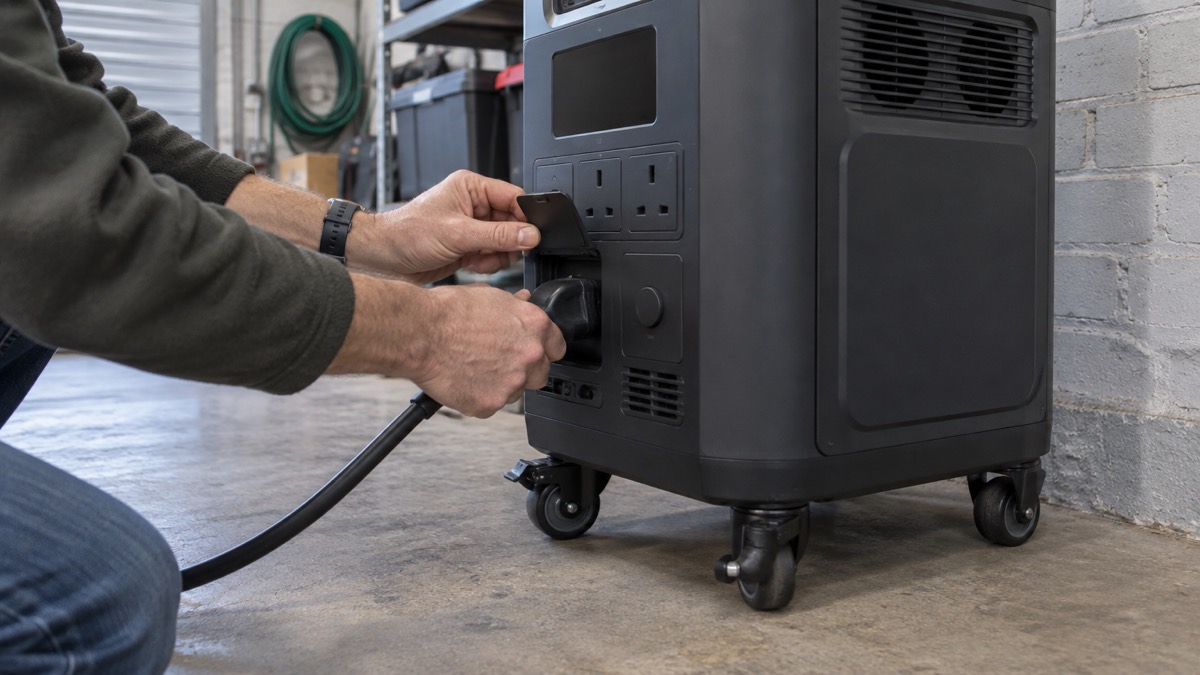
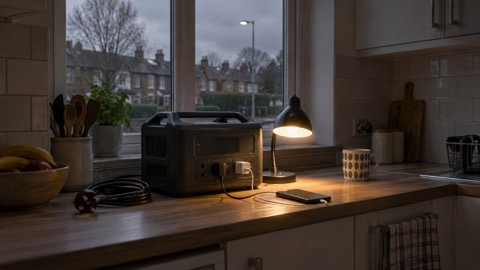
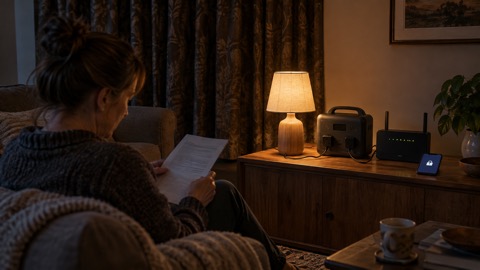
The Anker SOLIX F3800 is a large portable power station: a 3,840Wh lithium iron phosphate (LFP) battery in a wheeled case, with a 6,000W AC output and a 9,000W surge rating1. Anker describes the 3.84kWh capacity as enough to power a family's needs for one day, and says the same unit expanded to 26.9kWh can run for up to a week1. It is the kind of kit a household buys to keep a fridge, boiler, lights and phones going through a power cut, and to charge from the mains or from solar panels between outages.
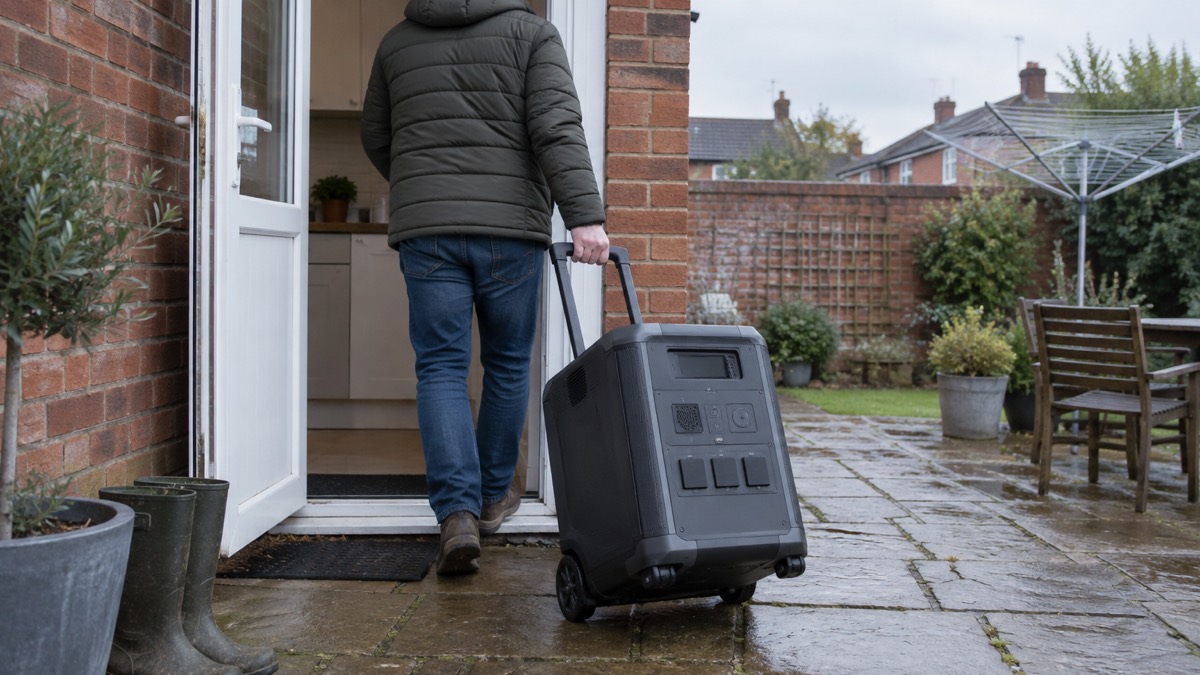
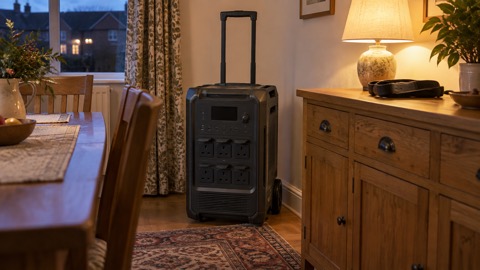
It is not a small device. Anker gives the weight as 60kg and the dimensions as 702 × 388 × 395mm with its 65mm wheels, and fits a retractable handle plus industrial-grade castor wheels so it can be moved between rooms or outdoors on rough ground2. Before buying, work out what you actually need to keep running: our guide to deciding what to keep running when the mains fails and our explanation of watts, watt-hours and surge will tell you whether a unit this size is the right fit or far more than you need.
This page sets out what the F3800 can do, how long it lasts, how to charge it, and how Anker says to use and store it safely. It does not compare it with other products or give prices.
What the Anker SOLIX F3800 is and who it suits
The F3800 is a single-unit power station rather than a generator: it stores energy in a battery and releases it as mains electricity, so it produces no exhaust fumes and needs no fuel. Anker builds it around LFP chemistry, which the maker brands InfiniPower and rates at 3,000 cycles, with 80 cells inside3. The manual gives the cell capacity as 51.2Vdc 75Ah/3840Wh and the chemistry as LiFePO45.
That combination of a large battery and a high output suits a household that wants to run ordinary mains appliances during an outage without the fuel storage, noise and carbon monoxide risk of a petrol generator. Anker gives a tumble dryer as an example of a load the unit can take3. It also has a 120/240 volt dual-voltage design and an RV port, so it can feed a vehicle or caravan power inlet as well as the home2.
The trade-off is weight and size. At 60kg it is a two-person lift if you ever need to carry it up steps, and it is designed to be rolled rather than carried2. If you only need to keep phones, a radio and a few lights going, a much smaller station or a power bank will do the job; our guide to portable power stations sets out the range of sizes and what each is for.
Specifications
Anker's figures for the F3800 are consistent across its product pages and manual on the main points, with a few places where the documents give different numbers. The table below uses the maker's figures and notes where they differ.
| Specification | Anker's figure |
|---|---|
| Battery capacity | 3,840Wh1 |
| Chemistry | LFP (LiFePO4)4 |
| AC output | 6,000W rated, 230V2 |
| AC surge | 9,000W2 |
| AC input | 2,990W on the product page; the manual gives 2,300W max charging and 2,990W max AC recharging2 |
| Solar input | 2,400W maximum6 |
| USB outputs | 2 × 12W USB-A, 3 × 100W USB-C2 |
| Car input | 120W, 12V or 24V2 |
| EV port | 3,000W4 |
| Weight | 60kg2 |
| Dimensions | 702 × 388 × 395mm with 65mm wheels2 |
| Warranty | 5 years3 |
| Cycle life | 3,000 cycles3 |
Two of these need a note. On AC input, Anker's UK product page lists 2,990W while the manual gives 2,300W max for charging and 2,990W max for AC recharging, so the two figures disagree and the practical charging rate may be lower than the headline2. On solar input, the maker states that an 11-32V solar charger supports 10A max, while a 32-60V charger supports 25A max1. Check the specification on the unit you receive.
How long it will run your home
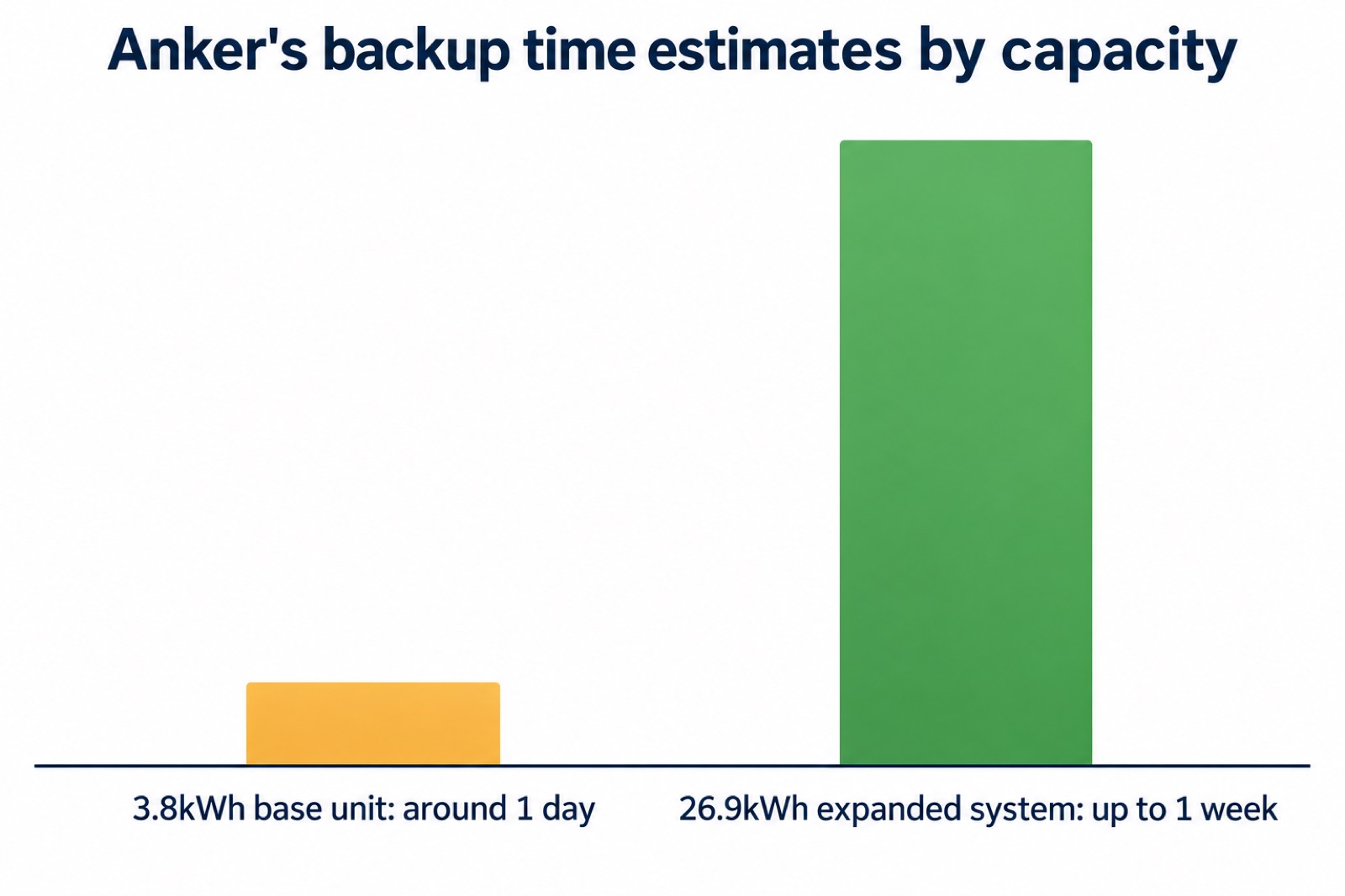
Anker's headline figures are around one day of backup from the 3.8kWh base unit and up to one week from a system expanded to 26.9kWh3. The maker states that these are calculated based on the average daily electricity usage during blackouts, so they are an estimate for a typical household rather than a promise for yours3. A home that heats with electricity, runs an immersion heater or charges a car will use far more than the average; a home keeping a fridge, a boiler, lights and a router going will use far less.
The way to plan is to add up the wattage of what you want to keep running and multiply by the hours. Our guide to how long a power station will run a fridge or laptop walks through that sum, and our power station sizing page helps you choose a capacity. The F3800's 6,000W output means it can start and run appliances with a high draw, and the 9,000W surge covers the brief spike when a motor starts2.
Expanding the capacity to 26.9kWh
The F3800 takes up to six expansion batteries of 3.84kWh each, taking the total to 26,880Wh, which Anker also writes as 26.9kWh4. One expansion battery brings the pair to 7,680Wh1. Anker's manual confirms the station can be connected to expansion batteries to increase capacity up to 26,880Wh5.
Expansion is how a household moves from riding out a short cut to covering a longer outage, and it is also how the "up to one week" figure is reached3. The batteries are added to the same unit, so the output stays at 6,000W while the stored energy grows. Anker also lists a maximum system configuration of 12kW and 53.8kWh, which involves more than one F3800: the maker says the system scales to up to two F3800 units4.
If you are planning a system this size, the question of how it connects to your home's wiring matters. Our guide to connecting a generator or battery to your home's wiring explains the difference between plugging appliances into the unit and having it wired in, and our page on home battery storage sets out what a fixed battery can and cannot do in a cut.
Charging from the mains and from solar
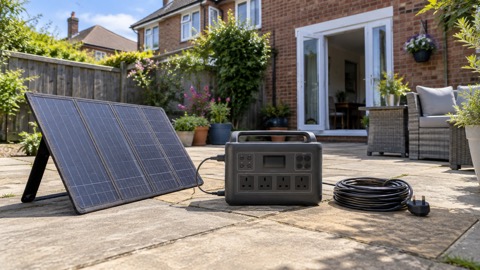
Anker gives two headline charging times: 2.7 hours to 100% from the grid at 1,800W, and 2 hours to 100% from 2,400W of portable solar panels2. A distributor's article gives a slightly different picture, with AC charging at 2 hours and solar at 2 to 4 hours depending on the weather7. Treat the maker's figures as the best case and expect solar to take longer in British weather; our page on how long solar charging takes in the UK explains why.
The solar input has firm limits that decide which panels you can use. Anker states that the solar input supports an 11-60V solar charger with an XT-60 connector, and that the maximum open-circuit voltage of each solar input port is 60V1. If you chain panels in series, the total open-circuit voltage must not exceed 60V4. The current limit depends on voltage: 10A maximum with an 11-32V charger, and 25A maximum with a 32-60V charger1.
Anker also lists a car input of 120W at 12V or 24V, which is a slow top-up rather than a full charge2. Our guide to charging a power station from your car covers what to expect. For panel choice, see portable solar panels for charging in a power cut and what size solar panel you need.
Charging an electric car from the F3800
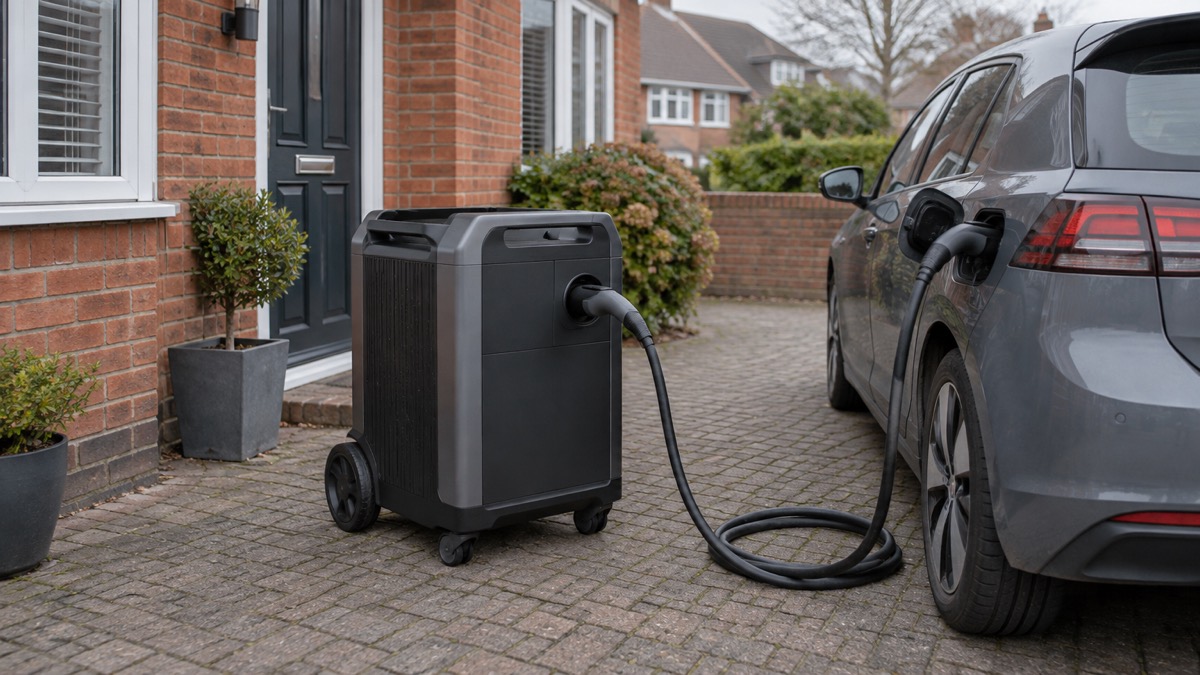
The F3800 has an EV port rated at 3,000W, and Anker says you can charge an EV at 2,990W4. The maker's manual gives the sequence: double-click the AC outlet button, wait until the car icon appears on the screen, then connect your EV charging cable to the EV port5. The car charging cable is not included5. Anker's product page describes the same step as double-pressing the power switch to activate EV mode, and its wording varies between the 240V and 230V switch1.
A distributor's article on charging electric cars from portable power explains that only specialised power stations can do it and that petrol or diesel generators risk damaging an EV, and it names the F3800 with its 3,000W EV port as an example7. That is a retailer's view, not an official one, and it does not tell you how much range you will get. Anker gives a range figure only for a much smaller load, describing the output as long enough for around a 20km ride3. Do not assume the F3800 will fill a car battery; it is a top-up for an emergency, and the car's own charging equipment and instructions decide what is safe.
Using it as a UPS and around the home
The F3800 can act as an uninterruptible power supply, switching over when the mains fails. Anker gives the switchover time as under 20ms on one product page, and the manual gives 20ms4. Which ports work in UPS mode is less clear: the manual describes the four 13A AC output ports as having the UPS function, while one product page states that in UPS mode only the three 120V ports labelled UPS are operational and the 240V ports do not function5.
To set up UPS mode, the manual says to connect the station to a wall outlet with the AC charging cable, press the AC outlet button and connect your devices to the UPS AC output ports5. Our page on using a power station as a UPS explains what switchover times mean for different equipment.
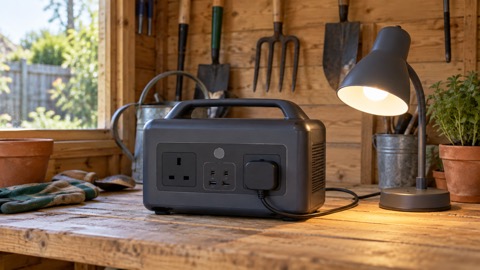
Around the home, the maker's safety advice is to keep within the output limits and to use the unit as designed. Anker lists a discharging temperature range of -20°C to 40°C and a recharging range of 0°C to 40°C2. That means the F3800 can run loads in a cold garage or outbuilding, but it should not be charged below freezing. Our guide to charging lithium batteries below freezing explains why, and our lithium-ion battery safety at home page covers the wider precautions.
Storing it so the battery stays healthy
Anker's storage instructions are specific, and following them protects the battery. The maker says to turn off all outputs, store the unit in a cool and dry place, check the battery capacity each week and fully charge it if it falls below 30%, and charge it to 100% every 3 months1. The manual adds turning off the main power button before storage5.
The reason is given by Anker: if the power station is stored at a low capacity for a long time, lithium batteries will self-consume power, which may lead to a quick discharge, poor conductivity and a reduced battery lifespan4. The manual also notes that when the station has only 1% battery remaining, the remaining battery indicator flickers to remind you to recharge5.
A simple routine keeps the unit ready: check it on the same day each week, top it up if it drops below 30%, and put a reminder in the diary for the three-month full charge. Our page on how to store a power station when not in use sets this out for any unit, and our backup power checks before winter checklist is a good time to run through it.
Support, warranty and UK availability
Anker backs the F3800 with a 5-year warranty and describes the battery as rated for 3,000 cycles with 10 years of everyday power3. The warranty period and the expected lifespan are different things: the warranty is what Anker covers, while the cycle rating and the 10-year claim describe how long the maker expects the battery to last. Anker's support contact is support@anker.com9.
On availability, Anker's UK product page for the F3800 showed the item as sold out when checked on 25 October 20261. Anker sells and compares products on its UK site10, and the maker notes for its international models that product availability and specifications may vary within the Australian market4. If you are buying, confirm the current status with the seller, and check the specification on the unit you receive against the table above, since the documents differ on AC input and solar input current.
Anker has issued recalls for some of its power banks, including models A1647 and A1652, with an expanded recall in June 202511. Those recalls concern power banks, not the F3800, but they are a reminder to register products and check recall notices. For the maker's wider range, see our Anker brand page.
Sources (11)
- Anker SOLIX F3800 product page, Anker, 2026-10-25
- Anker SOLIX F3800 specifications, Anker, 2026-10-25
- Anker SOLIX F3800 EU product page, Anker, 2026-10-25
- Anker SOLIX F3800 Australia product page, Anker, 2026-10-25
- Anker SOLIX F3800 Portable Power Station user guide, Anker, 2026-10-26
- Anker SOLIX Flex power station page, Anker, 2026-10-25
- Can a portable generator charge an electric car?, Generators Direct, 2025-09-03
- Anker SOLIX F3800 Belgium product page, Anker, 2026-10-25
- Anker SOLIX F3800 Portable Power Station support article, Anker, 2026-10-26
- Anker SOLIX UK specifications index, Anker, 2026-10-25
- Anker power bank recall notice, Anker, 2025-06

 BLUETTI Apex 300 Power Station
 BLUETTI Elite 100 V2
 Anker SOLIX C2000 Gen 2
 Anker SOLIX C1000 Power Station
 EcoFlow DELTA Pro
 BLUETTI Elite 400
 Anker SOLIX C300 Power Station
 EcoFlow DELTA 3
 EcoFlow DELTA 2 and DELTA 2 Max
 EcoFlow DELTA and DELTA Max
 EcoFlow RIVER 3 and RIVER 3 Plus
 EcoFlow RIVER 2 and RIVER 2 Max