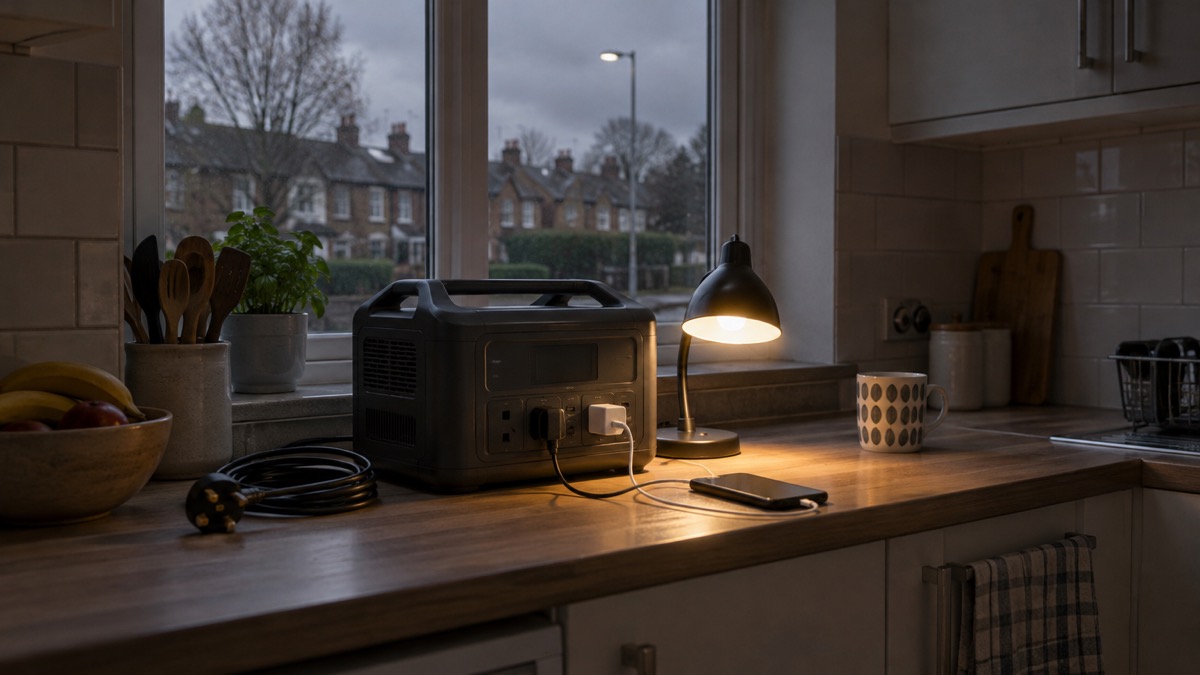
The EcoFlow DELTA and DELTA Max are portable power stations: large lithium-ion batteries with mains sockets built in, charged from a wall socket, a solar panel or a car. They are no longer sold new, so this page is for households that already own one, are buying secondhand, or want to understand what this class of kit can and cannot do. The standard DELTA holds 1260Wh and delivers 1800W of AC output, with a 3300W surge1. The DELTA Max comes in two versions: the DELTA Max (1600) at 1612Wh and 2000W, and the DELTA Max (2000) at 2016Wh and 2400W2.
What they are for is bridging a gap. A power cut that lasts a few hours is handled comfortably by either unit running lights, a fridge, a router and phone chargers. A cut that lasts days needs a way to recharge, and that is where solar panels or a car charger earn their place. The maker lists home backup, off-grid life and professional use as the intended roles1.
Before anything else, two limits matter. The maker's manual states plainly that the product is not recommended for powering medical emergency equipment related to personal safety4. And the DELTA Max is not water-resistant, so it should be kept away from liquids2. Everything else on this page follows from those two facts.
DELTA and DELTA Max: the versions and how they differ
Three units carry the name, and the differences decide what each can run. The standard DELTA is the oldest and lightest: 1260Wh, 14kg, 40 x 21 x 27cm, with four AC outlets1. The DELTA Max (1600) holds 1612Wh and weighs approximately 22kg2. The DELTA Max (2000) holds 2016Wh and also weighs approximately 22kg3.
The Max versions are the ones to look at if you need expansion. Both support up to two DELTA Max Smart Extra Batteries, sold separately, each with 2016Wh of capacity5. With both fitted, the DELTA Max (2000) reaches an expandable capacity of up to 6kWh3. The standard DELTA has no such expansion.
| DELTA | DELTA Max (1600) | DELTA Max (2000) | |
|---|---|---|---|
| Capacity | 1260Wh1 | 1612Wh2 | 2016Wh3 |
| AC output | 1800W, 3300W surge1 | 2000W, 4600W surge2 | 2400W, 4600W surge3 |
| Weight | 14kg1 | approx. 22kg2 | approx. 22kg3 |
| Extra batteries | No | Up to 25 | Up to 23 |
| Cycle life | 800 cycles to 80%+1 | 500 cycles to 80%+2 | 800 cycles to 80%+3 |
| Wi-Fi | Not supported1 | Not listed | Supported3 |
| Warranty | 24 months1 | 24 months2 | 24 months3 |
Note the cycle life: the DELTA Max (1600) is rated at 500 cycles to 80% or more of capacity, while the other two are rated at 8002. If you are buying secondhand, that figure tells you how much life is likely left.
Outputs: 1800W from the DELTA, 2400W from the DELTA Max
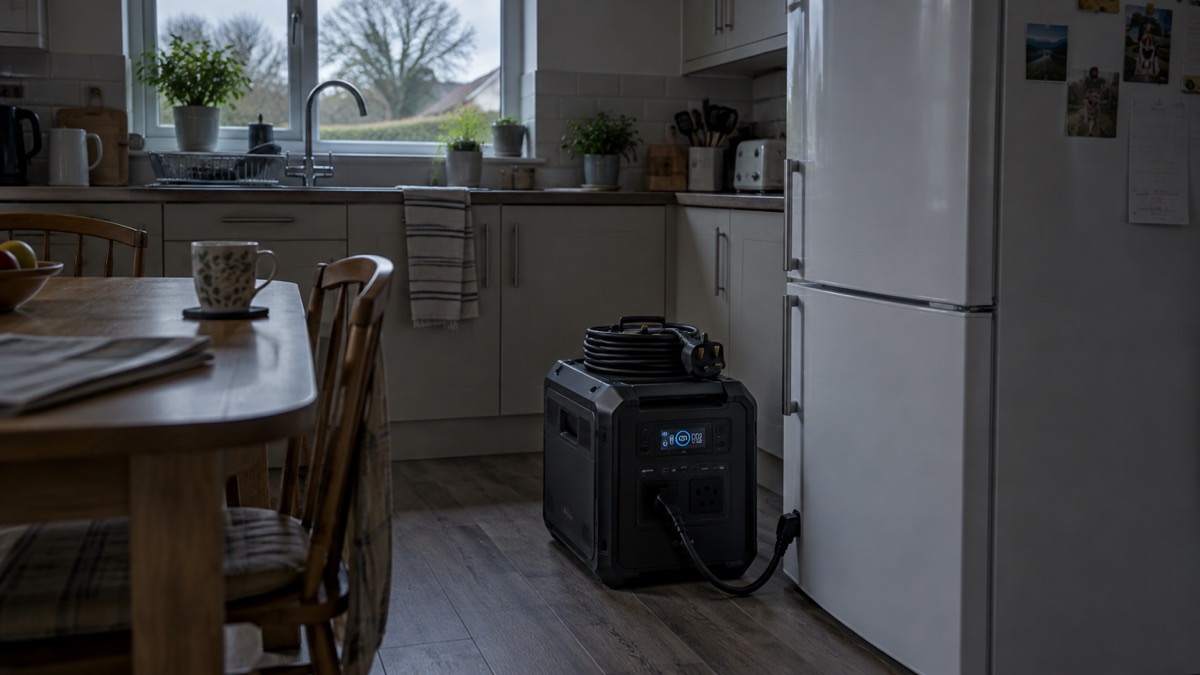
The headline figure is the continuous AC output, and it decides which appliances will run. The standard DELTA gives 1800W total with a 3300W surge, across four pure sine wave outlets1. The DELTA Max (1600) gives 2000W with a 4600W surge2. The DELTA Max (2000) gives 2400W with a 4600W surge3. Surge matters because motors in fridges and freezers draw a spike at start-up.
The maker's own examples of what the standard DELTA can run include a 150W fridge, a 1000W microwave, a 110W television, a 1600W hairdryer, a 600W coffee maker and a 1500W electric frying pan1. It can power up to 11 devices at the same time1. The DELTA Max (1600) supports up to 2500W from a single device through X-Boost2.
Two cautions. First, add up what you plug in: a 1600W hairdryer and a 1000W microwave together exceed the standard DELTA's 1800W. Second, the fire and rescue service advises never to use powerful appliances such as dishwashers, washing machines or tumble dryers on a multi-plug extension lead6. The same logic applies to a power station: run high-draw appliances one at a time, directly from the unit.
For a fuller explanation of how watts, watt-hours and surge interact, see Watts, Watt-Hours and Surge Explained.
Charging from the mains, solar panels and a car
The standard DELTA charges from an AC wall outlet, a 12V car adaptor or a solar panel1. The DELTA Max adds a Smart Generator and a Smart Extra Battery to that list2. On mains, the standard DELTA reaches 0% to 80% in 1 hour and is fully recharged within 1.6 hours1. The DELTA Max charges up in just 1 hour, according to the maker7.
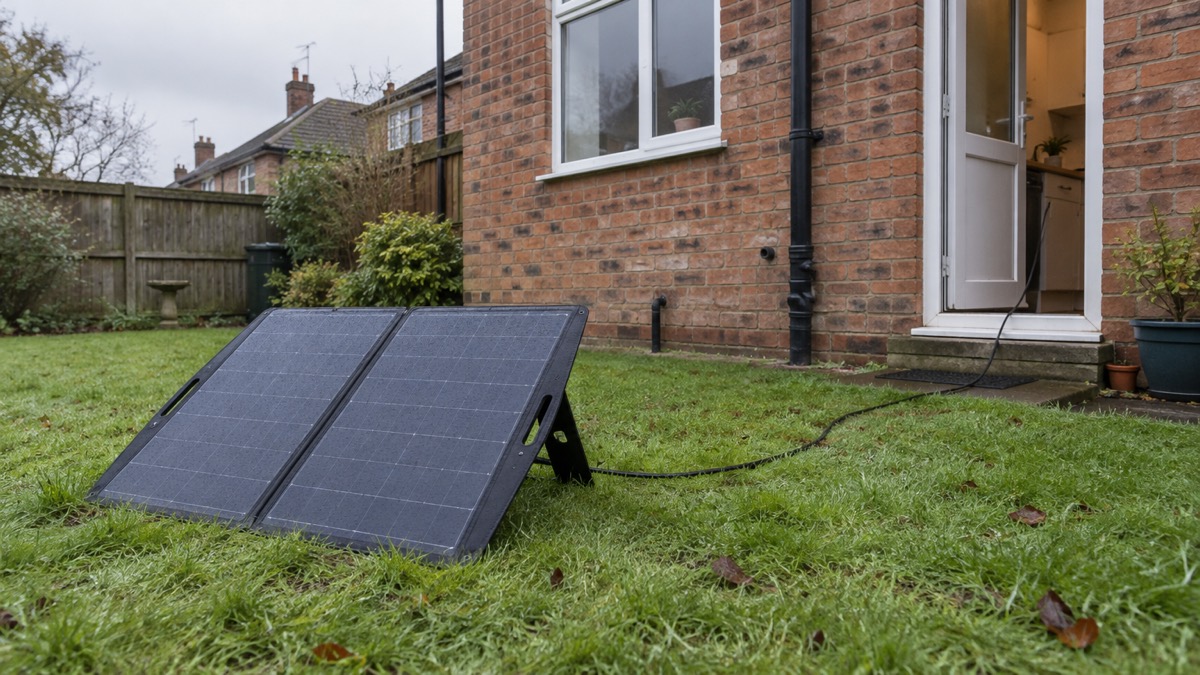
Solar is slower and depends on the panels. The standard DELTA accepts up to 400W of solar input at 10 to 65V DC, 10A maximum1. The maker gives these recharge times for the standard DELTA1:
- 1 x 160W solar panel: 10.5 to 21 hours
- 2 x 160W solar panels: 5 to 10 hours
- 3 x 160W solar panels: 3.5 to 7 hours
- 12V car charger: 13.5 hours
The DELTA Max accepts up to 800W of solar charging8. It connects with up to eight 100W flexible solar panels to deliver that 800W maximum9. Panels need an MC4 connector, with voltage and current within 11 to 100V and 13A maximum2. The maker notes that whether the product can be charged or discharged depends on the actual temperature of the battery pack2.
For panel choice and UK sunlight, see Portable Solar Panels for Charging in a Power Cut and How Long Does Solar Charging Take in the UK?. For charging from a vehicle, see Can You Charge a Power Station from Your Car?.
Backup power: switching to battery within 30ms
Both the standard DELTA and the DELTA Max can act as an entry-level uninterruptible power supply. When mains power stops, the DELTA Max automatically switches to battery power within 30ms2. The standard DELTA's manual gives the same figure: the product can automatically switch to battery-powered supply mode within 30ms4.
That is fast enough for most household equipment, but not everything. The maker's manual is explicit: the product does not support 0ms switching, and should not be connected to any device that requires 0ms UPS, such as data servers and workstations4. The product page describes the function as entry-level and recommends testing your devices case by case1.
The practical approach is to test before you need it. Plug the device in, pull the mains plug on the power station and see whether the device keeps running. Do this for each appliance you intend to protect. For more on what switchover times mean, see Using a Power Station as a UPS: Switchover Times.
Cold weather: charging stops below freezing
Lithium batteries do not like being charged cold. The maker gives a charging temperature range of 0 to 45°C for the standard DELTA, the DELTA Max (1600) and the DELTA Max (2000)1. Below freezing, charging stops. The DELTA's manual explains that charging can resume automatically after the battery temperature rises above 5°C4.
Discharging is more forgiving. The standard DELTA will discharge from -20 to 45°C1, and the DELTA Max (1600) has the same discharge range2. The manual adds that the power supply can resume automatically after the battery temperature rises above -12°C4.
What this means in a British winter: a unit kept in an unheated garage or shed may refuse to charge on a freezing morning. Bring it indoors to a room at normal temperature before charging, and let it warm up. Do not try to force a charge in the cold. For more, see Can You Charge Lithium Batteries Below Freezing? and What Temperature Should Batteries Be Stored At?.
Storing it between emergencies so it is ready
A power station that is flat when the lights go out is no use. The maker's manual gives specific storage instructions. For long-term storage, discharge the battery to 30% and recharge it to 60% every three months4. For long-term use as an emergency power supply, discharge the battery to 0% and then recharge it to 60% every three months4. Set a reminder in your phone for the same date each quarter.
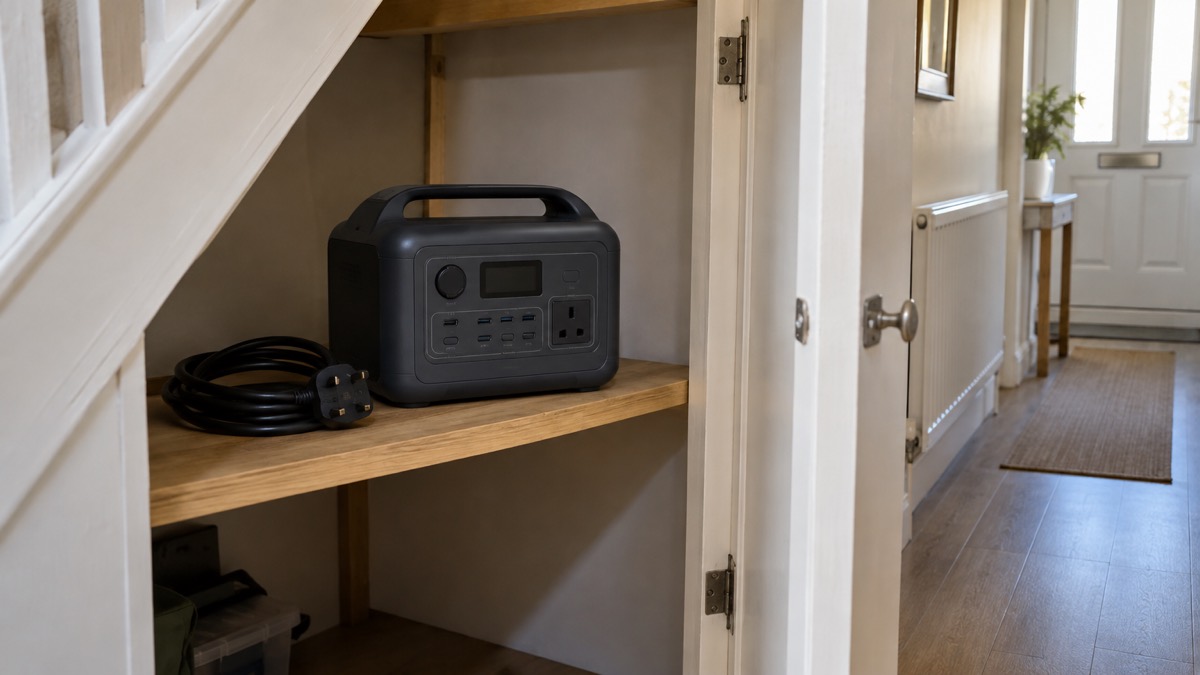
Where it lives matters as much as its charge. The DELTA Max is not water-resistant and should be kept away from liquids2. Keep it out of damp garages, off concrete floors that can sweat, and away from anywhere that could flood. A cupboard or shelf in a dry room at normal household temperature suits it.
Have a plan for the household too. Northern Power Grid's advice is to keep a copy of your emergency plan somewhere visible, like near your fuse box, fridge, or emergency kit10. Note on it where the power station is, what it can run and how to start it.
Who should not rely on it: medical equipment and implants
This is the section to read carefully if anyone in the household depends on powered medical equipment. The maker's manual states that the product is not recommended for powering medical emergency equipment related to personal safety, including but not limited to medical grade ventilators, hospital version CPAP, and artificial lungs4. That is the maker's own instruction for its own product, and it should be followed.
The manual goes further: power supply products generate electromagnetic fields, which are likely to affect the normal operation of medical implants or personal medical equipment such as pacemakers, cochlear implants, hearing aids and defibrillators4. If anyone in the household has an implant, keep the unit at a sensible distance and take advice from their clinician.
Fire and rescue services add their own guidance for people with medical equipment at home. North Yorkshire Fire and Rescue Service advises avoiding charging other electrical items near the equipment11. London Fire Brigade states: "Never charge electrical items or place anything hot (such as hair straighteners or hairdryers) on an airflow mattress"12.
If you need backup power for medical equipment, plan it with your supplier and your clinician rather than relying on a general-purpose power station. See Powering CPAP, Oxygen and Other Medical Devices From a Battery and Deciding What to Keep Running When the Mains Fails.
Support, warranty and where to get help
EcoFlow lists a 24 month warranty on the DELTA, the DELTA Max (1600), the DELTA Max (2000) and the DELTA Max Smart Extra Battery1. Keep your receipt and the serial number. If a unit fails, contact EcoFlow support through the UK store.
The standard DELTA does not support the EcoFlow App1. The DELTA Max (2000) lists Wi-Fi as supported3. If app control matters, check the exact model before relying on it.
For a power cut, the first call is your electricity network operator, not the retailer. Keep the number somewhere you can find it in the dark. For the wider picture, see Backup Power at Home: A Household Guide, Portable Power Stations: What They Do and How to Choose and the EcoFlow brand page. For the DELTA Max specifically, see EcoFlow DELTA Max.
Sources (12)
- EcoFlow DELTA Portable Power Station, EcoFlow, 2026-10-25
- EcoFlow DELTA Max 160W Portable Solar Panel, EcoFlow, 2026-10-25
- EcoFlow DELTA Max 400W Portable Solar Panel, EcoFlow, 2026-10-25
- EcoFlow DELTA-User Manual V1.1 (EN-US)_1724120671655.pdf, _1724120671655.pdf), EcoFlow
- EcoFlow DELTA Max Smart Extra Battery, EcoFlow, 2026-10-25
- Fire Safety Checklist, Devon and Somerset Fire and Rescue Service, 2026
- EcoFlow Solar Powered Generators, EcoFlow, 2026-10-25
- EcoFlow DELTA Solar Generators, EcoFlow, 2026-10-25
- EcoFlow DELTA Max Solar Generator (Flexible PV100W) - EcoFlow UK, EcoFlow UK
- Power Cut Plan, Northern Power Grid, 2026-10-26
- Medical Equipment, North Yorkshire Fire and Rescue Service, 2026-03-09
- Specialist Health Equipment, London Fire Brigade, 2026-10-25

 BLUETTI Apex 300 Power Station
 BLUETTI Elite 100 V2
 Anker SOLIX C2000 Gen 2
 Anker SOLIX C1000 Power Station
 EcoFlow DELTA Pro
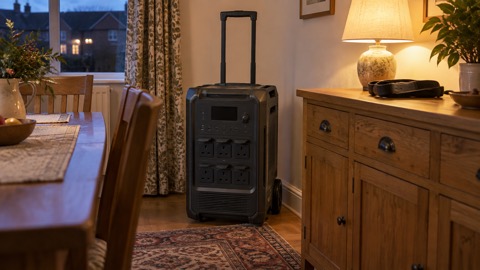 BLUETTI Elite 400
 Anker SOLIX C300 Power Station
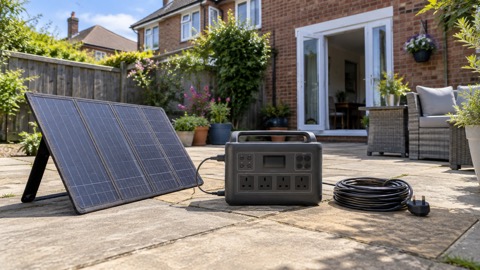 EcoFlow DELTA 3
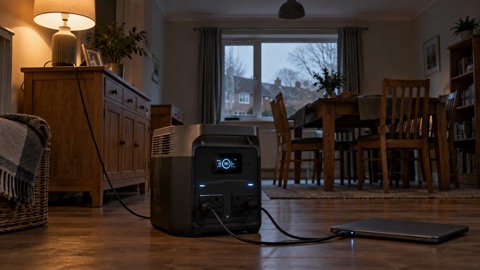 EcoFlow DELTA 2 and DELTA 2 Max
 EcoFlow RIVER 3 and RIVER 3 Plus
 EcoFlow RIVER 2 and RIVER 2 Max
 BLUETTI Elite 30 V2