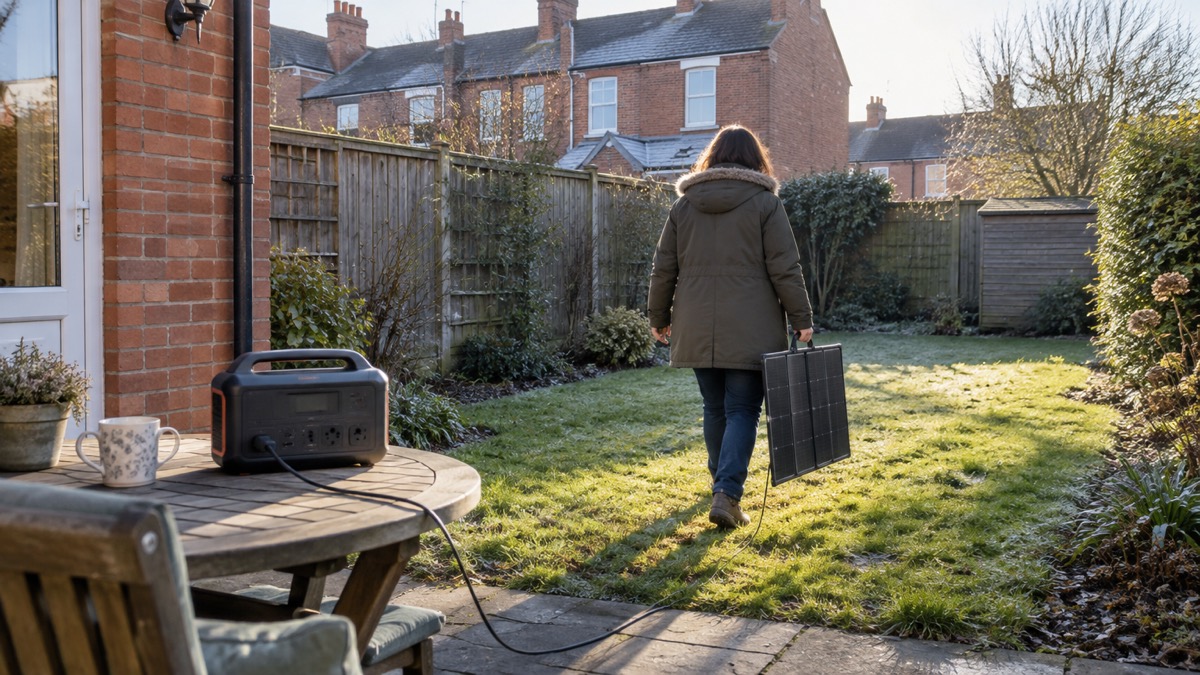
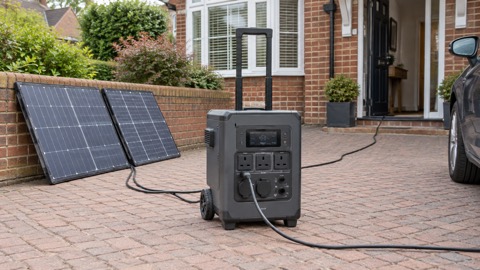
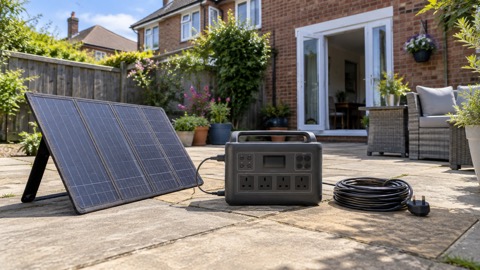
A folding 160W solar panel is the part of a backup power plan that keeps working after the petrol runs out. Laid out in the garden and plugged into a power station, it turns daylight into stored electricity with no fuel, no noise and no exhaust, which is why it earns its place in a household that wants to ride out a longer outage rather than a short one. EcoFlow sells several panels that carry the 160W name, and they are not the same product: they differ in weight, cell type, efficiency and warranty, so the first job is to work out which one you are looking at.
The headline figures are these. Rated output is 160W plus or minus 5W under standard test conditions, and the Lightweight model reaches up to 177W under BNPI test conditions because it collects light on both faces1. The NextGen panel weighs about 5.6kg and folds to 600 x 572 x 32 mm; the Lightweight panel weighs 3.8kg plus or minus 0.3kg, which EcoFlow states is 1.8kg lighter than previous models2. Both the Lightweight and NextGen panels carry an IP68 rating for water and dust1.
For emergency use, think of the panel as a slow refill rather than a generator. It will not run a kettle or a heater, but over a sunny day it can put meaningful charge back into a power station that is running phones, a router, lights or a fridge. Pair it with a station sized for what you actually need, and read it alongside our guide to portable solar panels for charging in a power cut.
Which EcoFlow 160W panel you actually have
EcoFlow uses the 160W name across several products, and the specifications differ enough to matter when you are deciding what to plug in and how to carry it. The Lightweight Portable Solar Panel is the newest of the family in the current listings, built around N Type TOPCon monocrystalline cells with an efficiency of 25% or above and a bifacial design that gathers ambient light on its rear side as well as the front1. The NextGen Portable Solar Panel also uses N Type TOPCon cells, is listed at 25% efficiency, and is described by EcoFlow as dust-resistant and able to withstand high temperatures while still generating well2.
The older 160W Solar Panel is a monocrystalline silicon design, and a separate 160W Portable Solar Panel listing gives monocrystalline silicon cells4. If you are unsure which you own, the label on the back and the weight in your hand will settle it faster than the box did.
| Model | Cells | Efficiency | Weight | Warranty |
|---|---|---|---|---|
| Lightweight Portable | N Type TOPCon | 25% or above | 3.8kg ± 0.3kg | 5 years1 |
| NextGen Portable | N Type TOPCon | 25% | Approx. 5.6kg | 24 months2 |
| 160W Solar Panel | Monocrystalline silicon | 21% to 22% | 7kg (panel 5kg) | 24 months3 |
| 160W Portable Solar Panel | Monocrystalline silicon | 21% to 22% | 5.6kg | 24 months5 |
EcoFlow's wider range runs from 60W to 400W in portable, rigid and flexible options, so a 160W panel sits in the middle of what the maker offers5. If you are still choosing, our portable solar panels guide sets out how panel size relates to power station capacity, and the EcoFlow brand page lists the rest of the range.
Size, weight and moving it when the power is off
A panel only earns its keep if you can get it into the light. The Lightweight model unfolds to 1677 x 598 x 26 mm including the handle and folds to 609 x 598 x 26 mm, so it stows behind a door or in a cupboard and comes out in one piece1. The NextGen panel unfolds to 600 x 1610 x 25 mm and folds to 600 x 572 x 32 mm2. The older 160W Solar Panel folds to 42 x 68 x 2.4 cm and weighs 7kg in total, with the panel itself accounting for 5kg3.
That weight difference is the practical point. EcoFlow states the Lightweight panel is 1.8kg lighter than previous models, at 3.8kg plus or minus 0.3kg, which is a comfortable one-handed carry for most adults1. The 160W Portable Solar Panel is listed at approximately 12.3lbs, or 5.6kg5. If your plan involves carrying the panel up a garden, out to a shed or into a stairwell for the best light, the lighter panel is the one you will actually bother to deploy on a grey Tuesday.
Setting the panel up: bracket angles from 30° to 60°
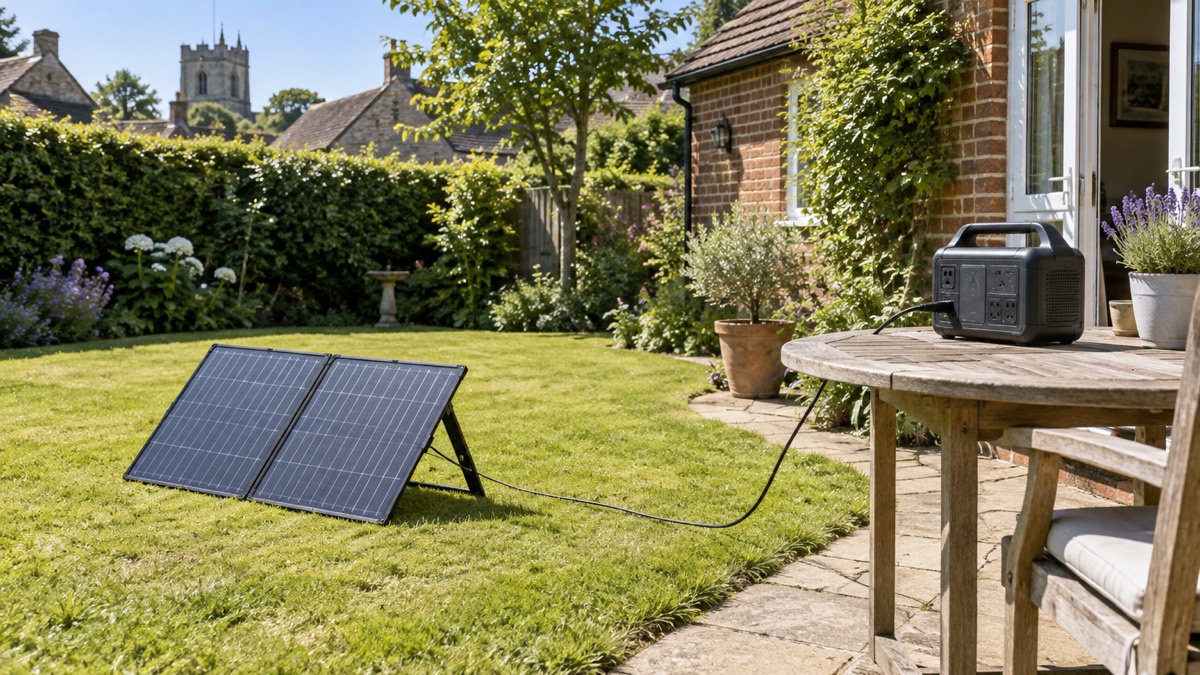
The Lightweight panel has a folding integrated bracket adjustable from 30° to 60°, which EcoFlow describes as ideal even for most high-latitude areas1. That range matters in the UK, where the sun sits low for much of the year and a panel lying flat collects far less than one tilted towards it. The NextGen panel lets you adjust the angle by 30 degrees in seconds, and EcoFlow's guidance for both is the same principle: keep sunlight at a 90° angle to the surface of the panel to capture the most energy possible2.
In practice, that means pointing the panel towards the sun and tilting it until its shadow is as short as it will go, then moving it as the sun crosses the sky. A panel left in one position from morning to evening will spend much of the day at the wrong angle. If you are setting up for a multi-day outage, plan to move it two or three times a day, and keep the cable run short and out of walkways.
Rain, dust and heat: what IP68 covers
Both the Lightweight and NextGen panels carry an IP68 rating, which EcoFlow describes as waterproof and dustproof1. EcoFlow states that all its solar panels, including the flexible ones, are waterproof to IP68, and describes the rating as top-ranking weatherproofing for its solar generators6. The 2023 product catalogue lists the 160W panel at IP68 as well8.
IP68 tells you the panel is sealed against dust and against water immersion under test conditions. It does not tell you the panel is safe to leave out in a gale, that its cable joints are protected, or that a connector lying in a puddle is a good idea. Treat the rating as permission to leave the panel out in the rain rather than as an instruction to do so. Bring it in during storms, keep connectors off wet ground, and check the cable and plugs for damage before every use. For the wider picture on charging kit outdoors, see our guide to portable solar panels for charging in a power cut.
What it can charge, and how much it puts back
The panel's job in an emergency is to refill a power station. EcoFlow lists the 160W panel's open circuit voltage at 21.4V with 18.2V at maximum power on the 160W Solar Panel and the 160W Portable Solar Panel, 21.4V with 18.8V at maximum power on the Lightweight model, and 21.3V with 18.6V at maximum power on the NextGen3. Short circuit current is listed at 9.6A with 8.8A at maximum power on the 160W Solar Panel and the 160W Portable Solar Panel, 9.1A with 8.6A on the NextGen, and 9.2A under standard test conditions or 10.2A under BNPI on the Lightweight, with 8.7A and 9.6A at maximum power3.
Those figures decide whether a panel is compatible with a given power station, so check them against the station's solar input before you connect anything. EcoFlow quotes an annual energy saving of 168 kWh per year for its 160W solar panel9. That is a figure for a panel set up and angled well across a year, not for one deployed for a week in December, and it should not be read as a promise of what you will harvest during an outage.
What the panel will not do is run high-draw appliances. It charges a battery; the battery runs the load. If you are working out what to keep running, start with our guide to deciding what to keep running when the mains fails and to watts, watt-hours and surge. For how panel size relates to charging time, see what size solar panel do I need to charge a power station and how long does solar charging take in the UK.
What comes in the box and how long the warranty lasts
The Lightweight panel ships with the panel itself plus a Quick Start Guide, Safety Instructions and Warranty Card1. The NextGen panel adds an XT60i charging cable and a protective bag to the same paperwork2. The 160W Solar Panel bundle includes the panel, a 160W Solar Panel Bag, a solar to XT60 charging cable and a user manual10. Read the safety instructions before the first connection, and keep the warranty card somewhere you can find it, because a panel that fails in year three is worth claiming on.
Warranty terms vary by model and by product family. EcoFlow lists 5 years for the Lightweight panel and 24 months for the NextGen panel and the 160W Solar Panel1. Elsewhere in the range, EcoFlow lists a 1-year warranty on a previous model11, a 3-year warranty on its flexible solar panels, and a 5-year warranty on rigid panels with 12 months on cables and accessories12.
| Item | Lightweight | NextGen | 160W Solar Panel |
|---|---|---|---|
| Panel | Yes | Yes | Yes |
| Charging cable | Not listed | XT60i | Solar to XT60 |
| Bag | Not listed | Protective bag | Panel bag |
| Paperwork | Quick Start, Safety, Warranty | Quick Start, Safety, Warranty | User manual1 |
Keeping it ready between emergencies
A panel stored flat under a bed will still work when you need it, but a few habits make the difference between a smooth deployment and a frustrating one. Store it folded, dry and out of direct sun, with the cable coiled loosely rather than kinked. Check it once a season: unfold it, look over the cells for cracks or delamination, inspect the cable and connectors, and confirm the bracket still locks at the angles you need. Add the check to your backup power checks before winter, when low sun and short days make every watt count.
Think about where it will go before the power fails. A south-facing garden, a balcony or a flat roof all work if they get clear sky; a shaded courtyard does not. If you live in a flat without outdoor space, a panel is a weaker fit for your plan than a larger power station you can charge from the mains before an outage, and our guide to portable power stations sets out the alternatives. Wherever you plan to use it, keep the cable run in mind: an extension lead trailing across a wet lawn is a trip hazard and a water risk.
For households in Scotland, Wales and Northern Ireland the principle is the same, though winter daylight is shorter the further north you go, so a panel will contribute less in December and more in June. Plan for the season you are in rather than the annual average.
Support, safety and where to get help
Beyond the paperwork supplied with the panel, the general safety rules for any outdoor electrical kit apply: keep connectors dry, do not modify cables, and do not attempt to connect a portable panel to your home's wiring. Our guide to connecting a generator or battery to your home's wiring explains why that is a job for a qualified electrician and not a DIY project.
If a panel or its cable is damaged, stop using it and seek advice from the maker rather than taping it up. For battery safety more broadly, including the power station the panel charges, see our guides to lithium-ion battery safety at home and warning signs a lithium battery is dangerous. Households that depend on electricity for medical equipment should read powering CPAP, oxygen and other medical devices from a battery and register for their supplier's Priority Services Register, which gives extra help during an outage.
For the wider picture on preparing a household for an outage, start with power cuts: a household guide and the power cut backup power checklist.
Sources (13)
- EcoFlow 160W Lightweight Portable Solar Panel, EcoFlow, 2026-10-25
- EcoFlow NextGen 160W Portable Solar Panel (Refurbished), EcoFlow, 2026-10-25
- EcoFlow DELTA Max 160W Portable Solar Panel, EcoFlow, 2026-10-25
- EcoFlow DELTA 160W Portable Solar Panel, EcoFlow, 2026-10-25
- EcoFlow Portable Solar Panels, EcoFlow, 2026-10-25
- EcoFlow Flexible Solar Panels, EcoFlow, 2026-10-25
- EcoFlow Solar Generators, EcoFlow, 2026-10-25
- EcoFlow 2023 Product Catalogue, EcoFlow, 2023
- EcoFlow Balcony Solar Generators, EcoFlow, 2026-10-25
- EcoFlow DELTA 2 Max Solar Generator (PV160W) - EcoFlow UK, EcoFlow UK
- EcoFlow 110W Portable Solar Panel (Refurbished), EcoFlow, 2026-10-29
- EcoFlow 2kWh Power Kits, EcoFlow, 2022
- EcoFlow 10kWh Power Kits, EcoFlow, 2022

 BLUETTI Apex 300 Power Station
 BLUETTI Elite 100 V2
 Anker SOLIX C2000 Gen 2
 Anker SOLIX C1000 Power Station
 EcoFlow DELTA Pro
 BLUETTI Elite 400
 Anker SOLIX C300 Power Station
 EcoFlow DELTA 3
 EcoFlow DELTA 2 and DELTA 2 Max
 EcoFlow DELTA and DELTA Max
 EcoFlow RIVER 3 and RIVER 3 Plus
 EcoFlow RIVER 2 and RIVER 2 Max