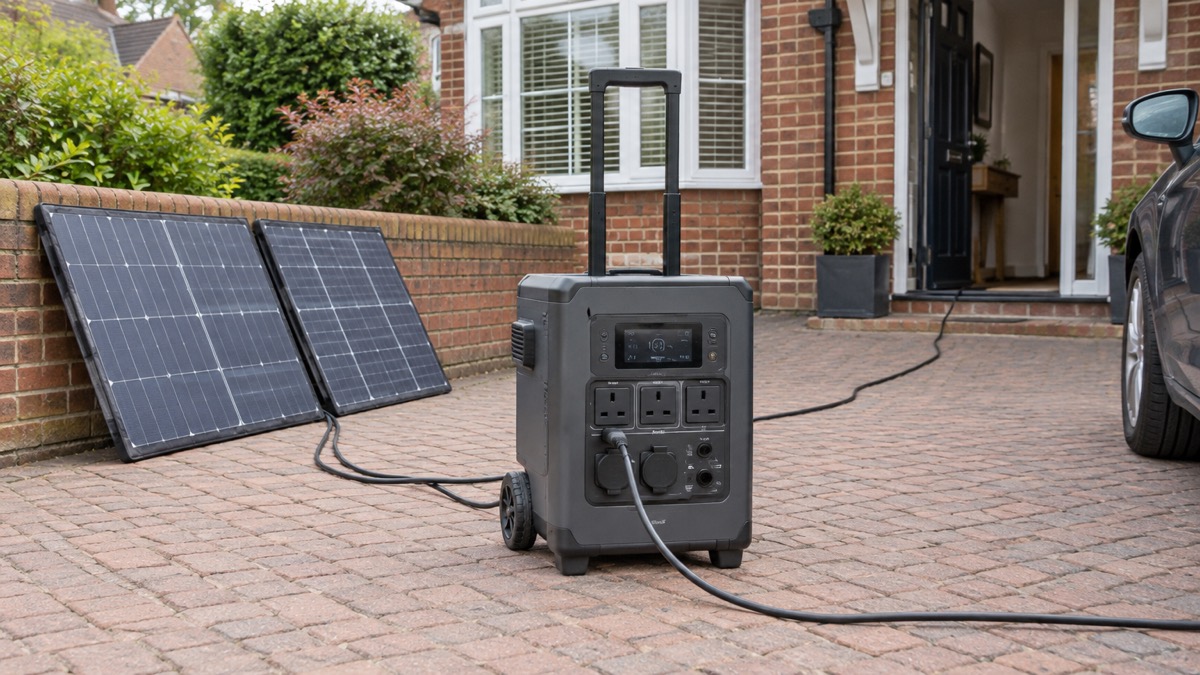
The EcoFlow DELTA Pro is a large portable power station: a 3600Wh battery in a wheeled case that you charge from the mains, from solar panels, from a car or from an EV charge point, and then plug household appliances into when the power fails1. EcoFlow describes it as using an LFP battery, a chemistry chosen for long life, and gives it a cycle life of 6,500 cycles to 50% capacity or 3,500 cycles to 80% capacity2. Its AC output is 3600W total with a 7200W surge, and EcoFlow states that X-Boost technology can expand the supported output to 4500W3.
For a household, the practical question is what it will keep running and for how long. EcoFlow's own figures give a 60W fridge up to 57 hours, a 500W blender 6.5 hours, a 1000W coffee machine 3.3 hours and a 1500W air fryer 3.3 hours5. Add the Smart Extra Battery and capacity doubles to 7.2kWh, or triples to 10.8kWh with two4. It is heavy at approximately 45kg, so plan where it will live before it arrives1.
This page sets out what the DELTA Pro is, what it can run, how to charge it from each source, how to add capacity or connect it to your home circuits, and how to charge, store and update it safely. It covers the maker's stated specifications only; it does not rank the unit against others. For the wider picture, start with Backup Power at Home: A Household Guide.
What the DELTA Pro is and who it suits
The DELTA Pro is a battery, an inverter and a set of sockets in one unit, made by EcoFlow. EcoFlow lists the battery as 3600Wh of LFP chemistry, the same capacity as its Smart Extra Battery, and gives both the same cycle life of 6,500 cycles to 50% capacity or 3,500 cycles to 80% capacity2. In plain terms, it is a unit for a household that wants to keep a fridge, lights, a router, phones and perhaps a small appliance running through an outage without fuel, fumes or a generator running outside.
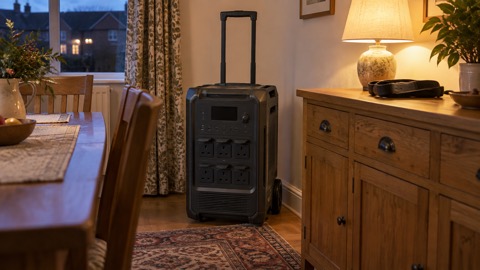
It suits a home where the unit can be stored at ground level and moved on its wheels, and where someone can lift or wheel approximately 45kg into position1. It does not suit a flat where the only storage is up a flight of stairs, or a household that wants something to carry in one hand. If you are still deciding what size of unit you need at all, What Capacity Power Station Do I Need? sets out the sums, and Portable Power Stations: What They Do and How to Choose explains the category.
The unit measures 63.5 by 28.4 by 42cm, and EcoFlow lists its connection options as Wi-Fi, Bluetooth and wired3. It has four AC outlets at 230V/16A, so several appliances can be plugged in at once, within the 3600W total3. EcoFlow also sells a remote control accessory, which runs on non-rechargeable AAA batteries and can connect by a standard ethernet cable as well as wirelessly6.
| Feature | EcoFlow's stated figure |
|---|---|
| Battery capacity | 3600Wh1 |
| Battery chemistry | LFP3 |
| AC output | 4 outlets, 230V/16A, 3600W total, 7200W surge4 |
| Output with X-Boost | up to 4500W3 |
| Cycle life | 6,500 cycles to 50%, 3,500 cycles to 80%2 |
| Weight | approximately 45kg1 |
| Dimensions | 63.5 x 28.4 x 42cm4 |
| Connectivity | Wi-Fi, Bluetooth, wired3 |
What it can run in a power cut, and for how long
Run time depends on the wattage of what you plug in, so the honest answer is a table rather than a single number. EcoFlow publishes run times for common appliances on a single DELTA Pro: a 60W fridge for up to 57 hours, a 500W blender for 6.5 hours, a 1000W coffee machine for 3.3 hours and a 1500W air fryer for 3.3 hours5. It also states that the unit will charge a 60Wh laptop 57 times5.
EcoFlow's kit pages give a fuller picture for a household running several things. On a single unit it lists a 50W Starlink connection for 72h, a 20W fridge for 180h, a 25W light for 144h, a 60W laptop for 60h and a 1200W air conditioner for 3h7. With the extra capacity of a second battery, the same page gives 144h for the Starlink, 72h for a 100W fridge, 288h for the light, 120h for the laptop, 7.2h for a 1000W coffee maker and 6h for the air conditioner7. Those figures are the maker's estimates for steady loads; a fridge or a heating appliance that cycles on and off will vary.
The lesson for planning is to add up the watts of what you actually want to keep running, then compare that with 3600Wh. Watts, Watt-Hours and Surge Explained walks through the arithmetic, and How Long Will a Power Station Run a Fridge or Laptop? covers the common cases. If a medical device is part of the plan, read Powering CPAP, Oxygen and Other Medical Devices From a Battery before relying on any unit.
Charging from the mains: 2900W and about 1.9 hours to full
From a wall socket, EcoFlow states the DELTA Pro takes 2900W maximum and recharges in about 1.9 hours2. That is the international version figure; the same page notes the US version charges at 1800W in 2.7 hours or 3000W in 1.8 hours, which does not apply to UK units2. The Smart Home Panel can charge it at 3000W maximum, and an EV station at 3400W maximum3.
EcoFlow gives a specific instruction for mains charging, and it is worth following exactly:
In practice that means no extension lead daisy chains and no travel adapters for a fast charge. If the circuit cannot supply more than 15A, turn the charging speed down rather than pushing it. Extension Leads and Overloading With Backup Kit explains why this matters, and Safe Battery Charging at Home Checklist gives a room-by-room check. Charging a unit this size draws a lot of power for a short time, so charge when the house is not also running an oven, a kettle and a tumble dryer.
Solar charging: up to 1600W within 11-150V and under 15A
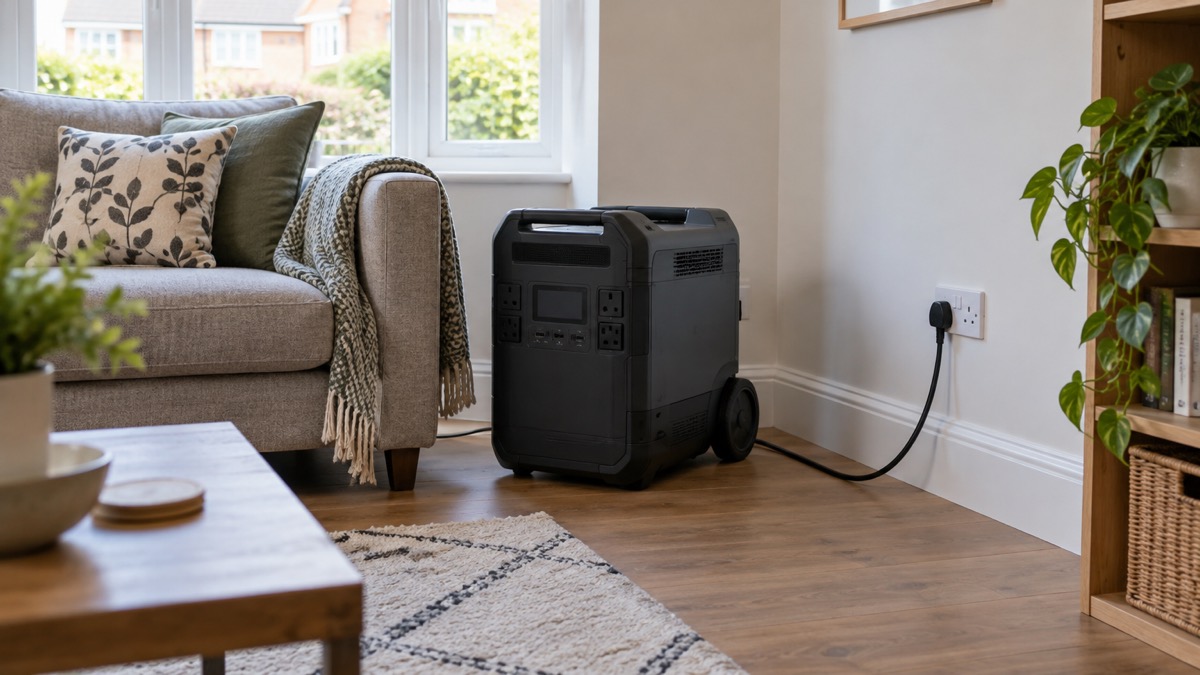
Solar charging is the part that needs the most care, because the panels must match the unit's input window. EcoFlow states a solar charging input of 1600W maximum, within 11 to 150V and 15A2. It also states that the wide voltage range makes the unit compatible with 90% of third-party solar panels that use solar connectors, provided their combined voltage and current stay within 11 to 150 volts and under 15 amps2.
Charge times depend on how much panel you connect. EcoFlow gives 2.8 to 5.6 hours at 1600W of solar, 3.5 to 7 hours with two 400W panels, 5.5 to 11 hours with two 400W panels in a second listing, 11 to 22 hours with one 400W panel, 5 to 10 hours with four 220W panels, 6.5 to 13 hours with three 220W panels and 10 to 20 hours with two 220W panels2. The two figures for two 400W panels come from the same maker's page and disagree; treat the range as approximate and expect UK weather to sit at the slow end.
| Panel set-up | EcoFlow's stated charge time |
|---|---|
| 1600W solar | 2.8 to 5.6 hours8 |
| 2 x 400W panels | 3.5 to 7 hours, or 5.5 to 11 hours in a second listing8 |
| 1 x 400W panel | 11 to 22 hours8 |
| 4 x 220W panels | 5 to 10 hours2 |
| 3 x 220W panels | 6.5 to 13 hours2 |
| 2 x 220W panels | 10 to 20 hours2 |
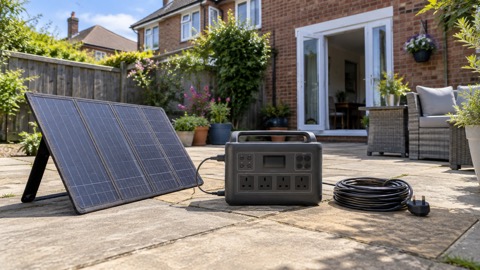
Panels are separate purchases. EcoFlow sells 400W and 220W portable panels for the DELTA Pro, and the unit can also take third-party panels within the voltage and current limits2. Portable Solar Panels for Charging in a Power Cut covers siting and cables, and How Long Does Solar Charging Take in the UK? sets expectations for our latitude.
Charging from a car or an EV charge point
There are two very different ways to charge from a vehicle, and they are worth keeping apart. The first is a 12V or 24V car socket: EcoFlow states the DELTA Pro supports a 12V/24V battery at 8A, and gives a full recharge time of 37.5 hours from a 12V car charger2. That is a trickle, useful for topping up on a long drive but not for restoring a flat unit overnight.
The second is an EV charge point. EcoFlow states the unit can take up to 3400W at an EV station, giving a full recharge in 1.7 hours1. The same page describes using the unit as a mobile EV charger on the road, and gives an example of extending the range of a Tesla Model Y by approximately 13.68 miles at 3.3 to 3.8 miles per kWh9. That is the maker's illustration, not a promise for your car.
For a household, the car socket is the fallback and the EV point is the fast option if you have one. Can You Charge a Power Station from Your Car? explains the limits of 12V charging, and 12V Inverters: Running Mains Kit From a Car or Battery covers the other direction of travel. If you are charging at a public EV point, check that charging a power station is permitted there before you plug in.
Adding capacity and connecting it to your home circuits
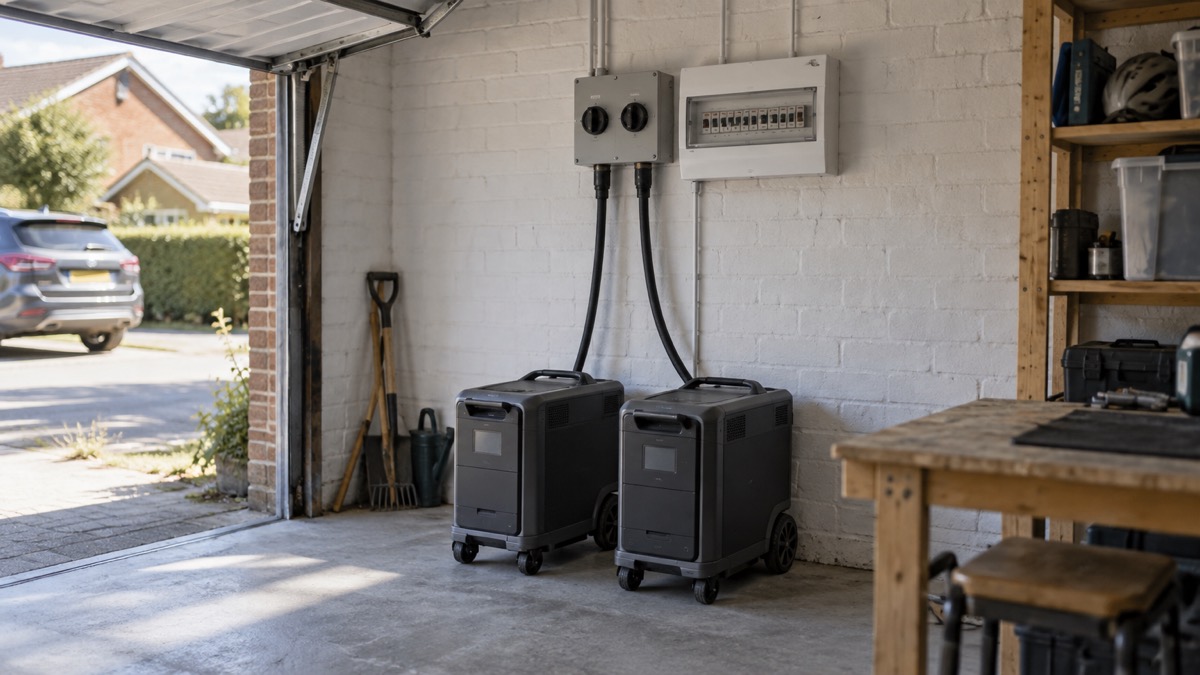
Capacity can be increased in two ways. The first is the Smart Extra Battery: EcoFlow states that one doubles capacity to 7.2kWh and two triple it to 10.8kWh, and that each DELTA Pro unit can take an extra two batteries4. Once connected, the maker states they charge and discharge in unison, keeping the battery percentage level across both units, and the extra battery has its own LCD screen showing output, input, remaining charge and time remaining4. It weighs approximately 38kg, so it is not a one-person lift for most people4.
The second is the Smart Home Panel, which EcoFlow states can integrate the DELTA Pro with up to 10 of your home circuits, giving emergency power and smart energy management10. Through the panel, EcoFlow states your chosen circuits stay powered with a 20ms switchover time during a blackout1. Two units paired with the panel give a potential 7200W output and 25kWh of capacity, and the maker states the system can reach up to 25kWh with extra batteries and a Smart Generator1.
Connecting a battery to fixed wiring is not a plug-in job. Connecting a Generator or Battery to Your Home's Wiring explains what is involved and why a proper changeover arrangement matters, and Using a Power Station as a UPS: Switchover Times covers what a 20ms figure does and does not guarantee. If you are weighing a fixed battery against a portable unit, Home Battery Storage: Does It Keep the Lights On? sets out the difference.
Safe charging, weight and keeping it up to date
The DELTA Pro is a large lithium battery, and the maker's own instructions are the ones to follow. Charge it with the supplied AC cable, directly into a wall outlet, and reduce the charging speed if the circuit cannot supply more than 15A2. Do not charge it below freezing: Can You Charge Lithium Batteries Below Freezing? explains why, and What Temperature Should Batteries Be Stored At? covers storage. For the general risks of lithium batteries at home, read Lithium-Ion Battery Safety at Home and Are Portable Power Stations a Fire Risk?.
Weight is a practical safety matter as well as a convenience one. At approximately 45kg, the unit needs two people or a ramp to move any distance, and the extra battery adds approximately 38kg1. Plan a permanent home for it at ground level, on a hard floor, near the socket you will charge it from, and away from doorways and stairs.
Keeping the firmware current matters because EcoFlow states that compatibility with newer products depends on it. The maker's instruction is to connect the unit to the EcoFlow App using Internet mode, then go to the Firmware section in Settings and follow the steps to upgrade12. The app also lets you monitor and control the Smart Extra Battery from a distance4. For storage, How to Store a Power Station When Not in Use covers the routine, and the Smart Extra Battery's stated shelf life of one year after a full charge is a reminder to recharge it periodically4.
The Smart Generator, the app and the remote
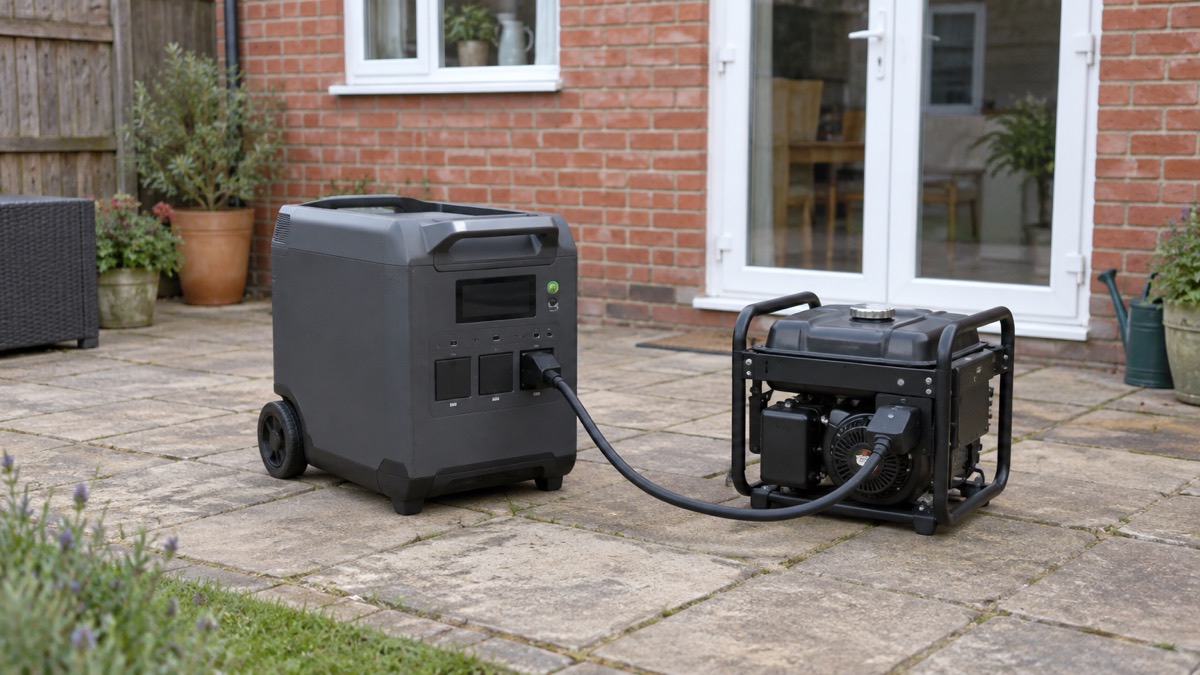
EcoFlow sells a Smart Generator that can charge the DELTA Pro, but it needs an adapter. The maker states that the DELTA Pro to Smart Generator Adapter, sold separately, is necessary when the DELTA Pro is connected to the Smart Generator1. The adapter has an input and output voltage range of 42 to 58.8V, measures 72 by 60 by 68mm and weighs 0.16kg, and the box contains the adapter and a user manual13. With the Smart Generator connected, EcoFlow states the Smart Extra Battery can take an 1800W DC fast charge through the generator port on the back, even when disconnected from the DELTA Pro4.
Control is straightforward. EcoFlow states you can operate the unit on the unit itself, with the remote control accessory, or through the EcoFlow App, which connects over Wi-Fi or Bluetooth2. The remote control is a separate purchase, runs on non-rechargeable AAA batteries and can also connect by a standard ethernet cable at 12V6. The app is also where firmware updates happen12.
What comes in the box, warranty and support
The DELTA Pro box contains the unit, an AC charging cable, a car charging cable, a DC5521 to DC5525 cable, a handle cover and a user manual1. The Smart Extra Battery box contains the battery, an extra battery cable, a handle cover and a user manual4. Solar panels, the Smart Home Panel, the remote control and the generator adapter are all separate products, so check any bundle's contents before ordering; EcoFlow's Smart Generator bundle page lists the DELTA Pro items and the generator items separately12.
On support, EcoFlow's UK pages refer to Warranty Protection and Lifetime Support, and the adapter page lists Warranty Protection offered by EcoFlow UK14. The pages do not state a warranty period in years, so confirm the terms with EcoFlow for the product you buy and keep your order confirmation and manual. For the wider context on what a power station can and cannot do in an outage, see Using Generators and Power Stations During an Outage and the Power Cut Backup Power Checklist.
Sources (14)
- DELTA Pro Portable Power Station, EcoFlow, 2026-10-25
- DELTA Pro 400W Portable Solar Panel, EcoFlow, 2026-10-25
- DELTA Solar Generators, EcoFlow, 2026-10-25
- DELTA Pro Smart Extra Battery, EcoFlow, 2026-10-25
- DELTA Portable Power Stations, EcoFlow, 2026-10-25
- DELTA Pro Remote Control, EcoFlow, 2026-10-25
- Portable RV and EV Power with DELTA Pro, EcoFlow, 2026-10-25
- DELTA Pro 220W Portable Solar Panel, EcoFlow, 2026-10-25
- DELTA Pro Smart Generator Bundle, EcoFlow, 2026-10-25
- Smart Home Panel, EcoFlow, 2026-10-25
- WAVE 2 Portable Air Conditioner with DELTA Pro, EcoFlow, 2026-10-25
- Solar Generators, EcoFlow, 2026-10-25
- DELTA Pro to Smart Generator Adapter, EcoFlow, 2026-10-25
- EcoFlow DELTA Solar Generators, EcoFlow, 2026-10-25

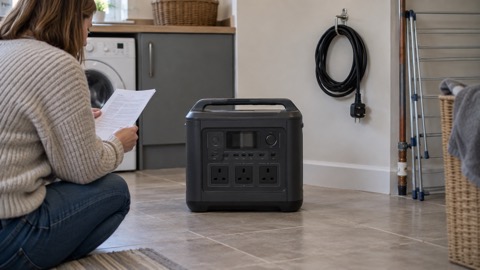 BLUETTI Apex 300 Power Station
 BLUETTI Elite 100 V2
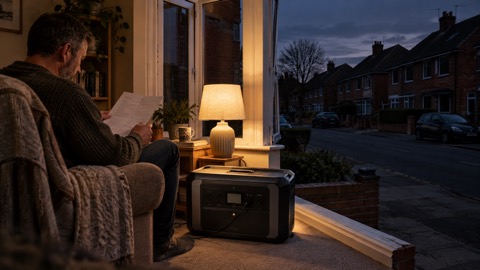 Anker SOLIX C2000 Gen 2
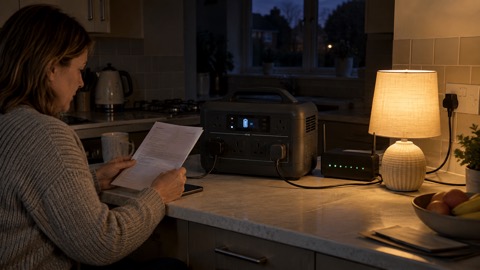 Anker SOLIX C1000 Power Station
 BLUETTI Elite 400
 Anker SOLIX C300 Power Station
 EcoFlow DELTA 3
 EcoFlow DELTA 2 and DELTA 2 Max
 EcoFlow DELTA and DELTA Max
 EcoFlow RIVER 3 and RIVER 3 Plus
 EcoFlow RIVER 2 and RIVER 2 Max
 BLUETTI Elite 30 V2