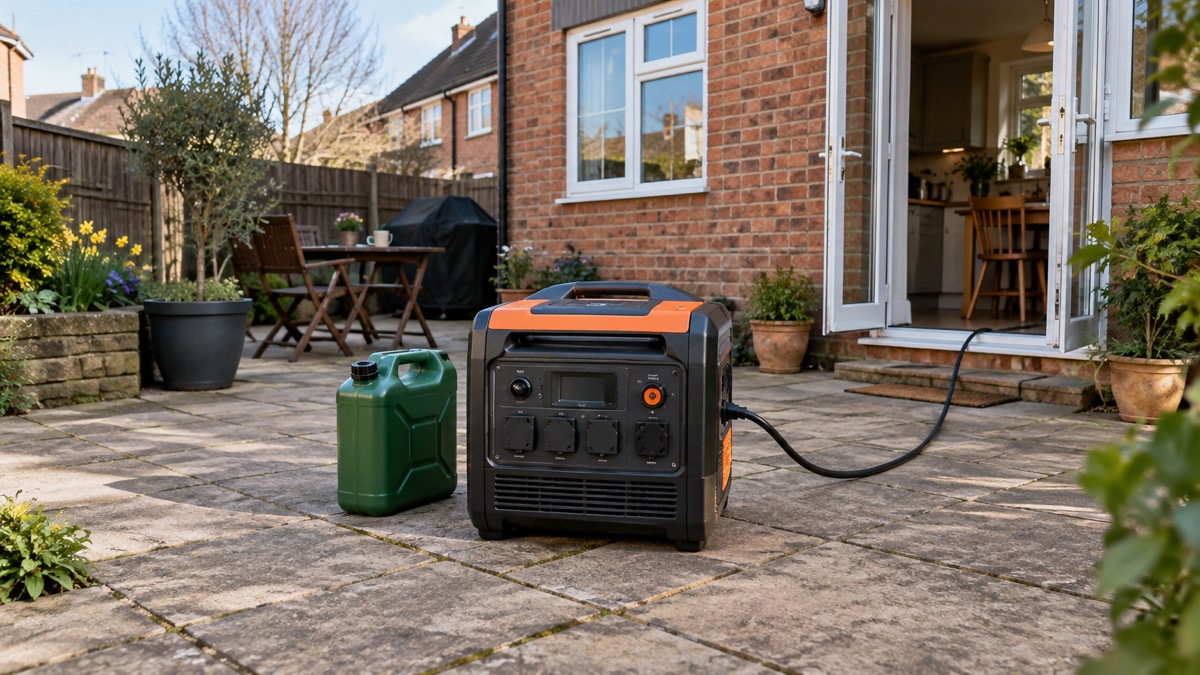
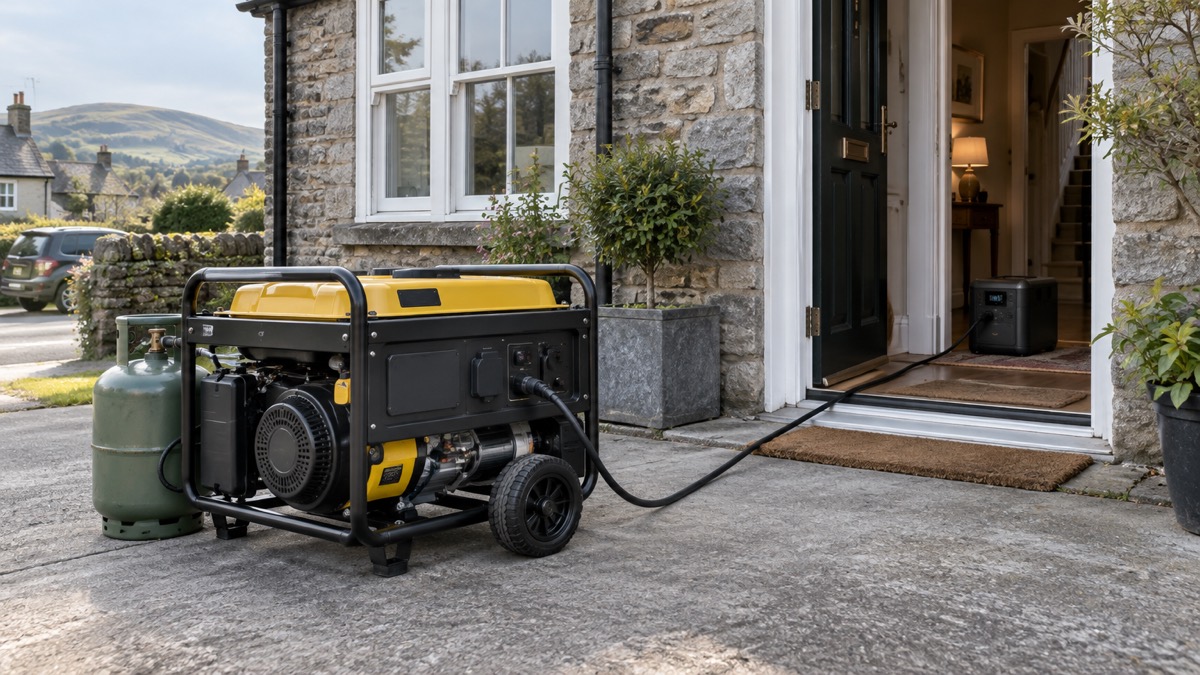
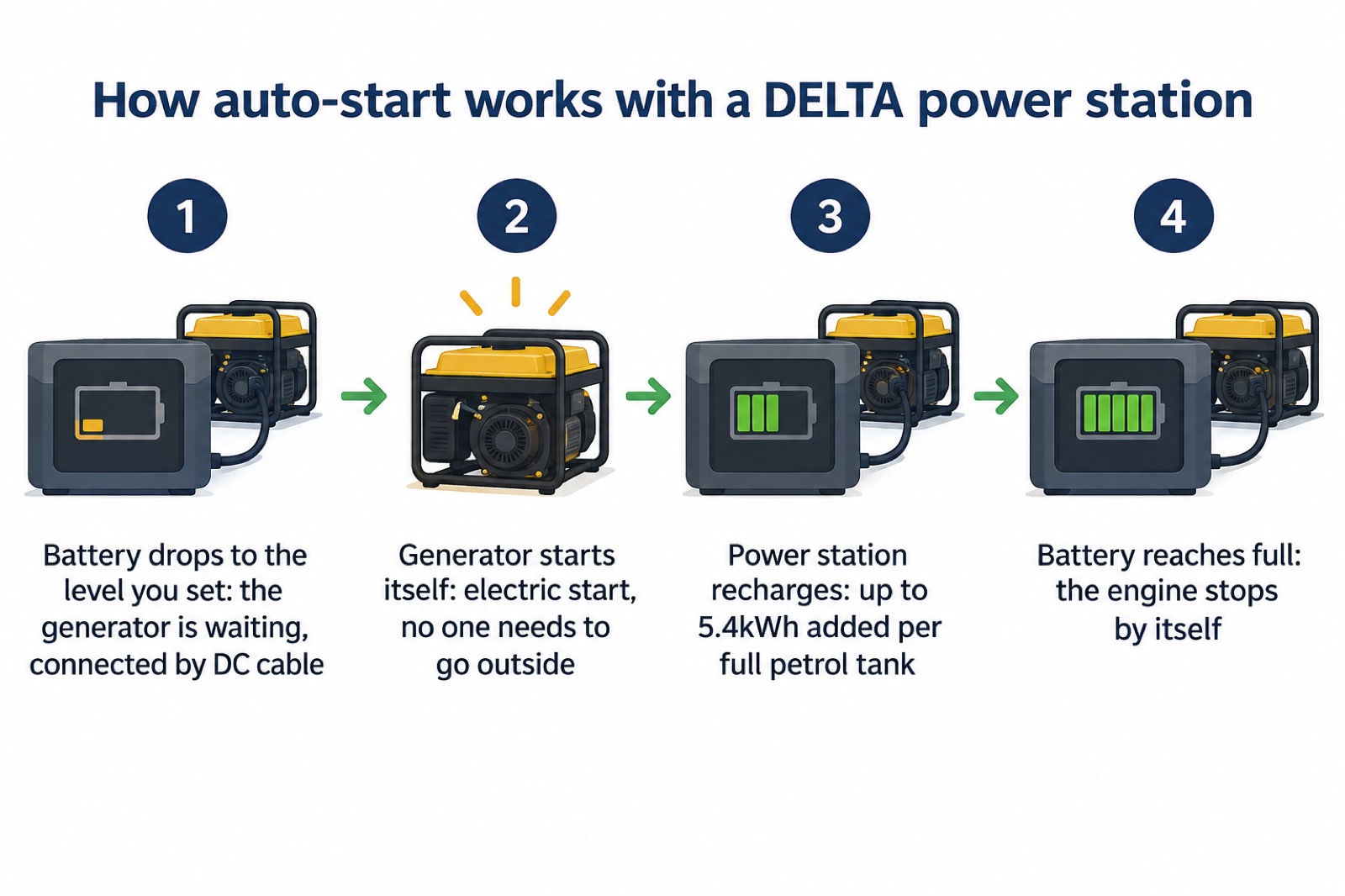
The EcoFlow Smart Generator is a small petrol or LPG generator built to do one job well in an emergency: refill an EcoFlow DELTA power station when the mains has failed and the battery is running down. On its own it is an inverter generator rated at 1800W with a 1900W peak on petrol, and it can run appliances directly through its AC output. Paired with a DELTA Max or DELTA Pro, it can start itself when the battery drops to a level you set, recharge it, and stop again when the battery is full1.
For a household preparing for power cuts, that pairing is the point. A power station alone is silent and safe indoors but finite; a generator alone needs fuel, a safe outdoor spot and someone to start it. The Smart Generator sits between the two: the maker states one full 4 L tank adds 5.4kWh to your DELTA system, and that a DELTA Max charges to full in 1.5 hours or a DELTA Pro in 2.7 hours1. It weighs 29.3 kg, so plan where it will live and how you will move it before you need it3.
This page sets out what the unit is, what it can and cannot do for your household, how to keep it ready between outages, and the safety rules that come with any petrol or LPG engine. It is written around the maker's own published specifications and instructions for its own product.
What the Smart Generator is and who it suits
The Smart Generator is an inverter generator: a small engine driving a generator head that produces clean power, in this case at 50Hz and 230V for the UK market2. The engine is a single cylinder, four-stroke, forced-air cooled unit of 79.7cc3. It is not a whole-house standby machine and it is not designed to be wired into your consumer unit. It is a portable unit that either feeds a compatible EcoFlow power station directly by DC, or runs appliances from its own AC outlet.
That shapes who it suits. It fits a household that already has, or plans to buy, a DELTA Max, DELTA Pro or EcoFlow Power Kits system and wants a way to keep that battery topped up through a long outage without running a generator continuously. The maker states the unit charges the power station directly with DC, which it says gives approximately 10% increased efficiency compared with other generators1. It also suits a household that wants the option of running a few mains appliances directly, because the unit works as a traditional generator when used alone3.
It does not suit everyone. It needs fuel stored safely, an outdoor spot with ventilation, and the physical ability to move 29.3 kg and refuel it. If your plan is to keep a few lights and phones going for a few hours, a power station charged in advance will do that without an engine at all. If your plan is to ride out a multi-day outage with a fridge, heating controls and communications, the combination of a power station and this generator is the arrangement the maker has designed.
Specifications at a glance
The maker publishes a full specification sheet for the Dual Fuel version. The figures below are the maker's own, and where the petrol and LPG modes differ they are shown side by side.
| Specification | Petrol mode | LPG mode |
|---|---|---|
| Rated power | 1800W (peak 1900W)2 | 1600W (peak 1700W)2 |
| Fuel | Unleaded petrol2 | LPG2 |
| Tank or supply | 4.0 L tank2 | 9.07kg LPG tank2 |
| Energy per full supply | 5.4kWh2 | Up to 20kWh2 |
| Continuous run time | 3.5 hours at full load2 | Up to 12.5 hours2 |
| Output voltage | 230V, 50Hz2 | 230V, 50Hz2 |
| DC output | 42 to 58.8V, 32A max3 | 42 to 58.8V, 32A max3 |
| Engine | Single cylinder, four-stroke, forced-air cooling, overhead valve, 79.7cc2 | Same2 |
| Engine oil capacity | 0.38 L3 | 0.38 L3 |
| Noise at full load | 56 to 67 dB at 7m3 | 56 to 67 dB at 7m3 |
| Weight | 29.3 kg3 | 29.3 kg3 |
| Dimensions | 59.7 x 29.6 x 47.5cm3 | 59.7 x 29.6 x 47.5cm3 |
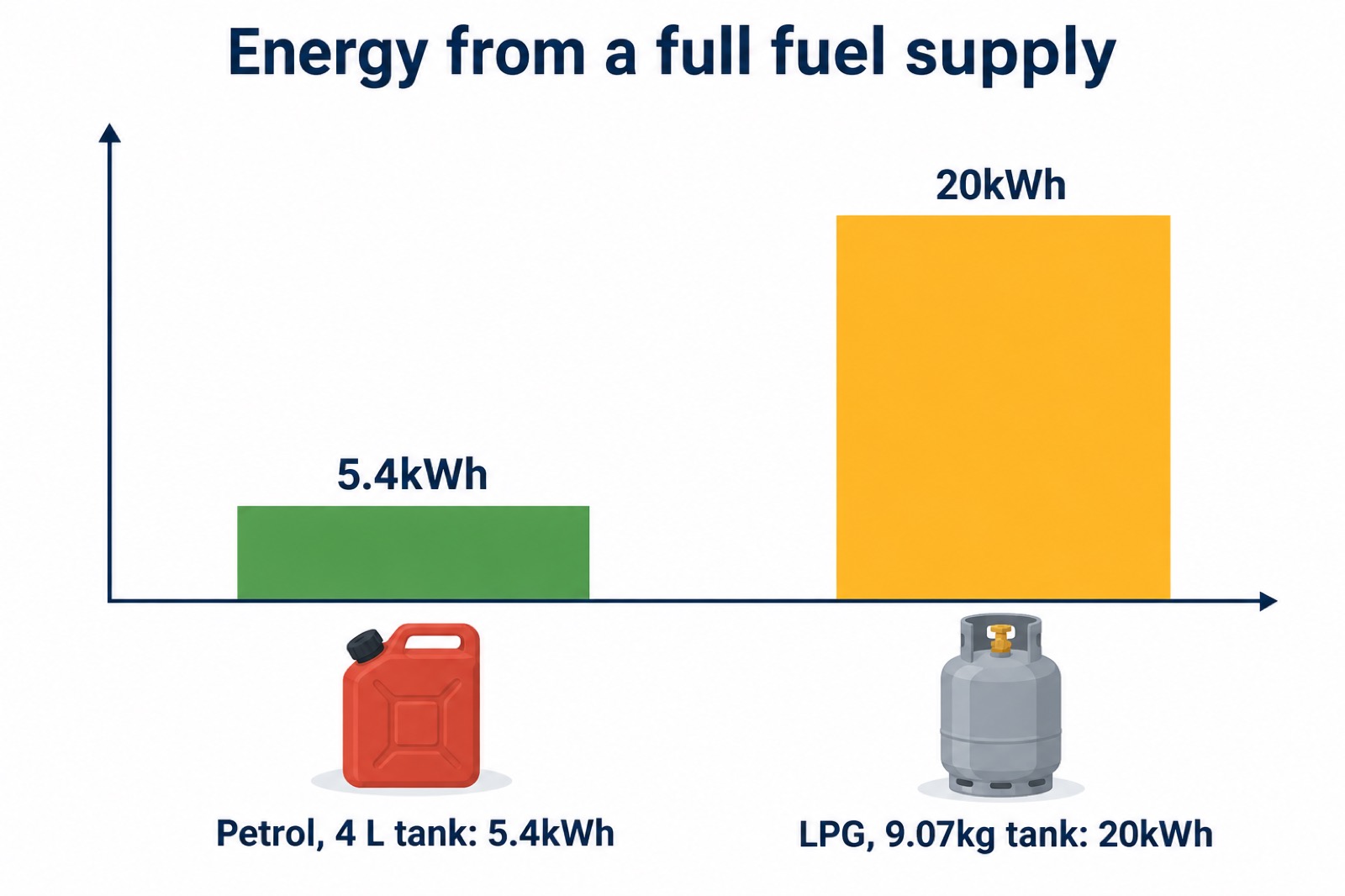
Two things in that table matter for planning. First, LPG gives you less power but far more energy: the maker states a 9.07kg LPG tank can yield up to 20kWh, against 5.4kWh from the 4 L petrol tank2. Second, the DC output is what feeds the power station, and it is a direct current connection, not a mains plug. If you want to understand how watts and watt-hours translate into run time for your appliances, our guide to watts, watt-hours and surge explains the arithmetic.
Run time and what a tank actually gives you
The headline figure is 3.5 hours at full load on the 4 L petrol tank2. That is continuous running at the unit's rated output, which is the hardest case. In practice, when the generator is charging a power station rather than running appliances directly, it is not working at full load for the whole tank, and the energy it delivers is the more useful number: 5.4kWh per full petrol tank1.
What does 5.4kWh mean for a household? It is the amount of energy the generator can put into your DELTA system from one tank. The maker states that this is enough to charge a DELTA Max to full in 1.5 hours or a DELTA Pro in 2.7 hours4. So a single tank can refill a large power station more than once, depending on its state of charge, and the power station then runs your appliances silently indoors while the generator is off.
On LPG the picture changes. The maker states up to 12.5 hours of runtime with LPG alone, and up to 20kWh from a 9.07kg tank2. That is a much longer, slower burn, which suits an outage you expect to last days rather than hours. The trade-off is lower rated output in LPG mode, 1600W against 1800W on petrol2.
If you are working out how long a tank will last for your own pattern of use, our guide to generator run time sets out the method. The maker also states that charging a DELTA Pro, DELTA Max or Power Kits this way can save up to 40% on fuel compared with other generators and portable power stations at the same full-rated power, made up of 10% from direct DC-DC charging and 30% from X-Stream charging2.
Charging a DELTA Pro or DELTA Max from the generator
This is the core function. The Smart Generator integrates with a DELTA Pro or DELTA Max, and the maker states that one full tank adds 5.4kWh to your ecosystem1. The connection is by DC cable, and the unit charges the power station directly rather than through a mains adapter, which the maker says gives approximately 10% increased efficiency1.
There is one accessory you must know about. The maker states that the EcoFlow DELTA Pro to Smart Generator Adapter, sold separately, is necessary when a DELTA Pro is connected to the Smart Generator1. The DELTA Max does not need it. If your plan centres on a DELTA Pro, budget for the adapter and check it is in stock before an outage, because one customer review on the maker's site reports that the adapter was not available anywhere5. Our page on the EcoFlow DELTA Pro covers the power station side of the pairing.
The Dual Fuel version is listed as compatible with the DELTA 2, DELTA 2 Max, DELTA Pro, DELTA Max and Power Kits2. The maker describes the unit as an emergency backup option for Power Kits, alongside solar panels, an alternator and shore power6. If you run a Power Kits system, the generator is one of several ways to refill it, and the one you would use when the sun is not cooperating.
Starting it: auto-start, the app and the manual pull
There are four ways to start the unit, and the one you choose depends on where you are and what you can reach. The maker lists electric start, manual start, the EcoFlow app, and automatic start at a designated battery level3. The electric start button brings the Dual Fuel version to life in 2 seconds2.
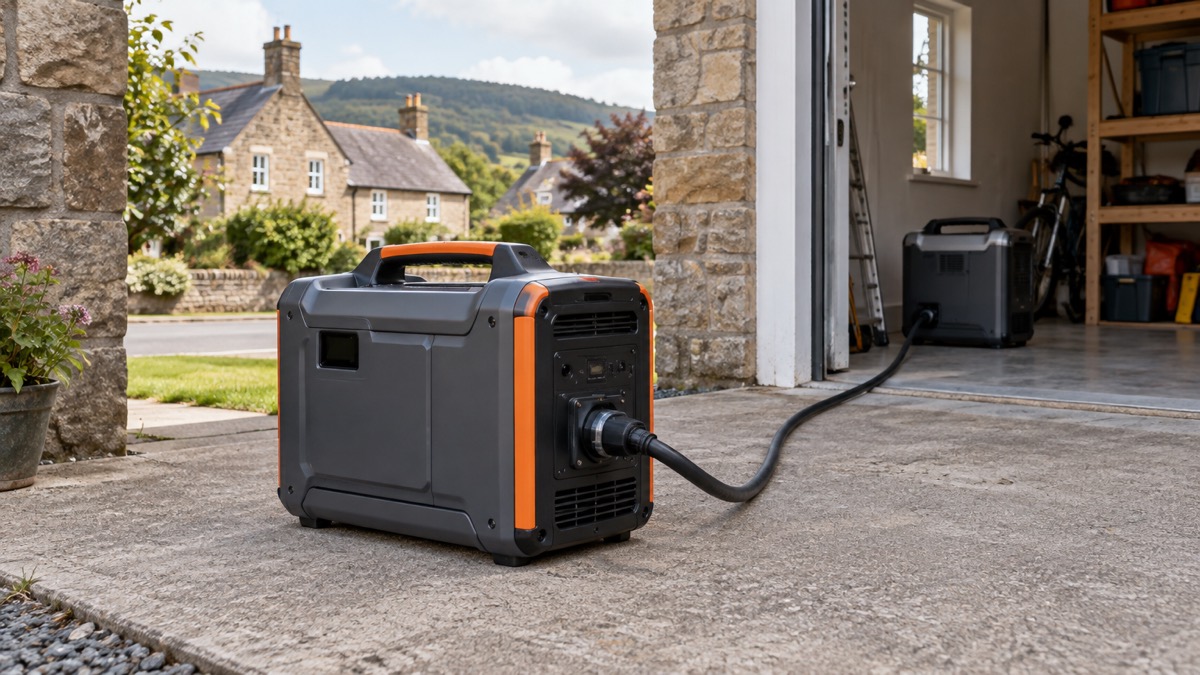
Auto-start is the feature that changes how a household uses it. The maker states that you can pre-define an auto-start when your power station depletes to a certain level7. With a DELTA Max, the maker describes the behaviour plainly: it auto-starts when the DELTA Max hits a low level of charge, recharges it, and stops the engine all by itself once the DELTA Max hits a full charge8. The same behaviour is described for the Dual Fuel version with a DELTA Pro, DELTA Max or Power Kits2. The maker states that auto-start requires use of a DELTA Pro, DELTA Max or Power Kits2.
The app adds remote control. Once connected by Bluetooth or WiFi, the maker states you can set the battery level for auto-start, control DC output levels, start or stop the unit remotely, switch on Eco mode, and see monitoring and alerts including LPG consumption and maintenance reminders2. The app is set up in the DELTA Pro, DELTA Max or Power Kits app interface2. The unit also has an onboard LCD screen for checking its vitals up close2.
The manual starter grip is the fallback if the electric start fails2. Practise using it once, in daylight, before you need it in the dark. If the unit is slow to start in cold weather, our guide to generators in cold weather covers the reasons.
Using it on its own to power appliances
The Smart Generator is not only a battery charger. The maker states it also works as a traditional gas generator for when you need it to work alone3. It has an AC output to power other devices while recharging your unit with an extra battery1. In practice that means you can run a fridge, a lamp or a phone charger from the generator's own outlet while it is also topping up the power station.
The maker states that the unit allows you to charge your power station and power your appliances at the same time, outputting up to 1800W2. In LPG mode the total output of DC and AC is 1600W, and the unit prioritises AC output when needed2. That prioritisation matters: if you plug in an appliance that pushes demand up, the generator will protect the AC supply first, which is what you want for a fridge or a medical device.
Running appliances directly means the generator must be running, which means it must be outdoors and supervised. The quieter, safer pattern for most households is to use the generator to charge the power station, then run appliances from the power station indoors. Our guide to using generators and power stations during an outage sets out how to sequence that. If you are deciding between a power station and a generator as your main backup, our comparison of portable power stations and petrol generators covers the trade-offs.
Safety: carbon monoxide, fuel and automatic shutdown
Any petrol or LPG engine produces carbon monoxide, and the Smart Generator is no exception. The maker has built detection and shutdown into the unit, but the first rule is about where you run it, not what the unit does. The fire and rescue service advises that generators are never used indoors, in a garage or in any enclosed space, because carbon monoxide is invisible and can kill. Our guide to generator safety sets out the full rules, and our page on carbon monoxide from generators covers the warning signs.
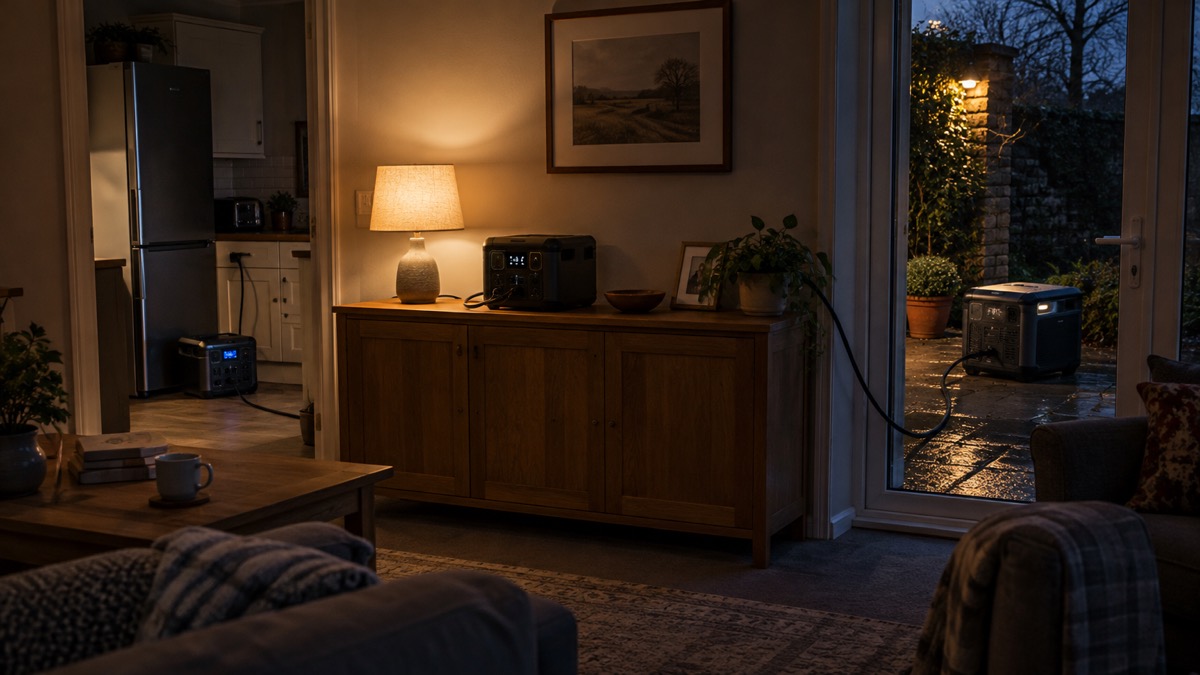
The maker's own safety features are a second line of defence, not a substitute for siting the unit correctly. The maker states the unit has a carbon monoxide detector, fuel alert, engine oil alert, temperature protection and overload avoidance, all with indicators on the unit, and that all of these except the fuel alert can trigger an automatic shutdown2. The CO alert shuts the unit down if there is too much carbon monoxide2. The overload protection alerts you when the load hits a certain level and shuts down to prevent overload2. Temperature protection shuts down to prevent the battery or engine overheating, and the unit can auto-start to keep the engine warm in cool environments when needed2. The engine oil alert tells you when more oil is needed and shuts down to prevent damage2.
Fuel handling is the other half of safety. The maker lists a 4.0 L petrol tank and an LPG inlet that connects without tools, with the unit switching modes automatically2. Store petrol only as the fire and rescue service advises, never refuel a hot engine, and keep fuel away from the unit while it is running. Our guide to petrol storage at home covers the limits, and our page on LPG cylinders and regulators covers the gas side.
Keeping it ready between outages
A generator that will not start is worse than no generator, because you have planned around it. The maker's maintenance reminder in the app helps, but the physical checks are yours. Before each winter, check the fuel is fresh and start the unit briefly to confirm it runs. Our backup power checks before winter checklist sets out the seasonal routine.
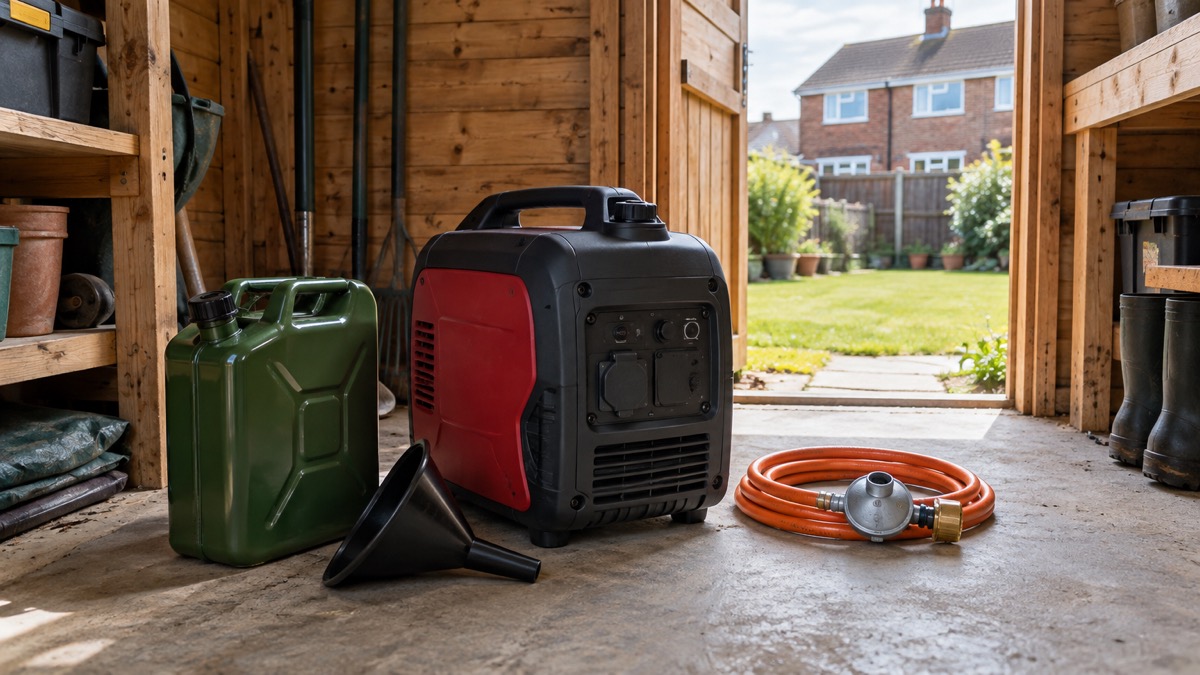
Storage matters. The maker states the unit can auto-start to keep the engine warm in cool environments when needed2, but that is a running behaviour, not a storage instruction. Store the unit dry, with the fuel system as the maker's manual directs, and keep the LPG hose and the accessories that came in the box together with it. The box contains the Smart Generator (Dual Fuel), a user manual and warranty card, an extra battery connection cable, an oil funnel, a screwdriver, a spark plug socket, a breaker bar, a double-ended spanner and an LPG hose2. Our guide to storing a generator after a power cut covers the longer term.
Warranty, support and refurbished units
The maker lists the Smart Generator (Dual Fuel) as available to buy on uk.ecoflow.com with warranty protection and lifetime support2. The same warranty protection and lifetime support terms appear across the maker's DELTA range9. The maker does not state a warranty period in the material published for this unit, so check the terms that apply to the unit you buy before you rely on it.
Refurbished units are also listed. The maker's refurbished Dual Fuel page describes the same core specification, including the 1800W petrol rating, the 4.0 L tank and the 5.4kWh per tank figure4. Customer reviews on the maker's refurbished listing describe units arriving in the original box and looking virtually new, and one reviewer notes that the electric start worked well once connected3. Another review describes difficulty getting a warranty issue resolved through customer services3. Treat reviews as one household's experience, not a guarantee, and keep your proof of purchase and serial number safe.
The unit is part of a wider system, and the maker's EcoFlow range includes the power stations it is designed to charge. If you are building a household backup plan around one, our guide to backup power at home sets out where a generator fits alongside batteries, solar and a power cut kit.
Sources (9)
- EcoFlow Smart Generator product page, EcoFlow, 2026-10-25
- EcoFlow Smart Generator (Dual Fuel) product page, EcoFlow, 2026-10-25
- EcoFlow Smart Generator (Refurbished) product page, EcoFlow, 2026-10-29
- EcoFlow Smart Generator (Dual Fuel) Refurbished product page, EcoFlow, 2026-10-25
- EcoFlow Alternator Charger Custom Fit Output Cable product page, EcoFlow, 2026-10-25
- EcoFlow 4kWh Power Kits product page, EcoFlow, 2022-07
- EcoFlow DELTA Pro Smart Generator Bundle product page, EcoFlow, 2026-10-25
- EcoFlow DELTA Max Portable Power Station product page, EcoFlow, 2026-10-25
- EcoFlow DELTA Solar Generators product page, EcoFlow, 2026-10-25

 BLUETTI Apex 300 Power Station
 BLUETTI Elite 100 V2
 Anker SOLIX C2000 Gen 2
 Anker SOLIX C1000 Power Station
 EcoFlow DELTA Pro
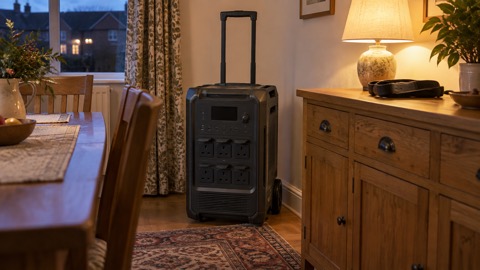 BLUETTI Elite 400
 Anker SOLIX C300 Power Station
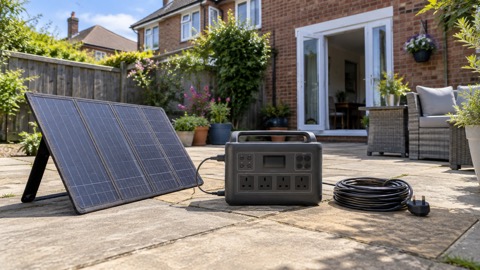 EcoFlow DELTA 3
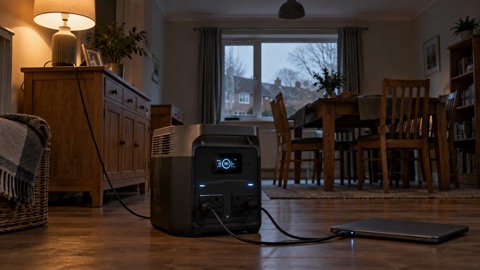 EcoFlow DELTA 2 and DELTA 2 Max
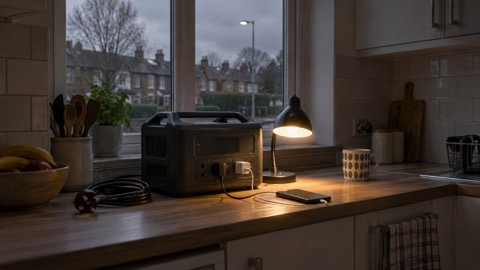 EcoFlow DELTA and DELTA Max
 EcoFlow RIVER 3 and RIVER 3 Plus
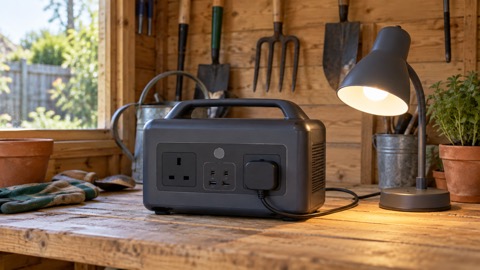 EcoFlow RIVER 2 and RIVER 2 Max