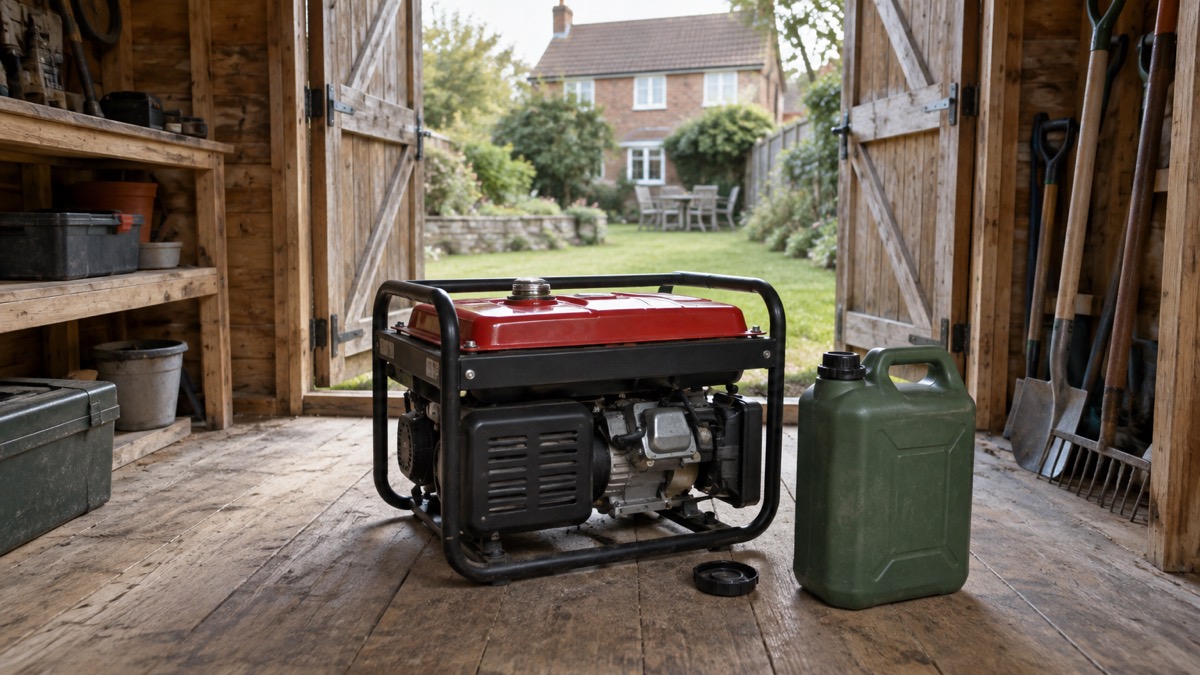
When the power comes back on, the generator has done its job, and the temptation is to wheel it into the garage and forget it until the next storm. That is how generators end up failing when they are needed. Storing one properly takes an afternoon: let it cool, deal with the fuel, put it somewhere the exhaust fumes can never reach a room, and run the checks the maker sets out in the manual1.
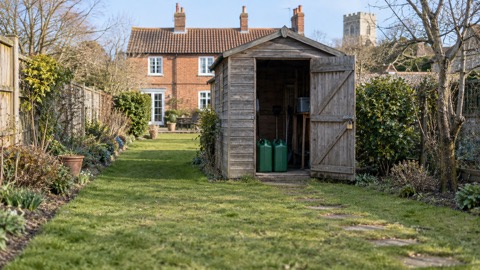
The order matters. Switch it off and let it cool before you move it, because hot parts and hot exhausts are a burn risk and a fire risk2. Store it in a dry, safe place such as a shed or garage, as Electrical Safety First advises for electric tools, and check it has not been damaged or affected by water before you use it again4. Keep petrol in suitable portable metal or plastic containers, up to 30 litres at home5.
Above all, remember what the generator produces. Never run a petrol or diesel generator indoors, because the exhaust gases contain carbon monoxide, which can kill6. That rule applies during the outage and it applies to any test run you do before storage. The rest of this page is the sequence: cool and switch off, fuel, siting, checks, and starting it again next time.
Switch it off and let it cool before you move it
The first step is the one people skip. The same principle appears across fire and electrical safety advice for anything that gets hot: do not move a patio heater when it is on or just after it has been turned off, wait for it to cool down3. A generator's exhaust and engine block get far hotter than a heater's casing, and a unit wheeled straight into a shed can sit against a wall or a bag of compost while it is still hot.
Give it time, and use the wait. While it cools, walk the cable and check it for damage, the way Electrical Safety First suggests inspecting a fan from storage for fraying, cuts or rodent activity such as exposed wires9. A generator that ran through a storm may have been dragged over gravel, stood in wet grass or had a lead trapped in a door. Catching that now is cheaper than finding it in the dark next winter.
Once it is cool, disconnect everything. Unplug appliances and extension leads, and if the generator was connected to your home's wiring, have the electrician who installed the connection isolate it properly. Guidance is clear that connecting your own generation must be done by a qualified professional10, and the same professional should be the one to disconnect it.
Petrol, diesel or dual fuel: what to do with the fuel
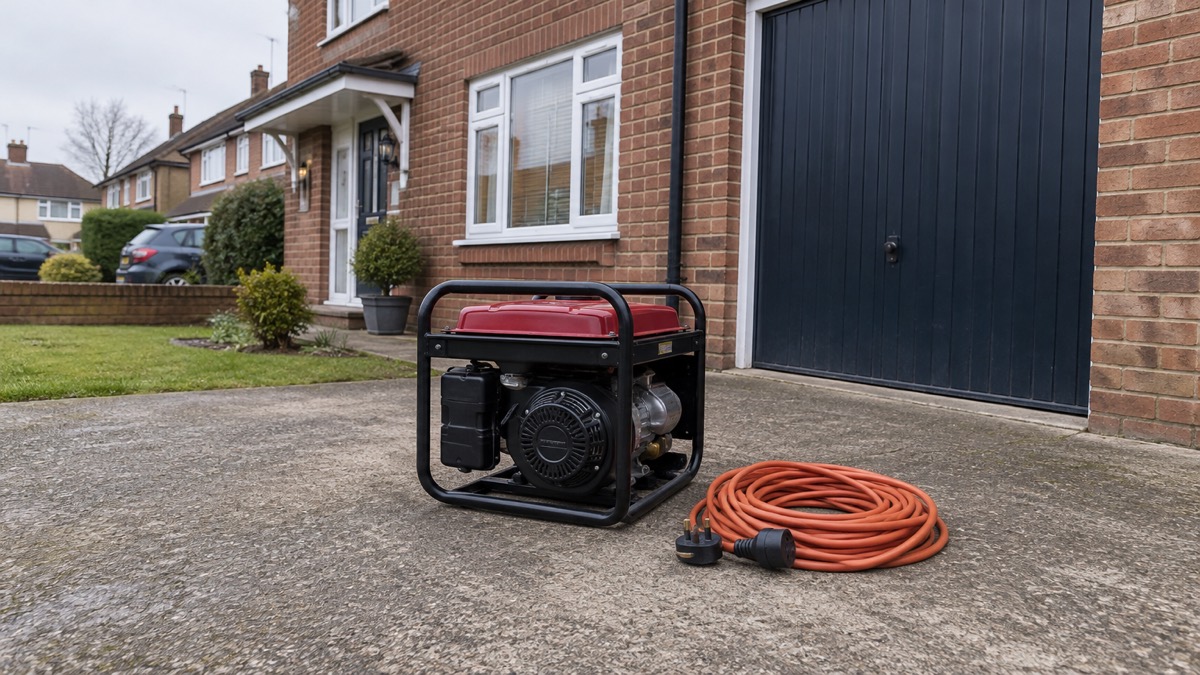
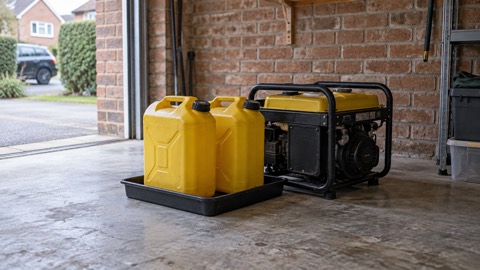
Fuel is where storage goes wrong. Petrol left in a tank or can for months is the usual reason a generator will not start next season, and it is also the part of storage with legal limits. You can store petrol at home in suitable portable metal or plastic containers, in one demountable fuel tank, or a combination of the above, as long as no more than 30 litres is kept5. For diesel, follow the safety guidance around storing it on the government website5.
The fuel type also shapes how you store and use the machine. Diesel generators generally last longer than petrol generators, with long running time, but diesel is more expensive to buy and can be noisier than petrol alternatives11. That is a reason to think about fuel before you buy, not just before you store.
| Fuel | What to do before storage | What to know |
|---|---|---|
| Petrol | Keep it in suitable portable metal or plastic containers, up to 30 litres at home5 | The most common fuel for small portable sets; store it away from the house and from ignition sources |
| Diesel | Follow the government's safety guidance on storing diesel5 | Diesel generators generally last longer than petrol, with long running time, but cost more to buy and can be noisier11 |
| Dual fuel (petrol and LPG) | Treat each fuel by its own rules; store LPG cylinders upright and never in basements, under stairs or in cupboards with electric meters2 | A dual fuel unit gives you a choice of fuel, so store both safely or store only the one you will use |
For a dual fuel unit, the LPG side brings its own storage rules. Never store a cylinder in a basement, near drains, under the stairs or in a cupboard containing electric meters or equipment13. Keep cylinders upright, out of direct sunlight, in a well ventilated, dry area away from heat sources, and do not use that space for paint, oil, grease or other combustible materials12. Our guide to LPG cylinders and regulators covers the connections in more detail.
Where a generator must never be stored or run
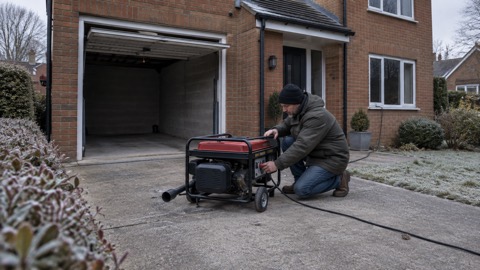
The storage place and the running place are different, and confusing them is the most dangerous mistake in this whole subject. The Health and Safety Executive's guidance is to locate petrol generators outside, in well ventilated spaces, so that fumes disperse and cannot gather or drift into building openings15. Fumes can travel: a generator running in a shed with the door ajar, or beside an open window, can put carbon monoxide into a bedroom.
So the shed or garage is for storage only. When you test it before winter, wheel it out onto firm, level ground away from combustible materials, standing water and areas where exhaust gases could accumulate1. Keep it away from doors, windows, air bricks and vents.
The same caution applies to other fuel stores in the same space. Never store propane or oxygen cylinders in basements, under stairs or in cupboards containing electric meters or equipment2. If you have oxygen cylinders at home for medical use, they must be stored upright, out of direct sunlight, in a well ventilated, dry area away from heat sources, and not alongside paint, oil, grease or domestic heating gases12.
Checks and maintenance before you put it away
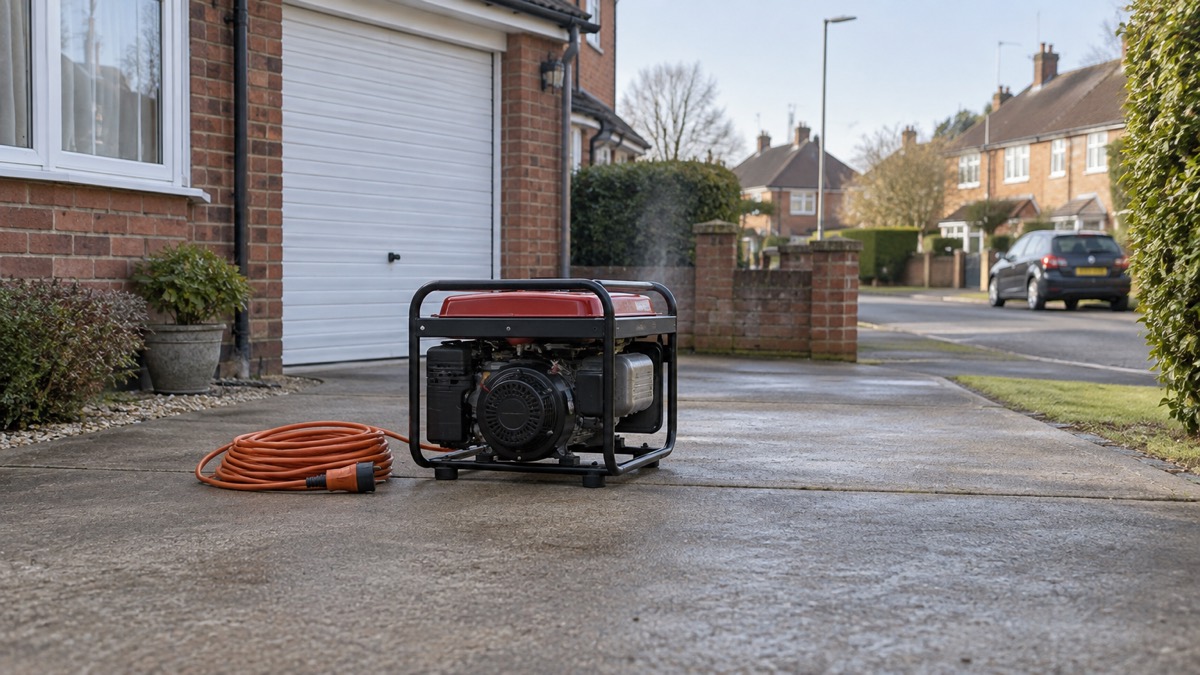
Storage is maintenance. The maker's instruction is simple: follow the maintenance intervals and storage procedure shown in the generator manual1. If you have lost the manual, find it before you put the unit away, because the intervals differ between models and the storage steps are specific to the machine.
If you already own a generator, check it meets the power needs and connections you might have to support in an emergency16. That check is worth doing now, while the lights are on, rather than during the next outage. Farmers and livestock owners are advised to check and test backup generators and equipment ahead of storm conditions14, and the same discipline suits any household that depends on one.
A short checklist before the unit goes into storage:
- Cool and switched off, with everything unplugged2.
- Cable and plugs inspected for fraying, cuts or rodent damage9.
- Fuel dealt with within the 30 litre petrol limit, or according to diesel guidance5.
- Stored dry, in a shed or garage, checked for water damage before next use4.
- Manual to hand, with its maintenance intervals and storage procedure1.
- Test run planned for before winter, outdoors, on firm level ground1.
If your generator is a permanent standby set, the same logic applies at a larger scale. Have it checked and tested, and make sure it meets the load you would need in an emergency16.
Getting it ready to start next time: electric or recoil
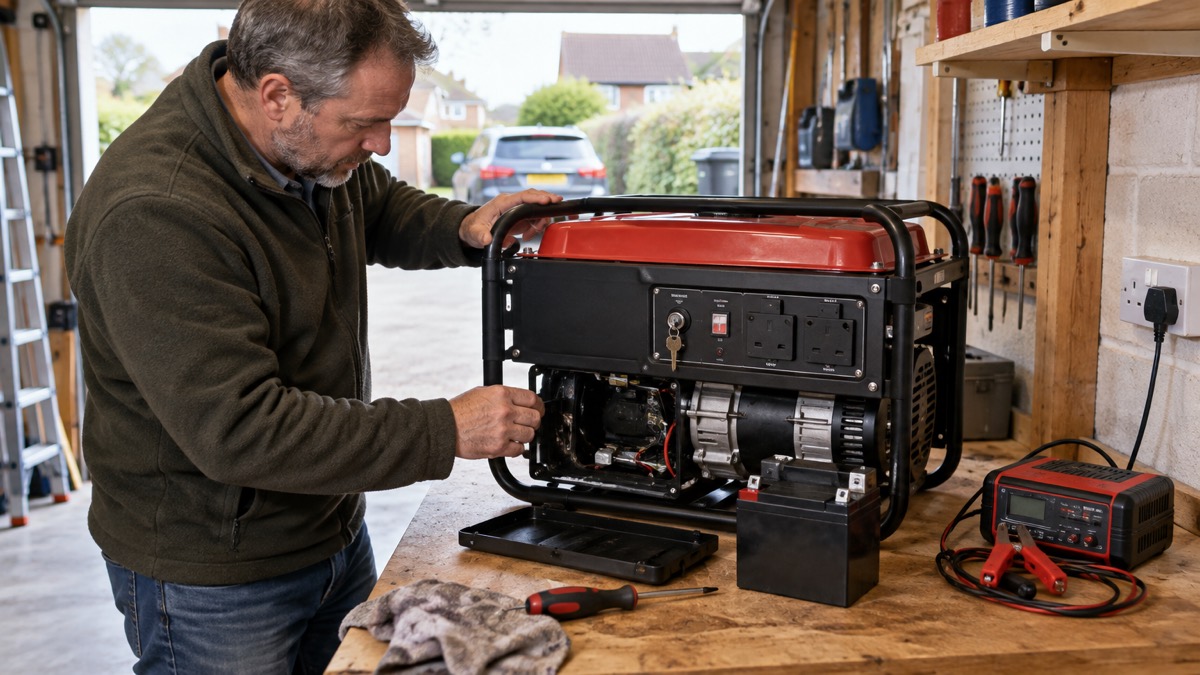
How you store a generator depends partly on how it starts. An electric-start model uses a key or switch, making larger engines easier to operate, but the battery must be kept charged and maintained, although some models retain a recoil starter as a backup1. That battery is the part most often forgotten: a unit stored for months with a flat starter battery will not turn over, and you will be pulling the recoil cord in the cold.
If yours is electric start, put a battery check on the calendar alongside the test run. If it is recoil start only, the storage job is simpler, but the engine still needs to turn freely and the fuel still needs to be right.
There is one more thing to check before you rely on the generator again: whether it is the right tool at all. Using a generator is not always the simplest solution: there will not be enough generators to keep everyone powered, and it may take longer to install and connect a generator to your local substation than the duration of the emergency power cut10. A generator is for the longer event, and it needs to be ready for one.
Who supplies generators, and when
Households sometimes ask whether the network will bring them a generator. The answer is usually no, and it helps to know why. Your local distribution network operator is responsible for restoring your power if your home loses supply18, and its teams are on hand around the clock to restore the supply as quickly and safely as possible19. Generators are used by power companies for faults where equipment cannot be repaired immediately20.
For extended repairs, operators order generators through network partners, who ensure a robust refuelling strategy is in place and connect to the network safely21. But the numbers do not stretch to every home, and installation takes time10. If you have solar panels and a battery storage system with power backup capability, some installations can continue to provide power during a power cut if they are designed and configured to operate independently of the grid22. That is worth knowing before you buy a generator at all.
If your outage is a planned one and your letter says you will be connected to a temporary generator, turn off your solar panels before the planned outage and turn them back on once mains power has been restored, because panels left on may feed electricity into the generator and cause it to stop working23.
| Situation | Who acts | What it means for you |
|---|---|---|
| Short unplanned outage | Your local distribution network operator18 | Report it, and expect reconnection once the network is reconfigured24 |
| Fault needing extended repair | Network operator, ordering generators through partners21 | A generator may be installed, but not for every household10 |
| Planned outage with a temporary generator | You, plus the network operator23 | Turn solar panels off before the outage and back on afterwards23 |
| Your own backup | You, with a qualified electrician for any wiring connection10 | The generator must be stored and maintained by you1 |
Where to get help and what to do next
If the power is off now, contact your electricity network operator, which manages the powerlines and substations and is the people you should contact if you experience a power cut24. Store the power cut helpline number, 105, on your phone8. If you rely on an electric water pump, store extra water just in case25.
For anyone who needs extra support, ask about the Priority Services Register through your network operator. If you have a backup generator already, check it meets the power needs and connections you might have to support in an emergency17. And if you are thinking about connecting a generator to your home's wiring, take advice first: it takes research by you and the advice and expertise of a qualified electrician before a generator may help you20.
For the wider picture, see our guides to backup power at home, portable generators, generator safety and how much petrol you can store at home.
Sources (25)
- Generators, Clarke International, 2026-10-25
- Portable heaters, gas fires and open fires, London Fire Brigade, 2026-10-25
- Patio heaters, Electrical Safety First, 2026-10-25
- Garden safety advice, Electrical Safety First, 2026-10-25
- Storing fuel, Devon and Somerset Fire and Rescue Service, 2026
- Flooding advice, Runnymede Borough Council, 2026-10-26
- After a flood, London Fire Brigade, 2026-10-25
- Top tips to be weather ready, Met Office, 2026-10-25
- Electric fans, Electrical Safety First, 2026-10-26
- Emergency power cuts, Electricity North West, 2026-10-25
- How to buy the best generator, Which?, 2026-01-20
- Specialist health equipment, Devon and Somerset Fire and Rescue Service, 2026
- Heating and gas, Scottish Fire and Rescue Service, 2024-11-21
- Strong winds weather warning information and advice, nidirect, 2026-01-27
- Carbon monoxide in construction, Health and Safety Executive, 2026
- Be winter ready, Electricity North West, 2026-10-26
- Care and assisted living providers, Energy Networks Association, 2026-10-25
- Energy outages, NESO, 2026
- How we deal with power cuts, National Grid, 2026-10-25
- Generators, Wiltshire and Swindon Prepared, 2026-10-25
- Restoration following a power cut, Electricity North West, 2026-10-25
- Be informed about hazards: power cuts, UK Government, 2026-10-21
- Planned power cuts, SSEN, 2026-10-25
- What to do in a power cut, SP Energy Networks, 2026-10-26
- What to do in a power cut, Northern Powergrid, 2026-10-25
 Power Cut Backup Power Checklist
 Backup Power Before Winter
 Safe Battery Charging at Home
 Running a Generator Indoors
 Carbon Monoxide from Generators
 Generator Sizing for a Power Cut
 Generator Run Time on a Tank
 Storing Petrol at Home
 Diesel Storage at Home
 Generators in Cold Weather
 Generator Noise and Neighbours
 Power Station Capacity Sizing
 Power Station Run Time
 Power Station for a Gas Boiler
 Power Station UPS Mode