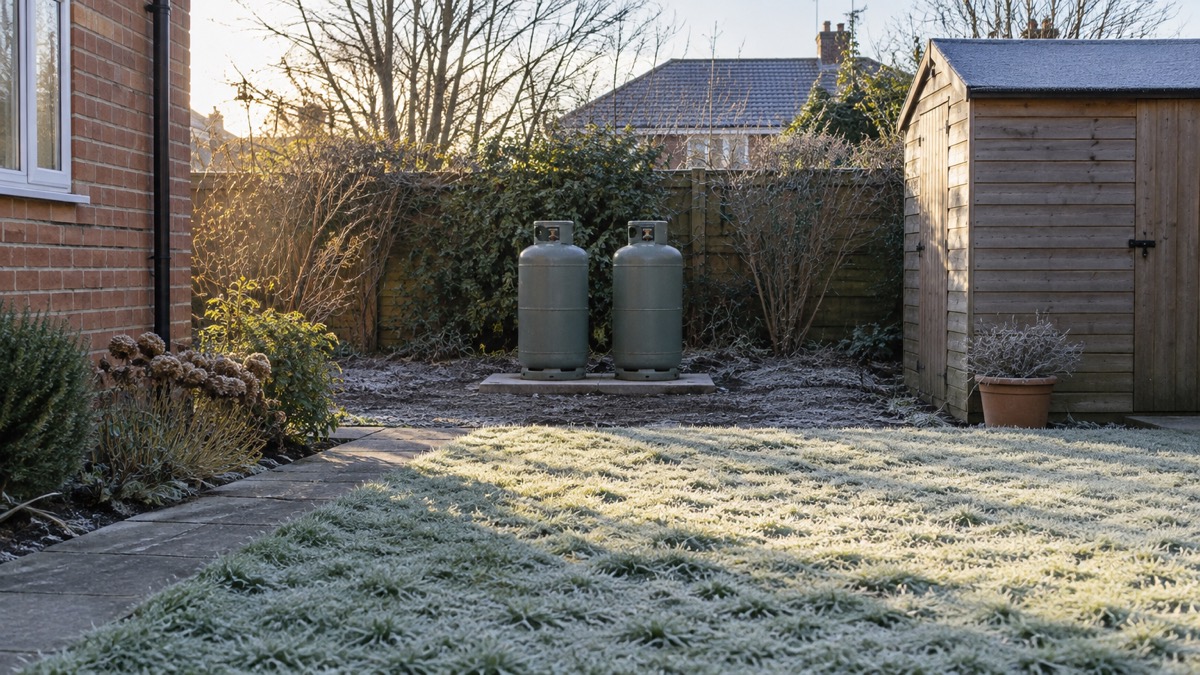
If you keep a spare gas bottle for a heater, a camping stove or a barbecue, the safest place for it is outside the home, standing upright, away from direct sunlight and protected from frost. Fire and rescue services across the UK are consistent on this: store spare cylinders upright and outside whenever possible1. Never keep them in a basement, under the stairs, or in a cupboard containing electric meters or equipment2.
The reason is fire. A cylinder caught in a house fire is a serious hazard, and one stored under the stairs can explode and block the way out3. Keeping bottles outdoors, upright and clear of clutter removes that risk from the rooms you sleep and escape through.
This page sets out where to put spare cylinders, how to store medical oxygen safely, and how to run a portable gas heater without adding to the fire risk. If you are choosing between heater types, the portable heaters guide sets them side by side, and Bottled Gas for Heaters and Stoves explains butane, propane and regulators.
Keep spare cylinders outside the home where possible
The default answer to "where should the spare bottle go?" is: outdoors, upright, and not against the house. North Yorkshire Fire and Rescue Service advises that gas, paraffin and LPG cylinders should be stored safely outside the home and out of direct sunlight, and not on balconies7.
Outdoors does not mean anywhere outdoors. Mid and West Wales Fire and Rescue Service sets out the places to avoid: never store cylinders in basements, near drains, under the stairs, or in a cupboard containing electric meters or equipment2. A drain matters because a leaking heavier-than-air gas can collect in low spots, and a meter cupboard matters because a spark there is exactly what you do not want near a leaking bottle.
Two further rules shape the spot you choose. Keep cylinders away from direct sunlight and frost, and do not store more than you need4. Sun heats the cylinder; frost is a sign the cylinder and regulator are being stressed by cold. Both are reasons to choose a sheltered, shaded, ventilated position rather than a sunny wall or an exposed corner.
If you live in a caravan or mobile home, the guidance is stricter still: store cylinders six metres away from your home, even when empty8. That distance is a figure to plan around if you have a static van or a park home with bottles on site.
Why cylinders indoors add to fire risk
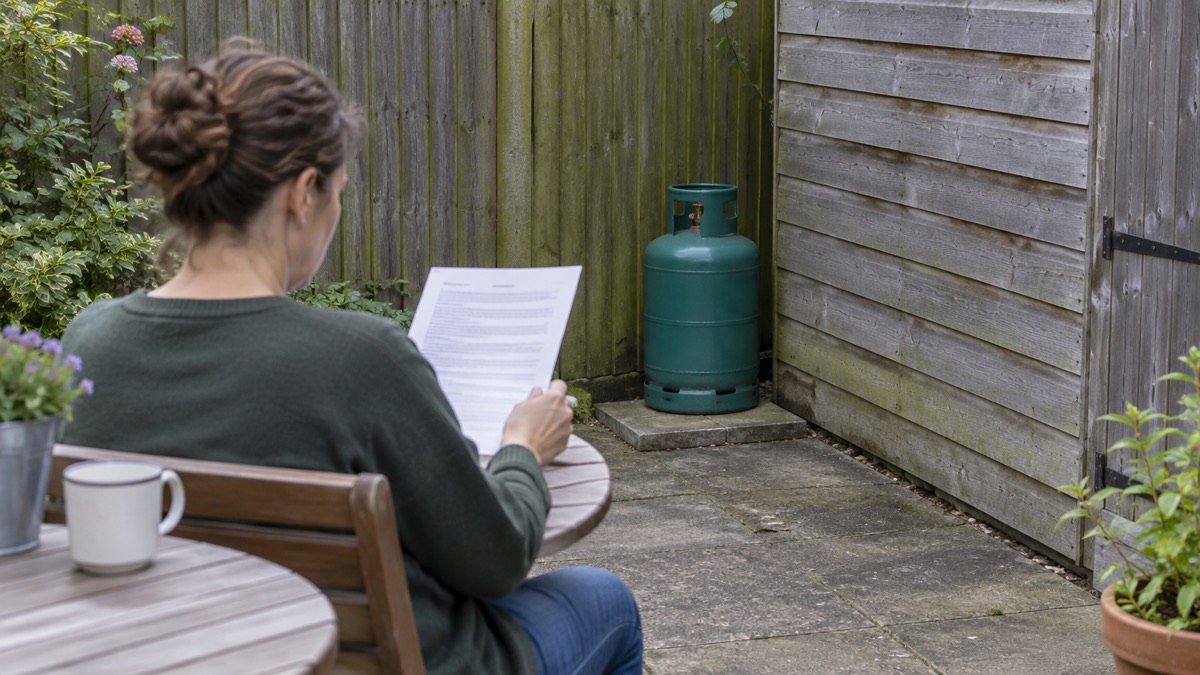
A gas cylinder inside the home is a hazard during a fire, and fire services say plainly not to store cylinders in your home for that reason9. The risk is not only the cylinder itself. It is what the cylinder does to your escape. The government's fire safety outdoors guidance is blunt: never store gas cylinders under the stairs, because if there is a fire they might explode and block your escape route3.
That single sentence explains most of the storage rules. Under the stairs is the classic escape route in a two-storey house. A basement is a low point where leaking gas can gather and where you may be trapped. A cupboard with the electric meter puts an ignition source inches from the valve. Each is a place where a fire and a cylinder meet.
Clutter makes it worse. Fire services warn that excessive storage of flammable items such as gas canisters, cardboard and refuse in rear areas or gardens is a fire risk that could block the escape route10. Hoarding is itself a fire risk in the home11. The practical rule is to keep the area around your cylinders clear, so that a small fire has nothing to feed on and you can reach the bottles to turn them off.
There is a carbon monoxide angle too. Smaller rooms containing fuel-burning appliances are particularly at risk, because the pollutant concentrates more quickly in confined spaces12. A cylinder and heater crammed into a small, unventilated room is the combination to avoid.
Storing cylinders in a garage, shed or outbuilding
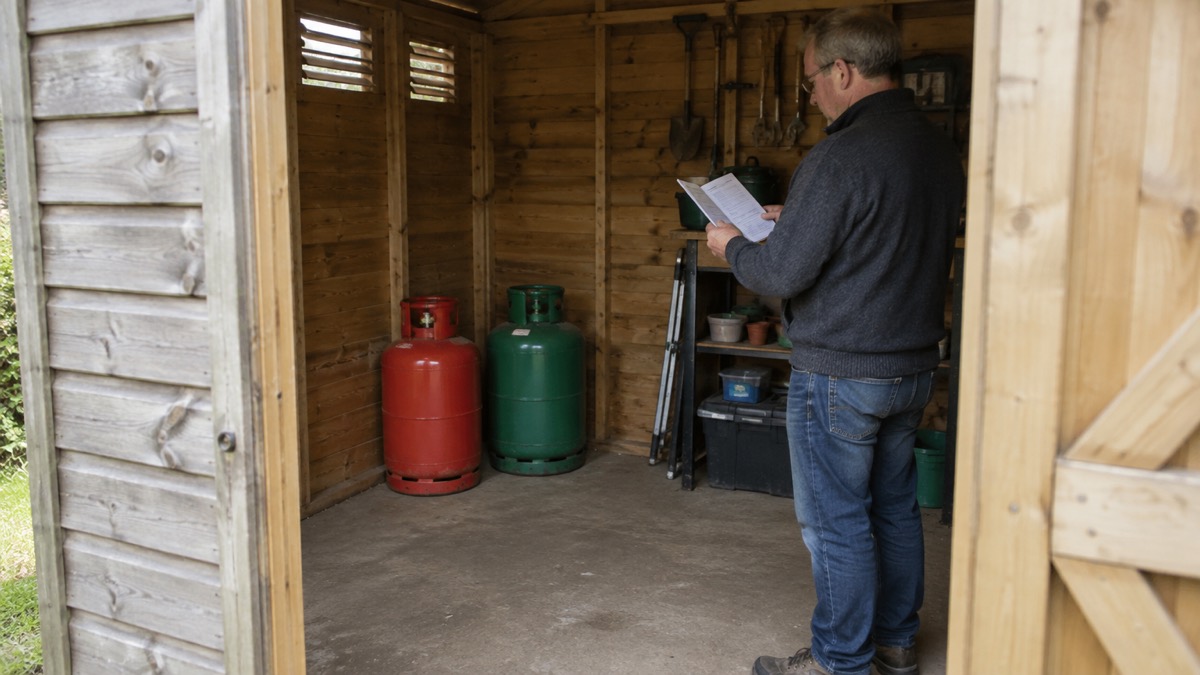
A garage or shed away from the house is generally a better home for a spare bottle than the kitchen, but it is not a free pass. The principles that apply to storing fuel containers apply here: keep them in a garage or shed away from other buildings, in a well-ventilated area, away from sources of ignition such as electrical equipment and naked flames13.
Use that as a checklist for your outbuilding:
- Away from other buildings: a detached shed is better than one built against the house.
- Well ventilated: air must move, so a sealed, airtight store is the wrong choice.
- Away from ignition: keep clear of sockets, chargers, power tools and anything with a flame or pilot light.
- Upright: every cylinder stands, whatever the store2.
- Not too many: do not keep more cylinders than you need4.
- Shaded and frost-protected: out of direct sunlight, and sheltered from hard frost4.
If your only outdoor space is a balcony, note the advice that cylinders should not be stored on balconies7. A balcony is outdoors but it is attached to the home and often above someone else's, so it fails the "away from the building" test.
Medical oxygen cylinders: store them upright
Oxygen is not a fuel, but it makes everything else burn far more readily, so its storage rules are tighter than for a propane bottle. Fire services advise avoiding storing gas cylinders in the home, and where oxygen is needed for medical use, storing cylinders upright and outside where possible9.
Where oxygen has to be kept indoors, the conditions are specific. Oxygen cylinders must be stored upright, out of direct sunlight, in a well-ventilated area that is dry and away from heat sources, and that area should not be used to store paint, oil, grease, domestic heating gases or other combustible materials5. Warwickshire Fire and Rescue Service adds that oxygen should be kept away from flammable materials such as oils, greases and aerosol cans, ignition sources and electrical devices, and away from locations prone to high temperatures14.
The same message comes from Scotland and Wales. Scottish Fire and Rescue Service says to store cylinders safely away from flammable materials15. Mid and West Wales Fire and Rescue Service says to keep oxygen equipment in a well-ventilated area, clean, dry and away from heat sources such as gas or electric fires and cookers16. Greater Manchester Fire and Rescue Service gives the same advice, adding naked flames to the list of things to avoid17.
"Oxygen cylinders must be stored in an upright position safely out of direct sunlight in a well-ventilated area that is dry and away from any heat sources."
A bedroom is a poor store: it is rarely well ventilated, and it usually contains electrical devices and soft furnishings. If you use home oxygen, keep the supply in the best-ventilated, coolest, clearest space you have, follow your supplier's instructions, and tell your fire and rescue service if you would like a home safety visit. The extra help guide covers support for medically dependent households.
Portable gas heaters and their spare cylinders
A portable gas heater heats the room it is in quickly and can be moved anywhere, but it needs its cylinder changing, and that change carries fire risk18. The safety rules cluster around the moment of changing the bottle and around the heater itself.
Change cylinders for portable heaters in a well-ventilated place, away from sources of heat and ignition7. Outdoors is best; a garage with the door open is the fallback. Only change a cylinder when it is completely empty19. Keep the heater maintained20, and have a working carbon monoxide alarm in the property6.
| Task | What to do | Why it matters |
|---|---|---|
| Storing spares | Upright, outside, shaded, frost-protected, no more than you need4 | Keeps fire risk out of the home |
| Changing a cylinder | Outdoors or well ventilated, away from heat and ignition7 | A leak at the connection has somewhere to go |
| When to change | Only when the cylinder is completely empty19 | Avoids handling a part-full bottle |
| Running the heater | Maintained, with a working CO alarm in the property20 | Catches carbon monoxide early |
| Placing the heater | Not in a small, unventilated room12 | CO concentrates faster in confined spaces |
Carbon monoxide is the danger that ties this together. It is invisible and has no smell, and smaller rooms with a fuel-burning appliance are particularly at risk12. Fit alarms in all rooms containing gas appliances or paraffin heaters21, ideally near bedrooms and living areas22, and test them weekly with your smoke alarms23. Landlords must install a carbon monoxide alarm in any room used as living accommodation that contains a fixed combustion appliance, excluding gas cookers24, and should install one in every room with a fixed combustion appliance, positioned at head height, on a wall or shelf, roughly 1 to 3 metres from the potential source24.
If you are weighing up heater types, Electric or Gas Portable Heaters and Paraffin or Bottled Gas Heaters compare them by what they do. For the changeover itself, How to Change an LPG Cylinder Safely walks through it step by step, and Using a Portable Heater Safely at Home covers placement and guards.
Cylinders for caravans, camping and boats
If your gas is for a caravan, tent or boat, the storage rules tighten because the space is small and the escape route is short. In a caravan, gas cylinders should be kept outside the caravan, turned off unless they are designed to run continuously, and changed only when completely empty19. Store cylinders six metres away from your home, even when empty8.
For camping, change gas cylinders outdoors whenever possible, or in a well-ventilated space, and store them outside, away from direct sunlight and freezing temperatures25. The same advice applies to gas barbecues: change cylinders outdoors or in a well-ventilated area, and store them outside, protected from direct sunlight and frost4. The government's fire safety outdoors guidance repeats it: store gas cylinders outside, away from direct sunlight and frost3.
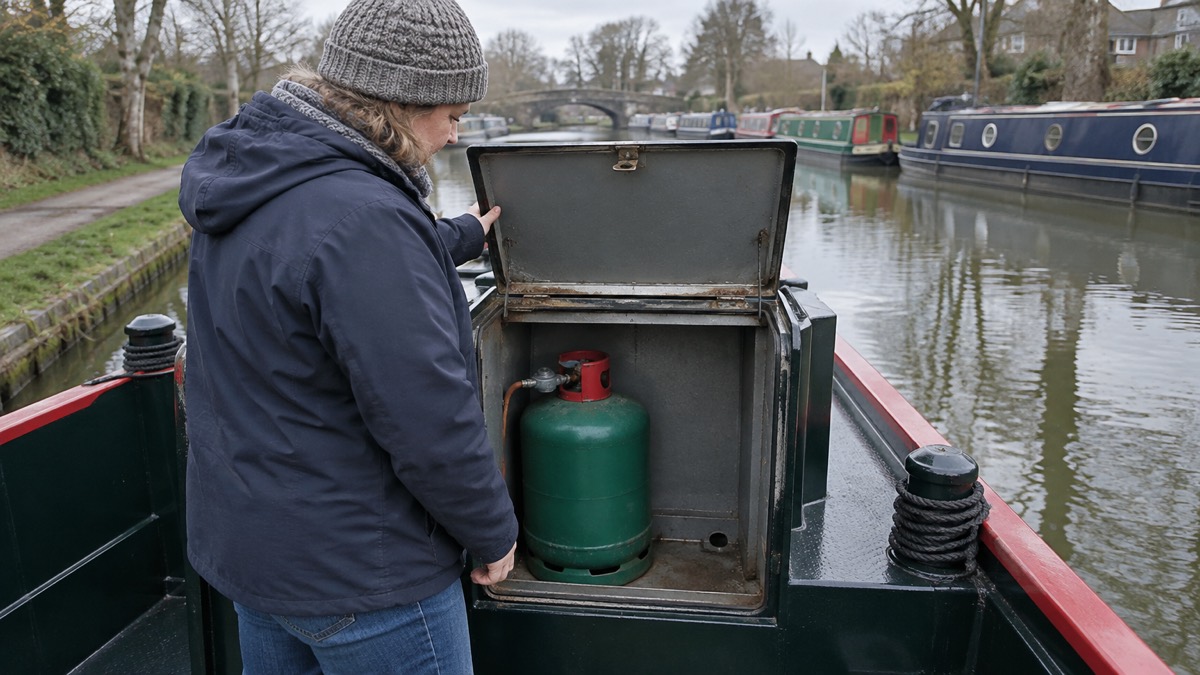
On a boat, the rule is about where leaking gas goes. Store canisters, bottles or cylinders upright, where any leaking gas will flow overboard and not into the interior, preferably in a suitable, vapour-tight, self-draining locker26. Equipment and canisters should be stowed in a self-draining gas locker, or on open deck where escaping gas can flow overboard26.
Where to get help and what to check
If you are unsure whether your storage is safe, your local fire and rescue service is the place to ask. Many offer a home fire safety visit, and they will look at heater and cylinder placement as part of it. If you use medical oxygen, tell them when you book, so the visit covers oxygen storage too.
A short check now covers most of the risk:
- Move every spare cylinder outdoors, upright, shaded and frost-protected1.
- Take cylinders out of basements, from under the stairs, and from meter cupboards2.
- Clear cardboard, refuse and other clutter from around the bottles10.
- Reduce your stock to what you actually need4.
- Check your carbon monoxide alarm works, and test it weekly23.
- If you have oxygen at home, move it to a well-ventilated, cool, clear space away from oils, greases and electrical devices14.
For the wider picture, the heating and cooking section covers staying warm and cooking without mains power, and the gas and heating failures guide explains what to do when the supply itself fails. If you are stocking up before winter, the before-winter checklist puts the heating checks in order.
Sources (26)
- Portable heaters, Greater Manchester Fire and Rescue Service, 2026-10-29
- Portable heaters, Mid and West Wales Fire and Rescue Service, 2026-10-29
- Fire safety outdoors, GOV.UK, 2022-05-25
- Storing fuel, Dorset and Wiltshire Fire and Rescue Service, 2026
- Specialist health equipment, Dorset and Wiltshire Fire and Rescue Service, 2026
- Heaters, Dorset and Wiltshire Fire and Rescue Service, 2026
- Heating your home, North Yorkshire Fire and Rescue Service, 2026-03-09
- Caravans and mobile homes, Dorset and Wiltshire Fire and Rescue Service, 2026
- Hoarding, Cheshire Fire and Rescue Service, 2026-05-20
- Advice if you live above or below a commercial premises, Dorset and Wiltshire Fire and Rescue Service, 2024-06-20
- Home fire safety tips, Warwickshire County Council, 2026-10-29
- The invisible danger of carbon monoxide, Wiltshire and Swindon Prepared, 2025-11
- Domestic and non-workplace storage, Greater Manchester Fire and Rescue Service, 2026-10-29
- Fire safety using medication and medical equipment, Warwickshire County Council, 2026-10-29
- Medical oxygen, Scottish Fire and Rescue Service, 2026-10-28
- Specialist health equipment, Mid and West Wales Fire and Rescue Service, 2026-10-29
- Home oxygen, Greater Manchester Fire and Rescue Service, 2026-10-29
- Heater safety, Dorset and Wiltshire Fire and Rescue Service, 2024-11-20
- Caravan safety, Lincolnshire County Council, 2026-10-29
- Snow buddies, Derbyshire County Council, 2026-10-29
- Fire safety for carers, Dorset and Wiltshire Fire and Rescue Service, 2026
- Safe home heating, Warwickshire County Council, 2026-10-29
- Smoke alarms and carbon monoxide detectors, Surrey County Council, 2026-08-24
- Housing standards, Cherwell District Council, 2026-10-29
- Camping safety, Cheshire Fire and Rescue Service, 2025-07-26
- Fire risk on boats, Dorset and Wiltshire Fire and Rescue Service, 2022-05-24
 Before-Winter Heating Checks
 Backup Stove Kit Checklist
 Wood Burner Lighting Kit
 Heating a Home with the Oven
 Paraffin Heater Indoors
 Changing an LPG Cylinder Safely
 Wood You Should Never Burn
 Disposing of Ashes Safely
 Open Fire in an Unused Chimney
 Oil Tank Leaks After a Storm
 Trangia Spirit Burner Fuel