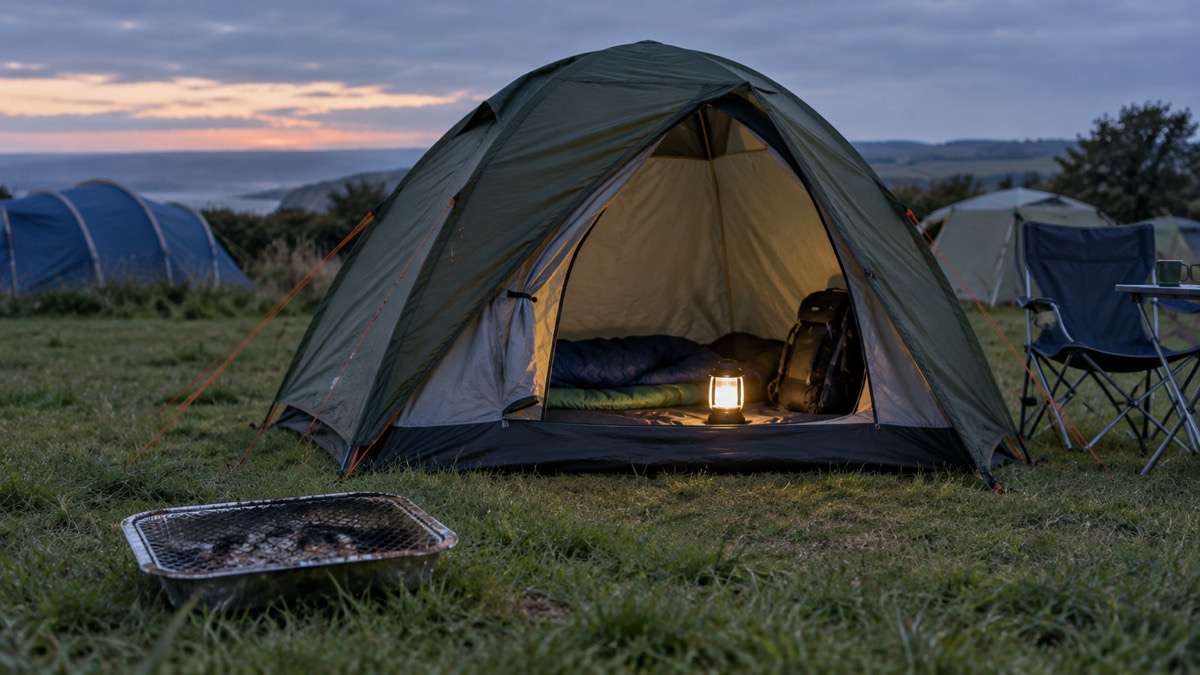
If you are sheltering or holidaying in a tent, caravan, campervan or motorhome, the single most important rule is this: never take a barbecue, camping stove, gas heater or lantern inside it. Cumbria Fire and Rescue Service are direct about it: never take a smouldering or lit barbecue into a tent, caravan or cabin, even if you have finished cooking, and never take a gas stove, light or heater into a tent, caravan or cabin unless it is a permanent fixture, installed and maintained correctly1. Devon and Somerset Fire and Rescue Service add that the carbon monoxide these devices produce can kill, and the heat they produce will set the tent on fire2.
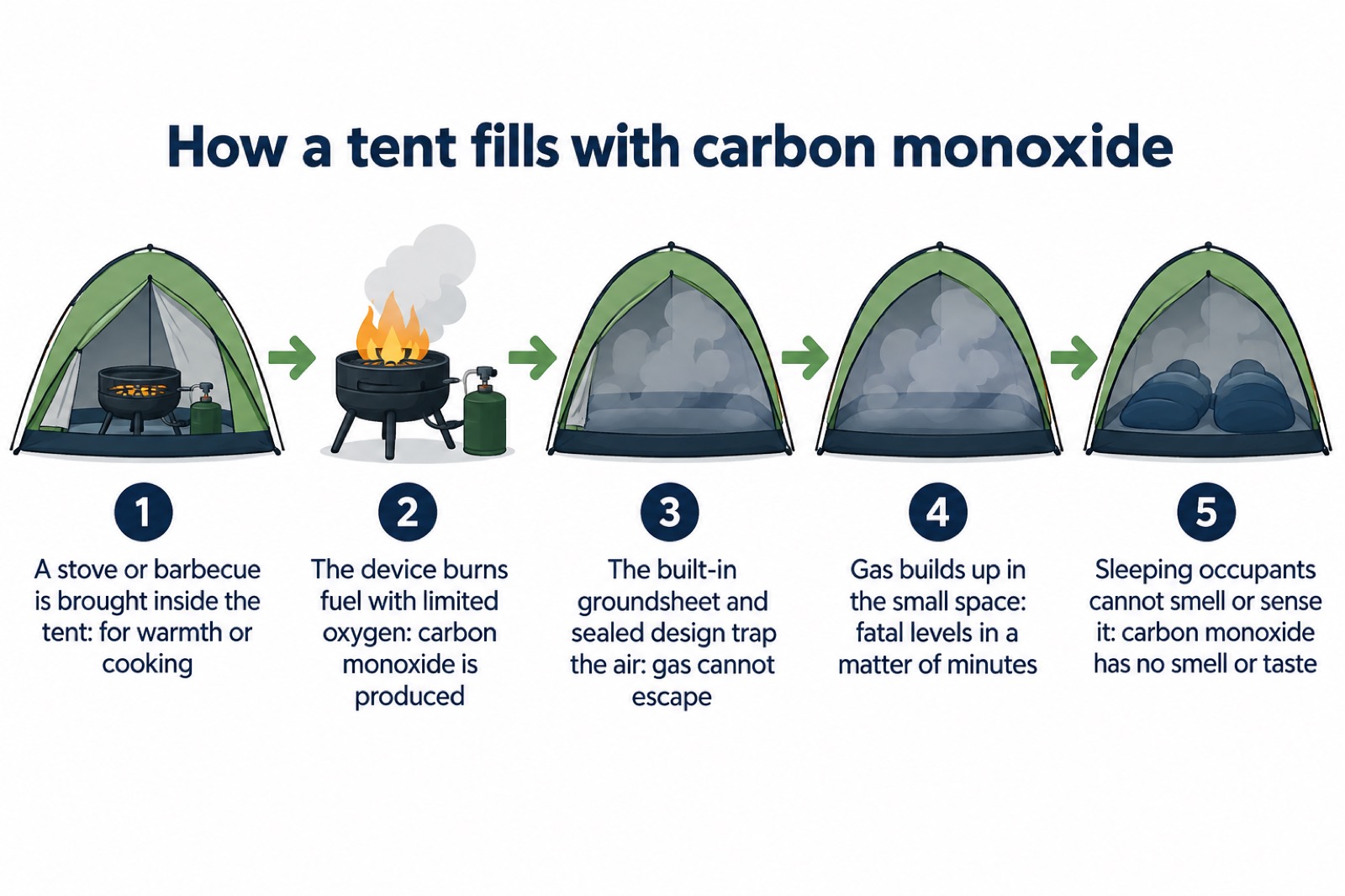
The reason is simple and unforgiving. Carbon monoxide has no smell and no taste, and in the small, sealed space of a modern tent it can build up to fatal levels in a matter of minutes2. A fire can destroy a tent in about 60 seconds2. Cheshire Fire and Rescue Service list the devices involved: disposable barbecues, camping stoves, camping heaters, lanterns and charcoal grills, and their advice is that none of them should ever be used inside a tent, camper or other enclosed shelter3.
This page sets out what fire and rescue services and health bodies across the UK advise: what never to bring inside, how to cook safely outside, what gas equipment is acceptable in a caravan, why ventilation matters, what alarms can and cannot do, and how to recognise carbon monoxide poisoning if it happens anyway.
Never take a barbecue, stove or heater into a tent, caravan or awning
Every fire and rescue service that publishes advice on camping says the same thing, in almost the same words. Wiltshire and Swindon Prepared put it plainly: never take portable or disposable barbecues, grills or charcoal fuel burners into your home or any confined space such as a tent, houseboat or caravan6. Humberside Fire and Rescue Service extend the warning to awnings and motorhomes, and note that even a cooling barbecue gives off plenty of poisonous carbon monoxide, which can kill4. Dorset and Wiltshire Fire and Rescue Service add the detail people most often get wrong: never use barbecues inside or near the entrance to your tent or caravan, either for cooking or as a heat source7.
The rule covers the whole life of the fire, not just the cooking. A barbecue that looks cold is not cold. Devon and Somerset Fire and Rescue Service warn that when barbecues cool, they release carbon monoxide, which can be deadly, and tell you not to put the barbecue or burnt charcoal in your car or tent8. Wiltshire and Swindon Prepared make the same point: even if you have put out the fire, leave the barbecue outside and well away from the building, tent or caravan you are staying in6.
The same applies during a power cut at home, which is when households are most tempted to reach for camping equipment. Dorset and Wiltshire Fire and Rescue Service state that you should never use a camping stove, portable barbecue, lit charcoal or generator in an enclosed space, because they are designed for outdoor use only and can produce poisonous carbon monoxide9. If you are considering a camping stove as a backup cooker at home, read our page on camping stoves for a power cut and on whether it is safe to use a camping stove indoors, and see our guide to barbecues in an emergency.
Why carbon monoxide builds up so fast in tents and caravans
Carbon monoxide is produced whenever a fuel burns without enough oxygen: charcoal, gas, paraffin, petrol. The NHS lists the causes that matter here, including using barbecues or camping stoves inside, and turning on vehicle or lawn mower engines in an enclosed space5. Public Health guidance on gov.uk notes that in indoor environments, oil, gas or kerosene heaters and faulty gas appliances produce significant amounts, and that barbecues and portable generators used inside homes, caravans and tents are examples of the indoor environments where people are exposed10.
Two things make tents and caravans unusually dangerous. The first is size. Dorset and Wiltshire Fire and Rescue Service explain that the confined spaces of a caravan or mobile home make the risk of suffering carbon monoxide poisoning far greater11, and nidirect in Northern Ireland notes that the risk of exposure from portable devices may also be higher in caravans, boats and mobile homes12. A small volume of air fills with gas quickly, and a sleeping person cannot notice it happening.
The second is design. Devon and Somerset Fire and Rescue Service point out that modern tents have an integral structure with built-in groundsheets, which means carbon monoxide gas can rise to fatal levels in a matter of minutes if you use a barbecue inside one2. The built-in groundsheet that keeps you dry and warm also traps the air, and with it any gas a stove or barbecue gives off.
The most common mistake is trying to keep warm. The Health and Safety Executive for Northern Ireland note that carbon monoxide poisoning occurs when people bring gas and charcoal barbecues into tents and other small enclosed spaces, sometimes in an attempt to keep warm13, and nidirect report that carbon monoxide has been linked to deaths where people did exactly that14. A cold evening, a warm-looking barbecue and a sealed tent are a combination fire and rescue services warn about every summer.
Opening up does not fix it. Cheshire Fire and Rescue Service state that opening doors and windows, and tent flaps, is insufficient to prevent a build-up of carbon monoxide concentrations from these devices15. That is the fact that catches most people out: the instinct is that a bit of fresh air makes it safe, and it does not.
Cooking safely outside the tent
Cooking on a campsite is safe when the cooker stays outside, in the open, well away from the tent. Cheshire Fire and Rescue Service advise that when using fuel-burning devices outdoors, the exhaust should not vent into enclosed shelters16, so site your stove where the fumes drift away from the tent, the awning and anyone sleeping. Devon and Somerset Fire and Rescue Service are blunter still: do not use barbecues or stoves inside your tent or caravan2, and Oxfordshire's wildfire prevention advice adds that you should never use barbecues or gas stoves inside tents, awnings, caravans or mobile homes, and should check gas and electrical equipment, including hobs, heaters and gas bottles, before use, making sure connections are secure and undamaged17.
A workable routine, drawn from the official advice:
- Set the stove or barbecue up outside, in the open, away from the tent entrance, awning and guy lines7.
- Check the appliance, its hoses and its connections before every use; if a hose looks damaged, get it replaced or do not use the appliance1.
- Keep the exhaust pointing away from any enclosed space16.
- Never leave cooking unattended2.
- When you finish, leave the barbecue outside and well away from where anyone is sleeping, and only dispose of it once all fire and ashes are completely extinguished1.
Keep lighting safe too. Dorset and Wiltshire Fire and Rescue Service say never to use candles in or near the tent, because torches are safer7. A head torch or battery lantern gives steady light with no flame and no fumes, and it cannot set fire to fabric. Our guide to emergency lighting at home covers the torch and lantern options that suit a tent as well as a house.
If you are choosing a stove for camping or for a power cut, our pages on gas cartridge stoves, gas cartridges and valve types and bottled gas, butane and propane explain the differences and what each is for.
Gas stoves and heaters in caravans: only fixed, maintained appliances
A caravan is different from a tent, because a caravan can legally and safely contain gas appliances, but only the right kind. Cumbria Fire and Rescue Service draw the line clearly: never take a gas stove, light or heater into a caravan unless it is a permanent fixture, installed and maintained correctly1. nidirect give the same advice for Northern Ireland14. A portable gas heater carried into a caravan bedroom, or a camping stove stood on the caravan table, falls on the wrong side of that line.
The reason is that faulty gas cookers, appliances and petrol-powered generators have led to carbon monoxide poisoning and deaths in holiday homes, caravans and boats1. Warwickshire County Council's carbon monoxide guidance identifies the underlying causes: poor or improper installation or use of appliances, such as cooking and heating devices18. Lincolnshire Fire and Rescue add that portable heaters using liquid petroleum gas are among the sources of carbon monoxide19. A properly installed, regularly serviced fixed appliance with a sound flue is a different proposition from a portable device sat on a worktop.
So the practical rules for a caravan are:
- Use only appliances that are permanent fixtures, installed and maintained correctly1.
- Read the manufacturer's instructions for every appliance14.
- Check gas equipment, including hobs, heaters and gas bottles, before use, and make sure connections are secure and undamaged17.
- Never leave cooking unattended, and keep pan handles out of children's reach2.
- Do not use stoves or barbecues inside, or too close to, your caravan20.
If you smell gas in a caravan, treat it seriously. Mid and West Wales Fire and Rescue Service warn that if leaking gas builds up in a caravan with blocked vents, you may fall unconscious and be unable to escape21. Turn off the appliance and the gas supply at the bottle if you can do so safely, get everyone out, and ventilate the space before investigating. Our page on how to change an LPG cylinder safely and our guide to where to store gas cylinders cover the handling side.
Ventilation: never block a caravan's air vents
Caravan air vents look like an inconvenience, especially on a cold night, but they are there to stop a build-up of lethal gas. Humberside Fire and Rescue Service state it directly: never block air vents, as they are essential for preventing a build-up of lethal carbon monoxide gas4. Lincolnshire Fire and Rescue go further: if leaking gas builds up you may fall unconscious and be unable to escape, and if air vents get blocked, it could be fatal22.
North Yorkshire Fire and Rescue Service advise always making sure the caravan is ventilated and never blocking air vents, to avoid the build-up of poisonous gases such as carbon monoxide23. Devon and Somerset Fire and Rescue Service say the same: make sure the caravan is well ventilated to avoid a build-up of poisonous gases, and never block air vents2. The Fire and Rescue Service in Northern Ireland's summer safety advice is to fit a carbon monoxide detector and keep air vents clear24.
In practice, before your first night in any caravan:
- Walk round the outside and find every vent, high and low.
- Check none is covered by an awning, a storage box, a bag or bedding pushed against the wall inside.
- Keep them open overnight, however cold it feels, and add bedding or clothing rather than sealing the caravan up.
- If you use an awning, make sure it does not sit against or over a vent4.
For keeping warm without sealing the space, see our guides on clothing and bedding to stay warm, hot water bottles and keeping one room warm, whose principles apply to a caravan as much as to a house.
A carbon monoxide alarm helps in a caravan but will not protect you in a tent
A carbon monoxide alarm is strongly advised in a caravan, motorhome or boat. nidirect tell you to install an audible carbon monoxide alarm in your caravan, holiday home or boat14. North Yorkshire Fire and Rescue Service say always to make sure you have a working carbon monoxide alarm in your caravan23. Humberside Fire and Rescue Service ask you to ensure there is a smoke and carbon monoxide alarm in place and that they are tested regularly4, and the Northern Ireland Fire and Rescue Service say to make sure you have both a working smoke alarm and carbon monoxide alarm, especially if you are planning to cook whilst on holiday24.
In a tent, the position is different, and it is worth being clear about why. Devon and Somerset Fire and Rescue Service state: "Don't rely on a carbon monoxide detector to keep you safe in a tent or awning. They are useful at home, in a caravan or in a motorhome, but they are not designed for the conditions found in a tent or awning."2
"Don't rely on a carbon monoxide detector to keep you safe in a tent or awning. They are useful at home, in a caravan or in a motorhome, but they are not designed for the conditions found in a tent or awning."
The alarm is not a licence to bend the rules in a caravan either. It is a last line of defence for a fixed, maintained appliance that develops a fault, not a reason to run a portable stove indoors. nidirect note that the risk of exposure from portable devices is higher in caravans, boats and mobile homes12, and an alarm does not reduce that risk; not bringing the device inside does.
| Where you are staying | Is a CO alarm advised? | Will it protect you? |
|---|---|---|
| Caravan, motorhome, campervan | Yes, fit one and test it regularly4 | Yes, as a defence against a faulty fixed appliance |
| Tent or awning | You may carry one, but do not rely on it2 | No, it is not designed for tent conditions2 |
| Holiday let or boat | Yes, take a portable alarm with you14 | Yes, and incidents have occurred in both25 |
A fire can destroy a tent in about a minute
The fire risk is as serious as the gas risk, and it moves faster than most people expect. Devon and Somerset Fire and Rescue Service state that a fire can destroy a tent in 60 seconds2. North Yorkshire Fire and Rescue Service say less than 60 seconds23, Dorset and Wiltshire say just a minute7, and the Northern Ireland Fire and Rescue Service say 60 seconds, adding that it is essential you have an escape plan and are prepared to cut your way out26. Devon and Somerset also caution that even fire retardant tents burn quickly2.
That speed changes what you do. There is no time to gather belongings, and possibly no time to find the door, so the Northern Ireland Fire and Rescue Service advice to be prepared to cut your way out is practical, not dramatic26. Before your first night:
- Know where the door is from your sleeping position, in the dark.
- Keep a knife or multi-tool where you can reach it without leaving your sleeping bag.
- Keep the exit route clear of bags, boots and bedding.
- Keep cooking and any flame well away from the tent7.
- Never use candles in or near the tent; torches are safer7.
The Northern Ireland Fire and Rescue Service also warn that as well as the fire risk, cooking can potentially produce carbon monoxide, so cooking appliances should never be used inside a tent26. Fire and fumes come from the same decision, and the decision is always the same one: keep the cooking outside.
Caravan fire safety: alarms, extinguisher and an escape plan
A caravan gives you more time than a tent, but not much, and the same three preparations apply: alarms, an extinguisher and an escape plan. Mid and West Wales Fire and Rescue Service recommend a specific kit list for caravans: a fire blanket, a smoke alarm and a dry powder extinguisher21. Devon and Somerset Fire and Rescue Service advise keeping a fire extinguisher by the entrance to your caravan, but reading the instructions before using it2, and their guidance is that smoke alarms should be fitted in caravans, with a dry powder extinguisher kept close to the door27.
What to have ready in a caravan:
- A smoke alarm, fitted and tested regularly4.
- A carbon monoxide alarm, fitted and tested regularly4.
- A fire blanket, kept where you can reach it while cooking21.
- A dry powder extinguisher, kept close to the door, with the instructions read before you need it2.
- An escape plan that everyone on board knows26.
Two rules protect the people as well as the property. Lincolnshire Fire and Rescue state that children should never be left alone in a caravan22, and Mid and West Wales Fire and Rescue Service say the same in their caravan safety guidance27. Devon and Wiltshire advice adds the kitchen discipline: never leave cooking unattended, and keep pan handles out of children's reach2.
If a fire does start, get everyone out first, stay out, and call 999. An extinguisher is for a small, contained fire on your way out, not for staying inside to fight one. Our guide to home emergencies, fire and carbon monoxide covers the same principles for a house.
Checking gas camping equipment before you use it
Most gas accidents on campsites trace back to equipment that was damaged, wrongly connected or past its best, and the checks are quick. Cumbria Fire and Rescue Service advise checking that the appliance is in good order and undamaged, and that hoses are properly attached and undamaged; if in doubt, get the hoses replaced or do not use it1. nidirect add the step people skip: read the manufacturer's instructions14. Oxfordshire's advice for campsite visitors is to check gas and electrical equipment, including hobs, heaters and gas bottles, before use, and to make sure connections are secure and undamaged17.
A pre-trip and first-use checklist:
- Read the manufacturer's instructions for the appliance14.
- Inspect the appliance body for dents, corrosion and damage1.
- Inspect every hose for cracks, perishing and secure attachment at both ends1.
- Check the connections between bottle, regulator and appliance17.
- If anything looks wrong, replace the hose or leave the appliance unused1.
It is also worth checking whether any of your cooking equipment has been recalled. On 25 March 2024 the Office for Product Safety and Standards notified a recall of MSR Trail Lite and Reactor camping cooking pots, a variety of cooking pots and stoves designed for camping and sold individually and as part of sets, because pot handles can come loose or disengage and spill hot contents, presenting a risk of burns28. If you own MSR pots, check the recall notice on gov.uk and stop using any affected item.
Recognising carbon monoxide poisoning and what to do
Carbon monoxide has no smell and no taste, so the symptoms are the warning. The NHS list them: a headache, dizziness, feeling sick or being sick, feeling weak, tiredness and confusion, chest and muscle pain, shortness of breath, your face turning hot and red (flushing), and loss of vision5. NHS 111 Wales give the same list and the same core advice for suspected exposure: go outside29. Sheffield's NHS stop smoking service, which uses carbon monoxide monitoring routinely, gives the same immediate instruction: go outside30.
If you or anyone with you has these symptoms while camping or caravanning:
- Get everyone outside into fresh air immediately29.
- Seek medical help; the NHS advises getting medical attention for suspected carbon monoxide poisoning5.
- Do not go back inside, and do not use the appliance again, until it has been checked1.
- If someone is unconscious or seriously unwell, call 999.
A useful tell is that carbon monoxide tends to affect several people, and pets, at once, and that symptoms ease in fresh air and return indoors. nidirect note that incidents and fatalities occur in holiday homes, caravans and on board boats, where faulty gas cookers, appliances or petrol-powered generators have led to carbon monoxide poisoning25, so the same vigilance applies to a rented holiday let or a boat as to your own caravan. Staffordshire Fire and Rescue Service highlight the dangers of carbon monoxide from barbecues in enclosed spaces such as tents, awnings and caravans31, and Manchester Fire and Rescue Service summarise the rule that covers all of it: camping and barbecue equipment should only be used outdoors, because inside they are a carbon monoxide and fire risk32.
For the wider picture of cooking and heating when mains power or gas fails, see our heating and cooking guide, and for the broader household preparations, our getting started page and emergency kit guide.
Sources (32)
- Safety Outdoors, Cumbria Fire and Rescue Service
- Camping and Caravanning Safety, Devon and Somerset Fire and Rescue Service
- Barbecue Safety, Cheshire Fire and Rescue Service, 2026-05-20
- Caravan, Motor Home, Campervan and Tent Safety, Humberside Fire and Rescue Service, 2026-10-29
- Carbon Monoxide Poisoning, NHS, 2025-12-16
- Carbon Monoxide: The Silent Killer, Wiltshire and Swindon Prepared, 2026-10-25
- Camping and Caravanning, Dorset and Wiltshire Fire and Rescue Service, 2025-06-20
- Barbecues, Devon and Somerset Fire and Rescue Service, 2026
- Power Cuts, Dorset and Wiltshire Fire and Rescue Service, 2023-11-30
- Carbon Monoxide: General Information, UK Government, 2022-05-24
- Caravans and Mobile Homes, Dorset and Wiltshire Fire and Rescue Service, 2025-06-20
- Carbon Monoxide Poisoning, nidirect, 2024-12-16
- Carbon Monoxide, Health and Safety Executive for Northern Ireland, 2026
- Carbon Monoxide Dangers if Camping, Caravanning or Boating, nidirect, 2026-04-02
- Caravan Safety, Cheshire Fire and Rescue Service, 2025-07-26
- Camping Safety, Cheshire Fire and Rescue Service, 2025-07-26
- Help Prevent Wildfires, Oxfordshire County Council, 2026
- Carbon Monoxide Awareness, Warwickshire County Council, 2026-10-29
- Fire Alarms and Carbon Monoxide Detectors, Lincolnshire Fire and Rescue, 2026-10-29
- Caravans and Mobile Homes, Devon and Somerset Fire and Rescue Service, 2026
- Caravan Safety Advice, Mid and West Wales Fire and Rescue Service, 2026-10-29
- Caravan Safety, Lincolnshire Fire and Rescue, 2026-10-29
- Caravans and Camping, North Yorkshire Fire and Rescue Service, 2026-05-13
- Simple Steps to Stay Safe This Summer, Northern Ireland Fire and Rescue Service, 2025-06-23
- Gas Safety and Carbon Monoxide, nidirect, 2025-11-24
- Appeal: Simple Steps to Keep You Safe This Summer, Northern Ireland Fire and Rescue Service, 2022-06-24
- Cyngor ar Ddiogelwch Carafanau, Mid and West Wales Fire and Rescue Service, 2026-10-29
- Product Recall: MSR Trail Lite and Reactor Camping Cooking Pots (2402-0314), Office for Product Safety and Standards, 2024-03-25
- Carbon Monoxide Poisoning, NHS 111 Wales, 2025-10-02
- Carbon Monoxide Information, Sheffield Yorkshire Smokefree NHS Service
- Carbon Monoxide Awareness, Staffordshire Fire and Rescue Service, 2026-10-29
- Stay Fire Safe, Manchester Fire and Rescue Service, 2026-10-29
 Before-Winter Heating Checks
 Backup Stove Kit Checklist
 Wood Burner Lighting Kit
 Keeping One Room Warm
 Clothing and Bedding for Cold
 Stopping Draughts
 Hot Water Bottle Safety
 Wheat Bags and Fire Risk
 Electric Blanket Safety
 Portable Heater Types
 Portable Heater Safety
 Wood Burners in a Power Cut
 Using a Wood Burner Safely
 Open Fires and Fire Guards
 Firewood and Seasoning Logs