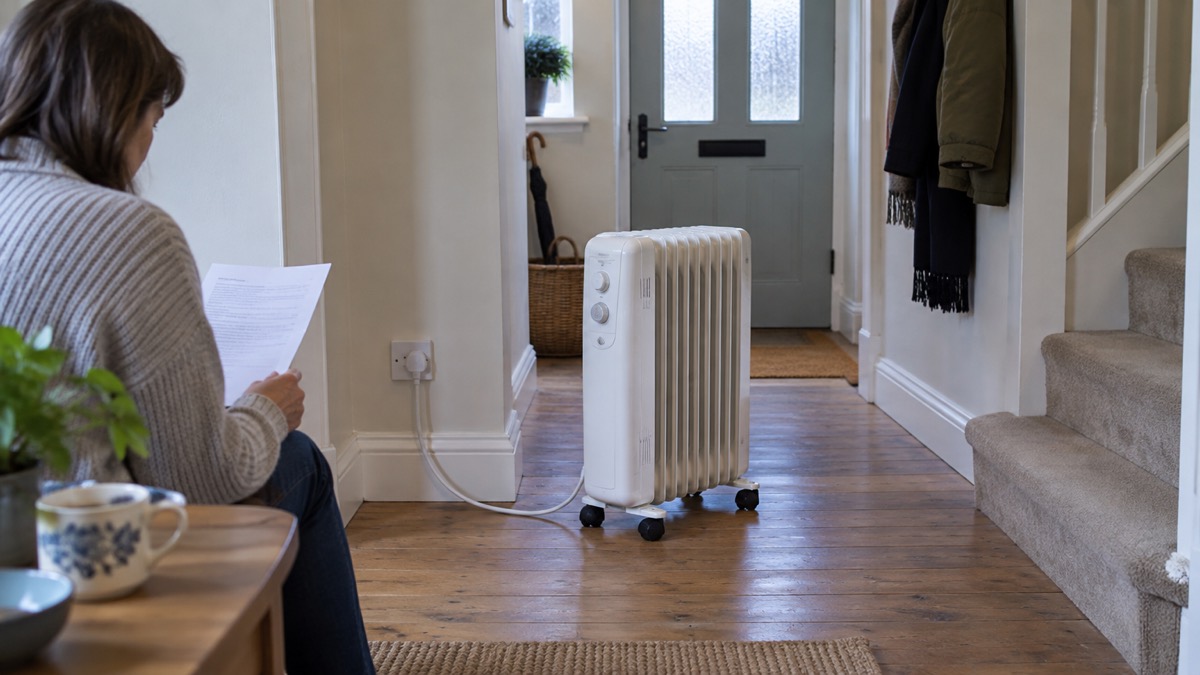
A portable heater is any heating appliance that is not fixed in place: an electric fan heater or oil-filled radiator you can carry, a cabinet heater running on a bottled gas cylinder, or a paraffin heater1. Used well, they are a practical way to warm one room when the central heating fails or you want to heat only where you are. Used carelessly, they are one of the most common causes of house fires, and Warwickshire County Council's fire safety guidance states plainly that portable heaters start fires in England every day2. Across the UK, more than 100 people die and nearly 1,000 are injured each year in fires caused by heaters3.
The good news is that almost every one of those fires follows a pattern fire and rescue services see again and again: sitting too close to the heater, placing it near curtains and furniture, or using it to dry washing4. That means the risk is largely in how the heater is used, not in the heater itself. This page sets out what fire and rescue services across England, Scotland, Wales and Northern Ireland advise: where to put the heater, what safety features to look for, why it must go into a wall socket rather than an extension lead, how to handle gas and paraffin models, and what to do if a heater does catch fire.
If you are still deciding which type of heater suits your home, our page on portable heater types compares electric, gas and paraffin models side by side, and electric or gas portable heaters weighs the two most common choices.
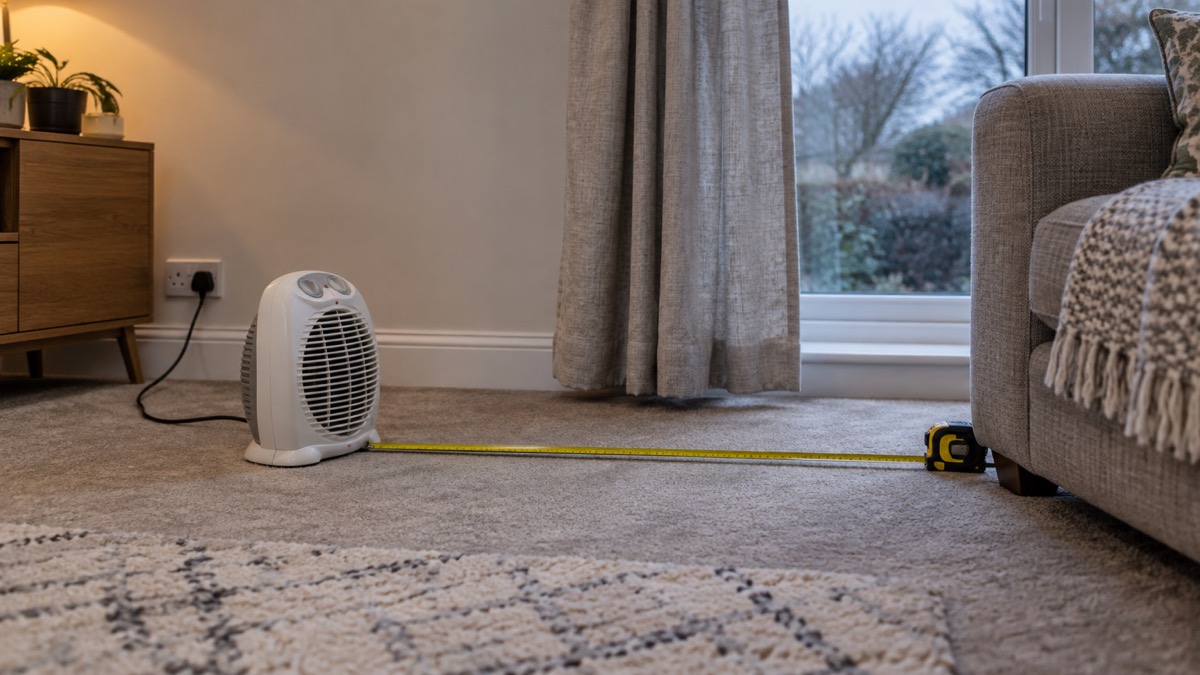
Keep the heater at least one metre from anything that can burn
The single most important rule is distance. Lincolnshire County Council's home fire safety advice says do not sit too close to a portable heater and keep it at least 1 metre away5. The London Fire Brigade's winter guide says the same for the things around it: keep heaters, including portable ones, at least one metre away from anything that could catch alight6. Warwickshire County Council expresses the same distance as three feet from flammable materials such as curtains, furniture, bedding or clothing2. The two figures are the same clearance, and every fire and rescue service that publishes guidance repeats it.
Where exactly you put the heater matters as much as the metre itself. Place it on a flat, stable surface, and put it somewhere it is unlikely to get knocked over, away from walkways and doorways, and not obstructed by other objects2. Devon and Somerset Fire and Rescue Service also advises trying to secure a portable heater against a wall to stop it falling over12. A heater standing in the middle of a thoroughfare is a heater waiting to be toppled by a passing child, a dog or a vacuum cleaner.
Never use a heater to dry clothes. Devon and Somerset Fire and Rescue Service's home safety guidance is direct about the cause of most heater fires:
"Most fires started by heaters are caused by sitting too close to them, placing them near curtains and furniture, or using them to dry washing."
A pair of jeans draped over the guard of a fan heater can reach ignition temperature in minutes, and the same applies to towels hung over an oil-filled radiator to dry. If you need to dry washing in a cold house, use an airer in a heated room with the heater a metre away from it, not on it.
Choosing a heater with a guard, tip-over and overheating protection
If you are buying a heater, or assessing one you already own, look for three things. First, a safety guard: Derbyshire County Council's keeping warm in winter guidance says to check portable heaters have a safety guard, and not to place them near furniture, beds or curtains13. The guard is the mesh or cage between the heating element and the room, and it is what stops bedding, clothing and fingers making contact with the hot surface.
Second, look for tip-over and overheating protection. Warwickshire County Council advises choosing portable heaters with these essential safety features, which switch the device off automatically if the hazard is sensed2. A heater that cuts out when it falls over, or when its air inlet is blocked, removes the two fastest routes to a fire. Third, buy from a reputable retailer and check the heater conforms to safety standards, which is the Northern Ireland Fire and Rescue Service's advice14. A cheap heater from an unknown seller may have none of the cut-outs described above, and recalls of heaters sold through online marketplaces, covered later on this page, show why this matters.
| Safety feature | What it does |
|---|---|
| Tip-over protection | Switches the heater off automatically if it falls or senses the hazard2 |
| Overheating protection | Switches the heater off automatically if it gets too hot2 |
| Safety guard | Keeps the heater's hot surfaces separated from furniture, beds and curtains13 |
| Secured against a wall | Stops the heater being knocked over or falling12 |
If you already own an older heater without these features, you can still reduce the risk: secure it against a wall, keep it a metre from everything, and never leave it unattended. But if you are buying new, the features above are what separate a safe heater from a hazardous one, and they cost little compared with the alternative.
Plug it into a wall socket, never an extension lead
Every fire and rescue service that has published on this point gives the same instruction, and it is worth understanding why. North Yorkshire Fire and Rescue Service: plug electric heaters into a wall socket, not an extension lead, because extension leads can easily be overloaded and cause fires7. Manchester Fire and Rescue Service: electric heaters should be plugged into a wall socket, and you should not use an extension lead, as they can be overloaded and cause fires15. Armagh City, Banbridge and Craigavon Borough Council, writing on heaters and generators, adds the mechanism: heaters draw a lot of power and can cause cords to overheat, leading to fires, so plug directly into a wall outlet and do not use extension cords or power strips16.
An extension lead is designed to share one socket between several low-power devices: a lamp, a phone charger, a router. A heater is not a low-power device. Plug a heater into a four-way extension along with anything else, or into a long coiled reel of cable, and the wiring in that lead can heat up just as the element does. Manchester Fire and Rescue Service's winter campaign puts it in five words: never power a heater from an extension lead17.
The same principle extends to anything that produces heat. Devon and Somerset Fire and Rescue Service recommends that anything which produces a form of heat, such as a toaster, air fryer or kettle, should have its own wall socket, not an extension lead18. And the Northern Ireland Fire and Rescue Service has urged households not to overload plug sockets and to plug high-powered appliances such as electric heaters directly into a wall socket19.
Two further checks complete the picture:
- Check the wall socket itself is in good condition and can handle the heater's power requirements, as Warwickshire County Council advises2.
- Unplug the heater when it is not in use, which the Northern Ireland Fire and Rescue Service recommends alongside plugging directly into a socket14.
If your problem is that the socket is in the wrong place for where the heater needs to stand, the answer is to move the heater to the socket, not the socket to the heater. Never solve it with a longer lead. Our page on backup power at home covers extension lead capacity in more detail if you want to understand the arithmetic.
Portable gas heaters: ventilation, carbon monoxide and changing cylinders
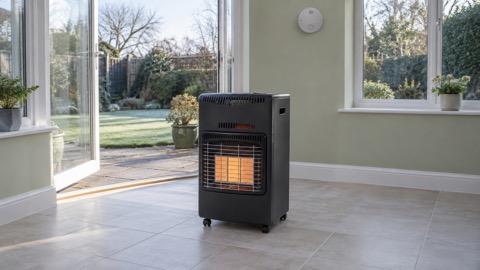
Portable gas heaters run on Liquefied Petroleum Gas (LPG), such as butane or propane, supplied in cylinders1. They can be moved anywhere and heat the room they are in quickly, as Devon and Somerset Fire and Rescue Service notes, but they require you to change the gas cylinders, which the service describes as a hassle that also poses fire risks11. Used properly, with ventilation and a carbon monoxide alarm, they are a workable way to heat a room during a power cut or a heating failure. Used carelessly, they carry two distinct dangers: fire from leaking gas, and carbon monoxide poisoning from burning the fuel in a sealed room.
Ventilation. North Yorkshire Fire and Rescue Service is categorical: portable gas heaters must not be used in bedrooms and should only be used in well ventilated rooms7. The Northern Ireland Fire and Rescue Service likewise says to ensure good ventilation in the room where the heater is being used14. Public health advice prepared for a national power outage makes the same point for gas bottle heaters approved for indoor use: make sure the room is well ventilated and follow all instructions carefully, as the fumes can be dangerous9.
Carbon monoxide. Using gas heaters carries the risk of carbon monoxide poisoning, so Devon and Somerset Fire and Rescue Service says you should have a carbon monoxide alarm in the same room as the heater11. The Fire Kills campaign likewise advises installing a carbon monoxide alarm near gas appliances8. Carbon monoxide has no smell and no taste, and it is the reason ventilation is not optional. Our page on home emergencies covers the symptoms of carbon monoxide poisoning and what to do about them.
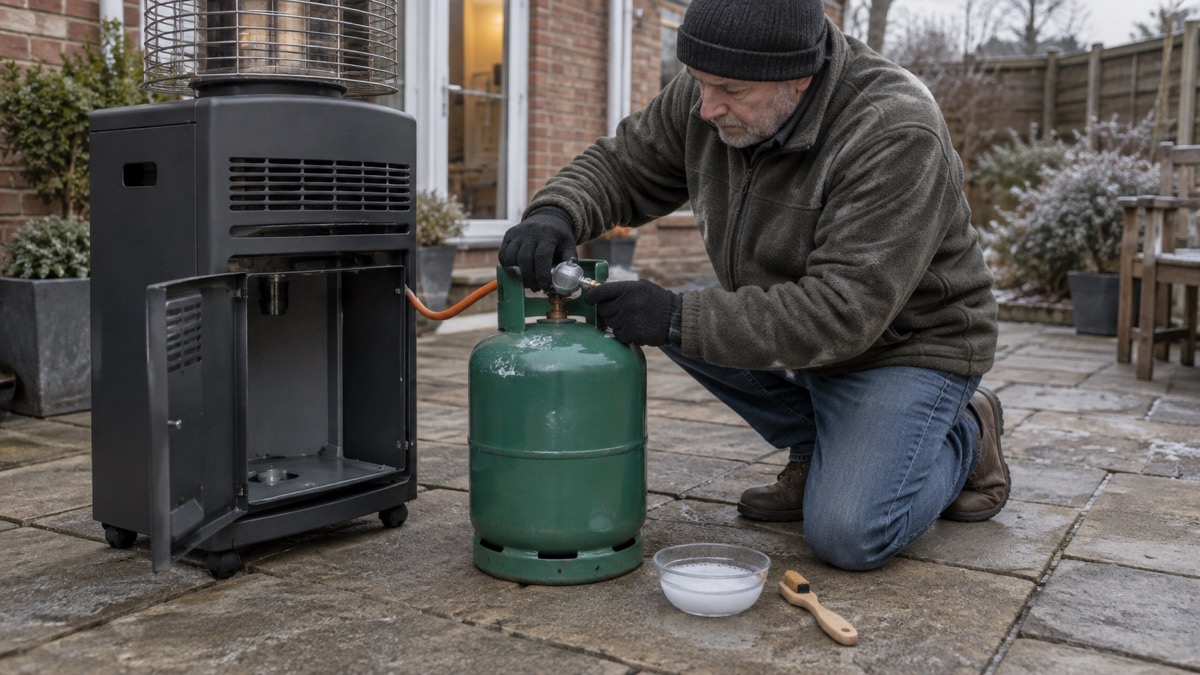
Changing cylinders. This is where gas heater accidents actually happen. The Scottish Fire and Rescue Service states that accidents from portable gas heaters happen due to gas leaks during appliance assembly or cylinder or cartridge changes20. So treat every cylinder change as the risk point it is:
- Change cylinders in the open air if possible, as the Northern Ireland Fire and Rescue Service advises14.
- If you cannot change it outside, change it in a well-ventilated place, away from sources of heat and ignition, per North Yorkshire Fire and Rescue Service7.
- Never change a cylinder on a stairway or other escape route, per the Fire and Rescue Service of Mid and West Wales21.
- After connecting, test for leaks before lighting: brush soapy water onto the flexible hose and fittings and watch for bubbles. If you find a leak, take the heater and cylinder into the open air and do not use them until the faulty part has been replaced21.
- Have the heater serviced regularly by a qualified engineer, and use a Gas Safe engineer to fix gas heaters, as the Northern Ireland Fire and Rescue Service advises14.
If you want more detail on the process, our page on how to change an LPG cylinder safely walks through it step by step, and where to store gas cylinders at home covers keeping spare cylinders safely between uses.
Paraffin heaters: an extra level of caution
Paraffin heaters are portable, heat a room well, and are still found in some homes and stored by some households as backup heating. They deserve a clearer warning than electric or gas models. The Fire and Rescue Service of Mid and West Wales states that people have been killed or injured in their homes using gas and paraffin portable heaters, and that these accidents can be avoided21. Official household flood plan guidance from Northern Ireland goes further, grouping paraffin-fuelled heaters with portable grills, camp stoves and other fuel-burning devices that carry a carbon monoxide risk and should not be used indoors for heating, boiling water or cleaning23.
If you already own a paraffin heater and intend to use it, read the maker's instructions in full before lighting it, ventilate the room as you would for a gas heater, and keep a carbon monoxide alarm in the same room. Check the heater over before every use, keep it a metre from everything that can burn, and never leave it unattended. If you are choosing between paraffin and bottled gas, our comparison of paraffin or bottled gas heaters sets out the differences, and the narrow question can you use a paraffin heater indoors? is answered on its own page.
Check the heater before use, and check it for recalls
Before you use a heater, especially one that has been in a cupboard or loft since last winter, give it a proper inspection. Warwickshire County Council advises performing routine inspections of your portable heater for any signs of wear, damage or loose connections, and keeping it clean and free of debris2. Devon and Somerset Fire and Rescue Service's campaign on saving money safely on energy bills puts it in practical terms:
"Check for damaged wiring. If something doesn't look right, dispose of it, or get it checked by a professional."
That is the standard: damaged wiring means the heater is finished, or it goes to a professional24. Oxfordshire County Council's advice to caravan and campsite visitors carries the same principle for gas equipment: check gas and electrical equipment, including heaters and gas bottles, before use, and make sure connections are secure and undamaged25.
Recalls. A recall only protects you if you hear about it. Check that your heater is not subject to a product recall or repair, and this matters most for heaters not used for several years or stored for emergencies7. Real examples show the scale of the problem: in September 2023 the Office for Product Safety and Standards required the recall of a Wanzhaoda portable gas fire sold via Amazon, over a serious risk of burns, fire and explosion from inadequate regulator and hose quality26. In March 2024 a portable electric space heater sold via Temu was recalled over a serious risk of electric shock27. And in December 2024 Flogas recalled Gold Butane Gas Cylinders in 4.5 kg, 7 kg and 13 kg sizes sold between 6 and 22 November 2024, because they had been filled with a butane and propane mixture outside the standard's parameters28. That last one matters even if your heater itself is fine: the cylinder attached to it may be the recalled item.
Registering. Devon and Somerset Fire and Rescue Service recommends you register the heater when you purchase it, so you will be made aware of any product recalls or safety information released later11. Registration is usually a short form on the maker's website. For a heater bought as emergency backup and rarely used, it is the only realistic way a recall notice will ever reach you.
A before-winter routine for any heater, electric or gas:
- Inspect for wear, damage and loose connections; keep it clean and free of debris2
- Check the cable and plug for damage; dispose of the heater or have it professionally checked if anything looks wrong24
- For gas heaters, check the hose and connections are secure and undamaged25
- Check the model is not subject to a recall or repair7
- Register it with the maker if you have not already11
Our before-winter checklist for your heating and stove builds this into a wider routine for the whole heating system.
Never leave a heater on unattended or while you sleep
This is the rule that saves the most lives, and it is stated by every service in the pack. Public health advice prepared for broadcast during a national power outage says never leave a fire, portable heating appliance or generator unattended, and keep a fire extinguisher nearby9. The Northern Ireland Fire and Rescue Service, in advice to students, says do not put portable heaters close to sofas, beds or clothing, and never leave them unattended29. Warwickshire County Council's fire safety advice for parents calls it essential to turn off portable heaters when leaving the room or going to bed10. The Scottish Fire and Rescue Service tells students to take extra care if using a portable heater in their room30.
The reason is simple: a heater fire that starts while you are in the room is a fire you can act on in the first seconds. The same fire starting while you sleep, or while the house is empty, has minutes of uninterrupted growth behind it before anyone notices. A heater left on overnight in a bedroom is the worst case of all, and for gas heaters the bedroom ban is absolute regardless: portable gas heaters must not be used in bedrooms7.
So the working rules are:
- Turn the heater off every time you leave the room, even for a few minutes10
- Turn it off before you go to sleep10
- Keep a fire extinguisher nearby if you have one9
If your worry is being cold overnight, the safer options are on our other pages: clothing and bedding to stay warm in a cold home, hot water bottles, wheat bags and electric blankets, each of which is designed for use in bed in a way a portable heater is not.
Children, pets, mobility and bathrooms
Children. Advice for parents is to turn portable heaters off when leaving the room or going to bed10. Guidance that applies to any household with clutter or limited space adds a further point: if using portable heaters, make sure items are not placed on top of, or too close to them31.
Pets. The animal charity PDSA is blunt: portable heaters should never be used if your pet is in the same room and you cannot watch them, because pets could knock them over and hurt themselves or cause a fire32. A cat that sleeps on top of a warm heater, or a dog's tail catching a cable, is a realistic scenario in most homes. The answer is supervision, placement out of reach, and switching off when you leave the room.
Mobility. The London Fire Brigade warns that people with mobility issues are especially at risk of tripping or falling onto a heater, so where heaters are placed is important33. Keep the heater out of your normal line of travel, away from doorways and turning points, secured against a wall, and prefer models with tip-over protection that switch themselves off33. Households that need extra support can ask their local fire and rescue service about home safety visits; Devon and Somerset Fire and Rescue Service runs home safety partnerships for exactly this purpose4.
Bathrooms. Standard portable heaters, gas or electric, must not be used in showers or bathrooms7.
If a heater starts a fire: smoke alarms and getting out
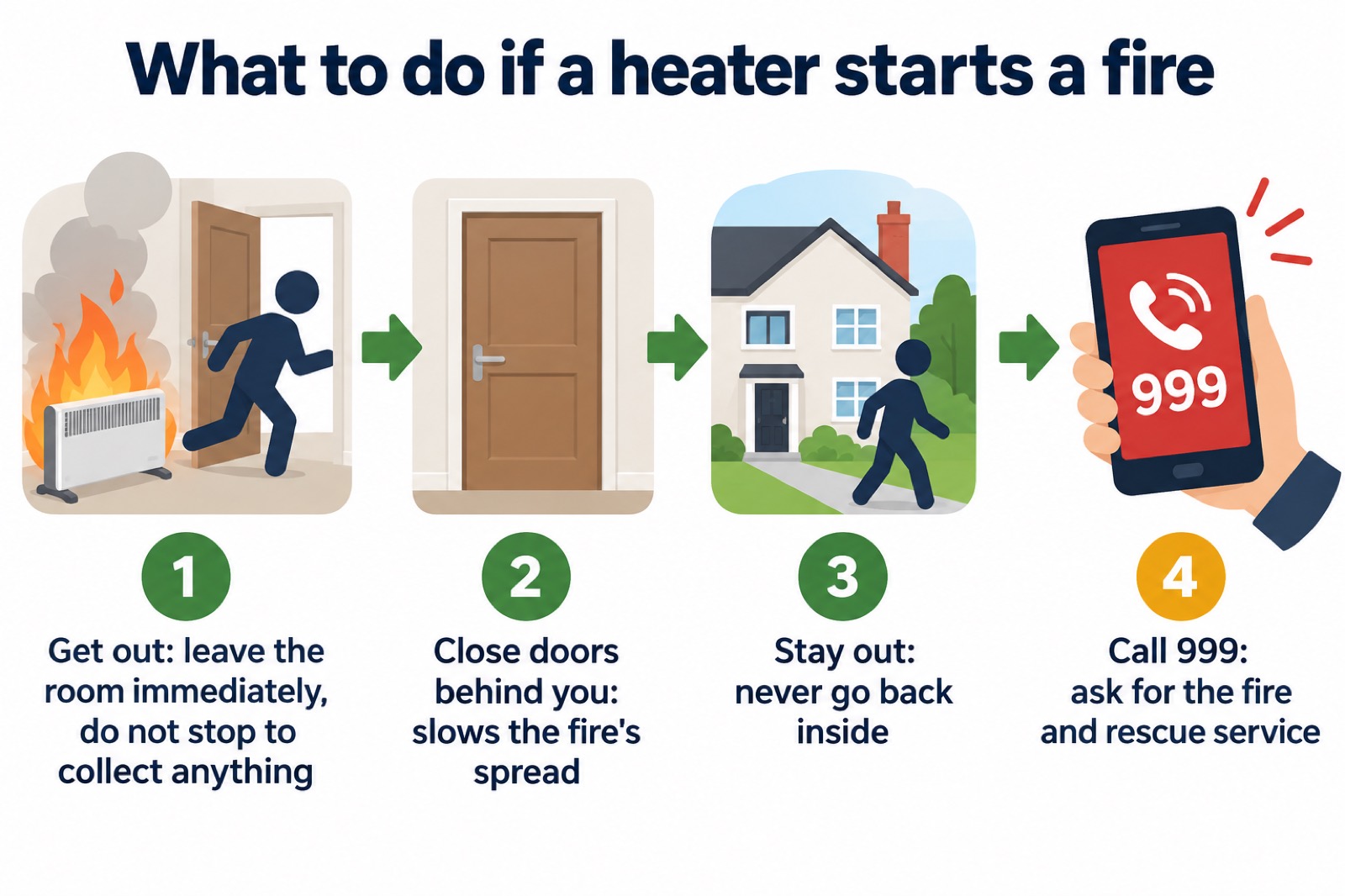
Despite everything, heaters sometimes catch fire, and what happens in the next thirty seconds decides the outcome. Devon and Somerset Fire and Rescue Service gives the instruction in one sentence:
"If your heater starts a fire, you must get out (closing doors behind you), stay out and call the fire service (999)."
Get out, close doors behind you to slow the fire's spread, stay out, and call 99912. Never go back in for possessions.
Two things make that escape possible. The first is working smoke alarms: test your alarms regularly, and make sure there is one between the heater and the bedrooms. The second is an escape route that is not blocked. Devon and Somerset Fire and Rescue Service records that there have been instances where portable heaters become a trip hazard, making escape more difficult4, which is a further reason for the placement rules above: a heater in a doorway is a hazard twice over, once in everyday use and again in the dark of a fire.
In flats and maisonettes, the London Fire Brigade's home fire safety guide advises being cautious when using portable heaters, candles or any open flames, and its advice on escape in purpose-built blocks differs from a house: know your building's evacuation strategy and follow it34. Warwickshire County Council's advice for residents of high rise buildings makes the same point about caution with portable heaters and open flames35. Our page on home emergencies covers house fires, carbon monoxide and gas leaks in full.
Sources (35)
- Portable heaters, Cheshire Fire and Rescue Service, 2026
- Safe home heating, Warwickshire County Council, 2026
- Gwresogyddion symudol, Fire and Rescue Service of Mid and West Wales, 2026
- Home safety partnerships, Devon and Somerset Fire and Rescue Service, 2026
- Heaters and electric blankets, Lincolnshire County Council, 2026
- Extreme weather winter guide, London Fire Brigade, 2025
- Heating your home, North Yorkshire Fire and Rescue Service, 2026
- Prevention, Fire Kills campaign, 2026
- Keeping warm or cool in extreme weather: scripts for broadcast media, UK Health Security Agency, 2025
- Fire safety advice for parents, Warwickshire County Council, 2026
- Heater safety, Devon and Somerset Fire and Rescue Service, 2024
- Heaters, Devon and Somerset Fire and Rescue Service, 2026
- Keeping warm in winter, Derbyshire County Council, 2026
- Home fire safety, Northern Ireland Fire and Rescue Service, 2026
- Stay fire safe, Manchester Fire and Rescue Service, 2026
- Safe use of heaters and generators, Armagh City, Banbridge and Craigavon Borough Council, 2026
- Stay warm safely this winter, Manchester Fire and Rescue Service, 2026
- Staying safe this season, Devon and Somerset Fire and Rescue Service, 2025
- NIFRS calls on community to prioritise fire safety in the home this winter, Northern Ireland Fire and Rescue Service, 2022
- Heating and gas, Scottish Fire and Rescue Service, 2024
- Portable heaters, Fire and Rescue Service of Mid and West Wales, 2026
- NIFRS appeal: simple steps to keep you safe this summer, Northern Ireland Fire and Rescue Service, 2022
- Household flood plan, nidirect, 2018
- Think fire safety when saving money on your energy bills, Devon and Somerset Fire and Rescue Service, 2022
- Help prevent wildfires, Oxfordshire County Council, 2026
- Product recall: Wanzhaoda portable gas fire sold via Amazon, Office for Product Safety and Standards, 2023
- Heater recalls, Prepared Britain, 2024
- Recall of Flogas Gold Butane Gas Cylinders, London Borough of Bromley, 2024
- Charge safely for your own safety, Northern Ireland Fire and Rescue Service, 2026
- Student fire safety, Scottish Fire and Rescue Service, 2025
- Fire safety for carers, Devon and Somerset Fire and Rescue Service, 2026
- Poisons and hazards for your pets, PDSA, 2026
- Portable heaters, gas fires and open fires, London Fire Brigade, 2026
- Home fire safety guide for purpose-built flats and maisonettes, London Fire Brigade, 2023
- Fire safety advice for residents in high rise buildings, Warwickshire County Council, 2026
 Before-Winter Heating Checks
 Backup Stove Kit Checklist
 Wood Burner Lighting Kit
 Keeping One Room Warm
 Clothing and Bedding for Cold
 Stopping Draughts
 Hot Water Bottle Safety
 Wheat Bags and Fire Risk
 Electric Blanket Safety
 Portable Heater Types
 Wood Burners in a Power Cut
 Using a Wood Burner Safely
 Open Fires and Fire Guards
 Firewood and Seasoning Logs
 Smoke Control Areas