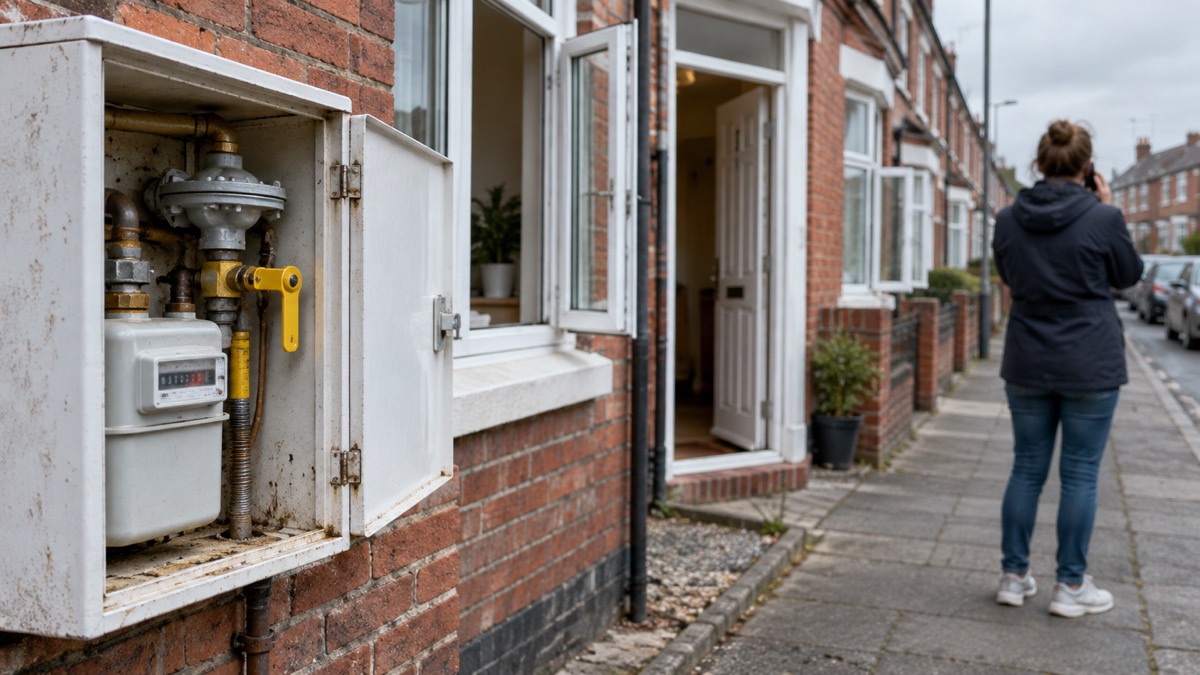
If you can smell gas in your home right now, stop reading and act. Do not turn any electrical switches on or off, including lights. Open the doors and windows. If you know where the meter is and can reach it safely, turn off the gas supply at the meter. Then leave the property and call the free, 24-hour National Gas Emergency Helpline on 0800 111 999 from outside1. In Northern Ireland the number is 0800 002 0013.
That is the whole procedure, and everything else on this page fills in the detail: why switches are dangerous, what to do about bottled gas, what the smell means, what happens after the call, and how to stop a leak happening in the first place. Gas itself is odourless in nature; the smell you notice is mercaptan, a non-toxic, harmless artificial smell added to gas so that leaks can be detected2. Treat any sulphur-like odour in your home as a possible leak and act on it.
What to do right now if you smell gas
Work through these steps in order. They come from the national gas emergency guidance used by councils and resilience forums across the UK1.
- Do not touch any electrical switches. Not lights, not the doorbell, not the cooker ignition. Turning a switch on or off either way can create a spark1.
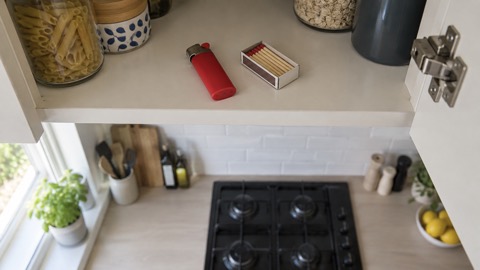
- Do not smoke or use any naked flame, including matches, lighters and candles8.
- Open the doors and windows to let the gas disperse4.
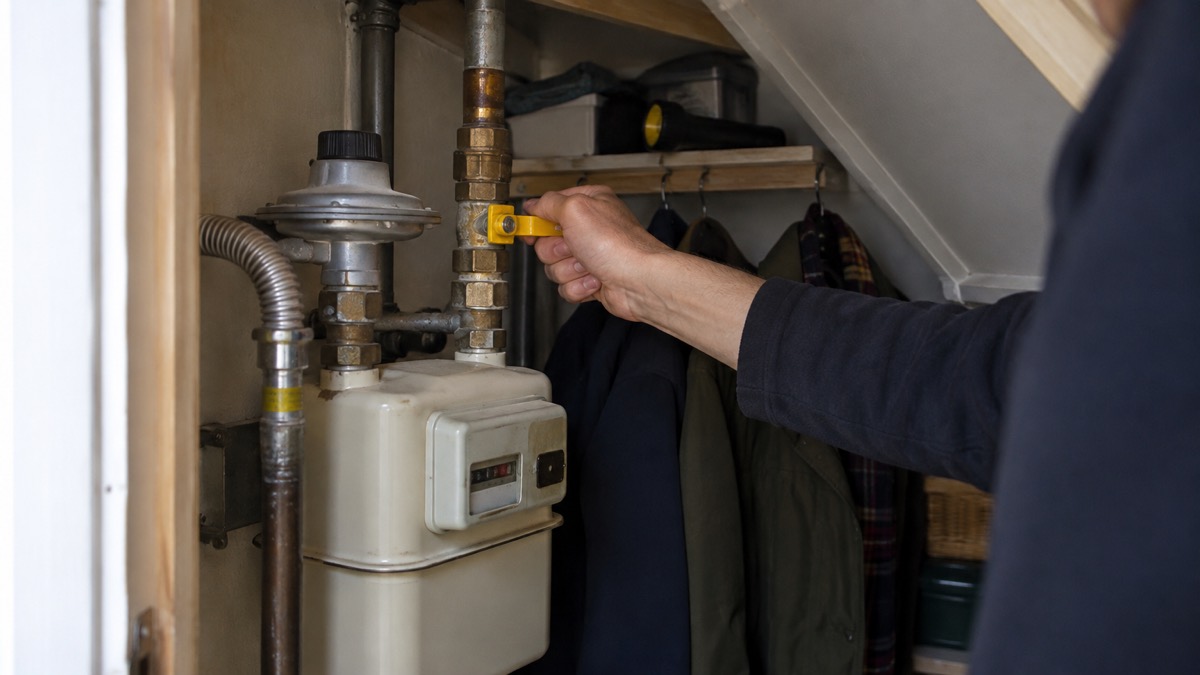
- Turn off the gas supply at the meter, but only if you know where the valve is and can reach it safely. If the meter is in the cellar, do not go into the cellar, and if the smell is coming from the cellar, do not enter it at all4.
- Extinguish all naked flames, including pilot lights, if you can do so without delay4.
- Leave the property, taking everyone with you.
- Call the gas emergency number from outside, on a mobile or from a neighbour's phone5.
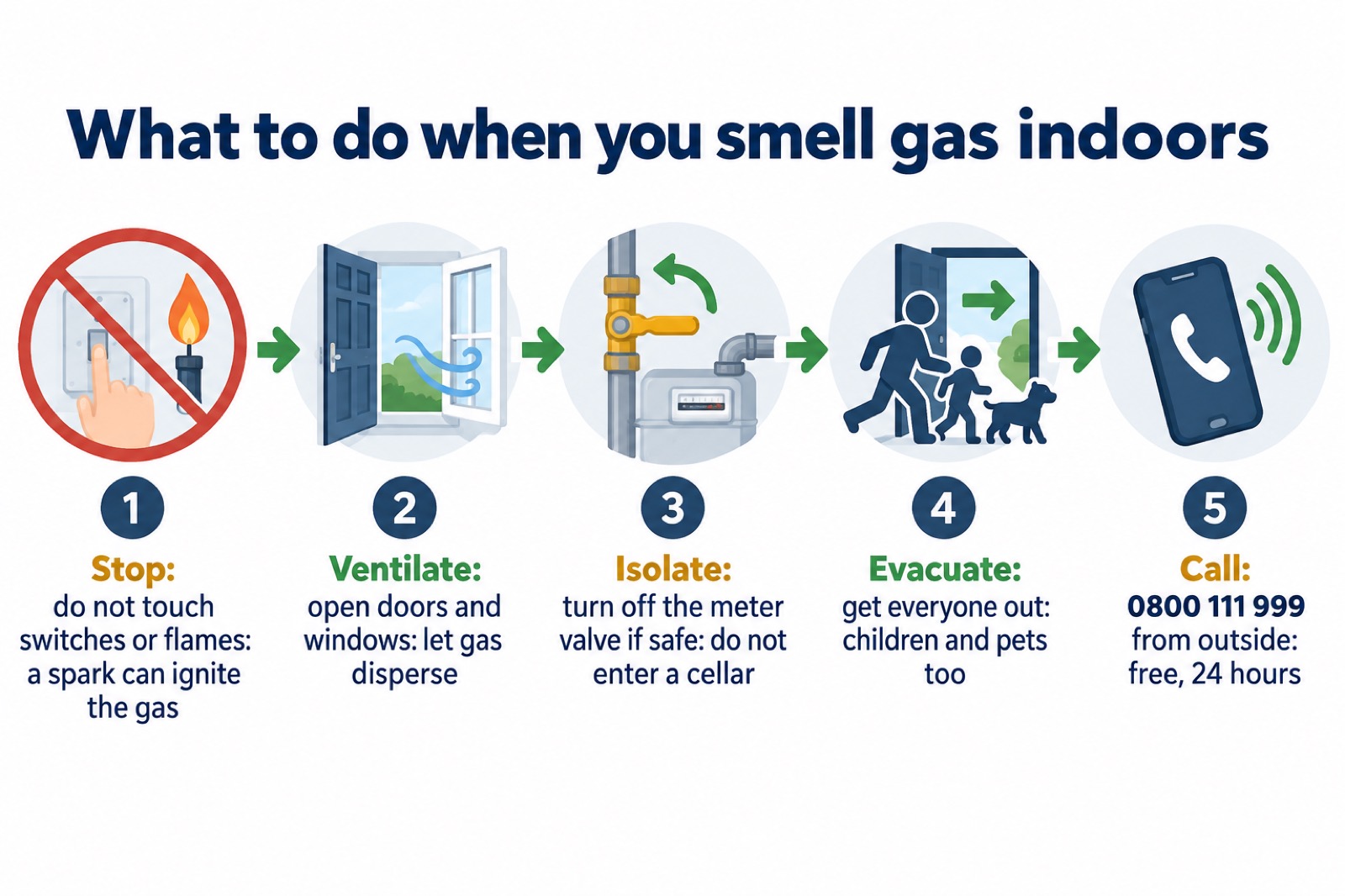
The order matters. Ventilation and evacuation come before anything that involves electricity, because a single spark near a concentrated pocket of gas is the main danger. If you cannot reach the meter safely, skip that step: the emergency engineer will isolate the supply. Your job is to get people out and get the call made.
If the smell is strong, you feel unwell, or there is any sign of fire, do not spend time on steps 3 to 5. Leave the property and call the National Gas Emergency Service immediately5. The helpline is free and available 24/7, and an engineer will attend a gas leak free of charge to make things safe5. Do not return to your home until authorised by your gas supplier or the fire department5.
Call 0800 111 999: the free 24-hour gas emergency number
The National Gas Emergency Helpline is free and runs 24 hours a day2. It can be called at any time, day or night, every day of the year9. You do not need to be a customer of any particular energy company: the number is the same whether the smell is inside your home, in the street, or at a neighbouring property1. Highland Council lists it simply as the Gas Freephone11, and the same number is given by councils, fire services and the electricity system operator across Great Britain12.
The number is different outside Great Britain. The Gas Safe Register publishes the full list:
| Where you are | Gas emergency number |
|---|---|
| England, Wales and Scotland (natural gas) | 0800 111 99914 |
| Northern Ireland (natural gas) | 0800 002 00114 |
| Guernsey | 01481 74900014 |
| Jersey | 01534 75555514 |
| Isle of Man | 0808 1624 44414 |
In Northern Ireland, Belfast City Council's emergency planning advice is to call the NI Gas Emergency Service on 0800 002 001 if you smell gas, and to report gas smells or leaks immediately3. The Utility Regulator for Northern Ireland gives the same number and the same instruction: turn off the emergency control valve in the meter box and contact the 24-hour Gas Emergency Service immediately15. Phoenix Energy, the gas network operator in Northern Ireland, adds a practical point: make sure you allow immediate access to the engineer when they arrive16.
For deaf and hard of hearing callers there are two routes. The National Gas Emergency Service can be reached by textphone on 0800 371 7874. For the 999 service, use the textphone service 18000, or text 999 if you have pre-registered with the emergencySMS service17. Pre-registering is worth doing in advance, because a gas leak is not the moment to be setting up a new service. Our page on smoke and CO alarms for deaf and hard of hearing people covers alerting equipment in more detail.
What not to touch: switches, flames, phones and appliances
The single most repeated instruction in UK gas safety advice is this: do not turn electrical switches on or off1. Nothing in the home counts as an exception: the advice extends to door entry systems, so do not press the intercom to let the engineer in, because that too is an electrical switch16.
The reason is that either direction of switching can spark. Flicking a light off on your way out feels like the safe thing to do, but the switch mechanism can arc internally, and near a pocket of gas that arc is enough. The same logic applies to anything electrical: do not use the doorbell, the cooker ignition, the extractor fan or a torch you have to switch on. A torch that is already on and stays on is not being switched; the instruction is about the act of switching.
The full list of things not to do:
- Do not turn electrical switches on or off, including lights, appliances and door entry systems1.
- Do not smoke or use naked flames until you are sure there is no leaking gas8.
- Do not switch on lights or electrical equipment when re-entering the property until you are satisfied there is no smell of gas18.
- Do not use the phone inside the property: make the call from outside, on a mobile or a neighbour's phone19.
That last point about re-entry matters after the event as much as during it. Guidance for households returning to a property after an emergency says not to switch on lights, electrical equipment or any naked light until you are satisfied there is no smell of gas18. The same caution applies from the moment you first notice a smell: do not use electrical switches, open flames or mobile phones near the suspected source, and ventilate the building by opening windows and doors20.
Turning off the gas at the meter or LPG valve
Should you turn off the gas at the meter? Yes, if you know where the valve is, you can reach it safely, and doing so does not delay your escape. Surrey County Council's guidance for gas failures sets out the conditions plainly: open doors and windows, turn off the gas supply at the meter unless the meter is in the cellar, extinguish all naked flames, do not turn any power or light switches on or off, and do not enter the cellar if the smell is coming from there4. The Health and Safety Executive's advice for a suspected gas leak is the same: open all the doors and windows and shut off the gas supply at the meter control valve if you know where it is21.
The valve is called the emergency control valve and sits next to the meter, usually in a meter box outside or in a cupboard under the stairs. It turns a quarter turn: when the handle is across the pipe the supply is off. If you have never found yours, do it now, before any emergency, so that you are not hunting for it in the dark with gas in the air. This is the same principle as knowing your stop taps for water: the isolation point is only useful if you know where it is.
For LPG, the isolation point is different. On a boat, where bottled gas is common, Devon and Somerset Fire and Rescue Service advises: turn off the isolation valve, open windows, hatches and doors, turn off the engine, put out all naked flames including pilot lights, evacuate if possible and call for help22. The same sequence applies in a house with bottled gas: the valve to close is the one on the bottle or tank itself, or the isolation valve on the supply pipe from it.
One caution from the Health and Safety Executive applies to portable gas heaters: ensure the correct size and type of gas bottle is being used with the appliance21. A bottle that does not match the heater's regulator is a leak waiting to happen, and the LPG section below explains why bottled gas leaks behave differently from mains gas.
Gas smell outside your home or in the street
The emergency number is not only for gas inside your own home. The national gas emergency service should be called whether the smell is inside or outside the property1, and the same instruction appears in storm and flood advice from Cornwall Council: if you smell gas, phone 0800 111 99912. Northumberland County Council's guidance for businesses and residents is the same: if you smell gas or suspect a gas leak, call the National Gas Emergency Service immediately13.
A smell in the street usually means a mains pipe has been damaged, by roadworks, a burst water main undermining a pipe, or ground movement in a storm. The same rules apply outdoors: do not smoke, do not create sparks, and keep people away from the area. Do not assume someone else has already reported it. Networks would far rather take ten calls about the same leak than none.
If you have hit a gas pipe while digging in your garden or doing building work, the advice is the same: get people away from the area, do not attempt to cover the pipe or backfill the hole, and call the emergency number. Our gas and heating failures page covers damaged pipes and supply interruptions in more detail.
What happens after you call: the engineer's visit
Once you have called, an engineer will be sent to make the property safe1. Manchester Fire and Rescue Service states that an engineer will be with you within the hour, seven days a week, 24 hours a day6. The documents in this area give slightly different framings of the response, so treat "within the hour" as the stated standard rather than a guarantee, and be ready to let the engineer in immediately when they arrive: Phoenix Energy's emergency advice is to make sure you allow immediate access16.
The engineer's job at an emergency call-out is to make the situation safe: to find the leak, isolate the supply if needed, and make the property secure. They are not there to repair your boiler. Any confirmation of a leak and any gas work that follows should be completed by a competent Gas Safe registered engineer5.
If the gas supply is lost for a long period, the network will send you details about the incident1. In a widespread event, such as a storm that has damaged the network, the gas failure becomes part of the wider response, and the advice on our gas and heating failures page applies: you may be without gas for heating and cooking for some time, and the preparation steps there, along with our heating and cooking without mains power or gas guide, will matter more than the leak itself.
LPG sinks and spreads: why bottled and tank gas needs extra care
Bottled and tank gas behaves differently from mains gas, and the difference changes what a leak can do. Liquefied Petroleum Gas, or LPG, is butane or propane stored as a liquid under pressure23. Because it is stored under pressure and is highly flammable, even a small leak can release a large volume of gas24.
The critical property is this: LPG is heavier than air. Mid and West Wales Fire and Rescue Service explains what that means in practice: a small leak can produce a large volume of highly flammable gas, and because the gas is heavier than air it collects near the floor or ground and can be ignited at a considerable distance from the source of the leak23.
Mains gas rises and disperses through open windows. LPG sinks, pools at floor level, flows along the ground, and can collect in low spots: cellars, floor voids, under-stairs cupboards, the bilges of boats. A pocket of LPG can then be ignited by a spark or flame some distance from where the leak actually is, which is why a bottle that smells of gas in the garden can still be dangerous to a cellar below the house.
That has two practical consequences. First, ventilation alone is less reliable with LPG: opening windows helps, but the gas may still pool low down, so evacuation matters even more. Second, never store or use LPG bottles in a cellar or basement, and never ignore a bottle that smells of gas, even outdoors. For bulk and metered LPG supplies, the Gas Safe Register advises calling the contact number on the bulk storage vessel or the meter; for cylinder supplies, check your local telephone directory for your supplier's contact details14. If the smell is strong or you feel unwell, get out and call 99925.
Signs of a leak beyond the smell: hissing, symptoms and scorch marks
The smell is the main warning, but it is not the only one. Warwickshire County Council's home heating safety advice says to look out for the smell of gas, described as a distinctive, sulphur-like odour, or hissing sounds near gas appliances or gas meters26. A hissing sound near a meter or an appliance can mean gas is escaping under pressure, and it should be treated exactly like a smell.
Your own body is another detector. The most common symptoms of a gas leak, as listed by the Gas Safe Register, are feeling lightheaded, nausea, dizziness and headaches14. Manchester Fire and Rescue Service explains the mechanism and the urgency: if you are feeling dizzy or you're getting headaches or loss of breathlessness there could be a gas leak that is displacing the oxygen in the room, so get out into some ventilation and call 0800 111 999 straight away6.
If several people in the household feel unwell at the same time, or the symptoms ease when you go outside and return indoors, treat it as a leak until an engineer says otherwise. Get out into fresh air first, then call.
It is worth being clear about the difference between a gas leak and carbon monoxide, because the two get confused. A gas leak is the fuel itself escaping, and you can usually smell it. Carbon monoxide is a product of incomplete burning, it has no smell, and it is detected by a CO alarm, not your nose. The Gas Safe Register notes that anyone can check for a gas leak by its smell, or by a CO detector activating in the case of carbon monoxide, but any confirmation and gas work should be completed by a competent Gas Safe registered engineer2. Warning signs of carbon monoxide include an unfamiliar or burning smell when gas or oil appliances are on27. If your CO alarm sounds, follow our page on what to do if your CO alarm sounds or you suspect carbon monoxide, and see can a carbon monoxide alarm detect a gas leak? for why the two need different alarms.
Annual servicing by a Gas Safe registered engineer
The best response to a gas leak is the one you never need, and the single most effective precaution is an annual service by a Gas Safe registered engineer. The Fire Kills campaign states it plainly: gas appliances should be serviced annually by a Gas Safe registered engineer, and this is a legal requirement for landlords28. Where there are any gas appliances in a rented property, landlords must arrange an annual gas safety check by a Gas Safe engineer28.
If you rent, your landlord must arrange an annual gas safety check by a Gas Safe engineer where there are any gas appliances28, and the HSE notes that good practice for landlords is the demonstration of regular, annual maintenance checks and subsequent repairs by a Gas Safe registered engineer21. If you are a tenant and have not seen a gas safety record in the last year, ask for it.
Never attempt DIY repairs on gas appliances or electrical installations28. A service visit is also the moment an engineer will check the condition of the appliance and its connections. If you use portable gas equipment, check it against current recalls; our page on how to check if an electrical product has been recalled explains how to look.
A few habits complete the picture:
- Find your meter and its emergency control valve now, so you are not searching during a leak4.
- Save the emergency number in your phone, and the right one for where you live: 0800 111 999 in England, Wales and Scotland, 0800 002 001 in Northern Ireland14.
- Have appliances checked every year by a Gas Safe registered engineer29.
- Fit a CO alarm if you have any fuel-burning appliance, and test it regularly; see our guide to carbon monoxide alarms.
- Check gas bottles for the correct size and type for the appliance, and for damage to hoses and regulators21.
For the wider picture of losing gas supply, and what to have ready for heating and cooking without it, see home emergencies and gas and heating failures.
Sources (29)
- Are You Ready booklet, Culham Parish Council, 2025-09
- What to do in a gas emergency, Gas Safe Register, 2026-10-29
- Emergency planning, Belfast City Council, 2026-10-29
- Power, gas and water: what if they fail, Surrey County Council, 2025-12-29
- Preparing for an emergency: be ready, stay safe, act now, Sussex Resilience Forum, 2025-10
- Stay fire safe, Manchester Fire and Rescue Service, 2026-10-29
- Gas supply issues, Buckinghamshire Council, 2026-10-29
- Preparing yourself for emergencies, Greater London Authority, 2026-10-26
- Action to take if you smell gas, Cornwall Fire and Rescue Service, 2021-05-10
- Energy outages, National Energy System Operator, 2026
- Contact in an emergency, Highland Council, 2026-01-30
- Storm advice and preparation, Cornwall Council, 2026-10-29
- Information about specific safety concerns, Northumberland County Council, 2026-05-21
- What to do in a gas emergency, Gas Safe Register, 2026-10-26
- Consumer Guide, Utility Regulator for Northern Ireland, 2020
- In an emergency, Phoenix Energy, 2026-10-29
- Herbert Protocol notice, Surrey Police, 2026-10-29
- Northumbria Local Resilience Forum, Northumberland County Council, 2026-10-28
- Help with heating costs, Age UK
- Prepare yourself, Greater Manchester Combined Authority, 2026-10-29
- Gas safety FAQs: domestic, Health and Safety Executive, 2026
- Boat safety, Dorset and Wiltshire Fire and Rescue Service, 2025-06-25
- Portable heaters, Mid and West Wales Fire and Rescue Service, 2026-10-29
- Portable heaters, Cheshire Fire and Rescue Service, 2026-05-26
- Winter safety advice, Dorset and Wiltshire Fire and Rescue Service, 2020-11-09
- Safe home heating, Warwickshire County Council, 2026-10-29
- Carbon monoxide: the silent killer, Wiltshire and Swindon Prepared, 2026-10-25
- Fire Kills prevention advice, Fire Kills campaign, 2026-03-25
- Carbon monoxide safety, Manchester Fire and Rescue Service, 2026-10-29
 Home Fire Safety Checklist
 Bedtime Fire Safety Checks
 Fire Risk Checks for Carers
 What to Do If Fire Starts
 How to Make a Fire Escape Plan
 Fire in a Block of Flats
 Kitchen Fires and Cooking Safety
 Electrical Fires and Sockets
 Smoking, Matches and Lighters
 E-bike Charging Safety
 Hoarding and Fire Risk
 Thatched Properties Fire Risk
 Fireworks and Bonfire Safety
 What to Do After a House Fire
 How Fire Services Respond