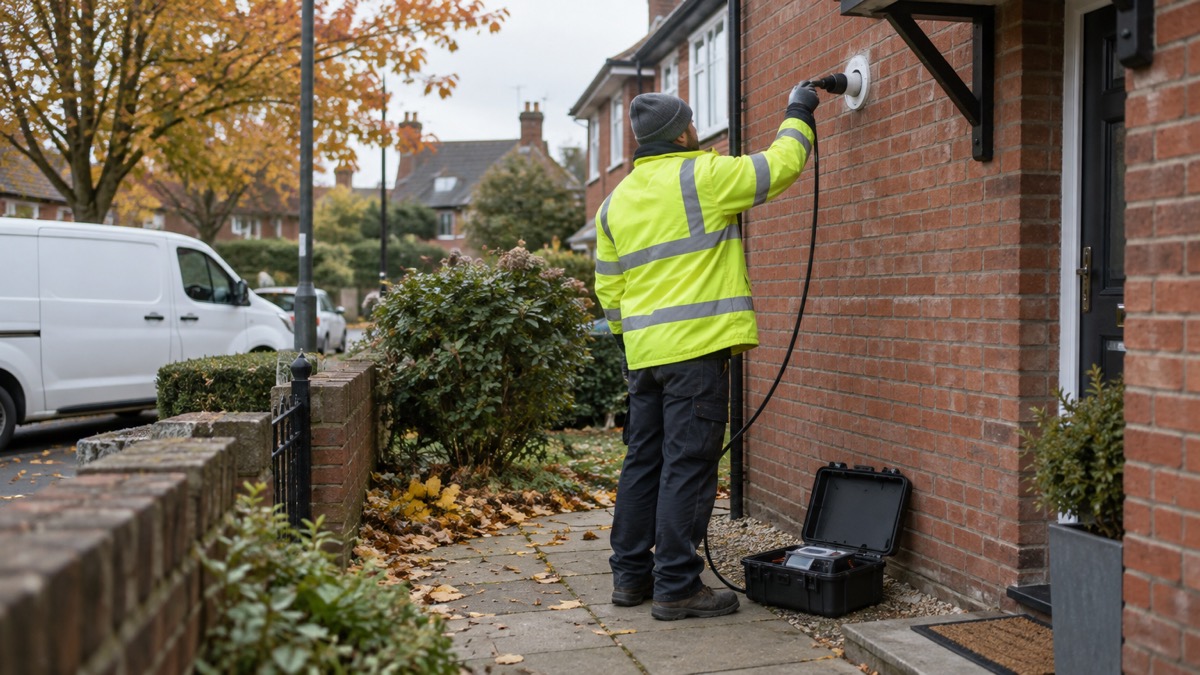
Every gas appliance in your home should be checked for safety at least once every 12 months by a Gas Safe registered engineer. That is the standing advice from the Health and Safety Executive (HSE), and it is repeated by fire and rescue services across the country1. The check covers your boiler, gas cooker, gas fire and any other gas-fired appliance, together with the pipework and flues that serve them2. For rented homes it is not just advice: your landlord must arrange it by law.
A safety check is not the same as a service, and the difference matters when you book. A safety check establishes that the appliance is safe to use at that moment. A service goes further, cleaning and adjusting the appliance so it keeps running safely and efficiently3. Many households have both done together at the annual visit. If money is tight, the safety check is the part you cannot do without, and for some households it is free: energy suppliers can offer free gas safety checks every 12 months to eligible customers4.
This page explains what the engineer actually tests, who qualifies for a free check and how to ask for one, what landlords must do, and what to do if you doubt an appliance's safety. It sits alongside our guides on boiler servicing, finding and checking a Gas Safe registered engineer and unsafe appliances.
What the engineer checks: flues, air supply and pressure
A gas safety check is a defined set of tests, not a general look-over. For each gas appliance, the check covers four things: the effectiveness of any flue, the supply of combustion air, the appliance's operating pressure or heat input or both, and its operation to ensure it is functioning safely3. Those four tests mirror the checks required of landlords under the regulations, and they are the same whether the check is paid for or free.
Each test catches a different way an appliance can harm you. The flue check makes sure the products of combustion are carried safely out of your home rather than spilling into a room, which is how carbon monoxide builds up. The air supply check confirms the appliance can draw enough air to burn the gas properly; this is why you should never block ventilation around a gas appliance1. The pressure and heat input checks confirm the appliance is burning gas at the rate it was designed for, and the final operational check confirms everything works as it should together.
| What is checked | What it protects you from |
|---|---|
| Effectiveness of the flue | Combustion fumes, including carbon monoxide, spilling into your home3 |
| Supply of combustion air | Incomplete burning of gas caused by blocked ventilation1 |
| Operating pressure or heat input | The appliance burning gas at the wrong rate3 |
| Safe operation | Faults in how the appliance functions day to day3 |
The engineer should also look at the pipework. If your home has been flooded, get a Gas Safe registered engineer to inspect the gas supply before anything is used again, alongside an electrician for the electrical appliances7. And when the engineer arrives, check they are who they claim to be: the Gas Safe Register's "Check an Engineer" service lets you input the licence number from the engineer's ID card and see pictures of the registered engineer and details of their qualifications6. Our guide on checking engineer ID covers this in more detail.
Who gets a free gas safety check every 12 months
Energy suppliers can offer free gas safety checks every 12 months4. The scheme is aimed at homeowners who could not easily afford a check, and eligibility has two parts.
First, you must receive a means-tested benefit. Second, you must own your own home and meet at least one of these conditions8:
- you live with a child under five
- you live alone or with others and have reached state pension age
- you live alone or with others and are disabled or chronically ill
- you live with others who have reached state pension age or are disabled, chronically ill or under 18
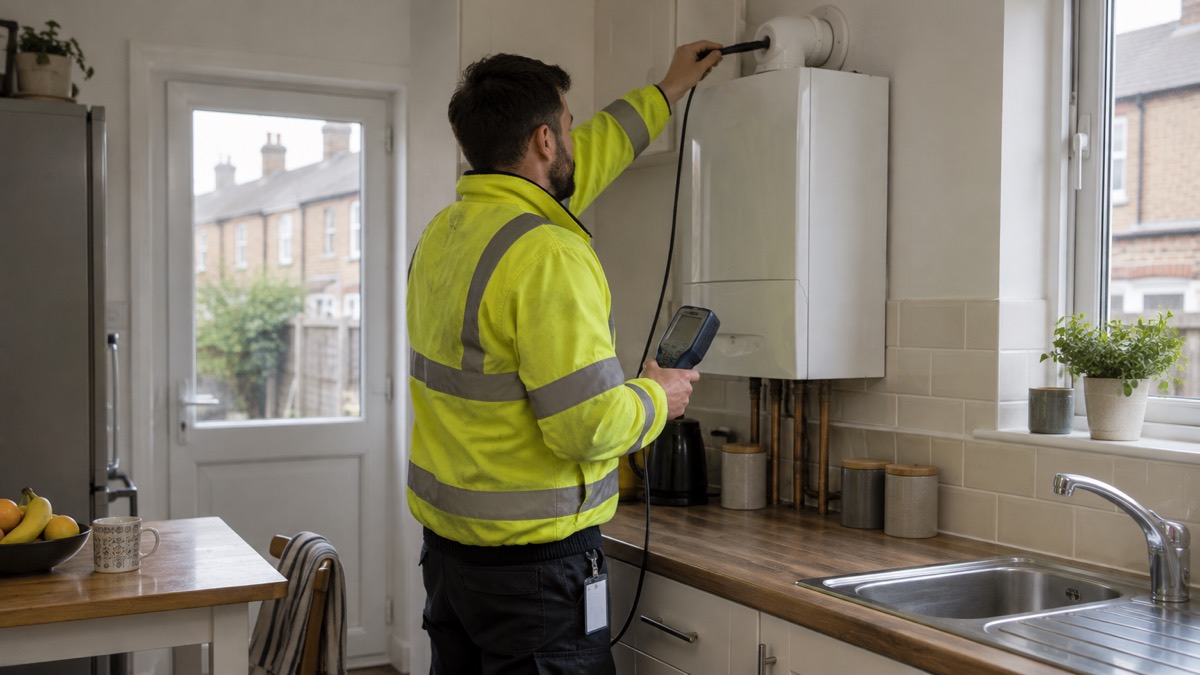
The free check is the same set of tests as a paid one: examination of the flue, the supply of combustion air, the operating pressure or heat input, and safe operation, for each gas appliance3. Suppliers have offered these checks for years; one supplier alone carried out 6,661 free gas safety checks in a single year when the scheme was reviewed3. The numbers are simply to show the scheme is real and used; what matters to you is whether you qualify.
If you are a homeowner and not eligible, the check is something you arrange and pay for yourself, and it is worth doing even when money is tight, because an unsafe appliance can produce carbon monoxide. The NHS advises having one carbon monoxide alarm for each room of your home containing appliances that burn gas, oil, coal or wood9, and an alarm is a back-up to the annual check, not a substitute for it.
How to ask your energy supplier for a free check
Asking is straightforward: contact your energy supplier and tell them you want to request a free gas safety check. Suppliers can offer them every 12 months, so it is worth diarising the request each year rather than assuming it repeats automatically4.
The other route in is the Priority Services Register. This is a free scheme run by energy suppliers and networks for households that need extra support, and most energy providers on the register will offer a free annual gas check, including to homeowners who have not had a gas safety check in the last 12 months10. Manchester Fire and Rescue Service's cost of living advice puts it plainly: homeowners should check with their energy provider to see if they are eligible for a free annual check through their Priority Services Register11.
To register, contact your energy provider or your Gas Distribution Network and ask whether your household could benefit10. Our guide to extra support from networks and suppliers explains what else the register brings, and our page on which network operator covers your home helps you find your network.
If you need to find an engineer for anything outside the free scheme, the Gas Safe Register freefone helpline is 0800 408 55001. If you ever suspect a gas leak or smell gas, that is not a job for the routine booking line: the National Gas Emergency Service exists for exactly that.
Tenants: your landlord must arrange the annual check
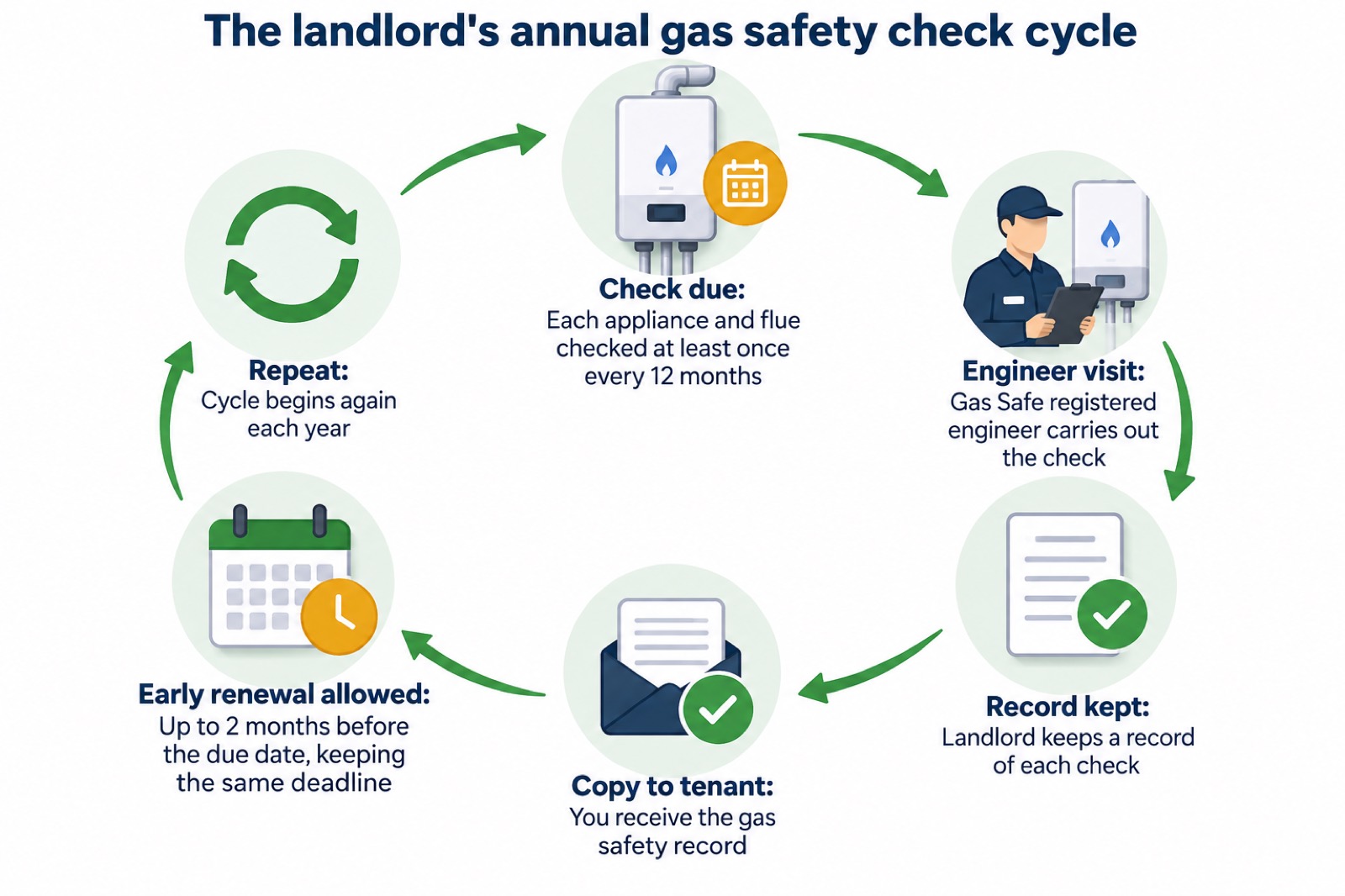
If you rent, the annual gas safety check is your landlord's responsibility, not yours to arrange or pay for. The Gas Safety (Installation and Use) Regulations 1998 deal with landlords' duties to make sure gas appliances, fittings and flues provided for tenants are safe1. Under those regulations, landlords must ensure an annual gas safety check is carried out on each appliance and flue, keep a record of each check, and give you a copy of the gas safety record following the check5. The Mayor of London's advice to tenants is blunt about whose job it is: "if it's your property, it's your responsibility"12.
What the landlord's duty covers:
- Gas appliances, pipes and flues provided as part of your tenancy, checked by a Gas Safe registered engineer11
- A copy of the gas safety record for you, and an up-to-date record before re-letting to new tenants5
- A check even where there is a live gas supply but you do not actually use gas1
- Communal appliances, flues and pipework in buildings the landlord does not own, through arrangements with the building owner1
The timing has some flexibility worth knowing about. A landlord can have the annual check carried out up to 2 months before the date it falls due and still keep the original deadline date, so you may see the visit arrive slightly early each year without the anniversary shifting1. As a tenant, you should allow access for the gas maintenance visit and safety check when it is arranged; the HSE notes this helps keep you and your family safe1.
If your landlord fails to provide the annual check, report them to your local authority10. North Yorkshire Fire and Rescue Service puts the tenant position simply: anyone who is a tenant should have an annual gas safety check for any fixed appliances, and this must be done by your landlord13. The NHS carbon monoxide guidance for private renters says the same: ensure your landlord has completed the annual Gas Safety check14. Our page on broken boilers in rented homes covers what to do when the heating fails, as distinct from the annual check itself.
Carbon monoxide alarms in rented homes
The annual check and a working carbon monoxide alarm work together. The check finds the fault; the alarm warns you if something goes wrong between checks. In rented homes in England, the alarm is a legal requirement as well as good sense.
From 1 October 2022, relevant landlords in England must ensure a carbon monoxide alarm is equipped in any room used as living accommodation which contains a fixed combustion appliance, excluding gas cookers15. Landlords in England were already required to supply a carbon monoxide detector in any room used wholly or partly as living accommodation which contains a solid fuel burning combustion appliance16. In Scotland, private landlords are legally responsible for their tenants' gas safety under the same 1998 regulations, and separate Scottish guidance covers carbon monoxide alarms in private rented properties17.
What a good alarm arrangement looks like:
- One carbon monoxide alarm for each room containing appliances that burn gas, oil, coal or wood9
- Alarms fitted in any room with a gas fuel burning appliance, like a boiler or gas fire, and in rooms with solid fuel appliances18
- Alarms tested regularly, weekly alongside your smoke alarms where guidance says so19
- Compliant alarms: Cherwell District Council recommends carbon monoxide alarms compliant with British Standards BS 50291, and advises that alarms in rental properties be mains-powered with integral battery back-up, installed by a competent electrician20
If you want to understand the wider risks, our home emergencies guide covers carbon monoxide alongside fire and gas leaks.
Shared flues and chimneys: a responsibility you share with neighbours
Not every flue serves one household. In flats and some terraced buildings, communal gas appliances, flues and pipework may serve several homes, and responsibility for checking them runs with the building. Where a landlord lets property in a building they do not own, their arrangements with the building owner must ensure that any communal gas appliances, flues and pipework used by tenants are maintained and checked for safety by the building owner, with evidence of those checks available1. If you rent in such a building, you can ask to see that evidence alongside your own gas safety record.
Flues also interact with neighbours' building work. The Gas Safety (Installation and Use) Regulations 1998 and Building Regulations require flues to be installed in a safe position at specified distances from the boundary, and the HSE advises that neighbours, builders and householders should consult before commencing work21. If a neighbour's extension or building work seems to be affecting your flue, get a Gas Safe registered engineer to examine it21. A flue that ends too close to a boundary or a new wall can push combustion fumes back into your home or theirs.
Tenants who own their own gas appliances have one extra check to make at the start of a tenancy: ask your landlord whether there are any flues or chimneys that are unsuitable for the installation of a gas appliance1. Bringing your own cooker or fire into a home is common, but the flue it connects to must be right for it.
Who must never do the check
Only a Gas Safe registered engineer may carry out gas safety checks. The HSE is categorical: all checks must be done by a Gas Safe registered engineer22. That rule catches two groups people sometimes assume are exempt.
The first is the competent amateur. Never attempt DIY gas work, as it is very dangerous, in the words of Manchester Fire and Rescue Service10, and Warwickshire County Council adds that gas-related tasks should not be attempted as DIY projects2. The second group is former gas fitters. A former gas fitter may not carry out the check themselves; it must be done by a Gas Safe registered engineer22. Registration is the legal test, not past trade experience.
There is a related trap for householders who have work done informally. It is not acceptable for a Gas Safe registered engineer to knowingly "sign off" gas work carried out by a person who is not registered, and where this occurs, both the registered and the unregistered installer may face prosecution22. So paying a registered engineer to rubber-stamp a friend's or a previous fitter's work protects nobody and exposes both of them to prosecution.
If you doubt an appliance's safety
Doubts about a gas appliance have a clear rule attached: it is illegal for anyone to use a gas appliance if they suspect it is unsafe. Turn the appliance off and do not touch it until it has been checked by a Gas Safe registered engineer1. That applies even if the doubt is vague, a smell, a strange flame colour, soot marks, or symptoms that ease when you leave the house.
If an engineer has already switched an appliance off, take that seriously: it was switched off because it was unsafe and should not be used1. An appliance turned off in this way is sometimes described as condemned, and our page on what help there is if your appliance is condemned covers the practical aftermath.
If your engineer recommends further work, always follow the advice given. Where you have doubts over the advice, follow it in the interim period and contact the Gas Safe Register for further advice1. In other words, act on the cautious advice now and seek a second opinion afterwards, never the other way round.
"It is illegal for anyone to use a gas appliance if they suspect it is unsafe. Turn the appliance off and do not touch it until it has been checked by a Gas Safe registered engineer."
Recalled gas appliances and cylinders: how to check yours
Recalls of gas appliances do happen, and they are a reason the annual check matters even when everything seems fine. Manchester Fire and Rescue Service advises using Electrical Safety First's online product checker to see if any of your appliances have been recalled10. It takes minutes and covers appliances you may have owned for years.
Recent examples show the range of what gets recalled. In 2022, a product safety report was published for certain Glen Dimplex gas range cookers sold under the Belling, Stoves and New World brands, warning of a carbon monoxide risk when the grill was used with the door closed, and a modification programme followed that November. In March 2024, Morco recalled four models of open-flued gas water heaters supplied between 2018 and 2023 because of a risk of gas leaks that could cause fire or explosion. In November 2024, Flogas recalled Gold butane gas cylinders in 4.5 kg, 7 kg and 13 kg sizes sold between 6 and 22 November 2024 across parts of England, because they had been filled with a butane and propane mixture outside the required standard, and offered replacements.
What to do about recalls:
- Check your appliances on the Electrical Safety First online product checker10
- If a gas appliance is in scope of a recall, stop using it and contact the maker's modification or recall programme
- Keep your annual gas safety check current: ensure you have a gas safety check each year for your boiler or appliances10
- For gas cylinders, follow the recall notice on returns and replacements rather than using the cylinder
If you use LPG cylinders rather than mains gas, our LPG guide covers storage and running out in winter.
Gas Safety Week: an annual reminder
Gas Safety Week is a yearly campaign that highlights the importance of following gas safety advice. In 2025 it marked its fifteenth year, and its theme, Looking after your Home, Friends and Family, reminded the public to not only take care of their own gas safety but to look out for others23.
The practical use of the week for an ordinary household is as a prompt. If your last gas safety check was more than a year ago, or you cannot remember when it was, Gas Safety Week is a sensible moment to book one, to check your carbon monoxide alarms, and to ask older relatives or neighbours whether their check is due. The core advice for the week is the same as the rest of the year: ensure you have a gas safety check each year for your boiler or appliances10.
Where to get help
Help with gas safety checks comes from several directions, and most of it is free to ask for:
- Your energy supplier, for a free gas safety check if you are eligible, offered every 12 months4
- The Priority Services Register, via your energy provider or Gas Distribution Network, for a free annual gas check and wider support10
- Your landlord, if you rent, who must arrange the annual check and give you the record5
- Your local authority, to report a landlord who fails to provide the check10
- The Gas Safe Register, on 0800 408 5500 or online, to find and verify engineers1
- The National Gas Emergency Service, if you smell gas or suspect a leak, covered in our emergency line guide
The gas and heating failures guide pulls together what to do when heating fails in winter, from boiler breakdowns in cold weather to help from networks during a long outage. The annual safety check is the piece you control in advance, and it is the one that keeps every other piece safer.
Sources (23)
- Gas safety: frequently asked questions, Health and Safety Executive, 2026
- Safe home heating, Warwickshire County Council, 2026
- Post-implementation review of free gas safety checks, Ofgem, 2008
- Priority Services Register, Derbyshire County Council, 2026
- Gas safety for students and tenants, Health and Safety Executive, 2026
- Gas Safe Register check, Health and Safety Executive, 2026
- After a flood: clearing up, nidirect, 2026
- Energy domestic consumer advice, England and Wales, Ofgem, 2024
- Carbon monoxide poisoning, NHS, 2025
- Stay fire safe, Manchester Fire and Rescue Service, 2026
- Cost of living leaflet, Manchester Fire and Rescue Service, 2022
- Gas safety for tenants, Greater London Authority, 2026
- Heating your home, North Yorkshire Fire and Rescue Service, 2026
- Carbon monoxide, Doncaster and Bassetlaw Teaching Hospitals NHS Foundation Trust, 2026
- Smoke and carbon monoxide alarms: additional advice for tenants, Manchester Fire and Rescue Service, 2026
- Fire safety in rented accommodation, Cornwall Council, 2026
- Carbon monoxide alarms in private rented properties: guidance, Scottish Government, 2021
- Keeping your home warm in winter, Met Office, 2026
- Smoke alarms and carbon monoxide detectors, Surrey County Council, 2026
- Housing standards, Cherwell District Council, 2026
- Gas safety: owner-occupier FAQs, Health and Safety Executive, 2026
- Landlord gas safety checks: who can carry them out, Health and Safety Executive, 2026
- Cross-government group on gas safety 2024-2025, Health and Safety Executive, 2025
 Finding a Gas Safe Engineer
 Extra Support for Households