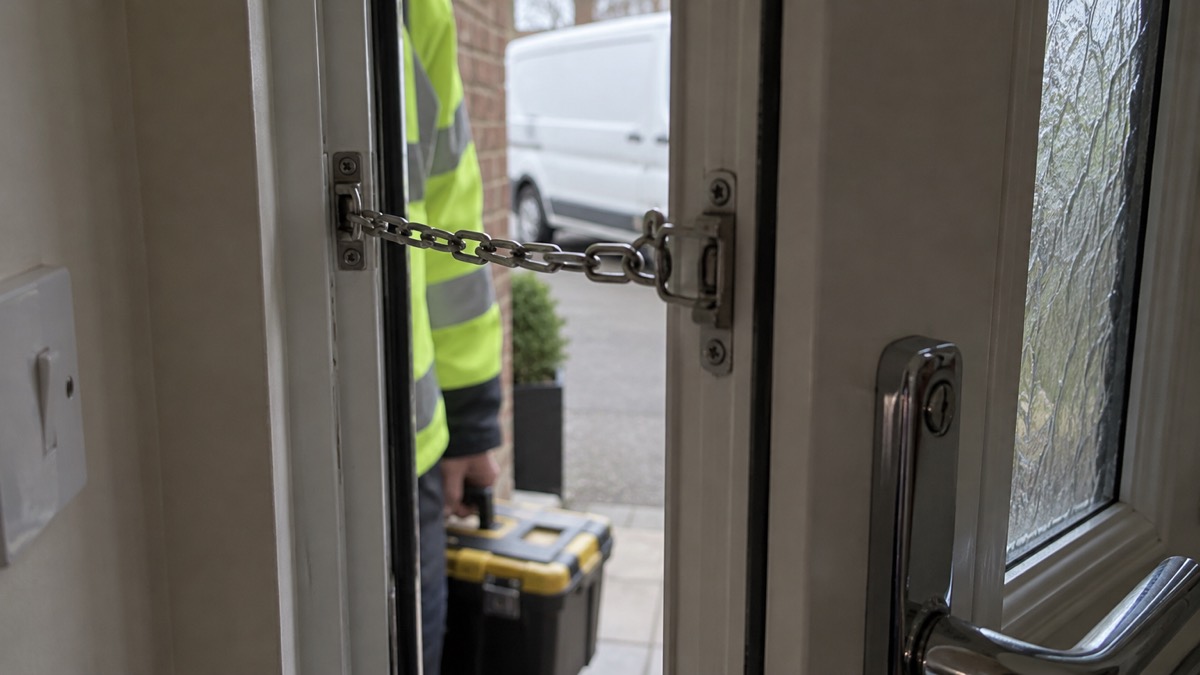
If someone knocks at your door during a gas or power outage and says they are an engineer, the first thing to do is ask to see their ID card, and check it before you open the door. Genuine engineers expect this and will wait while you do it. If they cannot show you a valid card, do not let them in and do not let them work on anything1.
For gas work, the card to look for is a Gas Safe ID card. It carries the engineer's photograph and a unique licence number, and the back lists the appliances they are qualified to work on2. You can check that number yourself on the Gas Safe Register website, by text, or by ringing the free helpline on 0800 408 55003.
If you smell gas, the number to ring is the National Gas Emergency Service on 0800 111 999, day or night4. The engineer they send will carry ID and will need to get into your home to make it safe, so check the card and then let them in5. If you are ever unsure about someone at your door, ring the network operator or the police non-emergency number on 101 using a number you have looked up yourself, never one the caller gives you6.
Ask for the ID card before you open the door
The single most useful habit is a simple one: never open the door to someone claiming to be an engineer until you have seen their card. Gas Safe Register is direct about this. If an engineer does not show you their ID card when they arrive, do not be afraid to ask to see it1. If they cannot produce a valid card, do not allow them to carry out work at your property, and contact Gas Safe Register to tell them1.
A genuine Gas Safe ID card has a photograph and a unique licence number, and you should look at both sides2. The front tells you who they are. The back is the part people skip, and it is the part that matters most: it lists which appliances the engineer is qualified to work on, so you can see at a glance whether they are cleared for the job in front of them3. Not every registered engineer can work on everything. Some are not qualified for caravans or non-domestic properties, so check that the card covers the work you need doing8.
This applies to emergency callouts as much as to booked work. When the National Gas Emergency Service sends an engineer, they will carry ID and will need to enter your home to make it safe5. The same is true of the engineers sent out by the gas networks when there is a problem on the network: one of their engineers will be dispatched to investigate, and they will carry ID9. Checking the card is not an insult to them. It is what they expect.
Check the card, then check the register
A card can be forged, so the card is the start of the check, not the end of it. The Gas Safe Register is the only official register of gas engineers, the list of people qualified to work safely and legally on gas appliances2. You can check an engineer or a business against it in several ways, and you do not need an account or a smartphone to do it.
- Online: use the Check an Engineer service on the Gas Safe Register website. Put in the licence number from the card and you will see pictures of the registered engineer and details of their qualifications10. You can also search by business name, registration number, business phone number, engineer name or ID number11.
- By text: text Gas and the engineer's seven digit licence number to 85080 and you will get a text back confirming whether that licence card number is registered3. You can do the same with a business registration number to check a firm3.
- By phone: ring the free helpline on 0800 408 55003.
- To see their photo: after the text confirms registration, you can reply with Photo and the licence number and be sent the engineer's photograph, provided the engineer has signed up to that service3.
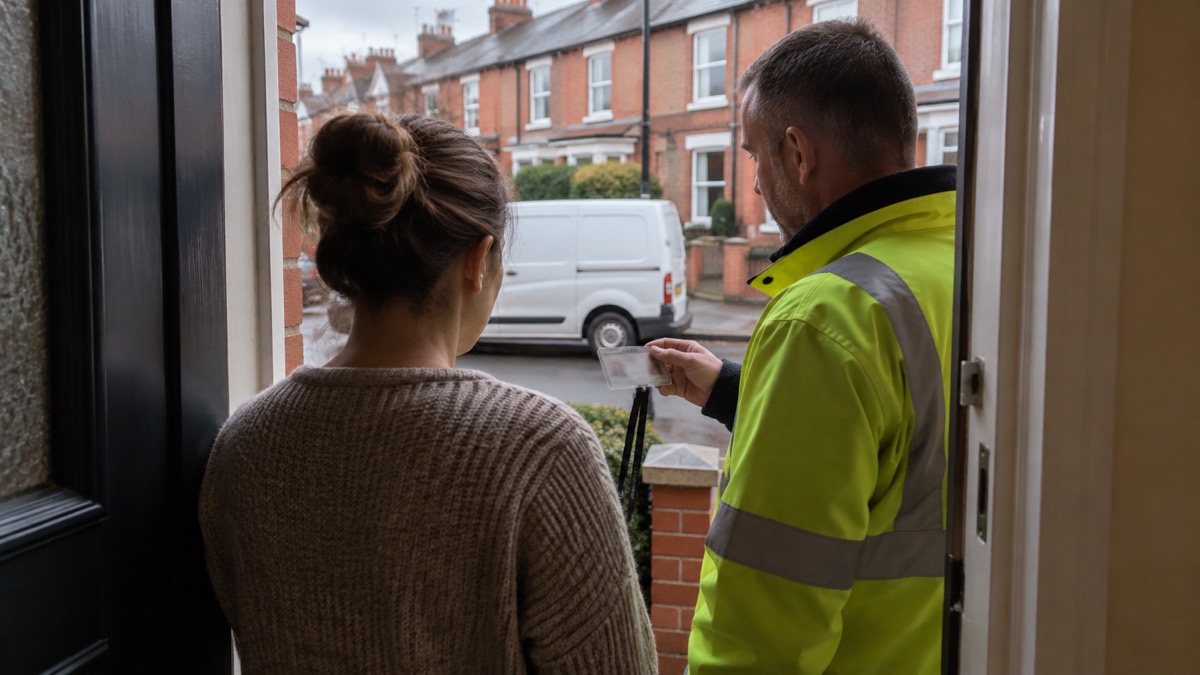
The check matters because the law is clear. Only a Gas Safe registered engineer should carry out gas work, and anyone else doing it is breaking the law8. It is also not acceptable for a registered engineer to knowingly sign off gas work carried out by someone who is not registered; where that happens, both the registered and the unregistered installer may face prosecution12. If you are arranging work in advance rather than answering the door, you can find a local registered engineer through the Find an Engineer service by entering your postcode3.
Ring the operator on a number you already trust
The commonest trick in any doorstep scam is to give you a phone number to ring. Do not use it. Look the number up yourself, from a bill, a previous letter, the operator's own website, or the numbers below, and ring that instead. A genuine engineer will not mind waiting while you do.
| Who you want | Number | When to use it |
|---|---|---|
| National Gas Emergency Service | 0800 111 999 | You smell gas or think there is a leak, 24 hours4 |
| Gas Safe Register | 0800 408 5500 | Checking an engineer or finding one3 |
| Police non-emergency | 101 | Checking the identity of a caller claiming to be from an energy or water company6 |
| Your gas network operator | From your bill or their website | A problem on the network, or to confirm a visit9 |
The 101 check is worth knowing about because it covers more than gas. You can phone 101, the police non-emergency number, to check the identity of callers to your home who claim to work for an energy or water network company6. The same service is offered in Northern Ireland, where you can phone 101 to check that a caller claiming to be from an energy or water company is who they say they are13. Genuine callers, such as meter readers, will be happy to wait while you check their identity14.
If you are on the Priority Services Register, you have a second line of defence. The register lets you choose a password so you know gas and electricity engineers are genuine7. It is run by energy suppliers and network operators for households that need extra help, and you can ask your energy provider or your gas distribution network whether your household could benefit15. It also offers practical help such as sending someone to check your meter regularly16. If you are unsure which network covers your area, see which network operator covers your home.
Signs a caller may not be genuine
Most doorstep callers are exactly who they say they are. The point of checking is not suspicion for its own sake, it is to make the rare bad caller easy to spot. These are the things that should make you slow down.
- No card, or a card they will not hand over. A genuine engineer carries ID and shows it. If they cannot show a valid Gas Safe ID card, do not let them work1.
- A card that does not match the job. The back of the card lists the appliances the engineer is qualified for. If it does not cover the work, they should not be doing it3.
- A phone number they give you. Ring a number you have looked up yourself, not one written on a card or read out at the door6.
- Pressure to get in quickly. Emergency engineers do need entry to make things safe5, but they will still wait while you check. Genuine callers will be happy to wait14.
- A demand for payment on the spot. Gas work must be done by a Gas Safe registered engineer, and anyone else is breaking the law8. If you did not call them and they want money, do not pay.
- They cannot be found on the register. Check the licence number before you let them start10.
When engineers turn up without warning
Unannounced visits are normal in this line of work, and they are not a warning sign on their own. When the National Gas Emergency Service is called, the network arranges for one of its emergency response engineers to come straight out, investigate and make the situation safe9. If there is a problem on the gas network, one of the operator's engineers will be dispatched to investigate17. After a flood, you may be advised to have gas appliances inspected by a Gas Safe Register engineer, because flue or ventilation systems may be affected even if the appliances appear to be working normally18. In each case, the engineer will carry ID and will need access.
The same rule covers all of them: check the card, and if anything is off, ring the operator on a number you trust before you let them in. If you have had work done and want to be sure it was done properly, an annual gas safety check by a Gas Safe registered engineer is the routine way to keep on top of it19. During a gas safety check, the engineer does a visual inspection of pipework and a tightness test to confirm there are no gas leaks11.
If your boiler has stopped and you are waiting for an engineer, it helps to know what to check first so you are not caught out by a caller who claims a fault you do not have. Our guide to checks to make before calling a boiler engineer sets out the simple things to look at, and finding a Gas Safe registered engineer and checking their card goes further on booking work in advance.
If you think someone is not genuine
If you suspect someone is working on gas illegally, report them to Gas Safe Register. If an organisation advertises itself as Gas Safe but is not on the register, report it to Trading Standards8. If you have lost money to someone posing as an engineer, report it to Action Fraud.
Keep a note of what happened while it is fresh: the time, what the person looked like, any vehicle and its registration, and any paperwork they left. Do not let anyone who cannot show a valid card work on your gas appliances, and do not pay them1. If you are worried about an appliance that someone unregistered has already touched, contact a Gas Safe registered engineer, who can inspect the equipment and make any repairs20.
For the wider picture on gas safety at home, including what to do if you smell gas and how the emergency service works, see our guide to gas and heating failures and the National Gas Emergency Service. If you need extra help because of age, disability or a medical condition, our page on extra support from networks and suppliers explains what is available.
Sources (20)
- The Gas Safe ID card, Gas Safe Register, 2026-10-29
- Home gas safety tips, Gas Safe Register, 2026-10-29
- Gas safety FAQs, Health and Safety Executive, 2026
- Smell gas, Cadent Gas, 2026-10-29
- Smell gas, SGN, 2026
- Dealing with a caller at my home, Utility Regulator Northern Ireland, 2025-08-11
- Supporting you, Wessex Water, 2026-10-28
- Gas safety, Argyll and Bute Council, 2026
- Boiler not working, Northern Gas Networks, 2026-10-26
- Gas Safe Register check, Health and Safety Executive, 2026
- Check your gas appliances, Gas Safe Register, 2026-10-29
- Gas safety check - who can do it? - HSE, Health and Safety Executive (HSE)
- Quick Check 101, Phoenix Energy, 2026-10-29
- Community and child safety, NIE Networks, 2026-10-25
- Stay fire safe, Greater Manchester Fire and Rescue Service, 2026-10-29
- Priority Services Register, Derbyshire County Council, 2026-10-29
- Gas supply updates, SGN, 2026
- Flooding advice, Scottish Borders Council, 2026-10-29
- Safe home heating, Warwickshire County Council, 2026-10-29
- Energy, power supply and utilities, nidirect, 2025-10-23
 Checks Before Calling Engineer
 Boiler Checks When Moving In
 Power Cut Kit Checklist
 Stop a Condensate Pipe Freezing
 Repressurising a Combi Boiler
 Hot Water but No Radiators
 Resetting a Boiler Lockout
 Programmer Reset After Power Cut
 Boiler Leaking Water
 Boiler Overheating
 How to Bleed a Radiator
 Boiler On When Away in Winter
 Missed Reconnection Visit
 Prepayment Credit but No Gas
 Low Supply Pressure