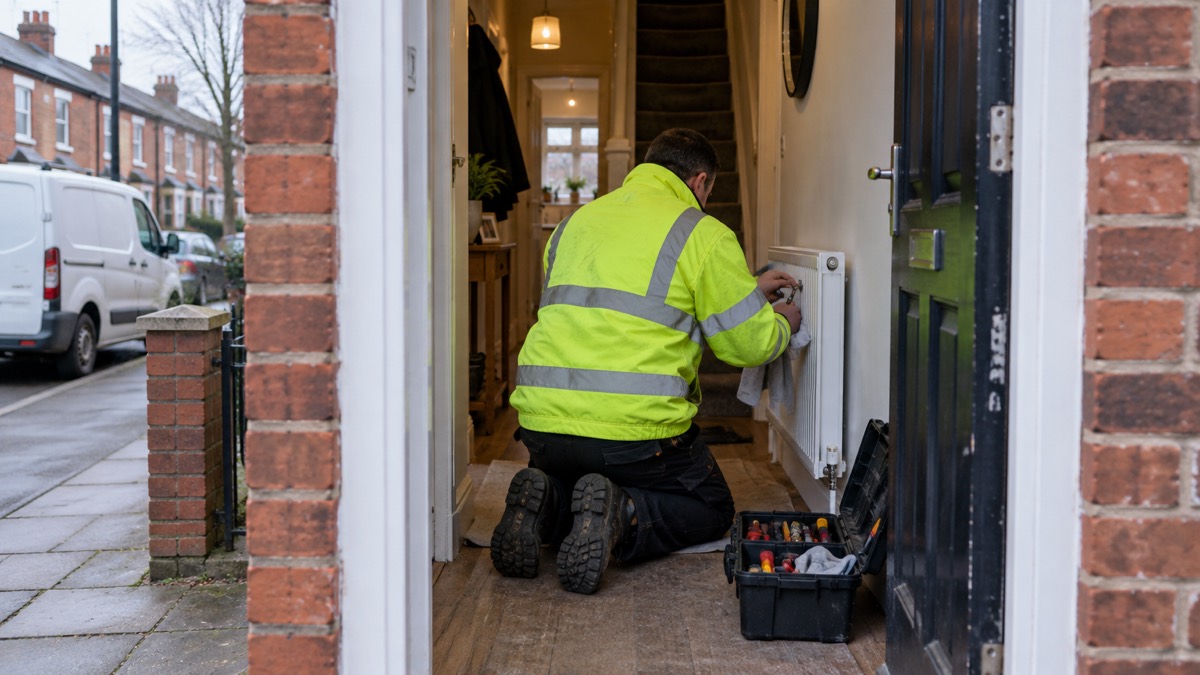
Hot water from the taps but cold radiators is one of the most common partial breakdowns in a UK home, and it usually has a simple explanation. Before you ring anyone, work through the checks in order: the thermostat and timer settings, the radiator valves, the boiler pressure gauge, and any error code on the display. Many households find the fault themselves in a few minutes.
If those checks come up clear, the cause is likely inside the boiler or the heating system: a stuck diverter valve on a combi, a zone valve or pump on a system boiler, or a frozen condensate pipe in cold weather. Those need a Gas Safe registered engineer. Do not open the boiler casing or attempt a repair yourself.
While the heating is off, keep warm safely, and know where to get help if anyone in the home is vulnerable. The sections below take each step in turn.
Check the thermostat, timer and radiator valves first
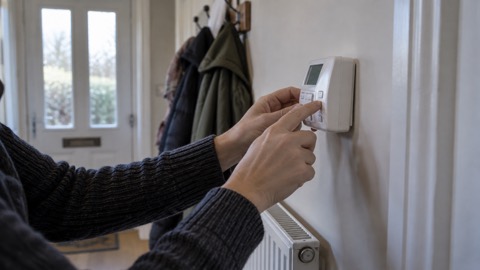
Start with the controls, because a surprising number of "no heating" calls end with a thermostat that was set lower than the room temperature. Ideal Heating's own guidance is to turn the thermostat to its maximum position and check whether a C appears on the boiler display. If the boiler fires and the radiators come on, the room thermostat simply was not set higher than the room temperature5.
Next, look at the radiator valves. A thermostatic valve turned down, or a lockshield valve closed after decorating, will keep a radiator cold while the rest of the house heats. Check that every valve is open, then feel each radiator from top to bottom.
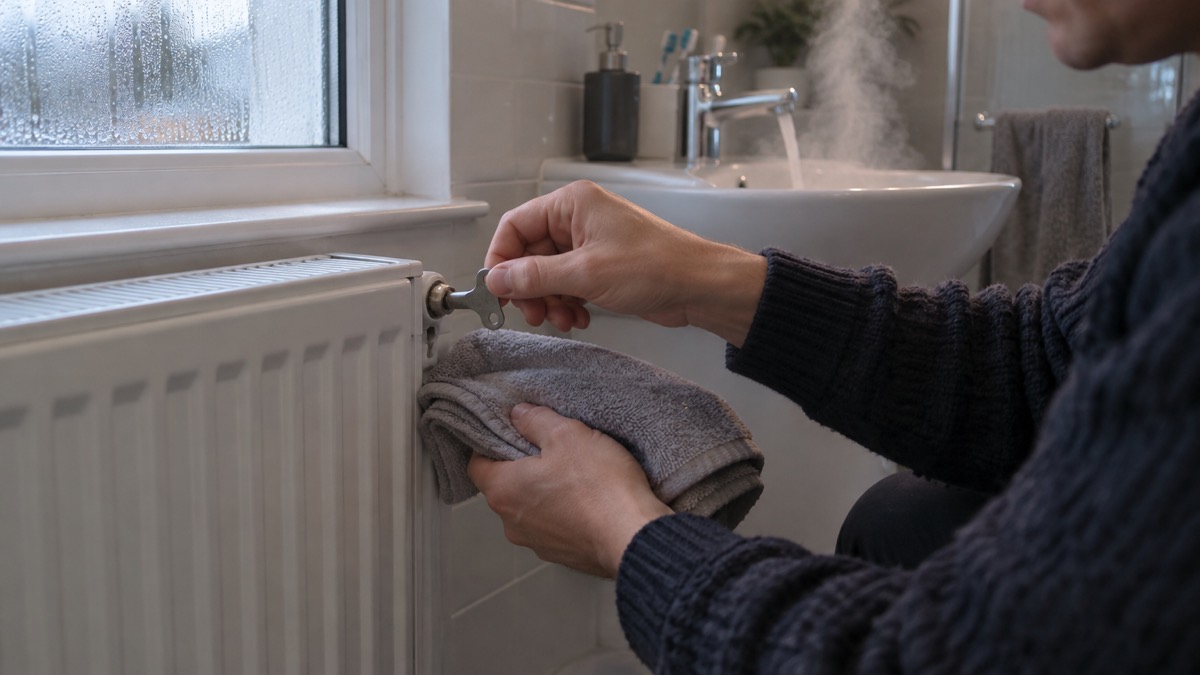
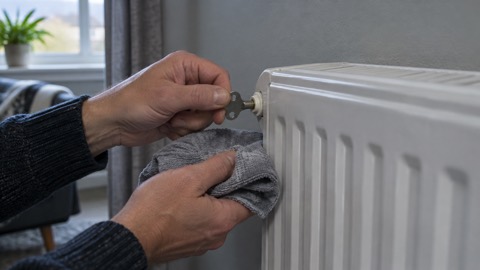
- Colder at the top than the bottom: trapped air. Bleed it with a radiator key, opening the valve gently at the top until a drop of water comes out, then closing it6.
- Cold all over while others are hot: a closed valve, or a balancing problem.
- Bleeding needed regularly: this is likely hiding a wider issue, and a Gas Safe registered engineer should check the system2.
It also pays to test the heating before winter arrives. Derbyshire County Council advises getting the boiler serviced and making sure radiators are hot from top to bottom, and checking that the external pipe of a condensing boiler is insulated7. If you are unsure how to bleed a radiator safely, our guide to bleeding a radiator walks through it step by step, and cold radiators covers air, sludge, valves and balancing in more depth.
Why a combi boiler can give hot water but no heating
A combi boiler heats hot water on demand, with no hot water cylinder, and supplies it at mains pressure2. That design is why the two functions can fail separately. The boiler has a diverter valve that switches the flow between heating the radiators and heating the taps, and if it sticks, one side keeps working while the other does not.
Baxi's guidance puts it plainly: a dodgy diverter valve might be why the heating works but there is no hot water, and on older boilers they do get stuck. If the fault is traced to the diverter valve, you need a heating engineer8. The reverse can happen too, with hot water fine and the radiators cold.
There is a second combi quirk worth knowing. Combi boilers are designed to give a temperature rise depending on the flow rate passing through the boiler, so as more hot water outlets are used, both flow and temperature are shared between them1. That explains why running two taps at once can make the shower cooler, but it does not explain cold radiators.
If your hot water has stopped rather than your heating, the checks are different. Our guide to no hot water covers combi and cylinder systems, and combi or system boiler explains which type keeps hot water going in an outage.
Low boiler pressure: what to check on the gauge
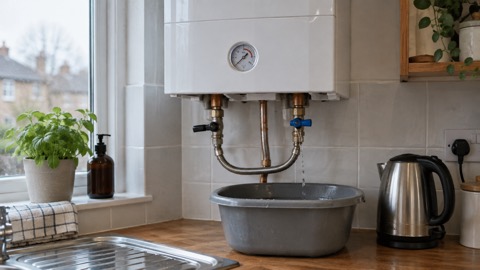
Boilers can lose system pressure as they age, so the gauge is the next thing to look at. Check the central heating system water pressure where applicable, and top it up if it is too low2. The maker's figure for an Ideal boiler is a pressure of 1 to 1.5 BAR after bleeding the radiators9.
Low pressure often follows bleeding radiators, because letting air out lets water out too. It can also point to a slow leak somewhere in the system, which is a job for an engineer rather than a top-up every week.
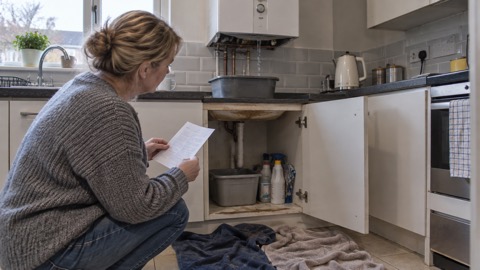
Our guide to boiler pressure explains what the gauge should read and how to deal with low or high pressure, and how to repressurise a combi boiler takes you through the top-up itself. If water is escaping rather than pressure dropping quietly, see what to do if your boiler is leaking water.
Boiler error codes and when to stop and call an engineer
A fault code on the display narrows things down, but codes differ between makers, so always check your own manual or the maker's fault code guidance. Ideal Heating's published codes give a sense of how the maker sorts faults into "you can try this" and "this needs an engineer".
| Code | What the maker says | What to do |
|---|---|---|
| FD | Central heating pump fault | Turn the boiler off, bleed the radiators, check pressure is still 1 to 1.5 BAR, turn it back on9 |
| FD | Pump not running, or running | Contact your installer if the pump is not running; contact Ideal Heating quoting FA if it is running, as it needs an engineer visit9 |
| FA | Installer fault | Contact the installer9 |
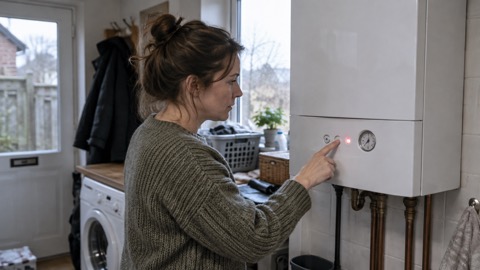
| C0 | Reset does not clear it | Contact Ideal Heating quoting C0, as it needs an engineer visit5 |
| F0 | No water flow thermistor | A component fault inside the appliance9 |
Two situations are worth stopping for. If hot water is running and the central heating is getting warm with a combi boiler installed, the maker says to contact them, as this requires a visit from an engineer9. And if you have tried the checks and the heating still will not come on, it is time to call a heating engineer8.
Our guides to boiler fault codes and how many times it is safe to reset a boiler lockout go further, and checks to make before calling a boiler engineer is a printable list.
Frozen condensate pipe and other cold-weather causes
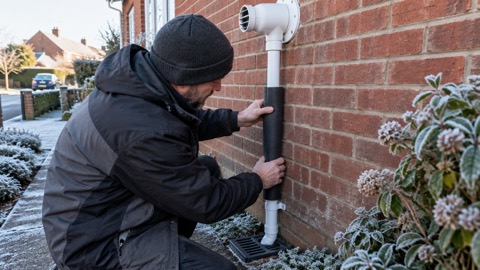
In freezing weather, a condensing boiler's condensate pipe can freeze and stop the boiler running. The fix is simple: thaw the pipe with a hot water bottle, or pour warm water over it10. Northern Gas Networks is specific about the temperature: pour warm, not boiling, water over the pipe using a jug or watering can3.
If the pipe freezes every winter, ask your engineer about insulating or rerouting it. Our guide to frozen condensate pipes covers the signs and the safe thaw, and how to stop a condensate pipe freezing looks at prevention.
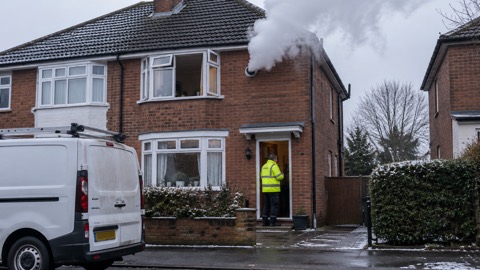
Cold weather brings other heating problems too. If your boiler has overheated, see what to do if your boiler overheats. If your programmer has lost its settings after a power cut, why your programmer reset after a power cut explains what to reset.
Keeping warm while the heating is off
While you wait for an engineer, keep the household warm safely. The NHS advises contacting a Gas Safe registered engineer to make sure heating and cooking appliances are working properly4, and the same winter advice is repeated across NHS trusts11.
- Use the hot water you have. A hot water bottle and a warm bath or shower help, and the hot water is still working.
- Layer clothing and use blankets, and keep the rooms you use most warm rather than the whole house.
- Close doors and use draught excluders to hold heat in living rooms.
- Check on neighbours, particularly older people living alone.
If the heating is off because of a power cut rather than a boiler fault, our power cuts guide and heating and cooking without mains power or gas cover what to do. For a wider look at staying warm in a cold snap, see storms, snow and ice.
Who to call: Gas Safe engineers and help for vulnerable households
For anything inside the boiler, call a Gas Safe registered engineer. The NHS advises contacting one to make sure heating and cooking appliances are working properly4. You can check an engineer's registration and ID card before letting them in, covered in finding a Gas Safe registered engineer.
If you rent, the repair is your landlord's responsibility, and our guide to broken boilers in rented homes sets out what they must do.
For households with someone older, disabled or medically dependent, help exists:
- Priority Services Register: energy suppliers and network operators keep a free list for people who need extra help, including help with prepayment meter access12. Water companies use it too, for people who cannot collect bottled water or need extra help during an incident13. Ask your supplier to add you, and ask anyone you care for whether they are registered14.
- Extra support from networks: our guide to extra support from networks and suppliers explains what is available.
- Boiler cover and warranties: check the small print. Some home emergency cover specifically excludes a boiler breakdown that leaves you without heating or hot water15. A warranty usually depends on regular servicing, so keep the record.
For the wider picture, start with gas and heating failures, and for preparing the home before the next cold snap, see getting started.
Sources (16)
- Boiler faults and hot water but no heating, Ideal Heating, 2026
- Boiler appliance guide, Gas Safe Register, 2026
- Boiler not working, Northern Gas Networks, 2026
- Cold weather advice, West Midlands Ambulance Service NHS Trust, 2026
- Boilers FAQs | Ideal Heating, Ideal Heating
- Prepare your home for winter, Southern Water, 2026
- Keep warm in winter, Derbyshire County Council, 2026
- What to check if you have no hot water, Baxi, 2026
- Boiler fault codes, Ideal Heating, 2026
- Boiler faults, Ideal Heating, 2026
- Stay well this winter, Cheshire and Merseyside NHS, 2026
- Help from your energy supplier, Buckinghamshire Council, 2026
- By your side, Yorkshire Water, 2026
- Water supply interruptions or outages, UK Government Prepare campaign, 2026
- Emergency home cover, Yorkshire Water, 2026
- Water pressure, Yorkshire Water, 2026
 Checks Before Calling Engineer
 Boiler Checks When Moving In
 Power Cut Kit Checklist
 Stop a Condensate Pipe Freezing
 Repressurising a Combi Boiler
 Resetting a Boiler Lockout
 Programmer Reset After Power Cut
 Boiler Leaking Water
 Boiler Overheating
 How to Bleed a Radiator
 Boiler On When Away in Winter
 Missed Reconnection Visit
 Prepayment Credit but No Gas
 Low Supply Pressure
 Checking a Network Engineer's ID