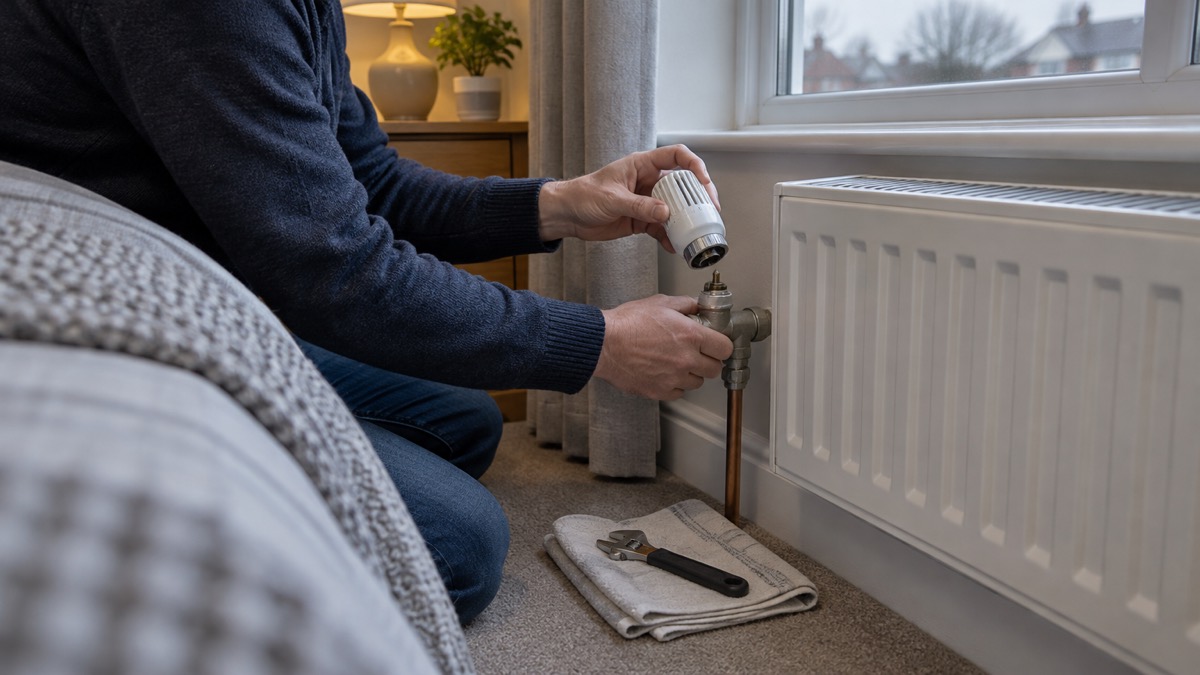
A cold radiator is one of the most common heating faults in a UK home, and where the radiator is cold tells you a lot about what has gone wrong. If it is cold at the top and warm at the bottom, the most likely cause is trapped air, which you can usually fix yourself with a radiator key1. If it is cold at the bottom, cold in patches, or cold all over while other radiators work, the problem is more likely inside the system, and that is a job for a heating engineer rather than a DIY fix.
Start by checking every radiator while the heating is on. Official winter guidance is to test your central heating and make sure radiators are hot from top to bottom2. Run your hand over each one, top and bottom, and note which are cold and where. That simple survey, done once with the heating fully on, is the diagnosis step that decides everything that follows.
Bleeding a radiator is a safe, small job: you use a radiator key to gently open the valve at the top of the radiator and twist it shut again as soon as a drop of water comes out3. What is not safe is ignoring the pattern behind the fault. Gas Safe Register guidance is clear that if your radiators need bleeding regularly, that is likely hiding a wider issue, and a Gas Safe registered engineer should check the system1.
Cold at the top, warm at the bottom: trapped air
When a radiator is warm at the bottom and cold at the top, air has collected in the top of it. Water fills the bottom and circulates as normal, but the air sits at the top like a pocket and stops that section heating up. Gas Safe Register describes exactly this pattern as the sign that a radiator needs bleeding: "You can tell if your radiators need bleeding if they're colder at the top than the bottom, meaning excess air is trapped"1.
Air gets into central heating systems in ordinary ways, through maintenance, small leaks of water out, or changes in the system over time. A single radiator that is cold at the top is usually nothing to worry about and is fixed in a few minutes with a key. The pattern to watch for is repetition. If the same radiators go cold at the top again within weeks of being bled, the air is getting in from somewhere, and Gas Safe Register guidance says that regular need for bleeding is likely hiding a wider issue that a Gas Safe registered engineer should check1.
One thing trapped air is not, is a sign of danger. It is a comfort and efficiency problem: the radiator gives out less heat, the room stays colder, and you pay for heat that does not reach the room. Fix it promptly, but there is no emergency. The emergencies in this page come later: leaks, banging noises and frozen pipes.
If you want the full step-by-step with photographs, see How to Bleed a Radiator.
Check each radiator while the heating is on
Before you touch anything, do the survey. Turn the heating on fully and let it run long enough for every radiator to reach temperature, then check each one from top to bottom with your hand. Derbyshire County Council's winter guidance is to "test your central heating - get your boiler serviced and make sure radiators are hot from top to bottom"2. Nottinghamshire County Council similarly advises households to get heating, radiators and boilers serviced7, and Suffolk Fire and Rescue Service tells residents to check that heating is serviced and cooking appliances are working correctly8.
While you are checking, look at how each radiator is installed as well as how hot it is. Two placement problems stop an otherwise healthy radiator heating a room:
- Do not block radiators with furniture or cover them. Belfast City Council's winter advice is "Don't block radiators as this reduces the heat"9, and the City of London Corporation says to make sure radiators are not blocked by furniture10. A radiator working perfectly cannot warm a room if a sofa is sitting in front of it.
- Check for warning signs that appliances are not working properly. Lincolnshire County Council includes this in its home safety advice11, which covers rust, drips and noises as well as temperature.
Write down what you find for each radiator: hot all over, cold at the top, cold at the bottom, cold all over, or noisy. That list is what you will work through, and it is useful information to have ready if you end up calling an engineer, because it tells them before they arrive whether the fault is in one radiator or across the system.
How to bleed a radiator with a radiator key
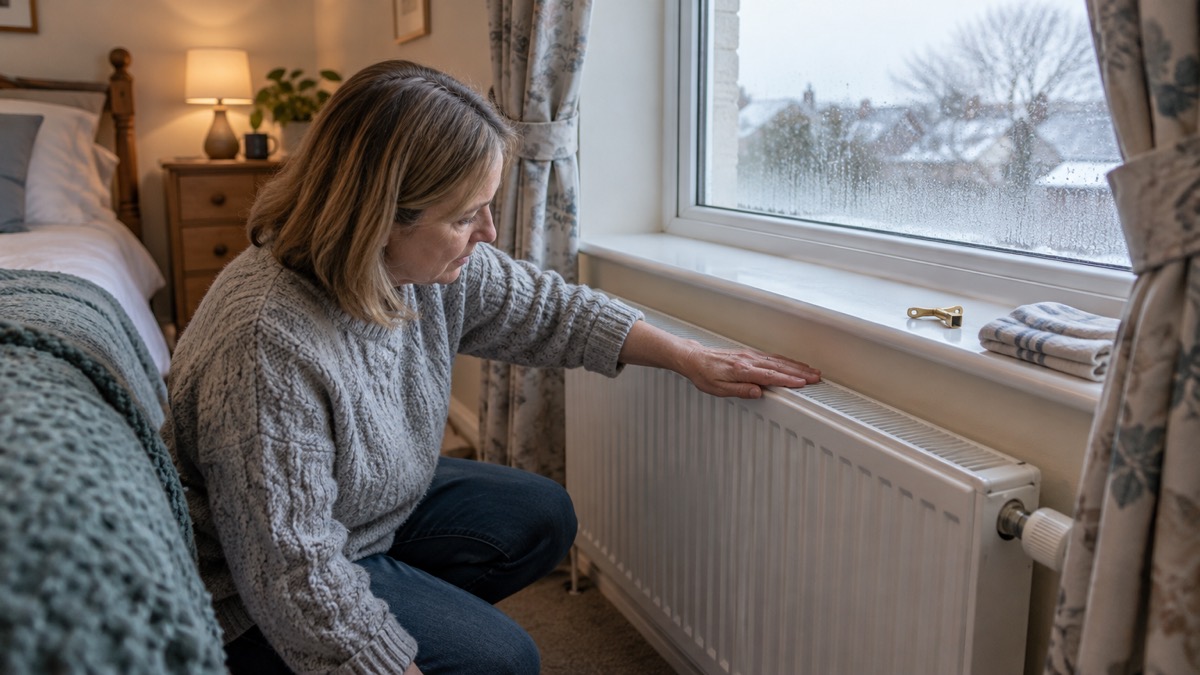
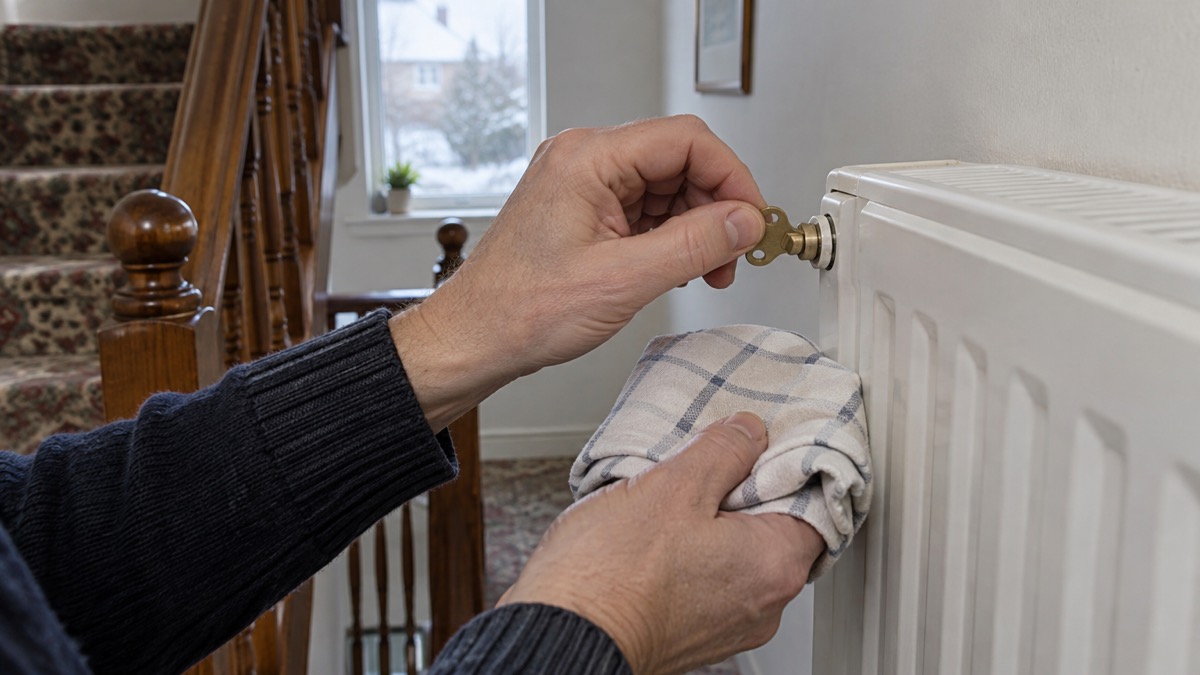
Bleeding is the fix for trapped air, and it is a job most households can do themselves. Southern Water's winter preparation guidance sets out the method: "To bleed your radiator, use a radiator key (you can get these from DIY stores) and gently open the valve at the top of the radiator" and, when you are done, "when a drop of water comes out, twist the valve shut"3.
The steps in order:
- Have your kit ready before you start: a radiator key (available from DIY stores), an old cloth or towel, and a small container to catch the water3.
- Find the bleed valve. It is at the top of the radiator, usually at one end, a small square-headed fitting in the middle of a round nut.
- Fit the key and gently open the valve at the top of the radiator3. You will hear hissing as the trapped air escapes.
- Wait for water. Air comes out first; when a drop of water comes out, the air has gone.
- Twist the valve shut as soon as that drop of water appears3. Do not leave it open, or water will follow the air out.
- Wipe away any water that has run onto the radiator or the floor, and wash your hands. The water inside a heating system is not drinking water and can be dirty in older systems.
Work gently throughout. The valve needs only a small turn to open, and forcing it can damage the seating. If the valve will not turn with reasonable pressure from the key, stop and leave it for an engineer rather than forcing it.
Bleeding to bring down high boiler pressure
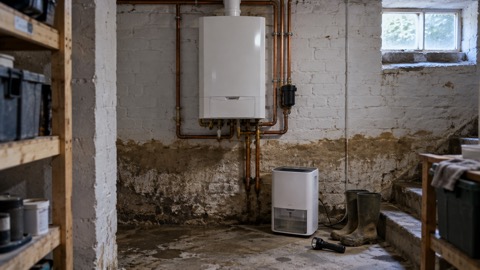
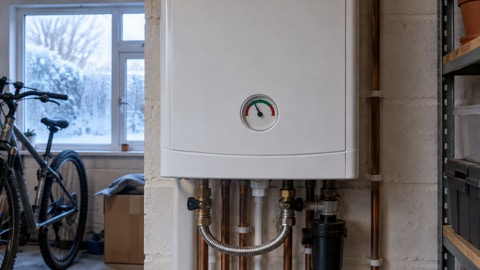
Bleeding a radiator does not only fix a cold top, it also removes air from the system, and that has a direct effect on your boiler's pressure gauge. Air in the system compresses in a way water does not, so removing it changes what the gauge reads. After bleeding, check the pressure gauge on the boiler before you turn the heating back on.
The maker's own guidance for Ideal boilers states the figure to aim for: after bleeding the radiators, "Ensure the boiler pressure is still at 1 to 1.5 BAR"4. If the gauge has fallen below that range after bleeding, the system may need repressurising, which is covered in How to Repressurise a Combi Boiler. If it reads above that range, bleeding further radiators can bring it down, since you are releasing air and a little water from the system.
Two cautions from Gas Safe Register guidance apply here. First, if you find you need to bleed your radiators regularly, Gas Safe Register guidance says this is likely hiding a wider issue, and a Gas Safe registered engineer should check the system1. Second, if the pressure behaves in ways you do not understand, or the gauge swings widely, stop adjusting and get the system looked at. For the gauge itself and what the readings mean, see Boiler Pressure: What the Gauge Should Read and Fixing Low or High Pressure.
Cold at the bottom or in patches: when it is not air
A radiator that is cold at the bottom while the top is warm, or cold in patches across its face, has a different problem, and it is not one a radiator key will fix. Where air rises to the top, debris in the system water settles and collects in the bottom of radiators and in the low points of the pipework, where it blocks the flow of hot water through exactly those sections. The result is the mirror image of the air problem: a hot top and a cold bottom, or cool stripes and patches where the water cannot circulate properly.
This kind of fault needs a professional. There is no safe household fix for debris inside a sealed heating system, and opening the system yourself risks leaks and further damage. The signs that the problem is inside the system rather than simple air are:
- Cold at the bottom or in patches, rather than cold at the top, which points to a build-up of sludge inside the system12
- Radiators that need bleeding again and again, which Gas Safe Register guidance says is likely hiding a wider issue1
If your radiators are making noises as well as running cold, the type of noise matters. Ticking and gurgling usually go with air and water flow, but a loud banging noise is different and more serious, and it is covered in the next section. For the full range of radiator noises and what each means, see Ticking, Gurgling and Banging Radiators: What Each Noise Means.
Rusty or dripping radiators are a warning sign
Rust on a radiator, damp patches on the floor beneath it, or a steady drip from a valve or joint are all signs that water is escaping, and they should not be left. Lincolnshire County Council's home safety advice is to check for warning signs that your appliances are not working properly11. A weeping radiator loses system water over time, which drops boiler pressure, lets more air in, and can damage the floor and decoration around it. Rust and drips often travel together with the cold-bottom pattern described above, because a system that is losing water and drawing in air behaves badly in several ways at once.
If a radiator is actively leaking, deal with the heat source first. North Wales Fire and Rescue Service gives this instruction for a leaking system: "Turn off the water heating system then drain it by running all the hot taps"13. Turning the heating off stops hot water feeding the leak; running the hot taps drains the hot water system down so less water is available to escape. Then get a plumber or heating engineer out to the radiator before the system is used again.
While the heating is off for a leak or a repair, do not try to move portable heaters around hot. London Fire Brigade's advice is "Before moving your heater, turn it off and allow it to cool first"14, and Manchester Fire and Rescue Service gives the same instruction15. If you are using a portable heater to keep one room warm while the system is down, let it cool before you shift it to another room.
Frozen pipes and cold snaps: when the whole system stops
Cold radiators take on a different character in freezing weather. When several radiators go cold at once, or the boiler cuts out entirely during a cold snap, the fault may not be in the radiators at all. Llangattock Community Council's adverse weather guidance warns: "If the heating system fails or makes a loud banging noise, this could indicate that a pipe is freezing. Turn off the system and call a plumber immediately"5. Acting on that warning means switching the system off straight away rather than letting it keep running, and getting a plumber out without delay.
For a frozen pipe that has not burst, Cornwall Council's advice is: "Contact a plumber or if it is safe try to thaw the affected pipe using a hair dryer or hot water bottle (Do not use a naked flame to do this)"16. Never use a naked flame, a blowtorch or boiling water directly on a frozen pipe.
Prevention is straightforward and worth doing before cold weather arrives:
- Lag exposed pipes with thick material or proper lagging; Cornwall Council suggests old blankets as an improvised measure where proper lagging is not to hand16
- Leave the loft trap door open in extreme cold so warm air can reach unlagged tanks and pipes in the roof space, which nidirect guidance advises when there is a chance of freezing17
- Check radiator pipes have not frozen after heavy snow, before you conclude the fault is in the radiators themselves18
The health stakes in a cold home are real and worth knowing. UK Health Security Agency monitoring of recent winters in England found that the risk of death from circulatory disease on the day of cold exposure stays close to baseline, then peaks around 4 to 6 days later and returns toward baseline by approximately 10 days19. In other words, the harm from a cold home arrives with a delay, which is why fixing the heating promptly, and keeping at least one room warm meanwhile, matters more than it might seem on the first cold evening. For the wider picture, see Boiler Breakdowns in Cold Weather: What to Do and Frozen Condensate Pipes: Signs and How to Thaw One Safely.
Boiler error codes alongside cold radiators
When radiators are cold, the boiler will sometimes tell you why, if you know how to read it. Codes and flashing displays mean different things on different boilers, so always check against your own maker's instructions. As an example of how specific these codes are, Ideal Heating's own support guidance for its boilers lists the following4:
| Display | What the maker says it means | What the maker says to do |
|---|---|---|
| Flashing F and 0 | No Water Flow Thermistor | Follow the maker's guidance |
| Flashing F and D | No Water Flow | Turn the boiler off, bleed the air out of the radiators, ensure the pressure is still at 1 to 1.5 bar, turn the boiler back on4 |
| Flashing C and 0 | BCC Activation Fault | Follow the maker's guidance |
| Flashing C and 2 | BCC Chip fault | Follow the maker's guidance |
The F and D entry is the one that connects directly to this page: no water flow can be caused by air in the radiators, and the maker's own remedy is to bleed them and confirm the pressure sits at 1 to 1.5 bar4. That is a maker's instruction for its own product, so follow it only if you have an Ideal boiler showing that code; for other makes, use the maker's own instructions. For a fuller explanation of codes, flashing lights and lockouts across boilers, see Boiler Fault Codes, Flashing Lights and Lockouts Explained, and for how many times it is safe to reset, see How Many Times Is It Safe to Reset a Boiler Lockout?.
When to book an engineer
Bleeding a radiator is DIY. Almost everything else on this page is not. Book a Gas Safe registered engineer rather than attempting the work yourself in these situations:
- Radiators need bleeding regularly. Gas Safe Register says this is likely hiding a wider issue1
- Cold at the bottom or in patches, which points to debris or a circulation problem inside the system12
- Rust, drips or an active leak, after you have turned the heating off and, for a leak, drained the hot water system by running the hot taps13
- Loud banging or system failure in freezing weather, where you should turn the system off and call a plumber immediately5
- Any work on the boiler itself, including gas appliances
The advice to use a Gas Safe registered engineer is repeated across official sources, and it is not a formality. Sussex Resilience Forum's winter guidance says to have heating and cooking appliances checked by a Gas Safe registered engineer to help protect you from exposure to high levels of carbon monoxide20. That check matters because a faulty appliance can expose you to carbon monoxide, which you cannot see or smell. When you book, ask for the engineer's Gas Safe ID card on arrival: if an engineer does not show you their ID card when they arrive at your property, do not be afraid to ask to see it.
Servicing is the routine version of the same protection. The Met Office's WeatherReady winter checklist includes getting the boiler serviced21, and the London Boroughs' winter guidance adds getting your heating system and cooking appliances checked, ventilating your home, and keeping fuel if you do not have gas or electric heating22. For how often a service is needed and what the engineer actually does, see Boiler Servicing: How Often and What an Engineer Checks, and for checking that the engineer who arrives is genuine, see Finding a Gas Safe Registered Engineer and Checking Their Card.
Before you call, run through the simple checks so you do not pay for a visit that ends with the engineer bleeding a radiator: our Checks to Make Before Calling a Boiler Engineer page lists them.
Help with costs while your heating is down
A broken heating system in winter is a cost problem as well as a comfort problem, and there is support you can ask for. Ask your energy supplier whether you qualify for their priority services register, which can mean advance notice of interruptions and extra help during outages; see Extra Support From Networks and Suppliers for Vulnerable Households.
Some council areas run their own schemes. Warm Homes Suffolk, for example, offers help with fuel payments, lends electric heaters, assesses households for financial assistance towards the cost of repairs or replacements if a boiler or heater stops working, discusses energy efficiency improvements, and helps people access grants for insulation and basic draught proofing8. Check your own council's website for the equivalent where you live, in England, Scotland, Wales or Northern Ireland, because these schemes are local and their names and rules differ.
If you are using an electric heater to keep warm while the system is being fixed, oil-filled radiators have a useful characteristic: Devon and Somerset Fire and Rescue Service notes that they take a little while to warm up but give out heat after they are switched off, which can help you save money on electricity23. Whatever heater you use, keep it clear of bedding and curtains, and never use it to dry clothes.
If the heating failure coincides with a power cut rather than a fault, the problem may be the electricity supply rather than your system. Electricity North West's guidance raises the question of how to keep warm without the heating during a power cut24; for that situation, see Power Cuts: A Household Guide and Heating and Cooking Without Mains Power or Gas: A Household Guide.
Sources (24)
- Boiler and appliance guide, Gas Safe Register
- Keeping warm in winter, Derbyshire County Council
- Prepare your home for winter, Southern Water
- Boiler support FAQs, Ideal Heating
- Adverse weather events and snow, Llangattock Community Council
- Cold weather, Public Health Wales
- Keeping warm in winter, Nottinghamshire County Council
- Seasonal winter safety advice, Suffolk Fire and Rescue Service
- Stay warm at winter, Belfast City Council
- Advice on coping in the cold weather, City of London Corporation
- Heaters and electric blankets, Lincolnshire County Council
- What do I do if my radiators are cold? | Alpha, Alpha (alpha-innovation.co.uk)
- Ice and burst pipes, North Wales Fire and Rescue Service
- Portable heaters, gas fires and open fires, London Fire Brigade
- Stay warm safely this winter, Manchester Fire and Rescue Service
- Snow and ice in Cornwall, Cornwall Council
- Steps to reduce the risk of burst pipes, nidirect
- Be prepared, Lancaster City Council
- Cold mortality monitoring report, winter 2024 to 2025, UK Health Security Agency
- Preparing for an emergency: be ready, stay safe, act now, Sussex Resilience Forum
- WeatherReady winter checklist, Met Office
- Keeping warm, healthy and safe in cold weather, Greater London Authority
- Heater safety, Devon and Somerset Fire and Rescue Service
- Power cut fault journey, Electricity North West
 Checks Before Calling Engineer
 Boiler Checks When Moving In
 Power Cut Kit Checklist
 National Gas Emergency Service
 When the Mains Supply Goes Off
 Getting Supply Back After Outage
 Compensation for Supply Cuts
 Planned Pipe Works
 Help During a Long Outage
 Prepayment Meters
 LPG Homes in Winter
 Oil Boiler Breakdowns
 Boiler Breakdown in Cold Weather
 Boiler Fault Codes
 Boiler Pressure Gauge