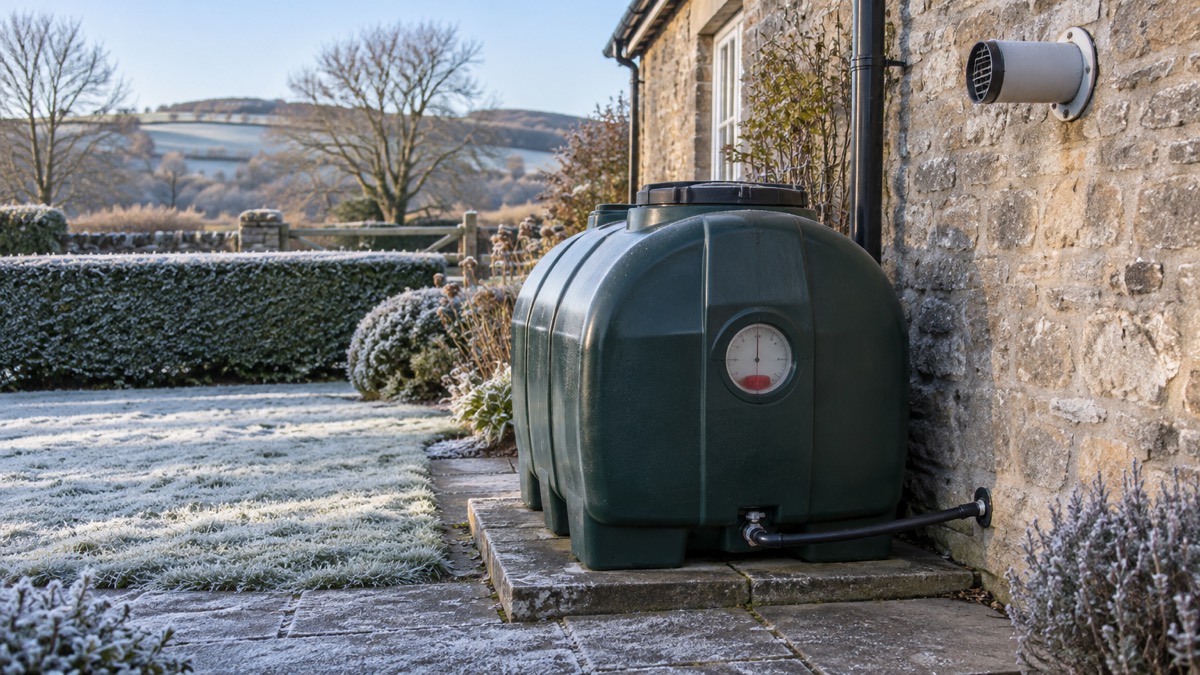
An oil boiler that will not fire, or that has shut itself down and shows a locked-out light, has almost always stopped for a reason you can narrow down quickly: no oil reaching the burner, a leak or blockage in the oil line, or a fault the burner has detected and protected itself against. The lockout itself is a safety feature, not the problem. Your job is to work out which of those causes it is, reset the burner only in the way the maker allows, and call an OFTEC-registered engineer when the cause is not simply an empty tank.
Start with the two checks that solve most cases: look at how much oil is in the tank, and look at the boiler's lockout light or display. If the tank is empty or nearly empty, the fix is a delivery and a proper restart, covered below. If there is oil but the boiler will not fire, or it fires and locks out again, stop resetting it and get an engineer. For oil appliances, Manchester Fire and Rescue Service directs householders to engineers registered with the Oil Firing Technical Association, OFTEC1.
If you smell oil fumes or see oil leaking from the appliance at any point, boiler maker Navien's instructions for its LCB700 apply as a model of what to do: extinguish any naked flames, isolate the electrical supply, isolate the fuel supply to the boiler, and then have the fault put right2.
What a burner lockout means
A lockout is the burner's own protective shutdown. When the burner cannot ignite the oil properly, or a safety limit is reached, it stops trying and locks itself out so that unburnt oil does not keep being sprayed into the combustion chamber. On most oil boilers this is shown by a red or amber light on the burner control box, and the boiler will not run again until the lockout is reset.
The commonest causes fall into three groups. The first is the oil supply: an empty tank, or a leak or blockage in the line between the tank and the burner, means no fuel reaches the burner and it locks out. Ceredigion County Council's severe weather advice notes that higher than usual oil consumption with no visible spillage can indicate defective underground pipework, and that installers can pressure test the lines to confirm this3. So if your oil seems to be disappearing faster than it should, a leaking underground line may be the reason your boiler is starving.
The second group is contamination or air in the oil line, which is what happens most often after a tank has run dry: the line draws in air and sediment, and the burner cannot establish a steady flame. The third is a genuine fault in the burner, the pump, the nozzle or a safety control, which is where an engineer comes in.
A lockout that keeps recurring after a reset is a signal to stop and get help. The Health and Safety Executive's guidance on wood pellet boilers, which applies the same principle to a related heating technology, is to turn the unit off and seek assistance immediately if problems such as the system not heating correctly persist7. The same discipline applies to oil.
Reading the light and resetting safely
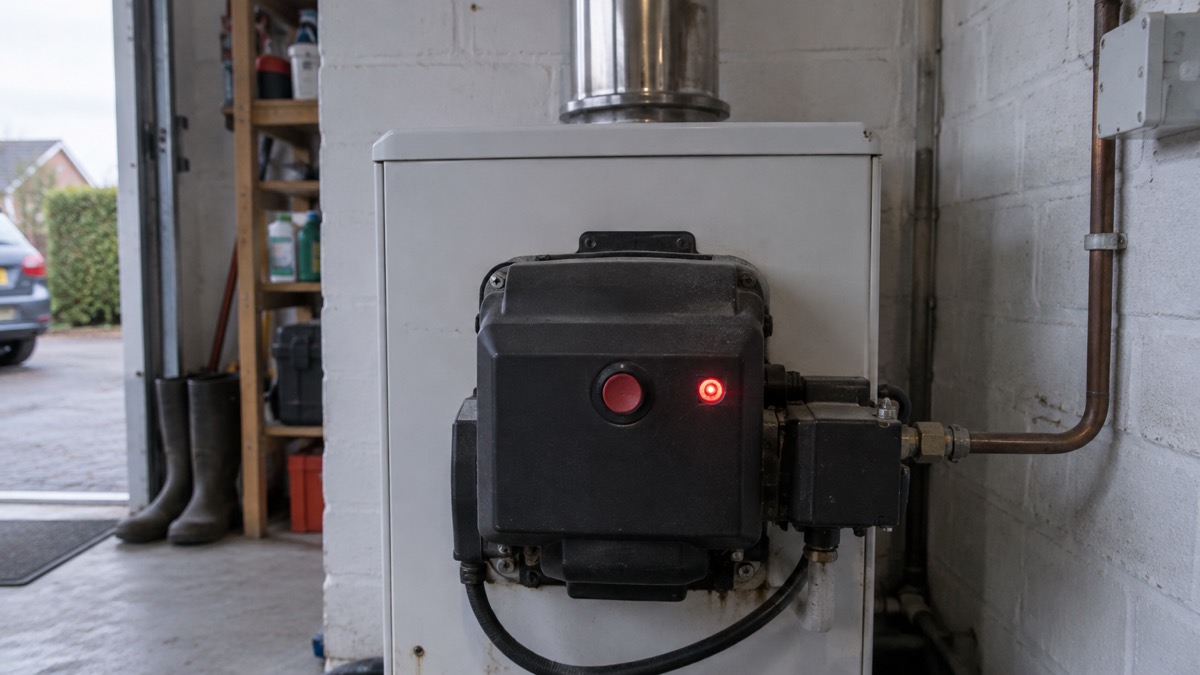
The light or display on your oil boiler's control box tells you which state it is in, and the meaning differs by maker and model, so the boiler's own manual is the authority on what each light means. In general terms, a burner lockout is shown by a steady or flashing red light on the burner, and the reset is the button on that same control box. An overheat lockout is different: it means the boiler itself got too hot, and it is usually reset by a different control, often one on the boiler rather than the burner.
The rule that matters is how many times you press reset. Press it once, following the manual. If the boiler fires and runs, the cause may have been a one-off. If it locks out again, press it at most once more. Repeatedly resetting a burner that keeps locking out sprays unburnt oil into the boiler and can create a fire risk when it eventually ignites, and it does nothing to fix the underlying cause. Our page on how many times it is safe to reset a boiler lockout covers this in detail, and boiler fault codes, flashing lights and lockouts explains what the common displays mean.
For an overheat, the sequence is: let the boiler cool, find out why it overheated, and reset the overheat limit stat only if you know the cause has been fixed. If a boiler overheats repeatedly, stop resetting it. Our page on what to do if your boiler overheats sets out the steps.
There are warning signs that mean you should not reset at all, but turn the boiler off and call an engineer. Cheshire Fire and Rescue Service's safe and well booklet lists the fault signs that mean a boiler should be switched off and an engineer called: strange noises, leaks, a yellow flame where it should be blue, unusual smells, the boiler turning itself on and off, low pressure or no hot water, and soot or staining around the boiler8. Those signs apply to gas boilers in that guidance, but the same symptoms on an oil boiler mean the same thing: stop, switch off, and get a qualified person.
Carbon monoxide is the other reason to treat a misbehaving boiler seriously. Dorset and Wiltshire Fire and Rescue Service warns that burning fuel in an enclosed or unventilated space, where there are no air vents and no windows or doors left open or ajar, causes carbon monoxide poisoning9. A faulty oil boiler can produce carbon monoxide, so if the boiler is running badly, ventilate the room and get it checked. If anyone in the household has symptoms of carbon monoxide poisoning, get medical help and get the boiler looked at before it runs again.
When the boiler runs but the radiators stay cold
A different problem from a lockout: the boiler fires, the pipes near it are hot, but the radiators do not warm up. This is usually a circulation or distribution problem rather than a burner problem, so resetting the burner will not help.
The likely causes are air in the radiators, sludge in the system, a stuck or closed valve, or the system needing balancing so that distant radiators get their share of the flow. Our page on cold radiators: air, sludge, valves and balancing goes through each in turn, and how to bleed a radiator covers the commonest fix step by step. If the boiler is hot but there is no hot water at the taps as well, see no hot water: checks for combi and cylinder systems.
Nottinghamshire County Council's advice on keeping warm in winter is to get heating, radiators and boilers serviced10, and the Humber Local Resilience Forum advises testing boilers or heating systems before winter6. A service will often catch the causes of poor circulation, such as sludge, before they leave you with cold radiators in a cold snap. Our page on boiler servicing: how often and what an engineer checks explains what that visit should cover.
One oil-specific check belongs here: if the boiler seems to be burning a lot of oil for little heat, and there is no visible spillage, Ceredigion County Council advises that defective underground pipework could be the cause, and that installers can pressure test the lines3. A leaking supply line wastes oil and starves the burner, which can produce exactly this pattern.
Running dry: restarting after the tank has emptied
Letting an oil tank run empty causes more trouble than the empty tank itself. When the tank runs dry, the oil line draws in air and any sediment from the bottom of the tank, and the burner locks out. Refilling the tank does not clear that air and sediment: the line has to be bled through, and if sludge from the tank has been drawn into the line and the filter, the tank and the oil lines may need cleaning and flushing before the boiler will run reliably again.
That work is not a householder's job. It involves handling fuel, breaking into the oil line and restarting a burner, which is why it falls to an OFTEC-registered engineer. Book the delivery first, then book the engineer to bleed and restart the system, telling them the tank ran dry so they arrive expecting to clean the filter and the line rather than just press reset.
While you wait, keep warm safely. Devon and Somerset Fire and Rescue Service notes that oil filled radiators have no exposed heating elements, so they are relatively low risk of igniting items nearby, and are preferred over other types of portable heater11. The same service notes they take a little while to warm up but keep giving out heat after they are switched off12. Never bring a barbecue or any outdoor fuel-burning appliance indoors, and never leave any heater unattended. Our heating and cooking without mains power or gas guide covers the options in full.
Keeping enough oil in the tank through winter
The practical rule is simple: order early and do not let the tank run low in the coldest months. A tank that runs dry in a cold snap leaves you with no heating and a restart job on top. If you use oil to heat your home, Oftec can be called on 01473 626 29813.
How much that means depends on your tank, your house and how cold the winter is, so the useful habit is to know how much oil you use. Northumberland County Council's pollution advice includes knowing how much oil you use as one of its regular checks, precisely because a sudden change in consumption is the earliest warning of a leaking line or a failing boiler4.
Storage rules matter too, and they differ slightly between the documents. Gov.uk's oil storage guidance states that you will need a bund (a secondary containment around the tank) if your tank can hold more than 2,500 litres of oil5. Northumberland County Council states that all tanks for outside storage of oils and fuel must be bunded to comply with current oil storage legislation, except domestic heating oil below 3,501 litres4. The two documents disagree on where the threshold sits, so if you are replacing a tank, ask your OFTEC-registered installer which rules apply to your tank and your situation. Gov.uk also notes that if your storage container can hold 3,501 litres or more, you must follow the regulations for businesses5.
Leaks, tank damage and who to call
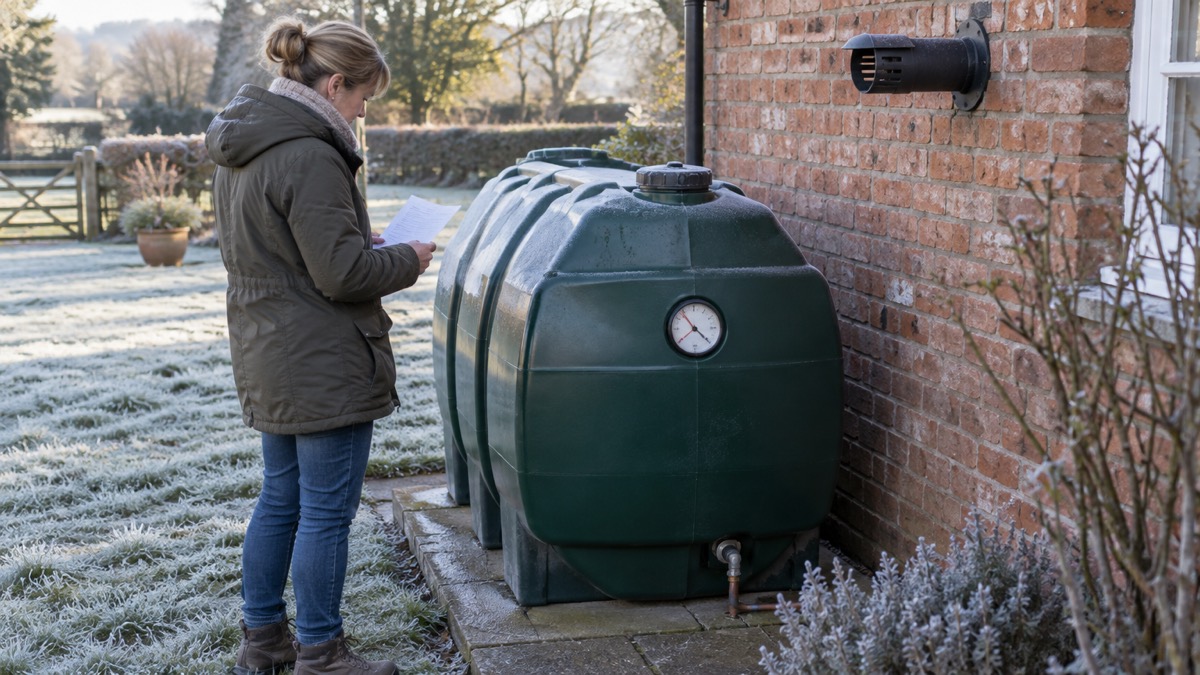
An oil leak is one of the few household emergencies where what you do in the first hour matters, because heating oil spreading into the ground, a drain or a watercourse can cause pollution that is hard to clean up. Northumberland County Council reports that faulty or badly maintained domestic central heating oil tanks cause numerous pollution incidents4, and Somerset Council warns that failing to address a significant spill can bring major liabilities to compensate adjacent landowners14.
One visible warning sign of a problem with a liquid fuel tank is bulging14. If you notice a leak, damage or another problem with your tank or heating system, contact your local heating oil distributor or an OFTEC-registered technician3. If the leak could affect a stream, pond or other water supply, call the Environment Agency immediately3, and if repair or replacement of the tank is required, do not attempt to do this yourself3.
If you find a leak, Northumberland County Council's sequence is: call your home insurance company or landlord and make them aware; find where the leak is coming from; switch off your oil supply at the tank and arrange to have it emptied if needed; try to stop the leak at the source; and block the spill from entering drains using absorbent materials such as earth or sand4. Somerset Council adds: if the leak could affect a stream, pond or other water supply, call the Environment Agency immediately14.
Gov.uk's oil storage safety advice adds two firm rules: stop the oil spreading if you can, following the advice on your tank sticker and on the Oil Care website, and do not try to clean up the oil spill yourself5. Somerset Council is equally firm about the tank itself: if repair or replacement is required, do not attempt to do this yourself14.
Prevention is mostly routine. Northumberland County Council's checklist for oil tank owners is: check the condition of your tank and boiler regularly; watch out for black stains; know how much oil you use; get your heating system serviced regularly; do not overfill your oil tank; keep the fill points clear; and review your home insurance policy to make sure you are covered for oil leaks or spills4. Doing those few things through the year is what keeps a small weep from becoming a pollution incident.
Finding an OFTEC-registered oil engineer
For oil appliances, the register that matters is OFTEC, the Oil Firing Technical Association. Manchester Fire and Rescue Service's winter heating safety campaign directs householders with oil appliances to OFTEC1, in the way that gas work belongs to Gas Safe registered engineers (see our page on finding a Gas Safe registered engineer for the gas equivalent). Use OFTEC's website to find a registered technician in your area, and check the technician's own registration covers oil work before they start.
OFTEC's role goes beyond keeping the register. Boiler maker Navien states in its LCB700 manual that OFTEC must be informed about every installation, that OFTEC will issue a building regulations compliance certificate to the householder, and that OFTEC will notify the local authority building control2. The same manual notes that fire valves on the oil supply system should comply with OFTEC standard OFS E101, with the installation complying with BS5410 Part 1 and OFTEC book 32. In practice this means an OFTEC-registered installer works to a published standard and your installation is properly recorded, which matters when you sell the house or make an insurance claim.
One caution worth knowing, from the carbon monoxide safety charity CO-Gas Safety: if you suspect a carbon monoxide problem with your appliance, it advises thinking carefully about calling in an engineer, even the one who installed it, because a repair may make the appliance safe but change the evidence; its alternative is to isolate the appliance, turn it off and seek its help to find an expert15. That is a judgement for the specific situation of a suspected CO fault, not for an ordinary breakdown, but it is worth knowing before you ring the installer.
Help with costs and keeping warm meanwhile
A boiler breakdown in winter is a cost as well as an inconvenience, and there is help available, though it varies by area. In Suffolk, the Warm Homes scheme can help with your fuel payments, lend you electric heaters, assess you for financial assistance towards the cost of repairs or replacements if your boiler or heater stops working, discuss energy efficiency improvements, and help you access grants for insulation and basic draught proofing13. Check whether your own council runs something similar.
The British Gas Energy Trust, an independent charity, gives free grants for boiler repairs and replacements, amongst other things, with nothing to pay back; people can apply online or request a form and send it freepost15. Despite the name, the trust is not limited to British Gas customers in the way many people assume, so it is worth checking its eligibility rules.
For households off the gas supply, Ofgem's consumer advice notes that network operators make additional payments and provisions available, including alternative heating and cooking facilities, when there are gas supply issues16. Our page on help from networks during a long outage and our guide to extra support from networks and suppliers for vulnerable households set out what you can claim and how. If you are struggling to get through to a supplier and the dispute has reached deadlock, the Energy Ombudsman can be called on 0330 440 162416.
While the boiler is out of action, keep warm safely. Oil filled radiators are the preferred portable heater because they have no exposed elements11, and they keep giving out heat after being switched off12. The Scottish Fire and Rescue Service advises keeping spare fuel for paraffin heaters outside the home, no more than 23 litres and preferably only 9 litres, in purpose made containers stored away from sources of heat17. Never use a portable heater to dry clothes, never leave one unattended, and never bring a fuel-burning appliance meant for outdoors inside, because of carbon monoxide9. Our heating and cooking without mains power or gas page has the full guidance.
Sources (17)
- Stay Warm Safely This Winter, Manchester Fire and Rescue Service
- Navien LCB700 Combi Installation and User Manual, Navien, 2026
- Snow and Ice: Severe Weather Advice, Ceredigion County Council
- Domestic Oil Pollution Advice, Northumberland County Council
- Oil Storage Regulations and Safety at Home, Gov.uk
- Winter Resilience Guidance, Humber Local Resilience Forum, August 2024
- Wood Pellet Fuels and Safe Installations, Health and Safety Executive
- Safe and Well Booklet, Cheshire Fire and Rescue Service
- Carbon Monoxide Safety at Home, Dorset and Wiltshire Fire and Rescue Service, 18 November 2025
- Keeping Warm in Winter, Nottinghamshire County Council
- Equipment Advice for Carers, Devon and Somerset Fire and Rescue Service
- Heater Safety, Devon and Somerset Fire and Rescue Service, 20 November 2024
- Seasonal Winter Safety Advice, Suffolk Fire and Rescue Service
- Oil Tank Leaks, Somerset Council, 29 July 2025
- Emergency Help and Grants, CO-Gas Safety, 6 July 2015
- England and Wales Domestic Energy Consumer Advice, Ofgem, November 2024
- Heating and Gas Safety at Home, Scottish Fire and Rescue Service, 21 November 2024
 Checks Before Calling Engineer
 Boiler Checks When Moving In
 Power Cut Kit Checklist
 National Gas Emergency Service
 When the Mains Supply Goes Off
 Getting Supply Back After Outage
 Compensation for Supply Cuts
 Planned Pipe Works
 Help During a Long Outage
 Prepayment Meters
 LPG Homes in Winter
 Boiler Breakdown in Cold Weather
 Boiler Fault Codes
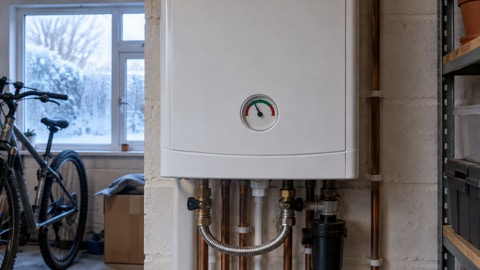 Boiler Pressure Gauge
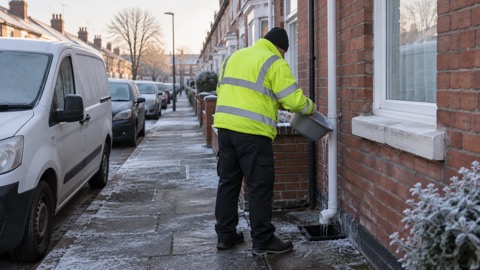 Frozen Condensate Pipes