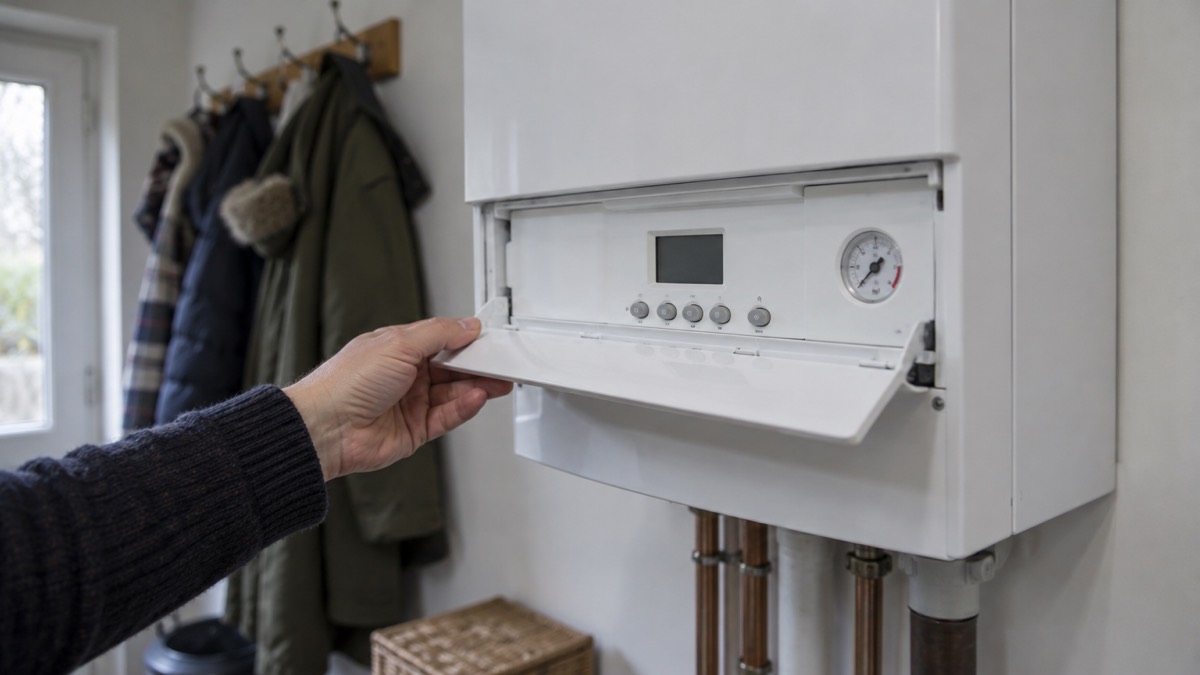
When your boiler stops working, it almost always tells you why. Modern UK boilers display a fault code, a flashing letter and number, or a sequence of lights on the front panel, and each code points to a specific problem: low water pressure, a failed ignition, a blocked condensate pipe or a sensor fault. The trick is knowing which codes you can act on yourself and which mean the boiler needs a Gas Safe registered engineer.
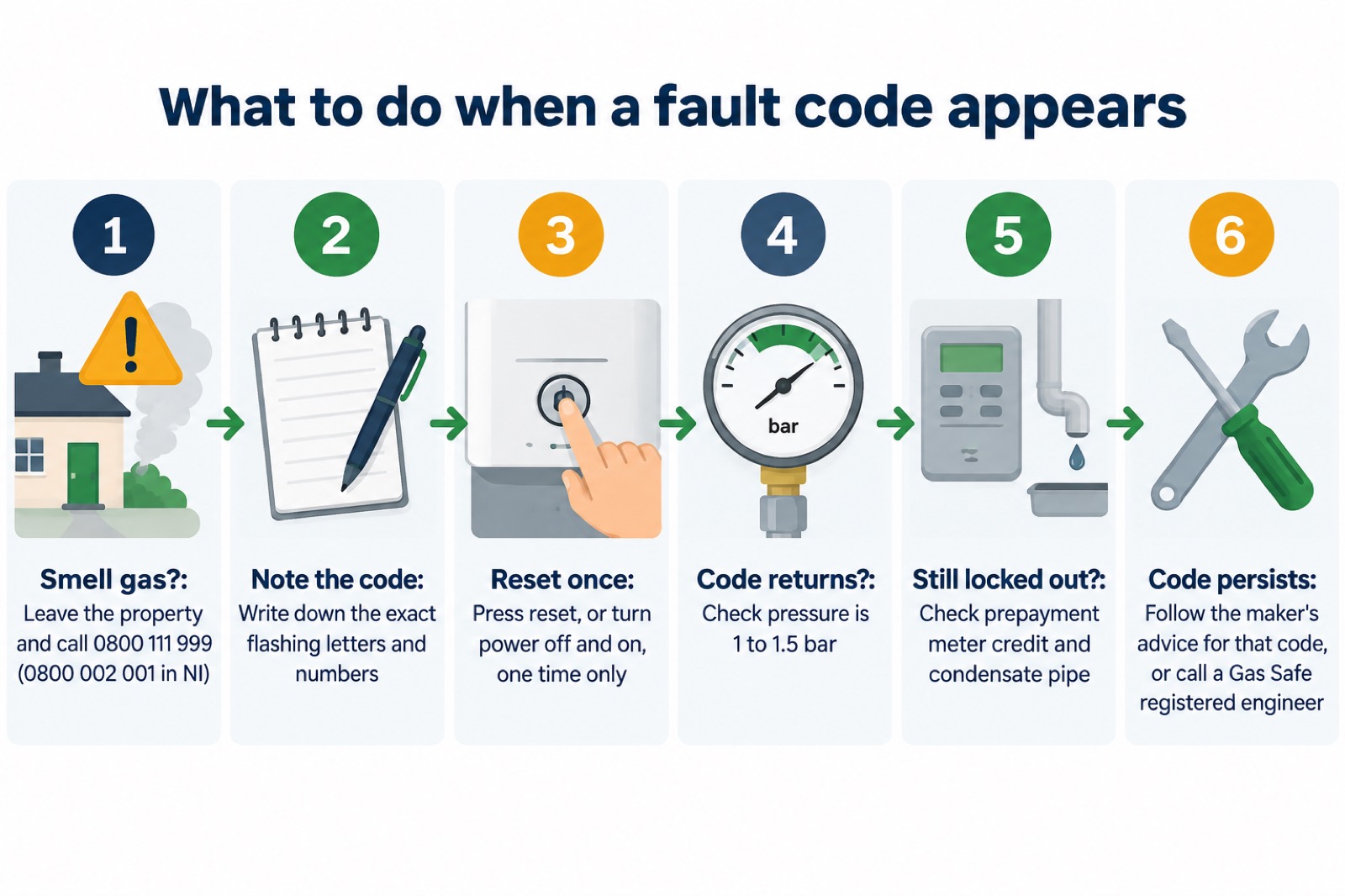
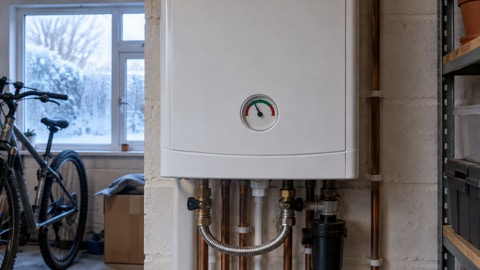
The first move with almost any code is the same: reset the boiler once, and if the code comes straight back, stop and diagnose rather than resetting again. Ideal Heating, one of the UK's most common boiler makers, warns that resetting too many times in 15 minutes triggers its own lockout code, L51. Two checks solve a large share of faults without any tools: the system pressure gauge should read 1 to 1.5 bar1, and if you are on a pay-as-you-go gas meter, there should be credit on it1.
One thing comes before every fault code: if you can smell gas, that is not a boiler fault to diagnose, it is an emergency. Open a window if you can, leave the property immediately and call the National Gas Emergency Service on 0800 111 9992. Do not smoke or use naked flames until you are sure there is no leaking gas2.
If you smell gas, leave the property and ring the emergency line first
Before any fault code matters, deal with gas. If you smell gas inside or outside your home, open doors and windows, leave the area and call the National Gas Emergency Line on 0800 111 9992. This is a free, 24-hour national number, and you should ring it whether the smell is inside or outside the property5. Fire and rescue services across the UK give the same advice: Scottish Fire and Rescue Service directs anyone who smells gas and suspects a leak to ring the National Gas Emergency Service on 0800 111 9996, and Cornwall Council lists the same number for gas leaks7.
Do not use electric switches, do not smoke, and extinguish any naked flames. The Royal Voluntary Service's winter guidance adds that you should turn off the gas at the meter unless the meter is in the cellar, in which case do not go down into it, because gas can collect there8. Once the leak has been stopped, any work on appliances such as cookers, boilers or fires has to be carried out by a Gas Safe registered engineer9.
In Northern Ireland the number is different: if you smell gas, call the NI Gas Emergency Service on 0800 002 0013. Tenants in rented homes are given the same 0800 111 999 number to call if they smell gas or suspect a carbon monoxide leak10. The Health and Safety Executive also says to call the National Gas Emergency Service on 0800 111 999 if you think your appliance is spilling carbon monoxide11. Our page on the National Gas Emergency Service explains what happens when you ring.
Reset the boiler once before anything else
Most fault codes can be cleared the same way, and the maker's own guidance is consistent about it: reset once, and only once, before you start investigating. On Ideal boilers, the advice for several codes is simply to reset the boiler12; for others, such as L5, the maker's instruction is to turn the power to the boiler off and on again12. If a single reset clears the code and the boiler runs normally afterwards, the fault was probably a one-off, such as a brief interruption in the gas or electricity supply.
If the code comes back immediately, do not keep resetting. Ideal Heating's own fault code list shows why: code L5 exists specifically to tell you the boiler has been reset too many times in 15 minutes1. The boiler is protecting itself. Instead, use the code to narrow down the cause:
- Note the exact code or light sequence, including which characters are flashing.
- Reset once, following the maker's instruction for that code.
- If it returns, check the two most common household causes: the pressure gauge (it should read 1 to 1.5 bar) and, on a prepayment meter, that you have credit1.
- If neither fixes it, match the code to the tables below and follow the maker's advice for it.
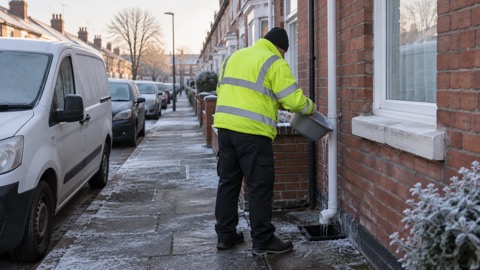
For ignition lockouts specifically, Ideal's troubleshooting manual for the Logic system range sets out the first steps in order: check the boiler's condensate pipe for blockages, then check whether other gas appliances are working13. A frozen or blocked condensate pipe is one of the most common causes of winter lockouts, and our page on frozen condensate pipes covers how to spot and safely thaw one.
Lockouts: what a flashing flame or L code means
A lockout is the boiler refusing to fire until the fault is cleared. On Ideal boilers, lockout codes begin with L. The most common is L2, which Ideal's troubleshooting manual defines plainly: "L2, Ignition Lockout"13. The support articles describe the same code as Flame Loss or Ignition Lockout, shown as a flashing L and 21. In plain terms, the boiler tried to light, failed, and shut down safely rather than pumping unburned gas into the burner.
Ignition lockouts have a short list of usual causes, and Ideal's own guidance walks through them. If your gas meter is pay-as-you-go, check there is credit available1. If other gas appliances are also not working, or you have no other gas appliances to check, look at whether the gas supply is on at the meter13. Check the condensate pipe for blockages, which in cold weather usually means ice14. If the boiler is making a gurgling or gargling noise whilst trying to fire, contact your installer, as there may be a blockage1. If none of that fixes it, call Ideal Heating quoting Error Code L21.
Other L codes on Ideal boilers point to different faults, and the maker's advice differs code by code:
| Code (flashing) | Meaning | Maker's advice |
|---|---|---|
| L1 | Flow Temperature Overheat or No Water Flow | Reset the boiler; ensure all radiator valves are open; if not fixed, contact Ideal Heating12 |
| L2 | Flame Loss or Ignition Lockout | Check credit, gas supply and condensate pipe; if not fixed, call quoting Error Code L21 |
| L3 | No Water Flow | Turn the boiler off, bleed the radiators, check pressure is 1 to 1.5 bar, turn back on12 |
| L4 | Flow Thermistor fault | Reset the boiler15 |
| L5 | Reset too many times in 15 minutes | Turn the power to the boiler off and on again to reset1 |
| L6 | False Flame Lockout | If a reset does not fix it, contact Ideal quoting error code L6, as it needs an engineer1 |
The pattern to notice: L1, L2, L3 and L5 have household checks attached to them. L4 and L6 do not, and the maker sends you straight to a professional. That distinction, more than the code itself, is what decides whether you can act.
Pressure faults: keep the system at 1 to 1.5 bar
Low water pressure is the fault most households can fix completely on their own, and it is the one to check whenever the boiler shows a pressure-related code or the heating runs poorly. Ideal Heating states the correct range repeatedly across its guidance: boiler water pressure should be at 1 to 1.5 bar1. On Ideal boilers, code F1 (flashing F and 1) means Low Pressure: the water pressure is too low in the system and will require topping up to between 1 and 1.5 bar1.
The maker's instruction for F1 is to check the system water pressure is between 1 and 1.5 bar on the gauge and, if that is the issue, re-pressurise the system as outlined in the user manual13. Our step-by-step page on how to repressurise a combi boiler walks through the filling loop, and the fuller background is on boiler pressure.
Pressure and air in the system are linked, and Ideal's advice for several codes combines the two. For code L3, the instruction is to turn the boiler off, bleed the air out of the radiators, ensure the boiler pressure is still at 1 to 1.5 bar, and turn the boiler back on1. Radiators need bleeding when they are colder at the top than the bottom, because that means excess air is trapped16. But bleeding should not become a routine: if it is needed regularly, it is likely hiding a wider issue, and a Gas Safe registered engineer should check the system16. Our page on how to bleed a radiator gives the full method.
Ideal boiler codes: F1 to F7 and the other display messages
Ideal Heating publishes its fault code meanings in its support articles, and the F series covers sensor, fan and supply faults. Several of these have no household fix, and the maker says so directly.
| Code (flashing) | Meaning | Maker's advice |
|---|---|---|
| F1 | Low Pressure | Top up the system to between 1 and 1.5 bar1 |
| F2 | Flame Loss / Ignition Lockout | Check gas supply and prepayment credit; if no reason found, contact Ideal Heating under warranty or a Gas Safe registered engineer1 |
| F3 | Fan Fault | Contact an engineer1 |
| F4 | Flow Thermistor | Contact an engineer1 |
| F6 | Outside Sensor Fault | Reset the boiler; if this does not fix the problem, contact Ideal quoting error code F6, as it requires a visit from an engineer17 |
| F7 | Low Mains Volume; voltage to the boiler may be too low | Contact a local electrician to inspect the electrics of your property1 |
Two of these deserve a note. F2 is the code where Ideal's warranty guidance is explicit: if you can see no reason the boiler shouldn't be working, get in touch with Ideal Heating if the boiler is under warranty, or a Gas Safe registered engineer if it is not13. F7 is unusual because the maker sends you to an electrician rather than a heating engineer: the voltage to the boiler may be too low, which points to the property's electrics, not the appliance1.
Ideal's displays also carry codes outside the main series. Flashing C and 0 is a BCC Activation Fault1. Code LC:5 means the boiler has been reset too many times in 15 minutes, and the fix is to turn the power off and on again1. Code DU's instruction is to rotate all knobs fully clockwise, turn the boiler off, turn it back on and then press restart17. Code FA means contact the installer17. If you own an Ideal Logic model, our product pages for the Logic Combi2, Logic Max Combi2 and Logic+ Heat2 H go into model-specific detail.
Worcester Bosch display symbols that are not faults
Not everything flashing on a boiler front panel is a fault. Worcester Bosch boilers display several symbols that look alarming but are normal operating modes, and the maker's support article is reassuring about each of them. The one that catches most people out is siphon fill mode: the boiler runs at a low burn for about 15 minutes to fill the condense trap. Worcester Bosch's own words are worth having to hand:
"This is perfectly normal - it is a safety feature of the boiler. It will last about 15 minutes, the boiler will then go back to normal operation."
The same 15-minute window applies to other non-fault symbols. Maximum mode and minimum mode should each last no longer than 15 minutes4. Air purge mode also lasts about 15 minutes, then the boiler returns to normal operation4. For maximum and minimum mode, the maker's advice is identical: leave the boiler alone for 15 minutes, and if the symbol is still showing after 15 minutes, ring Worcester Bosch on 0330 123 95594.
| Symbol | What it means | How long | What to do |
|---|---|---|---|
| Siphon fill | Boiler filling the condense trap at low burn | About 15 minutes | Wait; it is a safety feature4 |
| Maximum mode | Boiler operating in maximum mode | No longer than 15 minutes | Leave it alone 15 minutes, then ring 0330 123 9559 if still showing4 |
| Minimum mode | Boiler operating in minimum mode | No longer than 15 minutes | Leave it alone 15 minutes, then ring 0330 123 9559 if still showing4 |
| Air purge | Boiler purging air from the system | About 15 minutes | Wait; normal operation resumes4 |
| Key Lock | The front panel has been locked (New Greenstar 24/28 only) | Until unlocked | Not a fault; it is a child lock4 |
The Key Lock symbol is the other one that generates needless call-outs: it means the front panel has been locked, and it applies to the New Greenstar 24/28 only4. It is a child lock, not a breakdown. If your Worcester Bosch boiler runs on oil rather than gas, our page on oil boiler breakdowns covers the equivalent lockout and reset behaviour.
Baxi neon lights and Glow-worm fascia error messages
Not every boiler uses a two-character display. Baxi and Glow-worm boilers commonly signal faults with neon lights on the fascia and, on some models, error messages on a small panel. Glow-worm uses an F-numbered code series on its hxi and Energy ranges. The meanings are published in British Gas's guide to Glow-worm boilers:
The specific F-code meanings for Glow-worm's hxi and Energy ranges are not reproduced here. Check the documentation that came with your boiler, or the maker's support pages for your exact model, before acting on any code.
The household logic is the same as for Ideal codes. F22, Low water pressure, is the one you can act on yourself: check the gauge and top the system up, exactly as with Ideal's F1. F4, Ignition fault, sits in the same family as ignition lockout on other makes, so the same first checks apply: prepayment credit, the gas supply at the meter, and the condensate pipe. F10, F16 and F26 describe sensor, flame-detection and circulation faults inside the boiler, and none of them has a household fix: they need a Gas Safe registered engineer.
If your boiler signals with lights rather than codes, the same discipline applies. Note exactly which neons are lit, flashing or off before you reset, because that pattern is the machine's fault code, and an engineer will ask for it. Write it down before you touch anything.
Prepayment meter error codes
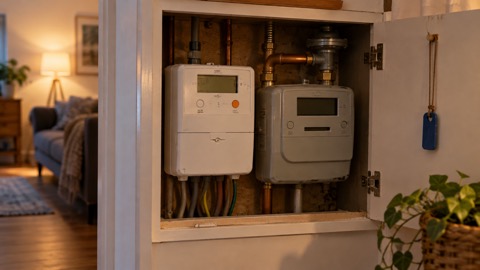
If your gas supply is on a pay-as-you-go meter, the meter itself can be the reason the boiler will not fire, and the meter shows its own error codes. Phoenix Energy, the gas supplier in Northern Ireland, publishes the meanings for its Pay as You Go meters:
| Meter message | Meaning | What to do |
|---|---|---|
| Error 02 | You're using the wrong card | Check with your gas supplier18 |
| Error 04 | You have too much credit on your meter | Let your credit run down before topping up18 |
| Card Fail 35 | Card reading problem | Ensure the card strip and chip is clean, and the card is inserted with the chip facing up; if the problem persists, contact your gas supplier18 |
This connects directly to boiler fault codes: Ideal's guidance for ignition lockout says to check there is credit available if your gas meter is pay-as-you-go1, and its troubleshooting manual says that if other gas appliances are also not working, check whether the gas supply is on at the meter, and with a prepayment meter, check whether it has credit13. Our pages on prepayment meters and on a prepayment meter that has credit but no supply cover the fuller steps.
Faults that need a Gas Safe registered engineer, and never opening the casing
The dividing line is simple: anything that involves opening the boiler, or working on the gas side of it, is a job for a Gas Safe registered engineer. The Royal Voluntary Service's winter guidance is direct: for gas appliance and boiler problems, call a Gas Safe registered engineer8. Gas Safe Register's own boiler guide adds the routine that prevents many of these faults in the first place: get your gas boiler and appliances serviced annually by a Gas Safe registered engineer16. Cheshire Fire and Rescue Service gives a free helpline for finding one: 0800 408 550019.
When the engineer arrives, check their credentials. Warwickshire Council's home fire safety guidance says to check Gas Safe ID cards, which should display their photo and details of their gas registration20. Our page on finding a Gas Safe registered engineer and checking their card gives the full method, and boiler servicing explains what the annual visit should cover.
Never open the boiler casing yourself, whatever the code. The components behind it carry mains electricity, gas and, on a running boiler, hot water under pressure. Any work on the boiler itself has to be carried out by a Gas Safe registered engineer8. A householder's access stops at the front panel.
Some warning signs go beyond fault codes and mean the boiler is unsafe rather than merely faulty. Cheshire Fire and Rescue Service's Safe and Well booklet lists them: turn the boiler off and call a Gas Safe engineer for strange noises, leaks, a yellow flame, unusual smells, the boiler turning itself on and off, low pressure or no hot water, or soot and staining around the boiler21. A healthy gas flame should always be blue21.
Carbon monoxide has no smell, which is why the flame colour and staining matter so much. The Health and Safety Executive says to call the National Gas Emergency Service on 0800 111 999 if you think your appliance is spilling carbon monoxide11, and Manchester Fire and Rescue Service advises getting a Gas Safe registered engineer to inspect your gas appliances and flues to check whether there is a dangerous problem23. The government's own winter advice lists yellow instead of blue flames from gas appliances as a sign of a possible fault, although fuel-effect, living-flame and decorative-flame gas fires are designed to look like solid fuel flames24. If anyone in the household feels unwell with these signs, treat it as a medical emergency. Our page on unsafe appliances covers what happens next.
Where to get help
Help with a boiler fault comes in three tiers, and picking the right one first saves time. For a fault code with a household fix, the maker's own support guidance is the place to start, and this page sets out what Ideal, Worcester Bosch and Glow-worm publish. If the fix does not work, call the maker quoting the error code shown on the display1. And where the maker says a code needs an engineer, it is telling you the fault cannot be fixed from outside the casing, and a visit will be required1.
If you rent, our page on broken boilers in rented homes sets out what your landlord must do. If a long outage or a breakdown in cold weather is the underlying cause, the section guide to gas and heating failures and the page on boiler breakdowns in cold weather pull together the wider checks, and extra support from networks and suppliers explains what help exists for households that need it.
Sources (24)
- Ideal Heating boiler fault codes, Ideal Heating, 2026
- Prepare yourself: resilience advice, Greater Manchester Combined Authority, 2026
- Emergency planning advice, Belfast City Council, 2026
- What do the error symbols mean on my boiler, Worcester Bosch, 2026
- Gas supply issues: prepare for adverse weather, Buckinghamshire Council, 2026
- Power cuts: staying safe at home, Scottish Fire and Rescue Service, 2026
- Flooding: useful links and numbers, Cornwall Council, 2026
- Preparing your home for winter, Royal Voluntary Service, 2026
- What you might need in a gas outage, Wiltshire and Swindon Prepared, 2026
- Safety in the home for tenants, Devon and Somerset Fire and Rescue Service, 2026
- Gas safety: carbon monoxide, Health and Safety Executive, 2026
- Boilers FAQs | Ideal Heating, Ideal Heating
- Logic system troubleshooting manual, Ideal Heating, 2026
- Boiler fault codes list | Vaillant, Vaillant UK
- Ideal Logic Combi Boiler | 24, 30, 35 Manual | Ideal Heating, Ideal Heating
- Boiler and appliance guide, Gas Safe Register, 2026
- Boilers FAQs | Ideal Heating, Ideal Heating
- Using your gas meter, Phoenix Energy, 2026
- Stay safe at home: carbon monoxide, Cheshire Fire and Rescue Service, 2026
- Safe home heating tips, Warwickshire County Council, 2026
- Safe and Well booklet, Cheshire Fire and Rescue Service, 2026
- Fire safety at home, Surrey County Council, 2026
- Carbon monoxide safety, Manchester Fire and Rescue Service, 2026
- Reduce the risk of carbon monoxide poisoning over winter, HM Government, 2015
 Checks Before Calling Engineer
 Boiler Checks When Moving In
 Power Cut Kit Checklist
 National Gas Emergency Service
 When the Mains Supply Goes Off
 Getting Supply Back After Outage
 Compensation for Supply Cuts
 Planned Pipe Works
 Help During a Long Outage
 Prepayment Meters
 LPG Homes in Winter
 Oil Boiler Breakdowns
 Boiler Breakdown in Cold Weather
 Boiler Pressure Gauge
 Frozen Condensate Pipes