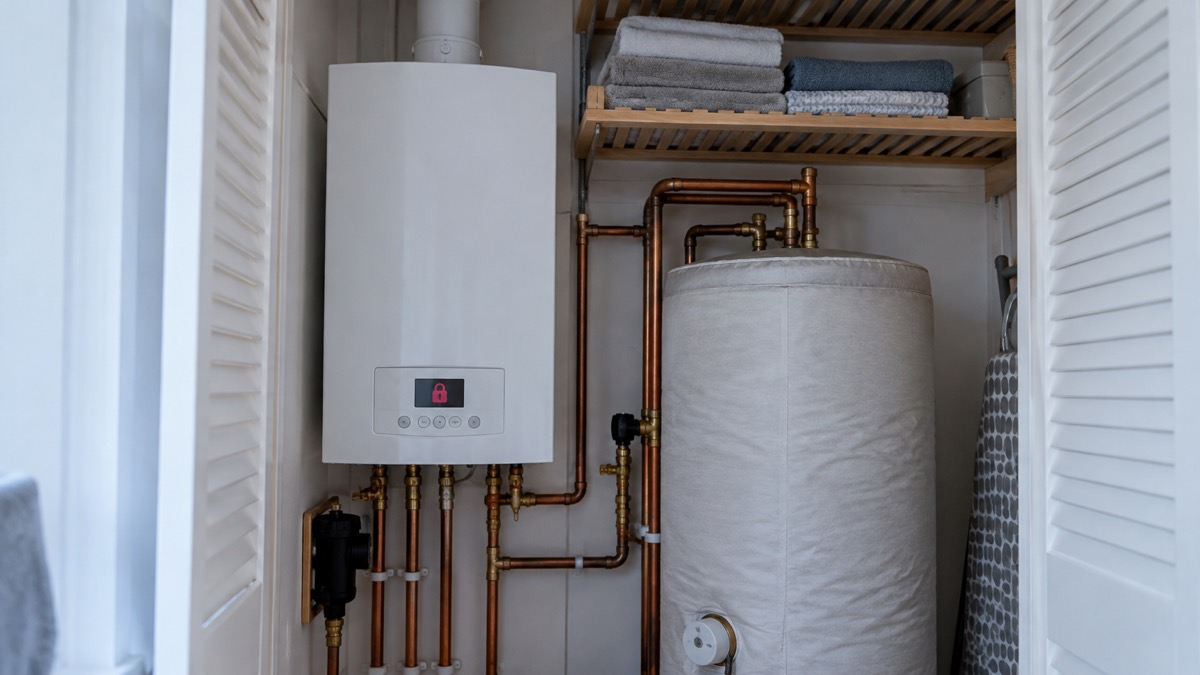
The Ideal Logic+ Heat2 H is a heat only boiler: it heats water for your radiators and for a separate hot water cylinder, and it does not make hot water on its own the way a combi does1. It is no longer sold new, so most people arriving here own one already, or have moved into a home that has one. The good news is that the maker's manual is unusually clear about what a household can safely do before calling anyone.
The first rule overrides everything else on this page. If a fault is known or suspected, the boiler must not be used until it has been corrected by a Gas Safe Registered engineer1. That is the maker's own instruction, in capitals in the manual. What follows is about the checks that come before that point: the ones the manual sets out for you, and the ones that tell you an engineer is needed.
Most winter breakdowns on this boiler come down to three things: a frozen condensate pipe, low system pressure, or an ignition lockout after five failed attempts to light1. Each has a check you can make yourself, and each has a clear point at which you stop and call.
What the Logic+ Heat2 H is, and what it suits
The Logic+ Heat2 H is a heat only boiler with full sequence automatic spark ignition and fan assisted combustion1. Because it has no hot water store of its own, it needs a separate hot water cylinder to provide hot water2. That arrangement suits a home with a cylinder already in place, and it has one practical advantage in an outage: the cylinder holds a tank of hot water that stays warm for a while after the boiler stops, which a combi cannot offer. If you are weighing up which arrangement keeps hot water going when the supply fails, our comparison of combi and system boilers sets out the difference.
The boiler controls the central heating radiator temperature to a maximum of 80°C, adjustable on the central heating knob1. In winter it may be necessary to turn the temperature knob clockwise until an 80°C target is shown to meet heating requirements1. To run it efficiently, using less gas, turn the temperature control knob until the leaf symbol is shown1. The maker also notes that reducing the room thermostat setting by 1ºC can reduce gas consumption by up to 10%1.
| Specification | Figure |
|---|---|
| Boiler type | Heat only, fan assisted, spark ignition1 |
| Hot water | Requires a separate hot water cylinder2 |
| Maximum central heating flow temperature | 80°C1 |
| Minimum radiator temperature setting | 30°C1 |
| Electricity supply | 230 V ~ 50 Hz, 3A fuse, must be earthed1 |
| Frost protection trigger | Water in the boiler below 5°C1 |
| Frost protection cut-off | 19°C1 |
| Clearance above | 165 mm1 |
| Clearance below | 100 mm1 |
| Clearance at the front | 450 mm1 |
| Service interval | At least annually, by a Gas Safe Registered engineer1 |
Installation and any work on the appliance is a legal matter: it must be carried out by a Gas Safe Registered engineer in accordance with the Gas Safety (Installation and Use) Regulations1. If you need to find one, our guide to finding a Gas Safe Registered engineer explains how to check their card.
Two safety notices: what applies to this boiler and what does not
Two product safety matters come up whenever people search for Ideal boilers, and they are different things.
In August 2022, Ideal Heating issued a safety notice requiring a thermostat upgrade to prevent a potential boiler overheat on certain boilers manufactured between August 2022 and 7 January 2024, across ten boiler ranges in the Logic, iMini, Independent and Keston lines4. The notice covers listed ranges rather than every individual model, so the way to settle it is to check your boiler's serial number and manufacture date against the notice, or ask Ideal Heating or your installer directly4. The manual for this boiler also sets out the legal requirement that installation and any work on the appliance is carried out by a Gas Safe Registered engineer in accordance with the Gas Safety (Installation & Use) Regulations2.
Separately, on 22 February 2024 the Office for Product Safety and Standards published a recall of the Ideal Heating Logic 2 Combi and System boiler range, covering 30 boiler models produced before 8 January 2024, following three fire incidents and one report of a customer extinguishing flames5. That recall is about the Logic 2 Combi and System range. The Logic+ Heat2 H is a heat only boiler, a different product, so the recall does not apply to it1. If you have a Logic 2 Combi or System boiler in the house as well, check the recall notice and act on it. The manual for this boiler also states that if a problem is found to be external to the boiler, Ideal reserve the right to levy a charge for the visit, or for any pre-arranged visit where access is not gained by the engineer2.
If a fault is known or suspected, stop using the boiler
This is the instruction that governs everything else. The manual states that if it is known or suspected that a fault exists on the boiler, it must not be used until the fault has been corrected by a Gas Safe Registered engineer1. The same wording appears in both the Logic+ Heat2 H and Logic Heat2 H manuals, so it is not a quirk of one document.
In practice that means: if the boiler is showing a fault code you cannot clear with the checks below, if it smells wrong, if it is making a noise that worries you, or if you simply are not sure, turn it off and arrange for an engineer. A boiler that is trying and failing to light is not dangerous in itself, but the reason it is failing might be, and the maker's instruction is not to keep pushing it.
The manual also sets out what to do if you smell gas: extinguish all naked flames, do not operate electrical switches, and open all windows and doors2. Then get out and call the gas emergency service. Our guide to the National Gas Emergency Service explains the number and what happens when you ring.
Ignition Lockout: check your other gas appliances, then restart
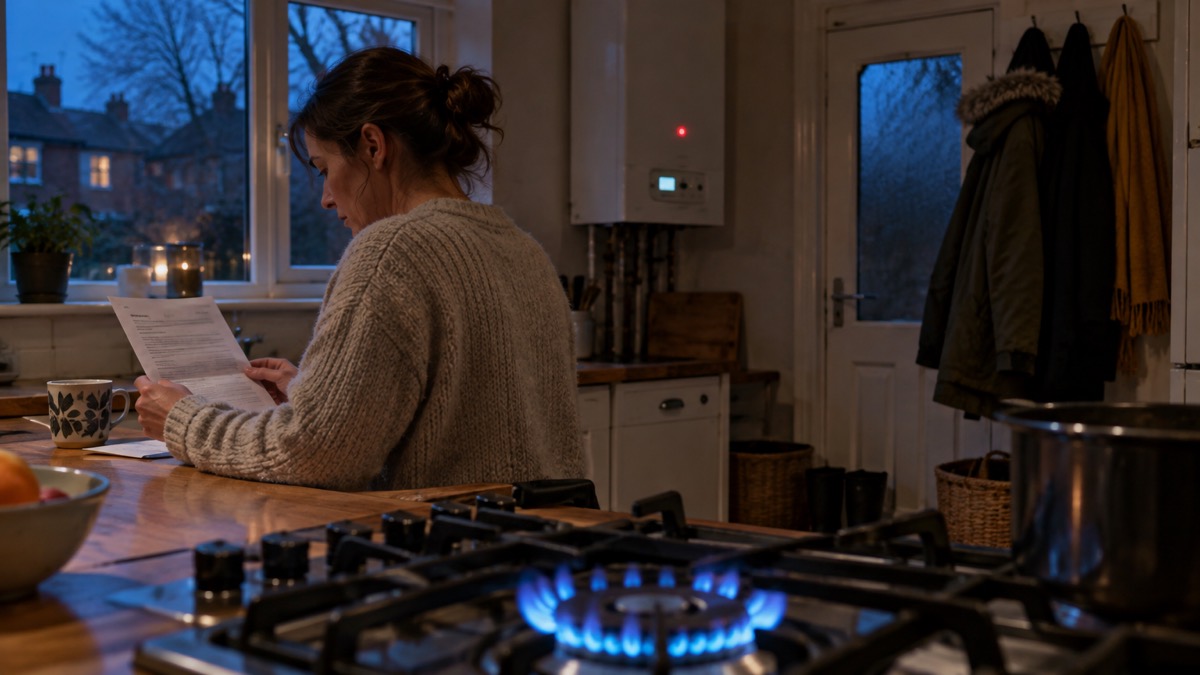
An ignition lockout means the boiler tried to light and failed. The Logic+ Heat2 H makes five attempts before it locks out and displays its fault message1. The manual's sequence for an ignition lockout is short: check that other gas appliances work, restart the boiler, and if the fault persists contact your installer1.
Checking the other gas appliances is the important step, because it tells you whether the problem is the boiler or the gas supply to the whole house. If the hob and the fire are working, gas is reaching the property and the fault is at the boiler. If nothing gas works, the problem is upstream, and our guide to what to do when the mains supply goes off covers the next steps. On a prepayment meter, check there is credit on the meter before assuming a boiler fault2.
The Logic Heat2 H manual adds a detail worth knowing: if the boiler fails to light after five attempts it displays L 02 and repeats the ignition sequence, and if it still fails you should consult a Registered Gas Installer2. It also warns that if the boiler is making a gurgling or gargling noise while trying to fire, contact your installer, because there may be a blockage6. That noise points to the next section.
Frozen condensate pipe: gurgling, then lockout
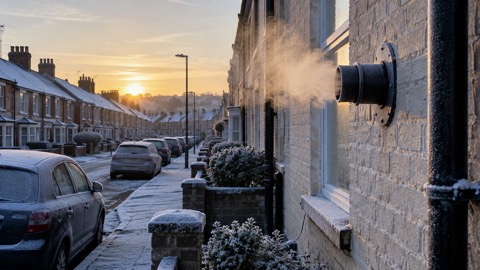
A condensing boiler produces acidic water as it burns gas, and that water leaves through a condensate pipe, usually a plastic pipe running outside to a drain. In a cold snap that pipe can freeze. The Logic+ Heat2 H manual describes exactly what happens: the condensate builds up to a point where it makes a gurgling noise before locking out and displaying "Ignition Lockout" on the display1. Northern Gas Networks puts it plainly: a frozen condensate pipe can stop your boiler from working, leaving you without heating or hot water, and you might hear a gurgling noise from the boiler or the condensate pipe outside3. Baxi describes the same two signs, gurgling noises from the heating system and the boiler shutting down7.
The boiler is fitted with a siphonic condensate trap system that reduces the risk of the condensate freezing1, but it cannot stop an external pipe freezing in a hard frost. The manual says the pipe is likely frozen at the most exposed point external to the building, at the open end of the pipe, at a bend or elbow, or where there is a dip in the pipe1. The Logic Heat2 H manual adds that it is likely to be at the most exposed point external to the building or where there is some obstruction to flow2.
The manual's own sequence for a blocked flue or condensate is: check whether the condensate pipe is blocked or frozen, check whether the flue is blocked, and if the fault persists contact your installer1. WaterSafe's winter advice is to insulate the pipe with foam insulation, which is a job for a mild day rather than a frozen one8. Our guide to stopping a condensate pipe freezing covers the preventive side in more detail.
How to thaw a frozen condensate pipe safely
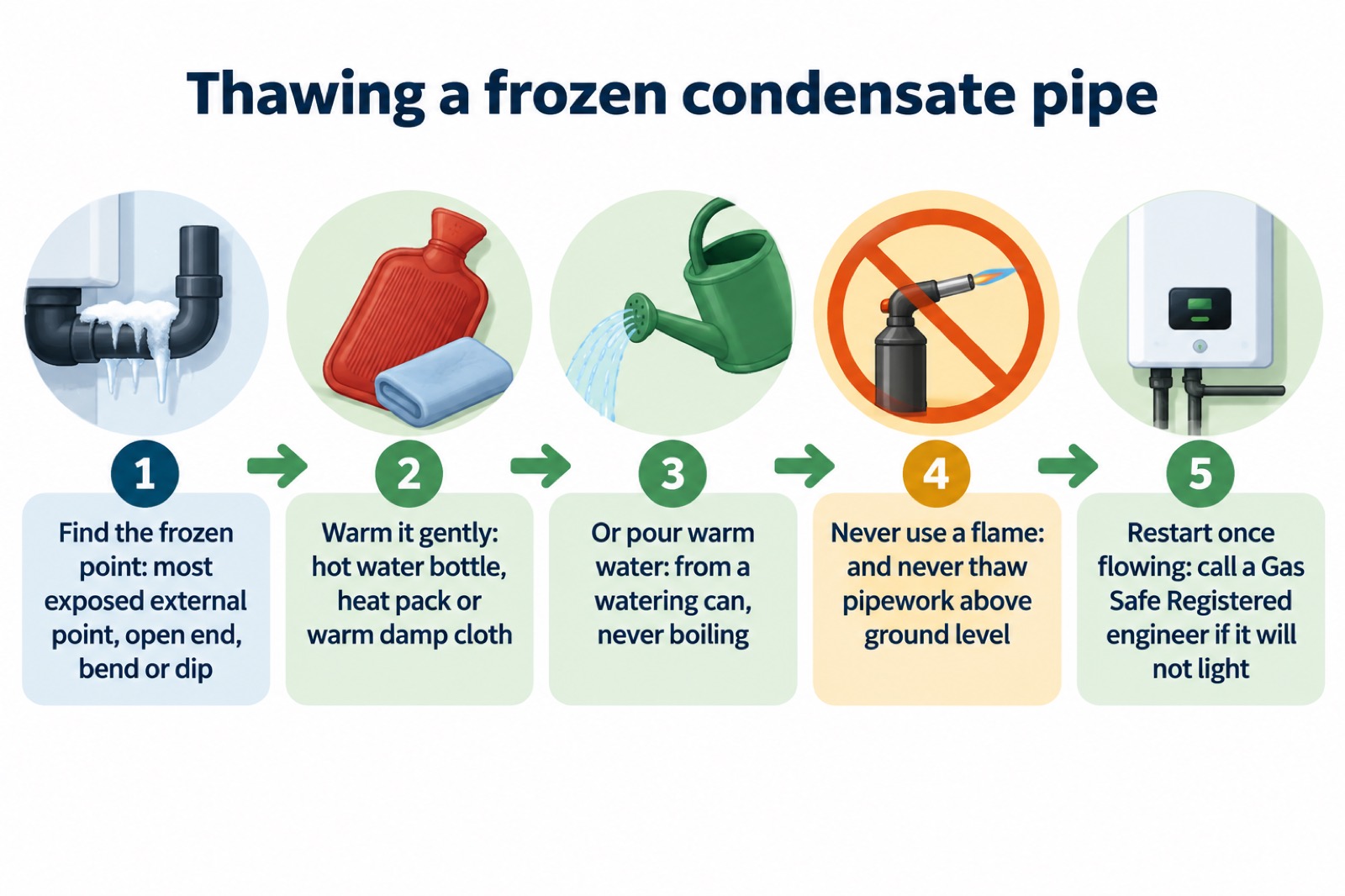
Thawing is the one repair the maker sets out for a household, and the method matters. The Logic+ Heat2 H manual says to apply a hot water bottle, microwaveable heat pack or a warm damp cloth to the frozen blockage area, and that warm water can be poured from a watering can1. It is explicit on two points: do not use boiling water, and do not attempt to thaw pipework above ground level1.
Other official and maker guidance agrees on the gentle approach. The Met Office says it is best to thaw out pipes slowly, with hot water bottles or towels soaked in hot water9. Cornwall Council's fire and rescue service says to contact a plumber or, if it is safe, try to thaw the affected pipe using a hair dryer or hot water bottle, and adds in terms: do not use a naked flame10. Worcester Bosch says to pour warm water along the pipe, not boiling water11, and Baxi suggests a hot water bottle, a microwaveable heating pack of the sort used for muscular aches and pains, or a cloth soaked in hot water7. Portsmouth Water suggests hot water bottles or a hairdryer on a warm setting12. The manual for this boiler says to apply a hot water bottle, microwaveable heat pack or a warm damp cloth to the frozen blockage area, that warm water can be poured from a watering can, that you should not use boiling water, and that you should not attempt to thaw pipework above ground level2.
Once the blockage is removed and the condensate can flow freely, restart the appliance; if it fails to ignite, call a Gas Safe Registered engineer2. You may need to repeat the warming a few times before the ice clears13.
Overheat and no water flow: refill the system to 1.0 bar
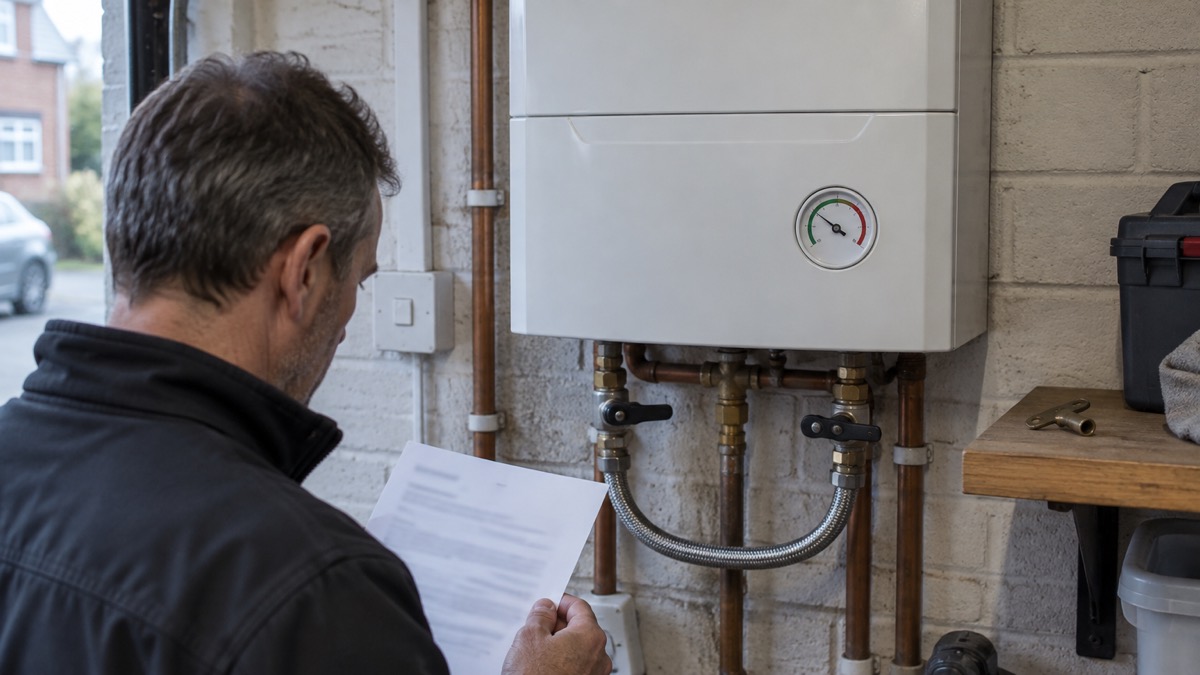
Low system pressure is one of the most common reasons a boiler stops, and it is one of the few things a household can put right. The Logic+ Heat2 H manual's instruction for a no water flow fault is: with the boiler off and the system cold, fill the system to 1.0 bar, bleed the radiators, refill the system to 1.0 bar, and contact your installer1. For an overheat lockout the sequence adds a check that the radiator and boiler valves are open, then a restart, and if the fault persists, contact your installer1.
The fault code articles give a slightly wider target. Ideal Heating's fault code guidance says that on code F1, water pressure is too low in the system and will require topping up to between 1 and 1.5 bar6. The Logic Heat2 H manual gives the same range for its low water pressure and overheat codes: check the system water pressure is between 1 and 1.5 bar on the system pressure gauge2. Yorkshire Water's guidance for no hot water says to check the boiler power supply first and that the pressure gauge should be at one bar14.
So the maker's manual for this boiler says fill to 1.0 bar, and the maker's fault code guidance and the sister manual give a range of 1 to 1.5 bar. Fill to 1.0 bar as the manual instructs, and use the gauge to confirm. If pressure keeps dropping after you top it up, stop topping up and call an engineer: a system that will not hold pressure has a leak somewhere. Our guide to boiler pressure and the step-by-step on how to repressurise a boiler cover the filling loop in detail.
Fault codes you can clear by restarting, and when to call your installer
The Logic Heat2 H manual lists a set of codes where the maker's own instruction is simply to restart the appliance: F03 fan fault, F04 and L04 flow thermistor fault, F05 and L05 return thermistor fault, F06 outside sensor failure, and L06 false flame lockout2. For code U, the diverter valve in mid-position, the manual says to rotate all knobs fully clockwise, turn the boiler power off and on, then press restart2. For code L0C, five boiler resets in 15 minutes, turn the electrical supply to the boiler off and on2.
Other codes are a stop sign. F09 and L09, an unconfigured or faulty PCB or a gas valve short circuit, mean contacting Ideal if under warranty or a Gas Safe Registered engineer2. F0U, a flow and return differential over 50°C, means contacting Ideal if under warranty or a Gas Safe Registered engineer2. On the fault code guidance, flashing F and 3 requires a visit from an engineer, and flashing C and 2 requires a visit quoting error code C26. Flashing L and 2 is a flame loss or ignition lockout, and if it persists you should call quoting error code L26. Code FA means contact the installer, and code SE, the service interval timer, also means contact the installer15.
| Code | Meaning | What the maker says to do |
|---|---|---|
| F03 | Fan fault | Restart the appliance2 |
| F04 / L04 | Flow thermistor fault | Restart the appliance2 |
| F05 / L05 | Return thermistor fault | Restart the appliance2 |
| F06 | Outside sensor failure | Restart the appliance2 |
| L06 | False flame lockout | Restart the appliance2 |
| U | Diverter valve in mid-position | Rotate knobs fully clockwise, power off and on, press restart2 |
| L0C | Five resets in 15 minutes | Turn the electrical supply off and on2 |
| F09 / L09 | PCB or gas valve fault | Contact Ideal if under warranty, or a Gas Safe Registered engineer2 |
| F0U | Flow and return differential over 50°C | Contact Ideal if under warranty, or a Gas Safe Registered engineer2 |
| F3 | Requires an engineer visit | Contact Ideal quoting error code F36 |
| C2 | Requires an engineer visit | Contact Ideal quoting error code C26 |
| FA | Contact the installer | Contact the installer15 |
| SE | Service interval timer | Contact the installer15 |
If you are resetting a lockout, do it once or twice and no more. Our guide to how many times it is safe to reset a boiler lockout explains why repeated resetting is not the answer, and the checks to make before calling a boiler engineer will save you a wasted visit.
Frost protection starts at 5°C, but only with the power left on
The boiler has frost protection built in, and it is worth understanding exactly how it behaves. If the water in the boiler falls below 5°C, the frost protection will activate and run the boiler to avoid freezing1. The Logic Heat2 H manual says the boiler will fire if the temperature is below 5°C, operating in all modes provided the power supply is always turned on2. It stays active until the temperature reaches 19°C1.
The condition is the part people miss: the power supply to the boiler must always be turned on1. A boiler switched off at the wall in an unheated house has no frost protection at all. The manual also warns that the frost protection does not guarantee other parts of the system are protected1, so pipes elsewhere in the house can still freeze. If a system frost thermostat is installed, the boiler must be set in winter mode, Ready or On, for the frost protection to run1.
For cold weather, the manual gives practical settings: set the central heating temperature knob to MAX during cold weather and return it afterwards, and place the heating on continuous with the room thermostat turned down to 15ºC overnight or when unoccupied1. For short absences, leave the heating controls or built in programmer switched on and running at a reduced temperature setting; for longer periods, the entire system should be drained1. Our guide to leaving the boiler on when away in winter takes this further.
Keeping the boiler safe between annual services
The single most useful thing you can do for this boiler is have it serviced at least annually by a Gas Safe Registered engineer1. The manual notes that the frequency will depend on the installation condition and usage, but should be carried out at least annually1. The boiler itself will remind you: when it has been installed for more than one year, a Service Due message appears on screen1.
Official and independent guidance is unanimous on the annual service. Have your boiler serviced annually16, and have it serviced yearly to keep it safe and efficient; if you rent your home, your landlord should arrange this17. Northern Ireland Water says to service your boiler regularly18, United Utilities says yearly to ensure it is working correctly19, and the Chartered Institute of Plumbing and Heating Engineering recommends annual servicing before the heating season begins to keep systems safe, efficient and effective20. The NHS winter booklet asks simply whether your boiler has had its annual service by a qualified professional21. The manual for this boiler says servicing should be carried out at least annually by a Gas Safe Registered Engineer2.
Between services, a few habits keep it safe. Dust the casing with a dry cloth, wipe stubborn marks with a damp cloth and finish dry, and do not use abrasive cleaning materials1. Do not store anything in the compartment if the boiler is installed in one: the manual says the compartment must not be used for storage purposes1. Keep the clearances clear, and never run the boiler with the casing off1. If you rent, our guide to broken boilers in rented homes sets out what your landlord must do.
Carbon monoxide alarms, spare parts and the warranty
A carbon monoxide alarm near the boiler is part of the safety setup, and the manual gives clear advice for when one misbehaves. If you suspect a fault with the alarm, first change the batteries; if the fault does not clear, speak to your landlord or replace the device with one that complies to BS EN 50291-1:20101. Cheshire Fire and Rescue Service advises repairing or replacing smoke and carbon monoxide alarms if they are reported as faulty22, and Manchester Fire and Rescue Service says to fit a carbon monoxide alarm in all rooms containing solid fuel, gas or paraffin heaters23. CO-Gas Safety has issued a warning about faulty smoke and carbon monoxide alarms24. If you are unsure whether your alarm is working, treat it as faulty and replace it. The manual also warns that if a problem is found to be external to the boiler, Ideal reserve the right to levy a charge for the visit, or for any pre-arranged visit where access is not gained by the engineer2.
On parts, the manual is firm: use only spare parts that conform to the safety and performance specification, and do not use reconditioned or copy parts that have not been clearly authorised by Ideal Heating1. That is a safety instruction, not a sales one: unauthorised parts have not been shown to meet the specification the boiler was built to.
On the warranty, Ideal Heating states that Logic+ boilers currently have 7 years warranty, while its Logic boilers currently have a 2-year warranty25. The manual also warns that if a problem is found to be external to the boiler, Ideal reserves the right to levy a charge for the visit, or for any pre-arranged visit where access is not gained by the engineer1. That is why the checks on this page are worth doing first: a frozen condensate pipe or a low pressure gauge is a household matter, not necessarily a boiler fault.
Where to get help
If you cannot clear a fault with the checks here, or the boiler is showing one of the codes that needs an engineer, book a Gas Safe Registered engineer. Our guide to boiler breakdowns in cold weather covers what to do while you wait, and the wider gas and heating failures section covers supply problems, prepayment meters and emergency support.
If you are without heating in cold weather and someone in the household is older, disabled or medically dependent, help exists. Ready Scotland's cold, snow and ice guidance covers what to do in severe weather in Scotland27, and our guide to extra support from networks and suppliers explains the Priority Services Register and who can join. For a suspected gas leak, leave the property and call the gas emergency service; the emergency line guide has the details. The manual also notes that if a problem is found to be external to the boiler, Ideal reserve the right to levy a charge for the visit, or for any pre-arranged visit where access is not gained by the engineer2.
Sources (27)
- Logic+ Heat2 User Guide (07.2023), Ideal Heating, July 2023
- Logic Heat2 User Guide (07.2023), Ideal Heating, July 2023
- Boiler not working, Northern Gas Networks, 2026
- Thermostat upgrade kit instructions, Ideal Heating, 2026
- Product recall: Ideal Heating Logic 2 Combi and System boiler range, Office for Product Safety and Standards, 22 February 2024
- Boiler fault codes, Ideal Heating, 2026
- How to thaw a frozen boiler condensate pipe, Baxi, 2026
- Winter advice, WaterSafe, 2026
- Frozen or burst pipes, Met Office, 2026
- Snow and ice in Cornwall, Cornwall Council, 1 October 2025
- Frozen condensate, Worcester Bosch, 2026
- Wrap up flyer, Portsmouth Water, 2024
- Why condensate pipes freeze, Baxi, 2026
- Water pressure, Yorkshire Water, 2026
- Ideal Heating error code FA and SE, Ideal Heating, 2026
- Heaters and electric blankets, Lincolnshire County Council, 2026
- Safe and well booklet, Cheshire Fire and Rescue Service, 2026
- Winter proof your home, Northern Ireland Water, 2026
- Prepare for winter, United Utilities, 2026
- Plumbing emergencies, Chartered Institute of Plumbing and Heating Engineering, 2026
- Stay Well this winter booklet, NHS England South, December 2024
- Smoke alarms, Cheshire Fire and Rescue Service, 27 July 2026
- Stay warm safely this winter, Greater Manchester Fire and Rescue Service, 29 October 2026
- Warning about faulty smoke and carbon monoxide alarms, CO-Gas Safety, 21 November 2025
- Ideal Logic+ boiler warranty, Ideal Heating, 2026
- Ideal Logic boiler warranty, Ideal Heating, 2026
- Cold, snow and ice, Ready Scotland, 25 March 2026
 Navien NCB300
 Navien NCB500
 Navien NCB700
 Ideal Logic Combi2
 Ideal Logic Max Combi2