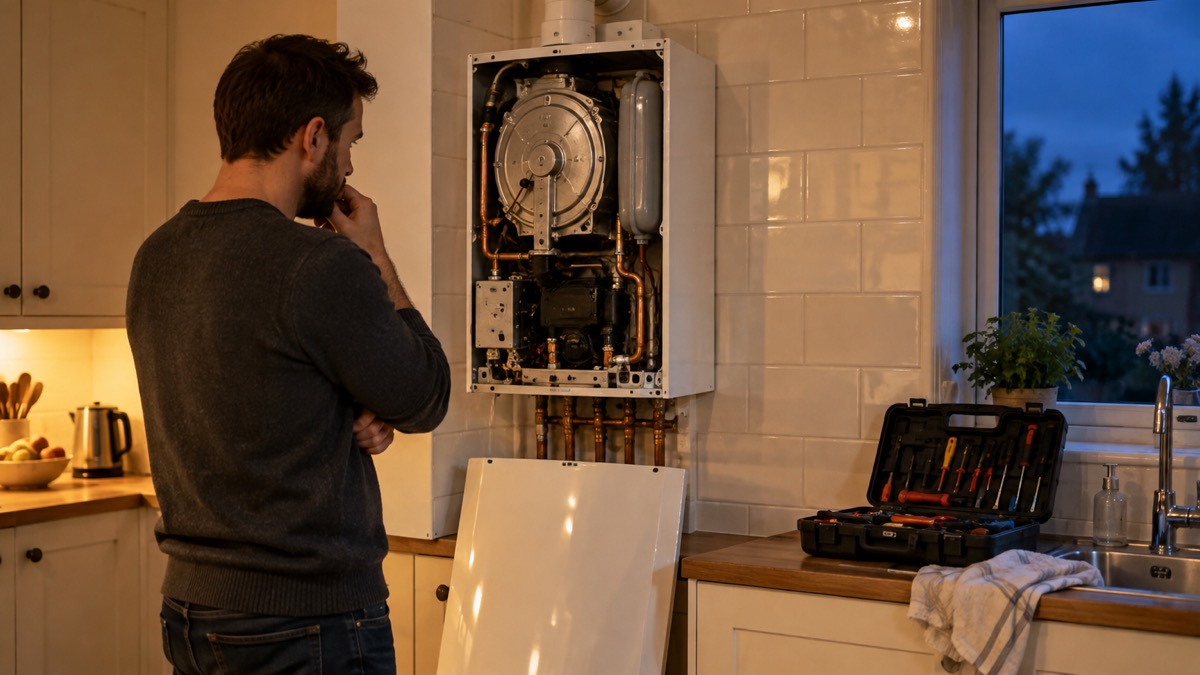
The Navien NCB700 is a wall-mounted gas condensing combi boiler, and most of what goes wrong with it in an ordinary home is one of four things: a fault code on the display, low water pressure, a frozen condensate pipe in a cold snap, or a power cut that has left you wondering whether it will come back on. Three of those you can deal with yourself, carefully. The fourth needs no action at all.
Start with the display. If it shows a code, note it down before you touch anything. To reset the boiler, press the Back button on the front panel1. If the code is E302, the pressure is low: top it up until the gauge reads between 1.0 and 1.5 bar2. If the boiler stopped during freezing weather and there is no code, suspect the condensate pipe before anything else3.
If you can smell gas, stop. Do not press buttons, do not switch anything on or off, and do not use a phone inside the building1. Leave, and ring the National Gas Emergency Service on 0800 111 9994. Everything else on this page comes after that.
What the NCB700 is, and what it suits
The NCB700 is a condensing combi boiler, which means it heats your radiators and your hot water from the same unit, with no separate cylinder. Navien lists it as a gas condensing combi boiler with stainless steel heat exchangers, a built-in domestic hot water recirculation pump for faster hot water delivery, and hydrogen-ready technology for a 20% blend5. It carries a NOx classification of Class 65.
Because it is a combi, it makes hot water only when a hot tap runs. That single fact explains several of the faults below: a tap that is not open wide enough, a frozen pipe that stops the condensate draining, or a pressure gauge that has drifted low will each stop hot water reaching you even though the boiler itself is sound.
| Specification | Detail |
|---|---|
| Type | B23-C13-C33-C53 condensing combi boiler1 |
| Fuel | Natural gas or LPG; an LPG conversion kit is included with the boiler1 |
| Heat exchanger | Stainless steel5 |
| Hot water factory setting | 50°C1 |
| Hot water range | 30°C to 65°C1 |
| Central heating flow range | 40°C minimum to 90°C maximum1 |
| Central heating return range | 30°C minimum to 65°C maximum1 |
| Electrical protection | IPX5D, per the maker's manual2 |
| NOx classification | Class 65 |
| Warranty | 12 years from the installation date for manufacturing defects1 |
One small discrepancy is worth knowing about if you are reading the paperwork: the maker's manual gives the boiler an electrical protection degree of IPX5D2, while the maker's own product page describes an IPX4 rating5. The two documents disagree, and the manual is the one that comes with the appliance.
If you smell gas near the boiler: what to do at once
A gas smell near a boiler is the one situation on this page where you do nothing to the appliance at all. Navien's manual is explicit: do not try to light any appliances, do not touch any electrical switch, and do not use any phone in your building1. A switch, a doorbell or a mobile phone used indoors can all produce a spark.
The official advice from local resilience partnerships is to open a window if you can, leave the property immediately, and call National Grid on 0800 111 9994. Do not smoke or use naked flames until you are sure there is no leaking gas4. The Royal Voluntary Service adds that you can turn the gas off at the meter, unless the meter is in the cellar, and that you should extinguish naked flames6. Cornwall Fire and Rescue Service says to call the national gas emergency service or the fire and rescue service straight away7. Cadent, which runs the emergency service, asks that if you smell gas outside your home you refrain from lighting any naked flames in the area and wait for an emergency gas engineer to attend and investigate8.
The Gas Safe Register's guidance is the one to keep in mind for the days after: a boiler that has been smelling of gas, sooting or making people unwell needs a registered engineer to look at it before it is used again9. Our page on unsafe appliances and being cut off explains what happens if an engineer condemns the appliance, and the National Gas Emergency Service page covers what happens when you ring.
Error codes that stop the boiler, and which ones you can reset yourself
The NCB700 shows a fault as a code beginning with E on the front panel. The manual lists what each one means and, crucially, how it clears: some reset manually, some reset automatically, and some need the power cycled. Knowing which is which saves you standing at the panel pressing a button that was never going to help.
| Code | What it means | How it clears |
|---|---|---|
| E001 | Overheating of heat exchanger | Manual reset1 |
| E003 | Ignition failure | Manual reset1 |
| E012 | Flame loss | Manual reset1 |
| E016 | Heat exchanger overheat | Manual reset1 |
| E030 | Abnormal exhaust temperature | Manual reset1 |
| E031 | Overheating of burner | Manual reset1 |
| E110 | Exhaust blockage (condensate blockage) | Manual reset1 |
| E302 | Low water pressure | Auto reset1 |
| E352 | High water pressure | Auto reset1 |
| E353 | Water pressure sensor fault | Auto reset1 |
| E782 | Main panel communication fault | Auto reset1 |
| E787 | Reset device fault | Manual or power reset1 |
To reset manually, press the Back button on the front panel1. That is the maker's instruction and it is the only reset a household should attempt. A code that returns within minutes of a reset is not asking to be reset again; it is asking for an engineer. Our general page on boiler fault codes and lockouts covers the same ground for other makes, and how many times it is safe to reset a boiler lockout answers the question directly.
Some codes are alarms rather than resets, including E060 for the dual venturi limit switch, E218 for the heating return thermistor, E407 for the hot water outlet thermistor and E445 for the mixing valve1. These point at components inside the casing. Do not open the casing to investigate: the boiler's electrical system must be fused at 3.15 A maximum through one common isolator2, and the internal glass fuses blow deliberately to cut the gas supply when there is a short circuit1. A blown fuse is a symptom of a fault an engineer needs to find.
Low pressure (E302): topping up to 1.0 to 1.5 bar
E302 means low water pressure, and it is the most common fault a household can fix without help. The manual explains that if the pressure falls below the minimum pressure set, which is 1 bar by default, error code E302 appears on the display10. The fix is to top the system up.
Navien's instruction is to pull the green lever down to fill the boiler pipes, until the pressure reaches between 1.0 and 1.5 bar2. Do it with the system cool if you can, watch the gauge as you fill, and stop at the top of that range. Overfilling pushes you towards the high pressure code, E352, which resets automatically but should not be invited1.
If the gauge will not hold its reading, or you find yourself topping up every few weeks, stop and call your installer. Pressure that keeps falling is water escaping somewhere, and on a sealed system that is an engineer's job. Our step by step guide to repressurising a combi boiler walks through the same procedure, and boiler pressure: what the gauge should read covers what high and low readings mean.
Frozen condensate pipe in cold weather: why the boiler shuts down
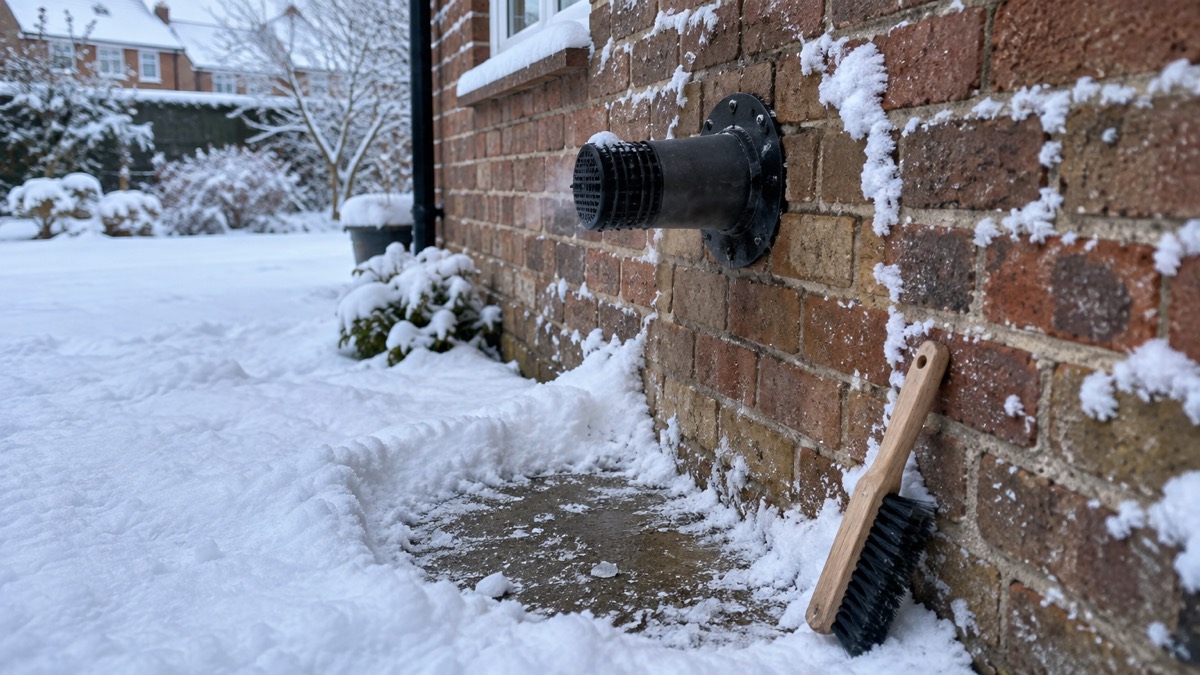
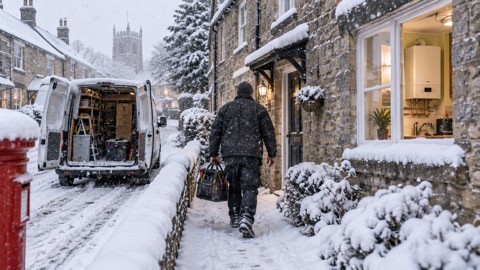
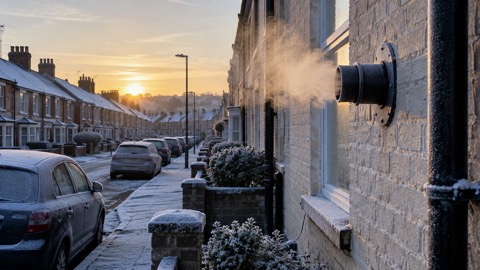
A condensing boiler produces water as it runs, and that water leaves through the condensate pipe. In cold weather the water inside the pipe can freeze, and this will stop your boiler from working3. Scottish and Southern Electricity Networks puts it plainly: if your boiler has stopped working in the cold, check whether the condensate pipe has frozen11. Wessex Water says the same: if your boiler has stopped working in the cold, the chances are you have frozen boiler condensate pipes12.
Northern Gas Networks explains the mechanism: when temperatures drop, water inside an external condensate pipe can freeze and cause a blockage, and if the condensate cannot drain the boiler may automatically switch off to protect itself13. The Chartered Institute of Plumbing and Heating Engineering notes that this happens when temperatures drop below freezing, and that it will cause the boiler to shut down14. You may hear a gurgling noise from the boiler or the pipe outside13.
If it happens, thaw the pipe gently. Wessex Water's advice is to hold a hot water bottle or heat wrap around the affected pipe, or pour hot, but not boiling, water over the frozen end of the pipe12. Never use a naked flame, and do not pour boiling water, which can crack the pipe. The Gas Safe Register suggests asking a Gas Safe engineer to insulate the condensate pipe so it is less likely to freeze again9, and WaterSafe advises insulating the pipe with foam insulation15.
Our pages on frozen condensate pipes: signs and how to thaw one safely and how to stop a condensate pipe freezing go further, and boiler breakdowns in cold weather covers the wider picture when the temperature drops.
After a power cut the boiler restarts on its own and keeps your settings
This is the reassuring one. Navien states that when the power is restored after a power failure, the boiler will automatically start and return to normal operation, and that a manual reset is not required1. It also states that the boiler will retain your settings during a power outage1. You do not need to reprogramme the heating schedule or re-enter temperatures when the electricity comes back.
That behaviour is worth knowing before the power goes, because it changes what you should do during an outage: nothing to the boiler. Leave it alone. If the heating does not come back when the power does, check the display for a code before assuming the boiler has failed, and check the pressure gauge, since a cold house and a system that has been off can leave the reading low.
If your programmer or thermostat has lost its settings after an outage, that is a separate device rather than the boiler. Our page on why your programmer reset after a power cut explains it, and the power cuts guide covers the wider household preparations.
Built-in protection against frost, overheating and carbon monoxide
The NCB700 carries a set of safety systems that work without you. A sensor inside the boiler automatically detects the temperature and, if necessary, initiates a safety heating cycle to prevent internal equipment damage due to freezing temperatures1. Excessive temperatures will automatically stop the boiler1. The boiler is designed to maintain a safe air to gas ratio and combustion rate, continuously monitored by its air ratio control module1. If the thermostat fails, the gas supply is shut off automatically as a safeguard1. The fan's rotation is automatically detected and controlled, and fan failure will stop the operation of the boiler1. Each boiler is specially grounded, both internally and externally, to protect against lightning strikes1.
None of this replaces an annual service, and none of it replaces a carbon monoxide alarm. The boiler's own monitoring protects combustion; an alarm protects the room. Our home emergencies guide covers carbon monoxide alarms alongside fire and gas leaks.
Two practical points from the maker's installation manual. The gas removal and air intake ducts must be protected from snow accumulation2, so keep an eye on the flue terminal in heavy snow. And do not store or use petrol or other flammable vapours and liquids in the vicinity of the boiler or any other appliance1.
Hot water temperature: factory set at 50°C to limit scalding
The boiler leaves the factory with its water temperature set to 50°C for your safety and comfort1. That is a deliberate choice, and the maker's own scald table shows why: at 70°C a young child can suffer a full thickness burn in less than 1 second, at 60°C in 1 second, at 55°C in 10 seconds, at 49°C in 10 minutes, and at 37°C there is very low scald risk1. The boiler's hot water range runs from 30°C to 65°C1.
The NHS advises setting your water heater thermostat to a maximum of 49°C to prevent scalding from taps16. The maker's factory setting of 50°C sits just above that, and the maker's own advice is that if your household has children or elderly or disabled residents, you should consider using a lower temperature setting, and feel the water before using it on children, the elderly or the disabled1.
The boiler also has an anti-Legionella function, which can be enabled or disabled with a set day of the week and a set time for the operation to run, through the Menu button and the DHW operation menu1. If you turn the hot water temperature down for scald safety, ask your service engineer about the interaction between the two at the annual service.
Warranty: 12 years if the boiler is serviced every year
Navien undertakes to rectify any manufacturing defect that occurs within 12 years of the installation date1, and the product page describes a 12-year warranty for complete peace of mind5. The condition is the one that catches people out: for the warranty to be valid, an annual service must be carried out by a suitably qualified and Gas Safe registered installer every year after installation, and the cost of that annual service is not included in the guarantee1.
Register the boiler on the Navien Installers Warranty App within 30 days of installation, or email a photo of your completed benchmark form to service@navienuk.com1. Keep the benchmark form and the service records together; they are what proves the annual service happened.
An annual service is good practice regardless of the warranty. Lincolnshire Fire and Rescue Service advises having your boiler serviced annually18, and NI Water advises servicing your boiler regularly19. Our page on boiler servicing: how often and what an engineer checks explains what the visit involves, and finding a Gas Safe registered engineer covers how to check the card of whoever turns up.
Who to call, and what to have ready
Navien's manual says that if your boiler develops a fault, your first action should be to contact your installer, because their professional assessment comes first; if you cannot contact your installer, phone Navien Service on 0344 332 2323 or visit navien.co.uk1. For installation questions, the maker directs you to an official Technical Assistance Service or the technical support section of its website2.
When you ring, have these ready, because the maker asks for them: the model number, the serial number, the date purchased, the installation location and type, and the error code if one appears on the display1. A photograph of the display and of the data badge saves time. If you rent your home, the landlord carries the responsibility for repairs, and our page on broken boilers in rented homes sets out what they must do.
If the fault is not the boiler at all, the problem may be the gas supply. Our gas and heating failures section covers supply interruptions, and what to do when the mains supply to your home goes off is the place to start if the hob will not light either.
Looking after the boiler between faults
Clean the outside of the boiler with a damp cloth with a little detergent, and do not use abrasive products1. That is the whole of the household maintenance the maker asks for; everything inside the casing belongs to the engineer.
The boiler has been approved for use in the UK and Ireland only, and using it in any other country will void the manufacturer's warranty1. If you are replacing it, the old gas removal system must be replaced by a new one2. And when the old boiler goes, neither the wall mounted boiler nor its accessories are to be disposed of with domestic waste: hand them in at a designated collection point, such as a duly authorised reseller or an authorised collection site for recycling1.
If you are weighing up whether a combi suits your household in an outage, our comparison of combi or system boiler: which keeps hot water going in an outage sets out the difference. For the wider household picture, heating and cooking without mains power or gas covers what to do when the boiler is out for days rather than hours.
Sources (19)
- NCB700 Combi User's Information Manual, version 1.3, Navien, October 2024
- NCB700 Combi Installation and Operation Manual, Navien, October 2024
- My boiler isn't working, SGN, 2026
- Prepare yourself, Greater Manchester Combined Authority, 2026
- NCB 700 Gas Condensing Combi Boiler, Navien, 2026
- Preparing your home for winter, Royal Voluntary Service, 2026
- Action to take if you smell gas, Cornwall Council, 2021
- Smell gas, Cadent, 2026
- Boiler and appliance guide, Gas Safe Register, 2026
- NCB700 Combi Installation and Operation Manual, Navien, April 2021
- Be winter ready, SGN, 2026
- Winter safety, Wessex Water, 28 October 2026
- Boiler not working, Northern Gas Networks, 26 October 2026
- Plumbing emergencies, Chartered Institute of Plumbing and Heating Engineering, 29 October 2026
- Winter advice, WaterSafe, 29 October 2026
- Burns prevention and tips, Mid and South Essex NHS Foundation Trust, 25 October 2026
- NCB Service Manual, Navien, September 2016
- Heaters and electric blankets, Lincolnshire Fire and Rescue Service, 29 October 2026
- Winter proof your home, NI Water, 28 October 2026
 Navien NCB300
 Navien NCB500
 Ideal Logic Combi2
 Ideal Logic+ Heat2 H
 Ideal Logic Max Combi2