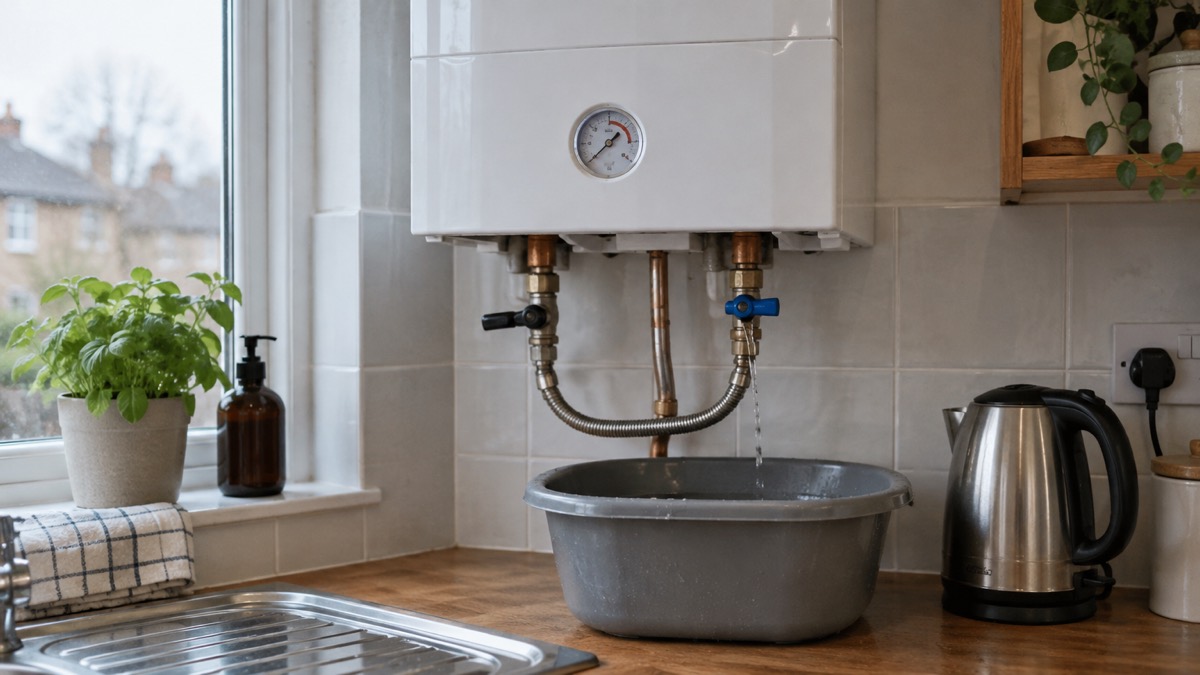
If your combi boiler has stopped heating or making hot water and the pressure gauge has dropped, the fix is usually to top the system back up through the filling loop. Switch the boiler off and let it cool first, find the filling loop, and open its valve slowly while watching the gauge. Close the valve when the reading reaches the level your boiler manual gives for your model; general guidance puts the target at one to one and a half bar1.
Then switch the boiler back on and check the gauge again. If the pressure holds, you have solved it. If it drops as soon as you close the valve, the maker Vaillant says there is likely a significant leak or a fault with the pressure release valve, and you should stop and call a Gas Safe registered engineer rather than keep topping up2.
This page covers the order to do it in, where to find the filling loop on different boilers, what the gauge should read, what to do if the pressure ends up too high, and the warning signs that mean the job is no longer a household fix.
Switch the boiler off and let it cool before you repressurise
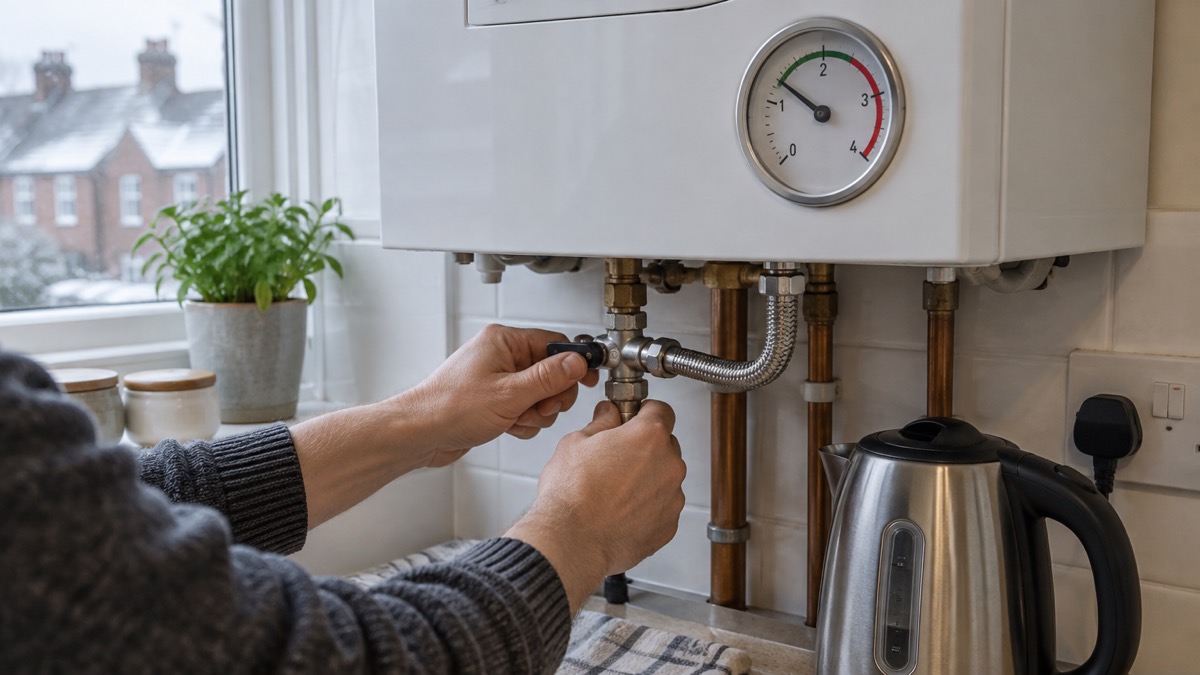
Every maker's guide starts the same way: turn the boiler off and let the heating system cool before you touch the filling loop. British Gas says to switch off your boiler and allow it to cool1. Vaillant is more specific: turn off the boiler, because the entire heating system needs to cool before work can be carried out on it2.
The reason is simple. A hot system is under pressure from expansion as well as from the water you are about to add, so the gauge will not give you a true reading and you risk overfilling. Letting it cool also means you are not handling valves and pipework next to hot components.
Once it is cool, find the filling loop. On many combi boilers it is a flexible, silver pipe with a valve at either end, connecting the cold mains supply to the boiler's pipes. British Gas says to double-check that it is securely attached to the boiler's pipes before you open anything1. Some boilers, including Worcester Bosch models, use a keyed internal filling loop instead: you align the arrow on the shaft of the white key with the open padlock, push it up into the open port, then turn the key and watch the pressure rise7.
If you cannot find the filling loop, do not guess. Vaillant notes that the location of the filling loop varies depending on the boiler model, so check your boiler manual4. The manual will also tell you the pressure your model should run at, which may differ from the general range.
Check the pressure gauge as you fill, and stop at the right reading
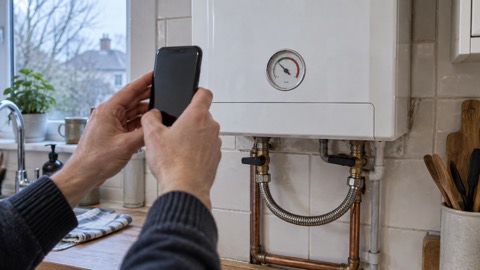
With the boiler off and the loop connected, open the valve slowly and watch the gauge. Check the pressure gauge as you open the handle valve and stop once it reaches the recommended level for your boiler10. On a keyed internal loop, Worcester Bosch says to turn the key and watch the pressure rise to just over one bar7.
What that recommended level is varies a little between makers, so the table below sets out what each says.
| Source | What it says about the target reading |
|---|---|
| Alpha | Close the filling valves once the gauge hits one bar3 |
| Alpha | Ensure the reading is within a safe level of between one and one and a half bar before switching the boiler back on3 |
| Worcester Bosch | Watch the pressure rise to just over one bar on a keyed internal loop7 |
| Vaillant | Stop once it reaches the recommended level for your boiler2 |
| British Red Cross | On most boilers the pressure gauge should be between one and two bar11 |
The figures differ between guides: one bar is the point at which Alpha says to close the filling valves, one to one and a half bar is the safe range it gives before switching the boiler back on3, and the Red Cross gives a broader one to two bar for most boilers11. Where your manual gives a figure for your model, follow it.
Once you have closed the valve, switch the boiler back on. Switch the boiler back on and, if needed, press the reset button12. Then check the gauge again with the system running, because that is when a leak or a faulty pressure release valve will show itself.
When to stop and call a Gas Safe engineer
Repressurising is a household job only while the pressure holds. Vaillant is clear that if you have followed the steps but the pressure drops as soon as you close the valve, there is likely a significant leak or a fault with the pressure release valve2. In that case, do not keep trying to repressurise the system, as this could potentially cause further damage2. Alpha's guidance is the same in spirit: repressurising is safe for householders who are confident the low pressure is not caused by a leak3.
There are also signs that mean you should not be working on the boiler at all. Cheshire Fire and Rescue Service lists strange noises, leaks, a yellow flame, unusual smells, the boiler turning itself on and off, low pressure or no hot water, and soot or staining around the boiler as reasons to turn it off and call a Gas Safe engineer13. A gas flame should always be blue; a yellow flame is a warning sign13.
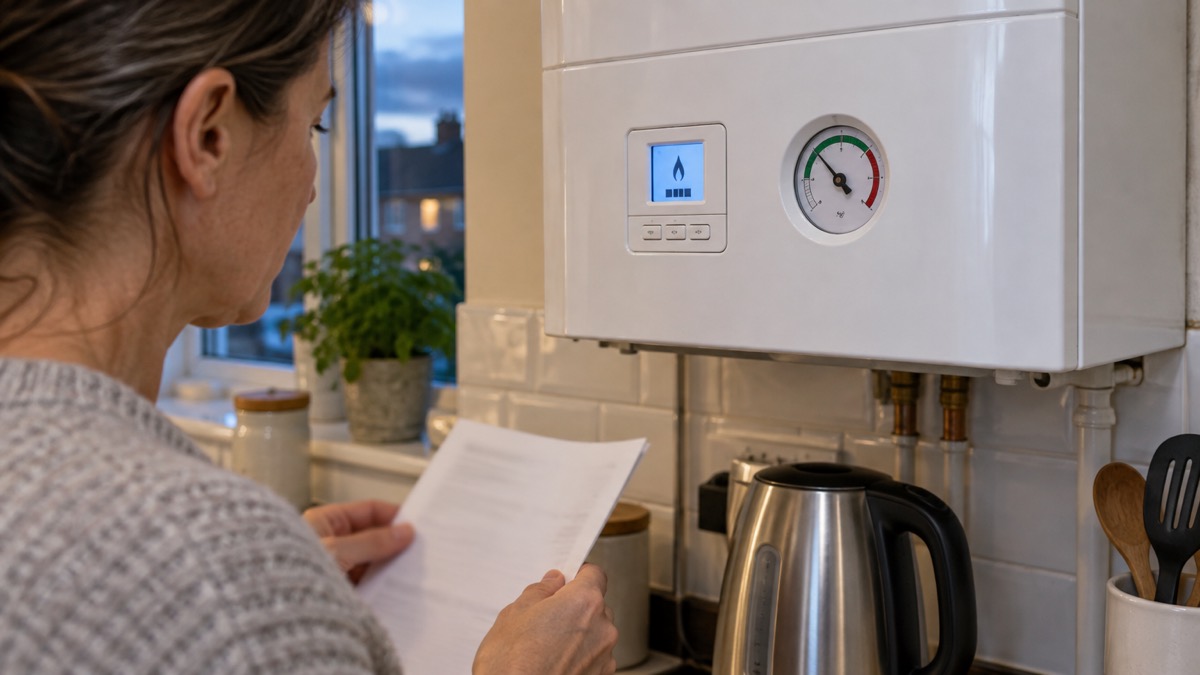
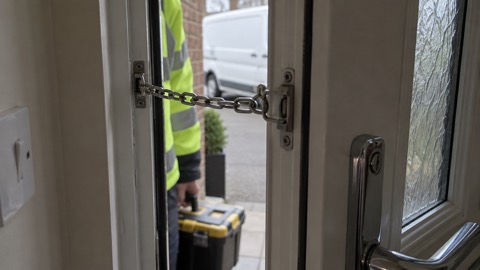
To find an engineer, use the Gas Safe Register. Northern Gas Networks directs households to a Gas Safe registered engineer through the register's website or on 0800 408 55005. Manchester Fire and Rescue Service gives the same number for getting a Gas Safe registered engineer to inspect appliances and flues6. Only ever use a qualified and competent Gas Safe registered engineer to service your boiler10, and check their Gas Safe Register ID card when they arrive15.
If your boiler is not working but the problem is unrelated to pressure, the advice is the same: contact a Gas Safe registered engineer to come out and take a look16. Our guide to boiler breakdowns in cold weather covers the checks to make first.
If the pressure is too high after topping up
Overfilling is the common mistake, usually from leaving the valve open too long or not watching the gauge. Vaillant says that if the pressure is greater than 2.5 bar, reduce the pressure before operating the appliance, either by bleeding a radiator or by seeking assistance from your installer or a local plumber4.
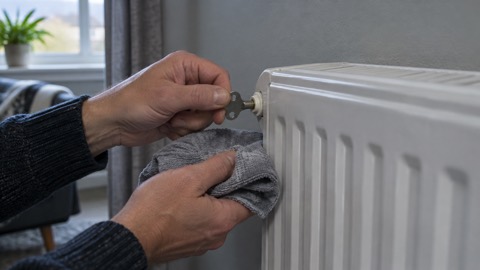
Bleeding a radiator is the household option, but it has a knock-on effect: letting water out of a radiator lowers the system pressure, and it can also let air in. Make sure you check the pressure gauge after bleeding a radiator1, and re-pressurise the boiler afterwards if the reading has dropped. Our page on how to bleed a radiator sets out the method.
If you have fixed a leak and repressurised the system but the pressure is still too low, Vaillant says to immediately close the filling loop and call a qualified engineer4. The same applies if the boiler continues to lose pressure, or if the problem is not remedied by repressurising or bleeding: contact a Gas Safe Registered engineer3.
Keeping the pressure steady through winter
Low pressure is often a cold-weather problem, and a little routine care prevents most of it. Regularly check your boiler pressure, and a service before winter arrives will help too11. Get your gas boiler and appliances serviced by a Gas Safe registered engineer15, and remember that boilers can lose system pressure as they age, so check the gauge and top up if too low10.
A service is not just about pressure. A Gas Safe registered engineer will check that the appliance is working properly and safely19, and the Health and Safety Executive's position is that only a Gas Safe registered engineer should work on gas appliances in your home14. If you rent, the arrangements for repairs sit with your landlord; our page on broken boilers in rented homes explains what they must do.
If the boiler has lost pressure because of a frozen condensate pipe rather than a leak, repressurising is not the fix. Northern Gas Networks says that if the blockage has not cleared or the boiler still is not working, contact a Gas Safe registered engineer for help16. Our guide to frozen condensate pipes covers thawing one safely.
For the wider picture on what the gauge means and how pressure behaves across the year, see our page on boiler pressure. And if you are without heat while you wait for an engineer, our section on gas and heating failures sets out the checks and the help available.
Sources (19)
- How to repressurise your boiler, British Gas, 2026
- How to repressurise a boiler, Vaillant, 2026
- Dealing with boiler pressure, Alpha Innovation, 2025
- What pressure should my boiler be?, Vaillant, 2026
- Boiler not working, Northern Gas Networks, 2026
- Carbon monoxide, Manchester Fire and Rescue Service, 2026
- Boiler pressure, Worcester Bosch, 2026
- What should I do if a pipe bursts?, WaterSafe, 2026
- Frozen or burst pipes, Met Office, 2026
- Boiler pressure guide, British Gas, 2026
- Snow and winter, British Red Cross, 2026
- Read our guide to learn how to re-pressurise your Worcester Bosch boiler - British Gas, British Gas
- Safe and well booklet, Cheshire Fire and Rescue Service, 2026
- Gas appliances: advice for homeowners, Health and Safety Executive, 2026
- Preparing your home for winter, Royal Voluntary Service, 2026
- My boiler isn't working, SGN, 2026
- Support, Cadent Gas, 2026
- Product recall: Ideal Heating Logic 2 Combi and System Boiler Range, GOV.UK, 2024
- Cold weather advice, West Midlands Ambulance Service, 2026
 Checks Before Calling Engineer
 Boiler Checks When Moving In
 Power Cut Kit Checklist
 Stop a Condensate Pipe Freezing
 Hot Water but No Radiators
 Resetting a Boiler Lockout
 Programmer Reset After Power Cut
 Boiler Leaking Water
 Boiler Overheating
 How to Bleed a Radiator
 Boiler On When Away in Winter
 Missed Reconnection Visit
 Prepayment Credit but No Gas
 Low Supply Pressure
 Checking a Network Engineer's ID