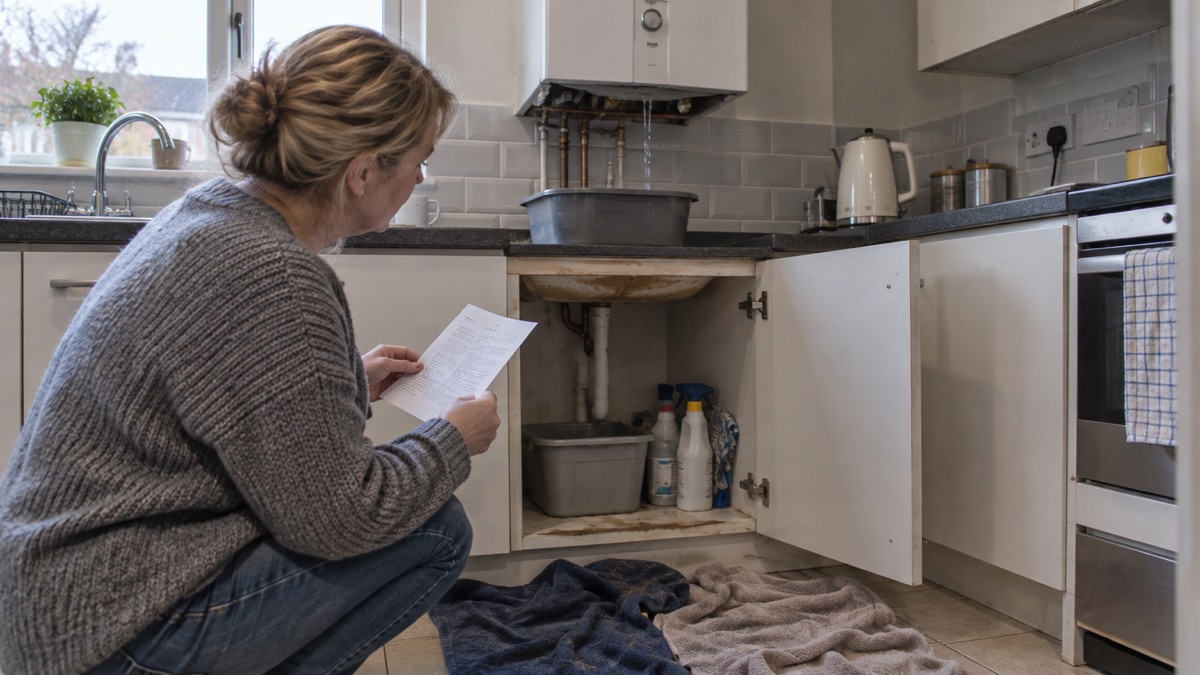
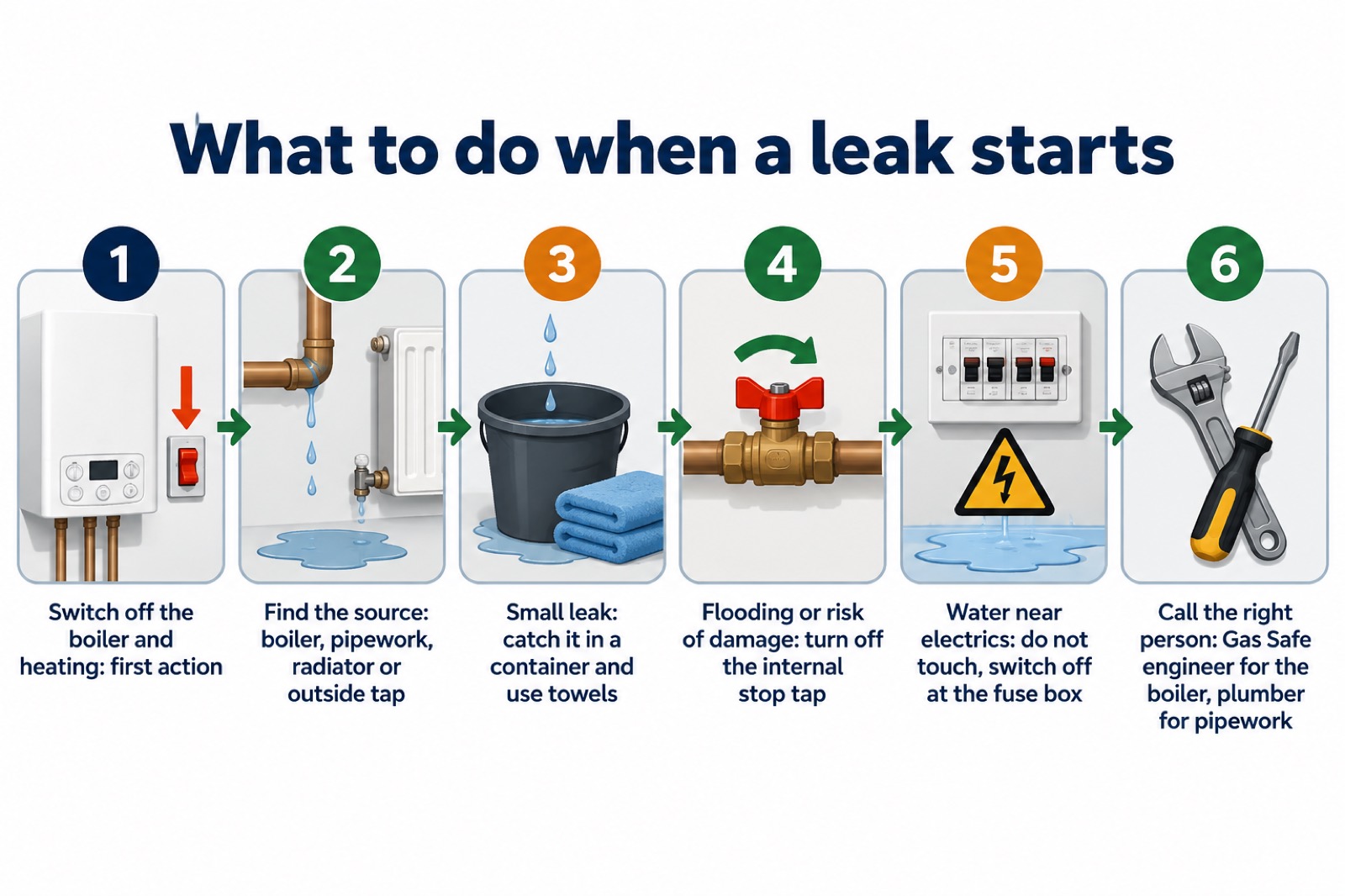
Water coming from your boiler, or from the pipes around it, needs dealing with in the right order. Switch the boiler off first, and do not try to fix it yourself. If you are not sure whether the leak is coming from your plumbing or your heating system, turn off your heating and boiler1. If a pipe has burst, turn off the water supply coming into your property at the stop tap and switch off your boiler2.
Then find where the water is actually coming from. A small leak can be caught in a container and soaked up with towels while you arrange for someone to look at it. A leak that is flooding the property, or has the potential to cause damage, means turning off your supply at your internal stop tap as soon as possible3. If water has leaked near your electrics, do not touch them and switch them off at the fuse box4.
Any work on the boiler itself has to be carried out by a Gas Safe Registered engineer5. Pipework, radiators and external pipes are a plumbing job. If you smell gas at any point, that changes everything: open windows, avoid using electrical switches, and call the National Gas Emergency Service on 0800 111 999 immediately6.
Switch the boiler off first, and don't try to fix it yourself
The first thing to do when you find a leak is turn off all water at the stop tap, sometimes called the stopcock7. Alongside that, turn off the central heating system, and if it uses a solid fuel boiler, allow the fire to die out7. If you are not sure whether the leak is coming from your plumbing or your heating system, turn off your heating and boiler1. That single action removes the pressure and the heat from the system while you work out what is happening.
Do not open the boiler casing, adjust valves inside it, or attempt a repair. Any work on appliances such as cookers, boilers or fires has to be carried out by a Gas Safe Registered engineer5. The boiler is a gas appliance, and the case is not a household maintenance panel.
If your boiler is a wood pellet unit, the Health and Safety Executive advises that if problems are encountered such as the system not heating correctly or flue gas flowing into the boiler room, you should turn the unit off and seek assistance immediately8. That is a different fuel and a different set of risks from a gas boiler, but the principle is the same: switch off, then get qualified help.
Once the boiler is off, note what you can see and smell. Strange noises, leaks, a yellow flame where it should always be blue, unusual smells, the boiler turning itself on and off, low pressure or no hot water, or soot or staining around the boiler are all reasons to turn the boiler off and call a Gas Safe engineer9. A yellow flame is a particular warning sign: it should always be blue9.
Find where the water is coming from: the boiler or the pipework around it
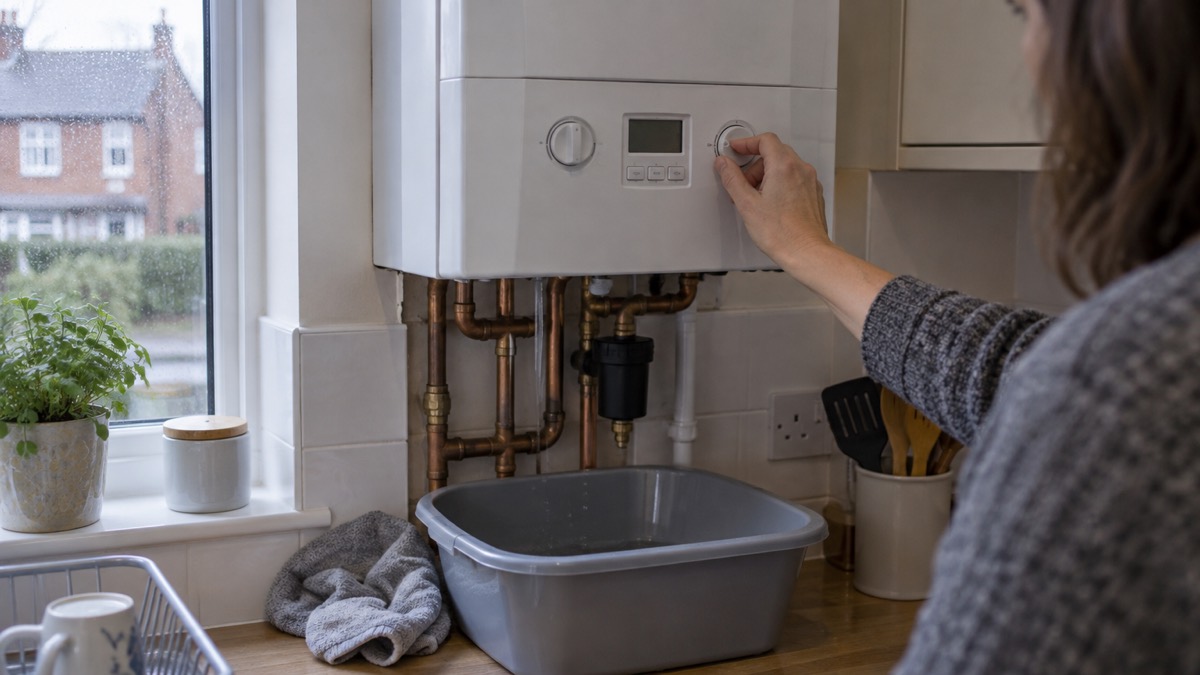
Water appearing near the boiler does not always start at the boiler. It is worth tracing it before you assume the worst, because the fix and the person you call are different. Look at the boiler itself, the pipes immediately around it, the discharge pipe that runs outside, and the joints and valves you can see.
Leaks also come from places you might not think of. WaterSafe advises looking out for poorly plumbed appliances and overflows from a water tank or cistern in the loft, and checking outside taps10. A leak can also appear some distance from its source: NI Water notes that it will work out where the leak is coming from, which is sometimes in a different location from where the water is visible11. The same logic applies inside your home.
| Where the water appears | What it often means | Who deals with it |
|---|---|---|
| From the boiler casing or its base | A fault inside the boiler, possibly the pressure relief valve12 | Gas Safe Registered engineer5 |
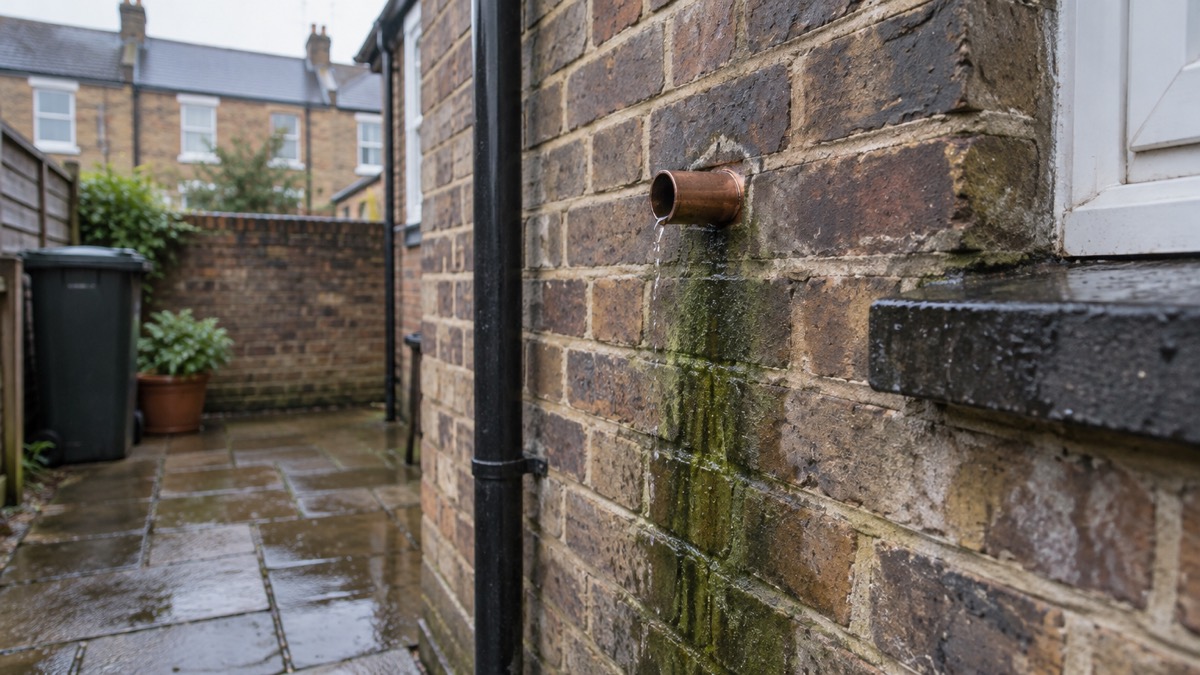
| From the copper discharge pipe outside | The pressure relief valve has been passing water12 | Gas Safe Registered engineer5 |
| From pipework, joints or valves near the boiler | A plumbing leak on the system | A qualified plumber3 |
| From a radiator or its valves | A plumbing leak on the heating circuit | A qualified plumber3 |
| From an outside tap or external pipe | External pipework, often frost related | A qualified plumber3 |
If the water is coming out of the boiler itself, British Gas says this could mean that the pressure relief valve isn't working as it should12. That is a job for a Gas Safe engineer, not a DIY repair. If the water is coming from a joint, a radiator valve or a pipe, it is a plumbing matter.
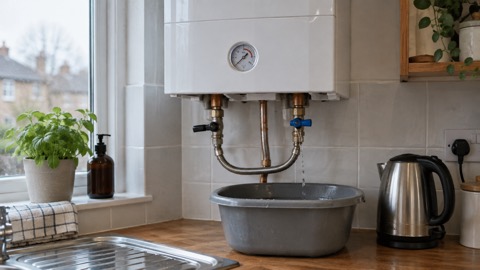
A small leak: catch the water in a container
A slow drip or a small trickle does not need alarm, but it does need managing while you wait for someone qualified. If the leak is small you may not have to isolate the boiler: put a container under the drip, making sure it is checked regularly so it does not overflow, and call an engineer13. Keep the area around the boiler clean and clear from debris, which is one of the visual checks British Gas recommends alongside checking the discharge pipe for any leaks12.
Catching the water protects your floors and the structure beneath them. Water that keeps escaping soaks into flooring and skirting, and left long enough it reaches the fabric of the building. It also matters for safety: Welsh fire and rescue service guidance notes that leaking water can damage electrical wiring and cause fire, which is why turning off the water at the mains stopcock matters when you go away14.
- Put a bucket or basin under the drip and check it regularly.
- Lay thick towels around the base to catch splashes and spread.
- Keep the area around the boiler clear of stored items and debris12.
- Note how fast the water is collecting, so you can tell the engineer.
- Do not put anything electrical near the leak.
If the drip turns into a steady flow, or water starts spreading across the floor, move to the next step and turn off the water supply.
When to isolate the boiler or turn off the stopcock
There is a clear line between a leak you can catch and a leak you need to stop at source. If the leak is flooding your property or has the potential to cause damage, you should turn off your supply at your internal stop tap as soon as possible3. If a pipe bursts, turn off the water supply coming into your property at the stop tap and switch off your boiler2. If your home is flooded, the electricity to the property should be isolated immediately, which would turn off the boiler4.
Turning off the stop tap stops new water entering the system. Opening the taps then helps drain what is already in the pipes: turn off the stopcock and boiler, open all taps to drain the system quickly, soak up escaping water with thick towels and call a qualified plumber3. Cambridge Water adds that after shutting the water you should switch off central heating, immersion heater and any other water heating systems, let solid fuel die out, then turn on hot taps to help drain the system15.
If your home is flooded, the electricity to the property should be isolated immediately, which would turn off the boiler16. That is the point at which the situation stops being a plumbing problem and becomes a safety one.
Finding your stopcock before you need it
The stop tap is usually under the kitchen sink17. Carmarthenshire County Council advises locating it so you can quickly turn off the water to your home if a pipe bursts or a leak occurs, and says that if you cannot find it you should contact your housing officer17. That advice is aimed at council tenants, but the habit is worth adopting in any home.
Find it now, while nothing is leaking. Check under the kitchen sink first, then look where the water main enters the property. If you live in a flat or a converted building, ask the landlord or managing agent where the internal stop tap is. Knowing the location turns a flooding emergency into a two minute job.
Northern Ireland has its own guidance on reducing the risk of burst pipes, which includes turning off the main stopcock18. The principle is the same across the UK: the stop tap is the household's own emergency control, and it is the first thing to reach for when water is escaping.
Leaks from a radiator or external pipework are a plumbing job
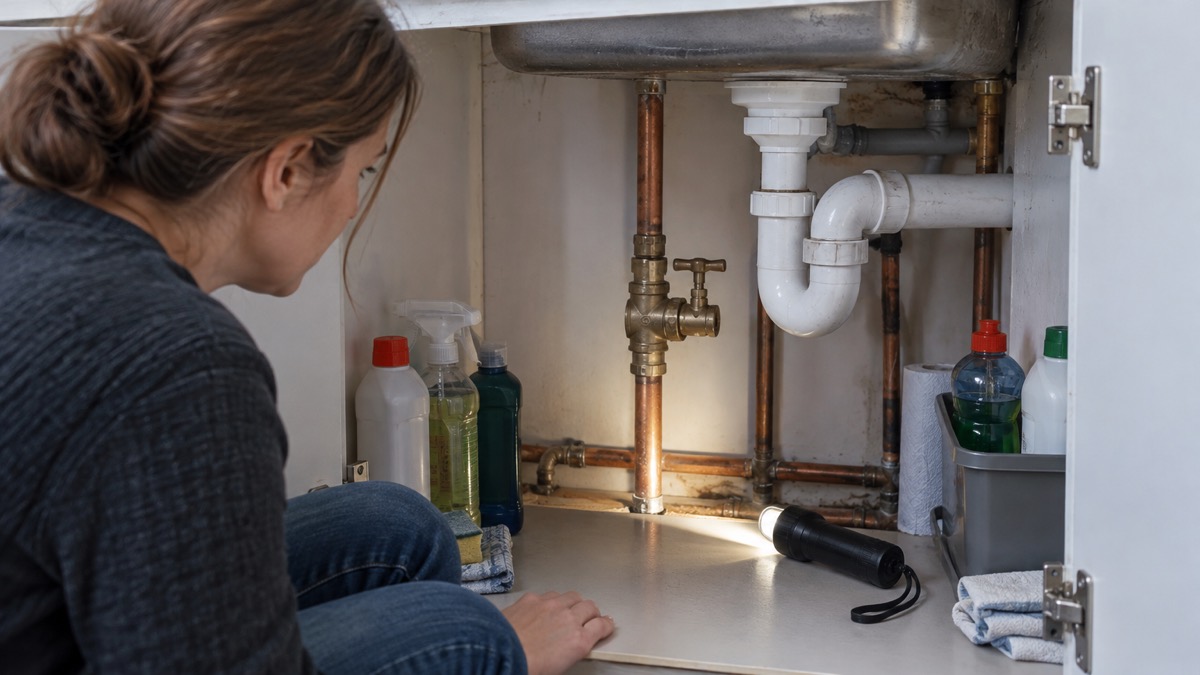
Not every leak involves the boiler. Water from a radiator, a radiator valve, an external tap or a run of pipework is a plumbing matter, and a qualified plumber is the right call3. Bristol Water sets out the split plainly: there are two kinds of leaks, ones that occur in the water company's pipework and are their responsibility, and ones that occur on your private pipework which require you or the homeowner to repair19. Yorkshire Water advises confirming whether the leak is located inside your property or on your supply pipe before repair work20.
That distinction decides who you ring. If the leak is inside your home, on your private pipework, it is yours to fix. If it is outside your boundary on the supply pipe, your water supplier may be responsible. If the flooding is due to a burst pipe, you should contact your water supplier21.
External pipework has its own seasonal risk. Portsmouth Water's advice on avoiding frozen pipes includes insulating water tanks and lagging pipes, fixing dripping taps, finding the internal stopcock, servicing the boiler, minimising draughts, leaving the heating on low when away, and keeping a separate supply of drinking water for emergencies22. If there is a risk of frost and the heating system is not working, consider calling a plumber to drain the pipework23.
- Lag exposed pipes and insulate tanks before winter22.
- Fix dripping taps22.
- Leave the heating on low when the house is empty in cold weather24.
- Keep a separate supply of drinking water for emergencies22.
Boiler losing pressure: what it tells you
Pressure and leaks are connected. Gas Safe Register advises checking the central heating system water pressure where applicable, checking the pressure gauge and topping it up if too low, because boilers can lose system pressure as they age5. A one-off top-up is normal maintenance. Pressure that keeps falling after you top it up is a sign that water is escaping somewhere.
That somewhere may be the pressure relief valve. British Gas describes leaks as water coming out from your boiler, which could mean the pressure relief valve isn't working as it should12. The valve's job is to release water when pressure gets too high, and a valve that keeps passing water will keep dropping your system pressure.
If you are topping up more than occasionally, get it looked at rather than living with it. A Gas Safe engineer can check the valve and the rest of the appliance. For the pressure gauge itself, what it should read and how to top up safely, see Boiler Pressure: What the Gauge Should Read and Fixing Low or High Pressure. If the copper pipe outside your boiler is the thing that keeps dripping, Why Is the Copper Pipe Outside Your Boiler Dripping? covers that specific symptom.
Water damage to floors, and stopping it spreading
The damage a leak does depends on how long it runs and what it reaches. Catching water in a container and soaking it up with thick towels limits the spread25. Turning off the stop tap stops the supply feeding it3. Both actions buy time, and time is what protects floors, joists and wiring.
Water and electrics are the combination to take seriously. If water has leaked near your electrics, do not touch them and switch them off at the fuse box4. If water has leaked near your electrics or into any electrical appliances, switch them off at the mains3. After the immediate danger, if electrical appliances have been wet, turn off the electricity at the fuse box, allow appliances to dry out and have a qualified professional check them before turning them on26.
If your home has actually flooded, the recovery is a bigger job. Sterilise all affected cooking utensils by boiling or by using suitable sterilizers before using them again27. For the wider picture of what to do during and after a flood, see Flooding: A Household Guide and Home Emergencies: Fire, Carbon Monoxide, Gas Leaks and Burst Pipes.
Calling a gas engineer, and when to call the emergency line
For anything involving the boiler itself, you need a Gas Safe Registered engineer. Any work on appliances such as cookers, boilers or fires has to be carried out by a Gas Safe Registered engineer5. Ask to see the engineer's card when they arrive, and check the appliance type is listed on it. Finding a Gas Safe Registered Engineer and Checking Their Card explains how.
A gas smell is different from a water leak and takes priority over everything else on this page. If you suspect a gas leak, open windows, avoid using electrical switches, and contact a Gas Safe registered engineer or the emergency gas helpline on 0800 111 999 immediately6. The National Gas Emergency Service number is 0800 111 99928. The National Gas Emergency Service: When to Ring and What Happens sets out what happens when you call.
For a leak that is not gas, the order is: switch off the boiler, contain the water, turn off the stop tap if needed, then call. If you have an issue with your gas boiler or any other gas appliance, call a Gas Safe Registered engineer or your gas supplier5. If you are a tenant, your landlord has responsibilities for repairs, covered in Broken Boilers in Rented Homes: What Your Landlord Must Do.
If the boiler is off and the weather is cold, the house will lose heat. Boiler Breakdowns in Cold Weather: What to Do covers keeping warm while you wait, and Heating and Cooking Without Mains Power or Gas: A Household Guide covers the wider options. Before you ring an engineer, Checks to Make Before Calling a Boiler Engineer lists what is worth checking yourself.
Sources (28)
- I've got a leak, emergency: what do I do?, Yorkshire Water
- What should I do if a pipe bursts?, WaterSafe
- Leaks on your property, Cambridge Water
- Frozen or burst pipes, Met Office
- Boiler appliance guide, Gas Safe Register
- Safe home heating, Warwickshire County Council
- What should I do if I find a leak in or around my home or business?, WaterSafe
- Wood pellet fuels, Health and Safety Executive
- Safe and well booklet, Cheshire Fire and Rescue Service
- How do I know if I have a leak in or around my home or business?, WaterSafe
- Leaks outside your property boundary, NI Water
- What is a pressure relief valve?, British Gas
- Boilers FAQs | Ideal Heating, Ideal Heating
- Mynd ar wyliau?, Mid and West Wales Fire and Rescue Service
- Leaks inside your property, Wessex Water
- Flooding, Chartered Institute of Plumbing and Heating Engineering
- Keeping your home safe, Carmarthenshire County Council
- Steps to reduce risk of burst pipes, nidirect
- Core customer information, Bristol Water
- Supply pipe leaks, Yorkshire Water
- During flooding, Somerset Council
- Pipework, Pressure & Leaks | Portsmouth Water, Portsmouth Water
- Fire, Devon and Somerset Fire and Rescue Service
- Learning about your boiler, British Gas
- What to Do If a Water Pipe Bursts in Your Home, WaterSafe
- Preparing yourself for emergencies, London Resilience Partnership
- Be prepared, Lancaster City Council
- Emergency, Basingstoke and Deane Borough Council
 Checks Before Calling Engineer
 Boiler Checks When Moving In
 Power Cut Kit Checklist
 Stop a Condensate Pipe Freezing
 Repressurising a Combi Boiler
 Hot Water but No Radiators
 Resetting a Boiler Lockout
 Programmer Reset After Power Cut
 Boiler Overheating
 How to Bleed a Radiator
 Boiler On When Away in Winter
 Missed Reconnection Visit
 Prepayment Credit but No Gas
 Low Supply Pressure
 Checking a Network Engineer's ID