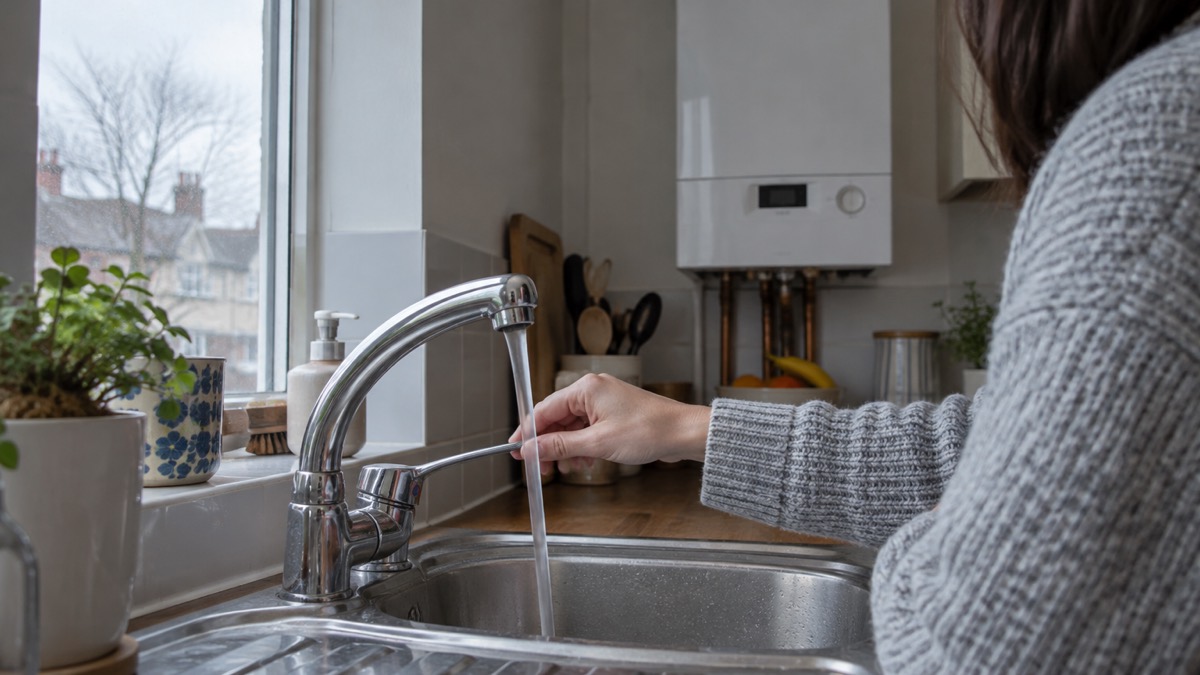
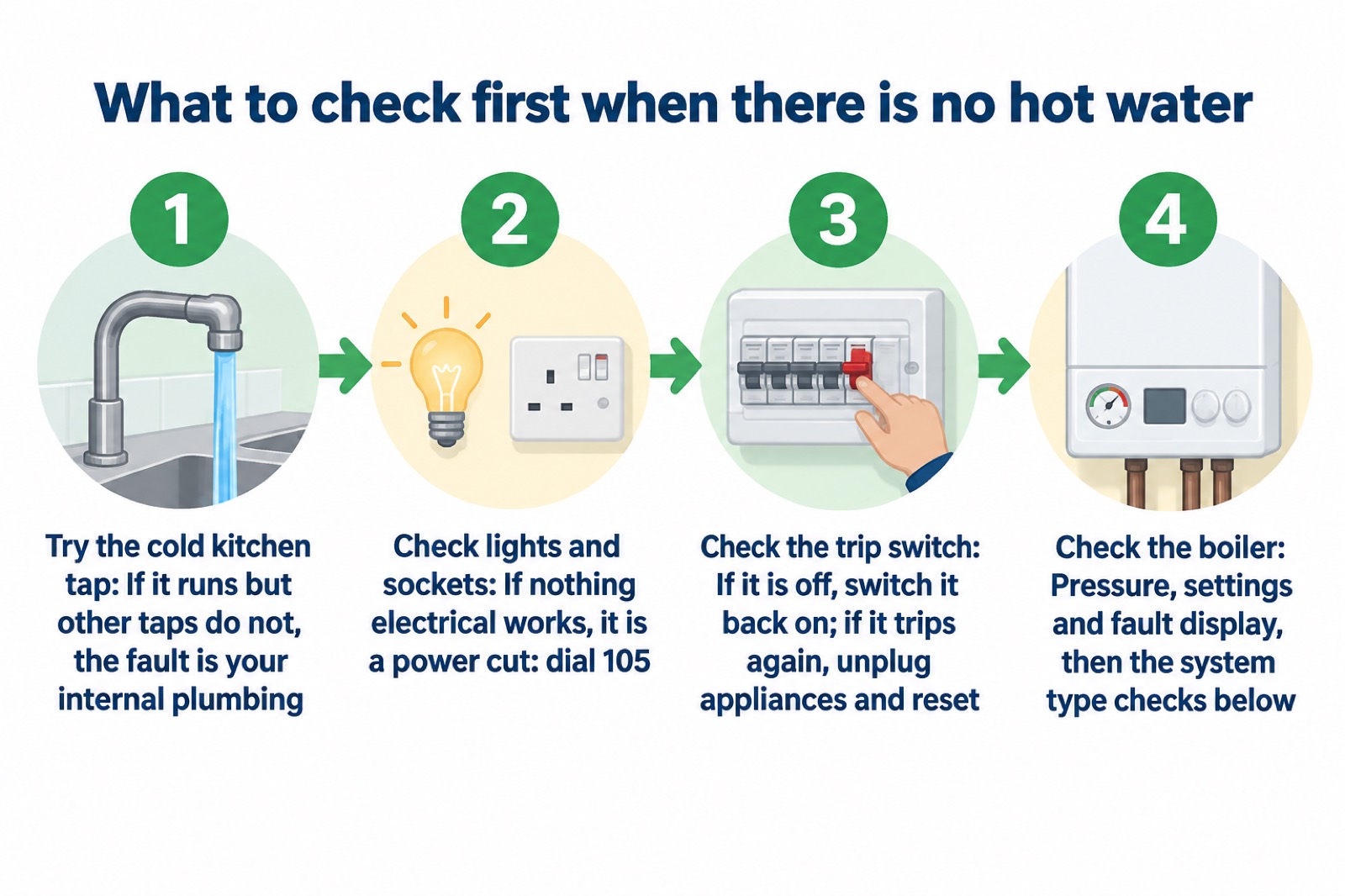
No hot water usually has one of four causes: the boiler has stopped or lost pressure, the electricity supply has failed, your internal plumbing has a problem, or the mains water supply itself is off. The fastest way to narrow it down is to try the cold kitchen tap first, because the main water supply normally enters your home at the cold kitchen or utility room tap: if water comes out of that tap but not elsewhere, the problem is with your internal plumbing rather than the supply in the street1.
Next, work out which kind of system you have, because the checks are different. A combination (combi) boiler provides hot water on demand straight from the mains, with no hot water cylinder2. A cylinder system stores hot water in a tank, usually fed by a cold water storage tank in the loft3. If the mains water is off, a combi stops making hot water but you can keep using the heating, whereas a cylinder system has its own rules about what is safe to run3.
Most of these checks take a few minutes and need no tools. Work through them in order before you call anyone out, because several of the common causes, a tripped switch, low boiler pressure, a tap left running somewhere, are things you can fix yourself in minutes.
First checks: is the hot water off everywhere?
Start with the cold kitchen tap. Official guidance on utilities failures is clear that the main water supply normally enters your home in the cold kitchen or utility room tap, so this tap tells you whether water is reaching the house at all. If the cold kitchen tap runs normally but other taps do not, the fault is inside your own plumbing, and that changes who you need to call: a plumber for your internal pipes rather than the water company1.
If the cold kitchen tap is dry too, the mains supply is likely off, and you should treat the problem as a water cut rather than a heating fault. While there is no mains water supply, official advice is to use alternative supplies such as bottled water solely for drinking, washing your hands and food preparation6. Our page on water in an emergency covers how much to keep stored and how to use it safely.
While you are checking, take in the rest of the house. Run more than one hot tap: if the upstairs bath runs hot but the kitchen sink does not, the problem is a single tap or a single pipe run, not the boiler. Check that nobody has turned a valve off, and check that hob and oven switches are all off, as the fire and rescue service advises at bedtime, and do not assume they are off just because the indicator light is off7. If the house is unusually hot or cold, check that any heating is turned off or on as you expect it to be, since a heating timer or thermostat knocked out of place can stop hot water on some systems8.
Power cuts and a tripped fuse box
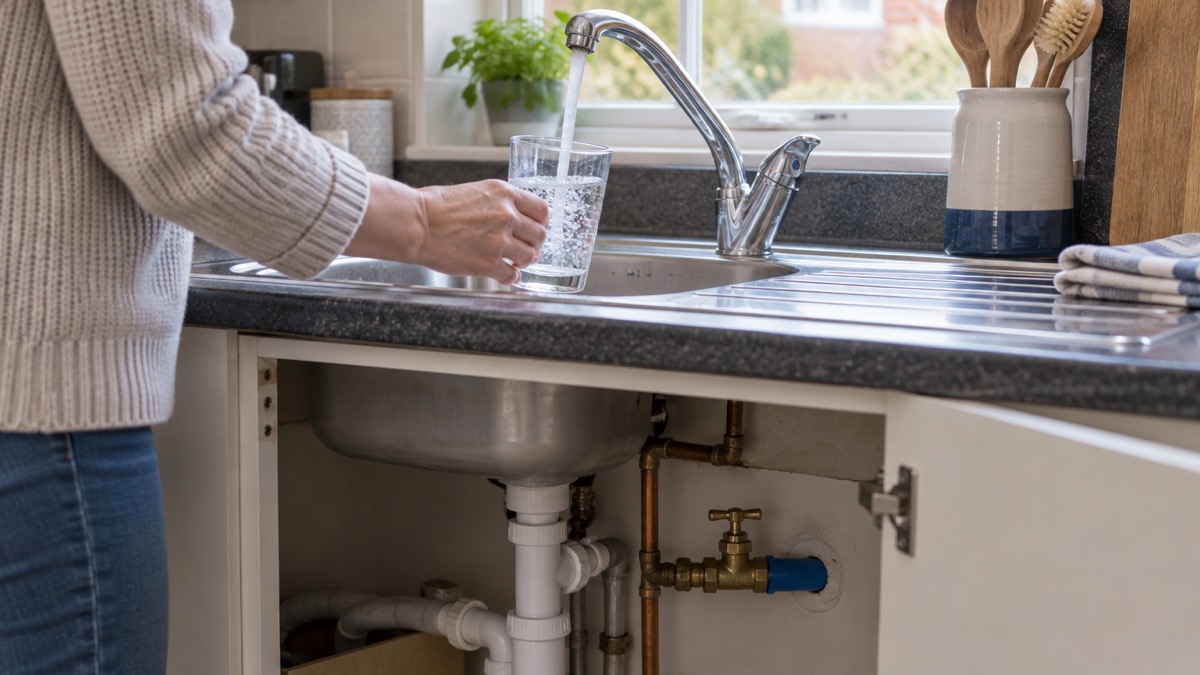
Boilers need electricity to run. Official guidance on power cuts states plainly that gas ovens, boilers, heat pumps and your home internet will not work without power, and that the mains water supply could also be disrupted during and after a power cut4. So before you blame the boiler, check whether anything else electrical in the house has stopped: if the lights and sockets are dead too, you have a power cut, not a hot water fault.
If the whole street is affected, dial 105, the free power cut line, to report the fault and get information9. In a short cut the sensible move is to wait, keep the boiler switched off at the wall until power returns, and then switch it back on. If your boiler has a programmer or timer, check it after the power comes back, as a cut can reset it; our page on why your programmer reset after a power cut explains what to do.
If only your home is affected, the fault is probably at your fuse box. Official emergency guidance gives this sequence: check your trip switch, a circuit breaker fuse system near your electricity meter. If the trip switch is still on, call your electricity network operator. If it is off, switch it back on; if it switches off again, unplug all appliances and reset the trip. If only part of the supply has failed and the trip will not reset, contact a registered electrician10.
One warning that matters for hot water specifically: in a widespread or long electricity failure, the gas supply can go off as well, and the water may slowly stop from the taps, because the utilities depend on each other11. A long power cut can therefore turn into a hot water problem even with a healthy boiler. Our power cuts guide covers what to keep ready for this.
Combi boilers: settings, valves and pressure
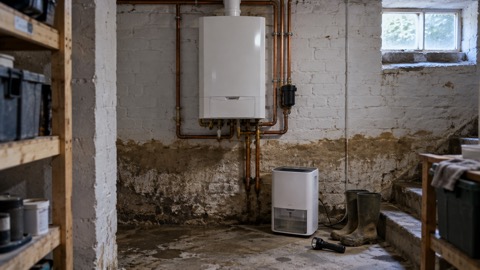
A combi boiler heats hot water on demand as you open the tap, so when a combi stops producing hot water the fault is at the boiler itself or in what feeds it. Combination boilers provide on-demand hot water with no cylinder needed, supply hot water at mains pressure, are often more compact, and can be more cost effective to install than other boiler types2. That on-demand design is also its weak point: if the boiler is off, faulting or starved of water, there is no stored hot water to fall back on.
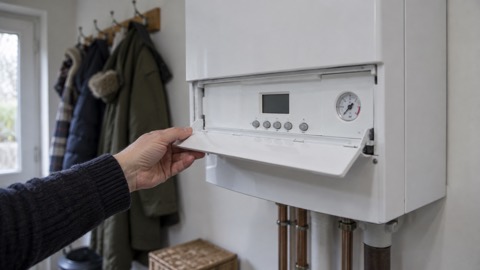
Check the hot water temperature setting on the boiler's controls first. Make sure the hot water mode is actually switched on and the temperature dial or menu is set where you normally keep it, and that nobody has changed it. Then check the isolation valves on the pipes beneath the boiler: these small valves shut off the water supply to the boiler for servicing, and if one has been knocked or left closed after work was done, the boiler has nothing to heat. If you have had a service or repair recently, this is one of the first things to look at.
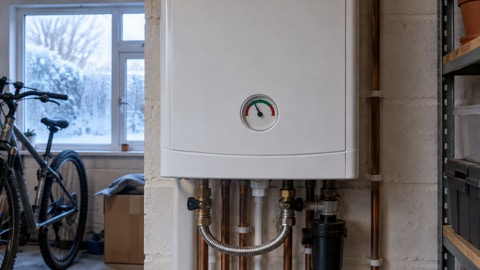
Check the pressure gauge. Boilers can lose system pressure as they age, and the Gas Safe Register's own boiler guide advises householders to check the central heating system water pressure where applicable, look at the pressure gauge and top it up if it is too low2. On the right figure, the guidance disagrees: one piece of maker guidance says the gauge should be around 1.5 bar, while another says the water pressure inside your boiler should be between 1 and 2 bar12. Treat roughly 1.5 bar as a healthy reading and anything well below it as needing a top-up. Our pages on boiler pressure and how to repressurise a combi boiler walk through the job step by step.
If your combi is a condensing model, and most sold in the UK are, check the external condensate pipe in freezing weather. Official winter guidance from Derbyshire Council advises householders to test their central heating, get the boiler serviced, make sure radiators are hot from top to bottom, and if you have a condensing boiler, check that the external pipe is insulated13. A frozen condensate pipe will shut the boiler down entirely, taking the hot water with it; our page on frozen condensate pipes explains the signs and how to thaw one safely.
| Check | What to look for | What it means |
|---|---|---|
| Hot water setting | Hot water mode on, temperature at its usual level | A changed setting or switched-off mode stops hot water2 |
| Isolation valves | Valves under the boiler fully open | A closed valve starves the boiler of water2 |
| Pressure gauge | Around 1.5 bar, or between 1 and 2 bar depending on the guidance | Low pressure can shut the boiler down2 |
| Condensate pipe | External pipe insulated, not frozen | A frozen pipe locks the boiler out in cold weather13 |
Cylinder systems: programmer, thermostat and immersion backup
If your hot water comes from a cylinder, usually a large tank in an airing cupboard, the system works differently: water is heated in advance and stored, controlled by a programmer and a cylinder thermostat. Check the programmer first and make sure a hot water cycle is actually scheduled: if the programmer has been reset, perhaps by a power cut, the schedule may have reverted to off. Check that the programmer is set correctly and that the cylinder thermostat is turned up14.
Then check the cylinder thermostat, the small control strapped to the side of the cylinder. If it has been knocked down to a low setting, the cylinder may be heating only lukewarm water, or not at all. Because a cylinder stores already-heated water, a change to the thermostat affects the next heating cycle rather than the water you draw immediately, so give it a full cycle before judging whether the change worked.
The immersion heater is your backup. Most cylinders have an electric immersion heater that heats the cylinder independently of the boiler, which makes it genuinely useful when the boiler breaks down: switch it on and you have hot water again while you wait for an engineer. It runs on electricity, so it will not help in a power cut, and it heats water only, not radiators. Follow the maker's instructions for your own heater, and do not overfill or misuse any self-heating appliance; official safety guidance is blunt on this point: "Do not overfill with water · follow manufacturer's instructions."15
One structural point worth knowing: a sealed system boiler is a closed system that only requires a boiler and a cylinder, with no requirement for separate water tanks in the loft unless it feeds an open vented hot water cylinder, but it needs space for the cylinder and installation can be more expensive than a combi2. Whether your cylinder is fed from the loft or sealed changes what happens in a water cut, which the next section covers.
When the mains water is off
A combi boiler heats mains water directly, so when the mains supply is cut off the combi simply stops making hot water. Welsh Water's winter guidance for combi boilers, where hot water is heated directly from the gas boiler with no hot water cylinder, is explicit: "you can use your heating, but you must not use any hot water from the taps"3. The heating circuit is sealed and separate, so radiators keep working; the hot water side has nothing to draw from.
For a cylinder system the rules depend on the cold water storage tank. If the water supply is cut off but the cold water storage tank is full, it is safe to run the central heating, but hot water should not be used3. If the cold water storage tank has run dry, the position is more serious: do not use the central heating or the hot water, because this could cause the hot water cylinder to collapse3. That is a warning worth acting on, not a technicality.
While the supply is off, use alternative water such as bottled water solely for drinking, washing your hands and food preparation, as official guidance on water supply interruptions advises6. If there is no gas or electricity available to boil water, use bowser or bottled water in all these circumstances, official guidance on private water supplies adds16. When the supply comes back, run the cold tap nearest to your stopcock, usually under the kitchen sink, for a while to clear any discoloured water before using it, and contact your water company if problems continue17.
| System | Heating in a water cut | Hot water taps |
|---|---|---|
| Combi boiler | Safe to use | Must not be used3 |
| Cylinder, cold tank full | Safe to run central heating | Should not be used3 |
| Cylinder, cold tank run dry | Do not use | Do not use; the cylinder could collapse3 |
How a combi and a cylinder differ, and the flow problem
The two system types fail differently, and knowing which you have tells you what to expect. A combi gives instant hot water at mains pressure with no cylinder, which suits smaller homes and saves space2. Its limits appear under demand: as the Gas Safe Register's boiler guide warns, if incorrectly designed, on-demand hot water means there can be a problem with hot water supply to taps if more than one is running at a time, reduced water flow when filling a bath, and a lack of mains water pressure or flow affecting hot water performance2.
So if your hot water goes weak when two taps run at once, or a bath fills slowly, that is likely the system working as built rather than a fault. Run one hot tap at a time and see whether the flow recovers. If a single tap is also weak, the problem is more likely the mains supply or your plumbing, and the cold kitchen tap test in the first section will help separate the two1.
A cylinder system trades instant response for storage. The cost is space for the cylinder, a more expensive installation than a combi on sealed systems2, and the collapse risk if the loft tank runs dry in a water cut3. Our comparison page on combi or system boilers and which keeps hot water going in an outage sets the two side by side in more detail.
Cold weather: frozen and burst pipes
Cold snaps cause a distinct set of hot water failures. Official Scottish guidance lists frozen or burst pipes among the hazards of cold, snow and ice18. If the heating system fails or makes a loud banging noise, this could indicate that a pipe is freezing; turn off the system and call a plumber immediately, as community resilience guidance for adverse weather events advises19. North Wales Fire and Rescue Service gives the same instruction for burst pipes: turn off the water heating system, then drain it by running all the hot taps20.
If you are leaving the home in freezing weather, turn off the water at the mains so that a burst pipe cannot flood the house while you are away. Our page on whether to leave the boiler on when away in winter covers the trade-offs, and boiler breakdowns in cold weather pulls the whole cold-weather picture together.
When to call a Gas Safe registered engineer
Call a Gas Safe registered engineer when the checks above point to the boiler or a gas appliance rather than to water, power or plumbing: the boiler will not fire at all, it keeps locking out, the pressure will not hold, or you have any concern about unsafe gas equipment. The Health and Safety Executive advises that if you have concerns about unsafe gas equipment you should contact a Gas Safe registered engineer, who can inspect the equipment and make any repairs21. NHS winter advice likewise says to contact a Gas Safe registered engineer to make sure your heating and cooking appliances are working properly and are safe22.
Always check the engineer is registered. The Gas Safe Register website has a Find an Engineer service where you can find a local registered engineer by entering your postcode, or you can call the freefone helpline on 0800 408 55005. Our page on finding a Gas Safe registered engineer and checking their card shows what to look for on the card itself.
Two situations need an engineer without delay. After a flood, if you use gas heating or gas appliances, official guidance says you will need a Gas Safe registered engineer to do an inspection before you use them again23. If you smell gas or suspect a leak, that is the National Gas Emergency Service, not a routine engineer visit; our page on when to ring the emergency line explains what happens.
For a full checklist of everything to rule out before you pay for a call-out, see our page of checks to make before calling a boiler engineer, and for keeping the boiler out of trouble in the first place, boiler servicing: how often and what an engineer checks.
Sources (23)
- Utilities failure: what to do, London Borough of Richmond upon Thames, 2026-05-22
- Boiler and appliance guide, Gas Safe Register, 2026-10-29
- Protecting your heating systems if your supply fails, Dŵr Cymru Welsh Water, 2026-10-28
- Power cuts: be informed about hazards, UK government Prepare campaign, 2026-10-21
- Gas Safe Register: checking an engineer, Health and Safety Executive, 2026
- Water supply interruptions or outages, UK government Prepare campaign, 2026-10-12
- Bedtime fire safety checks, London Fire Brigade, 2026-10-25
- Beat the heat: keeping cool at home checklist, UK government, 2026-07-21
- Prepare an emergency plan, Ready Scotland, 2026-10-29
- Are You Ready booklet, Culham Parish Council, 2025-09
- Failure of national electricity, Wiltshire and Swindon Prepared, 2026-10-25
- How to fix high Boiler pressure | Baxi Guides, Baxi
- Keep warm in winter, Derbyshire County Council, 2026-10-29
- Dimplex Quantum night storage heaters, Centre for Sustainable Energy, 2026-06
- Outdoor cooking and self-heating safety, Manchester Fire and Rescue Service, 2026-10-29
- Flooding advice for private water supplies, Shropshire Council, 2026-10-29
- Loss of essential services, Greater Manchester Combined Authority, 2026-10-29
- Cold, snow and ice, Ready Scotland, 2026-03-25
- Adverse weather events, Llangattock Community Council, 2026-10-25
- Ice and burst pipes, North Wales Fire and Rescue Service, 2026-10-29
- Energy, power supply and utilities, nidirect (Northern Ireland government), 2025-10-23
- Cold weather advice, West Midlands Ambulance Service NHS Foundation Trust, 2026-05-20
- After a flood: clearing up, nidirect (Northern Ireland government), 2026-05-06
 Checks Before Calling Engineer
 Boiler Checks When Moving In
 Power Cut Kit Checklist
 National Gas Emergency Service
 When the Mains Supply Goes Off
 Getting Supply Back After Outage
 Compensation for Supply Cuts
 Planned Pipe Works
 Help During a Long Outage
 Prepayment Meters
 LPG Homes in Winter
 Oil Boiler Breakdowns
 Boiler Breakdown in Cold Weather
 Boiler Fault Codes
 Boiler Pressure Gauge