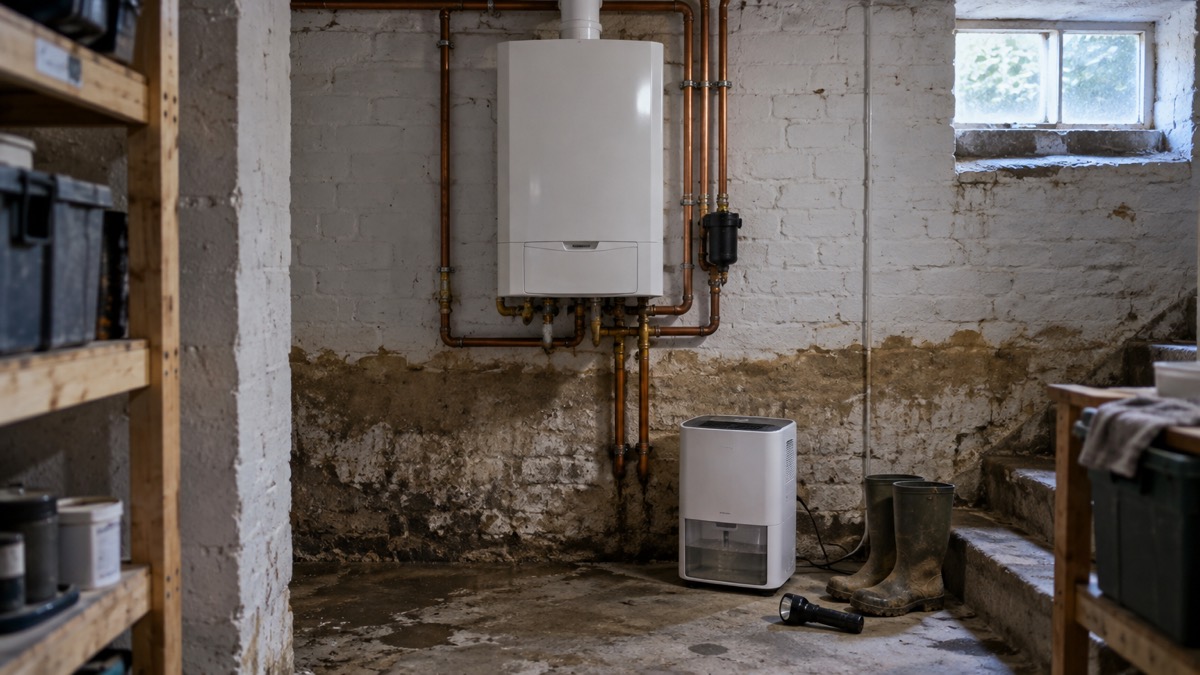
If your home has been flooded and you have no heat or hot water, the first thing to know is that you should not switch the boiler back on to find out whether it still works. Official flood guidance is consistent: make sure your gas and central heating has been checked by an engineer before turning it on1. The same applies to oil systems, and to the electrics that power the boiler and its controls.
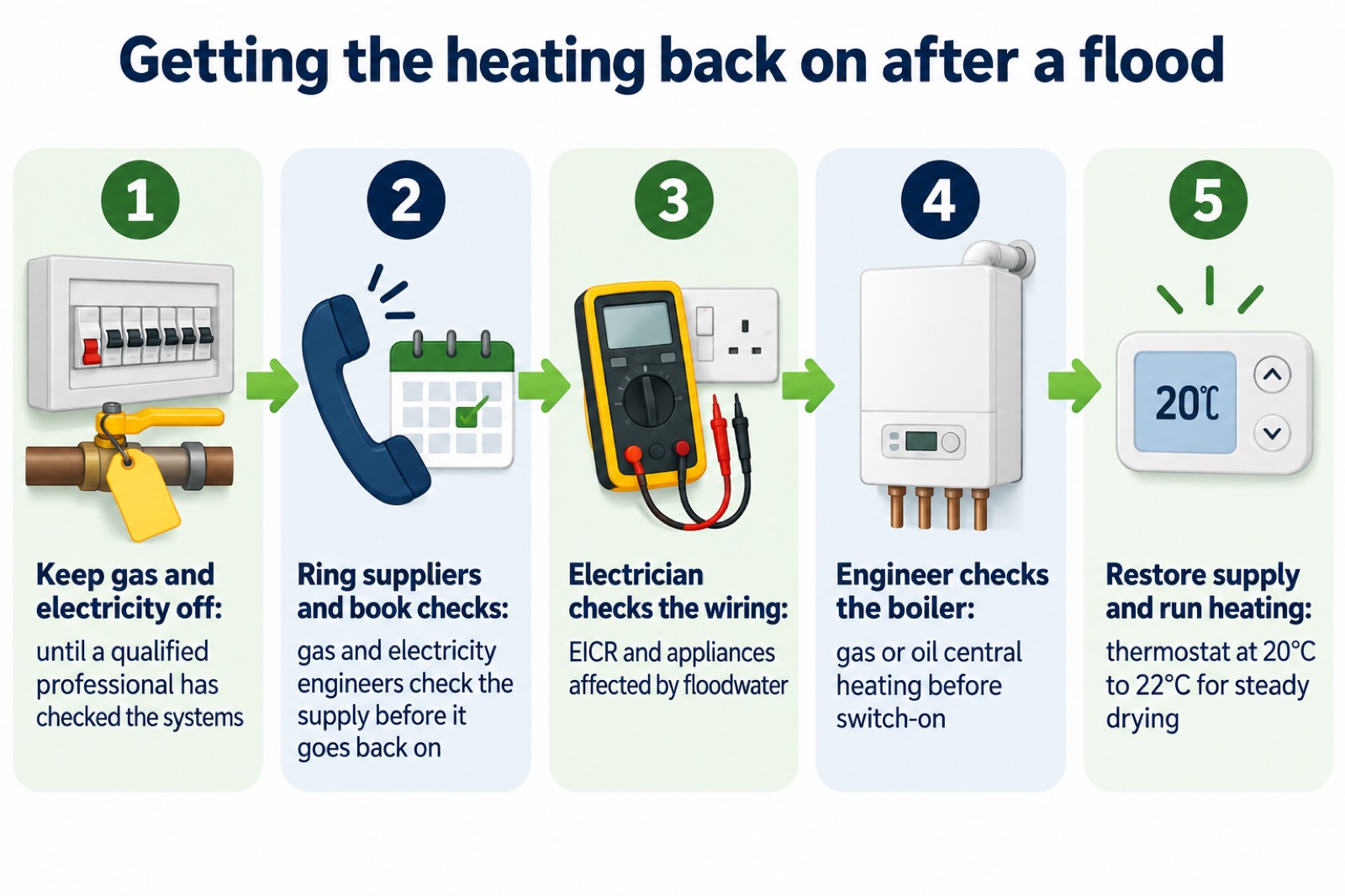
The order matters. Gas and electricity supplies should stay switched off until a qualified professional has checked the systems thoroughly2. Get your utilities company or a qualified engineer to check they are safe before turning them back on3. For the wiring, wait for an electrician's approval before restoring power, and do not use electrical equipment exposed to flood water until a qualified electrician has checked it4.
Once those checks are done, the boiler can be brought back into use, and the heating can then help dry the house. This page sets out the checks in the order to make them, what each one covers, and how to confirm that the person you call is genuinely qualified for the work.
The checks to make, in order
Work through this list before you ring anyone, so that you can tell the engineer exactly what has happened and what has already been done.
Leave gas and oil heating off until an engineer has checked it
The single most important rule after a flood is that the boiler stays off until someone qualified has looked at it. Gas or oil central heating should be checked by a qualified engineer before turning it on13. Gas and oil central heating should be checked by an engineer, and electrics by a qualified electrician, before they are turned back on14. Do not turn on gas or gas appliances until your system has been checked by a Gas Safe registered engineer15.
This is not box ticking. Water gets into places you cannot see: the flue, the burner, the controls, the fuel line on an oil system. A boiler that lights and appears to run can still be unsafe. That is why the advice is to have your gas or oil central heating checked by a qualified person before switching on the gas or trying to light any appliance4, and why a gas engineer should evaluate safety before you use gas appliances, with no attempt to turn them on if damage or leaks are suspected17.
Oil systems deserve particular care. The same rule applies: get gas or oil central heating checked by a qualified engineer before turning it on13. If you want to understand how an oil boiler behaves when it locks out or runs dry, that is covered separately in the oil boiler breakdown guidance, but none of those steps replace the post-flood inspection.
For appliances that use fossil fuels, including wood, the wider advice is to have them installed and serviced at least annually by a qualified and registered engineer, and not to turn on appliances which may have got wet until they have been checked12. After a flood, that annual service is the minimum, not the answer.
Electrics need a qualified electrician before they go back on
The boiler depends on the electrics, and flooded electrics are a danger in their own right. Wait for an electrician's approval before turning power back on4. Do not use electrical equipment that has been exposed to flood water until a qualified electrician has checked it, and properly switch off all electrical appliances before the supply is restored4.
Ask for an EICR. A registered electrician will check the condition of the wiring, and can also check any electrical equipment or appliances affected by floodwater10. If you know or suspect that electrical equipment associated with a private water supply has been affected, it should be inspected and declared fit for use by a suitably qualified electrician before you try to restore the supply18. The same principle applies to anything electrical in the house.
Heating appliances get their own warnings. If you think the wiring is damaged, do not use your heater: get it checked by a qualified electrician19. If you find any damage, or are not sure about the fuse or wiring, get a qualified electrician to advise you20. Fixed electric heaters should be installed by a qualified electrician21. And if a heater is electrical and getting older, get it tested by a qualified electrician or replace it22.
If you cannot get a satisfactory answer from a competent electrical contractor about a safety concern, the Health and Safety Executive advises contacting HSE23.
| What was affected | Who checks it | What to ask for |
|---|---|---|
| Wiring, sockets, consumer unit | Registered electrician | An EICR on the home10 |
| Boiler and heating controls | Qualified engineer | A post-flood check before switch-on13 |
| Gas appliances and flue | Gas Safe registered engineer | An inspection after the flood12 |
| Electrical appliances that got wet | Qualified electrician | A check before use4 |
| Private water supply equipment | Suitably qualified electrician | Inspection and a declaration of fitness18 |
Turning the heating on to dry the house, once it is safe
Drying out is the reason most people want the heating back on quickly, and once the checks are done it is exactly what the heating is for. You can use your central heating to help dry out the house once the heating system has been checked by a qualified engineer7. For best results, set the temperature at 20 to 22 degrees centigrade7. Keep the thermostat between 20°C and 22°C for steady drying9.
How you dry depends on the method. If you are drying naturally, keep doors and windows open as much as possible. If you are using dehumidifiers, close external doors and windows instead. If the gas or oil central heating has been checked by an engineer, turn it on and keep the thermostat between 20°C and 22°C for steady drying9.
Ventilation is not optional. Ensure heaters, dryers or fires are well ventilated to avoid carbon monoxide poisoning, and do not use petrol or diesel generators or other similar fuel-driven equipment indoors, because their exhaust gases contain carbon monoxide24. Never run a petrol or diesel generator indoors: they can produce fatal levels of carbon monoxide8.
Getting your heating checked by a qualified engineer
"Qualified" has a specific meaning for each trade, and it is worth knowing before you book.
For gas work, it means a Gas Safe registered engineer. Have your heating and cooking appliances checked by a Gas Safe registered engineer to make sure they are working safely25. Contact a Gas Safe registered engineer to check your heating and cooking appliances are working properly and are safe26. The same advice appears across NHS winter guidance: contact a Gas Safe registered engineer to make sure your heating and cooking appliances are working properly27.
You can verify the person at your door. All Gas Safe registered engineers carry ID cards which tell you which appliances they are qualified to work on, and their competencies are clearly marked on the back of the card15. The Gas Safe Register's Check an Engineer service lets you input the licence number from the engineer's ID card to see pictures of the registered engineers and details of their qualifications15. Our guide to finding a Gas Safe registered engineer and checking their card walks through this.
For electrical work, it means a qualified electrician, as set out above. For the boiler itself, the check is a condition of switching it back on, not a service you can defer.
Carbon monoxide and gas smells after a flood
Two hazards deserve their own section because they can hurt you before the boiler is ever switched on.
Carbon monoxide is odourless and comes from fuel-burning appliances and equipment. Be aware of the signs of carbon monoxide poisoning and always ensure your property has a carbon monoxide detector8. Have your heating and cooking appliances checked by a Gas Safe registered engineer to help protect you from exposure to high levels of carbon monoxide29. If an alarm activates or you suspect carbon monoxide, isolate all possible sources, ventilate the property and get out, then call a qualified engineer to check for a leak17. The fire and rescue service's TASK advice is to turn off or extinguish fuel-burning appliances if it is safe to do so, open doors and windows and go outside, seek medical assistance if unwell, and keep appliances off until checked by a qualified engineer17.
A gas smell is an emergency. In Northern Ireland, call the NI Gas Emergency Service immediately if you can smell gas6. Do not turn your gas supply on or use gas appliances until they have been checked by a Gas Safe registered engineer6. The same principle applies across the UK: leave the supply off and let the emergency service and a registered engineer take it from there.
If you need help while the heating is off
A cold home while checks are arranged is uncomfortable but manageable. The NHS advises that heating and cooking appliances are checked by a Gas Safe registered engineer so they are working safely25, and that keeping warm matters for health in cold weather. If you have older neighbours, relatives or anyone with a health condition, check on them while their heating is off.
For wider help during a heating failure, our gas and heating failures section covers boiler breakdowns in cold weather, loss of supply and reconnection. If your boiler is a particular model, the fault code and breakdown pages for that model explain what the display is telling you, but none of them override the post-flood rule: the system is checked by a qualified person before it is switched on13.
Sources (29)
- What to do after a flood, Natural Resources Wales, 2026
- Staying safe in a flood, Herefordshire Council, 2026
- After a flood, GOV.UK, 2026
- Clearing up after a flood, Oxford City Council, 2026
- Flooding advice, Mid and West Wales Fire and Rescue Service, 2026
- Household flood plan, nidirect, 2018
- After flood: clearing, nidirect, 2026
- Flooding advice: after a flood, London Fire Brigade, 2026
- Before, during and after a flood, Suffolk County Council, 2021
- Flooding advice, Dorset and Wiltshire Fire and Rescue Service, 2026
- Personal flood plan, GOV.UK, 2023
- How to recover from flooding, GOV.UK, 2023
- Flooding and health: safely cleaning your home, Wiltshire and Swindon Prepared, 2026
- Flood risk in Anglesey: be prepared, Isle of Anglesey County Council, 2013
- Gas safety: frequently asked questions, Health and Safety Executive, 2026
- Flooding advice, Belfast City Council, 2026
- Home fire safety, Northern Ireland Fire and Rescue Service, 2026
- Private water supplies after floods or storms, Argyll and Bute Council, 2026
- Heaters, Devon and Somerset Fire and Rescue Service, 2026
- Electric blankets and portable heaters safety, Warwickshire County Council, 2026
- Portable heaters, Cheshire Fire and Rescue Service, 2026
- Portable heaters, gas fires and open fires, London Fire Brigade, 2026
- Electrical safety: frequently asked questions, Health and Safety Executive, 2026
- Flooding and health: advice for the public, GOV.UK, 2024
- Cold weather, snow and ice, UK Government Prepare campaign, 2026
- Use the right service this winter, Hampshire Hospitals NHS Foundation Trust, 2026
- Cold weather advice, West Midlands Ambulance Service, 2026
- Stay well this winter, NHS Cheshire and Merseyside, 2026
- Be ready, stay safe, act now, Sussex Resilience Forum, 2025
 Boiler Checks When Moving In
 Power Cut Kit Checklist
 What to Keep Charged