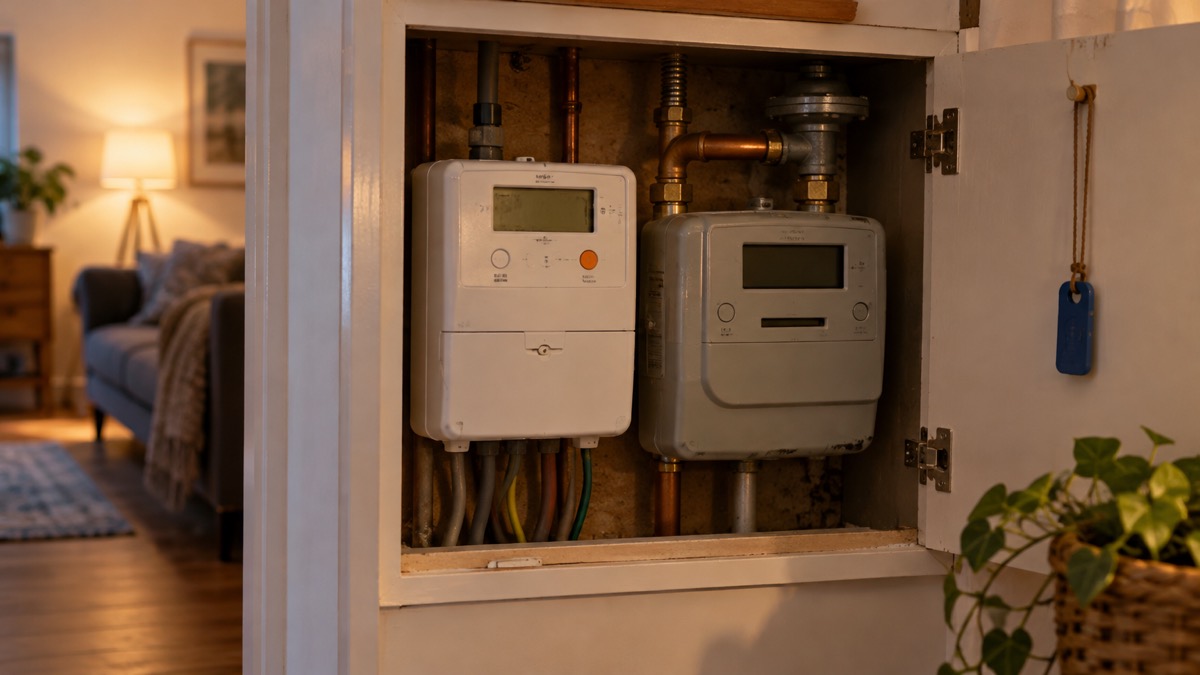
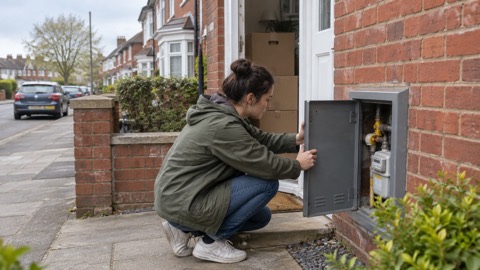
A prepayment meter cuts the supply when the credit runs out, so the first thing to check when your gas or electricity stops is the balance on the meter itself. If you have a pre-pay meter, check that you still have credit1. If the credit has gone, you can usually switch on emergency credit at the meter, and friendly credit may keep the supply on overnight, at weekends and on bank holidays so you are not left without heat until the shops open2.
If the meter has credit but the supply is still off, the problem is likely with the meter or, for gas, with the regulator at the meter, and your supplier has to act: where the power supply is still working, they must take appropriate action within 3 hours, or 4 hours on a weekend or bank holiday2. If your electricity or gas has already stopped, your supplier has to send someone to repair or replace the meter2. If you can smell gas, that is a different emergency: turn off the gas supply at the meter and ring the National Gas Emergency Service, which is available 24 hours a day, 365 days a year4.
No supply on a prepayment meter: what to check first
Work through the checks in order before you call anyone, because the answer changes who you need to ring.
- Check the meter display. Look at the balance. If you have a pre-pay meter, check that you still have credit1. A blank screen, or a message such as 'error', 'call help' or 'battery', probably means a fault with the meter rather than empty credit2.
- Check whether your neighbours have supply. If the neighbours' supply is still working, your loss of power might be caused by a meter problem, your prepayment meter running out of credit, or a blown fuse or tripped circuit breaker switch2. If the whole street is off, it is a network problem: for electricity, ring 1057.
- Check for a smell of gas. If you can smell gas, turn off the gas supply at the meter4 and follow the emergency steps in the warning below.
- Check for water damage. If electricity or gas supplies have been in contact with water, for example in a flood, turn them off and get them checked before using them again8.
If you have no electricity because of prepayment meter technical problems and you are in Scotland, you can contact Advice Direct Scotland, which is open Monday to Friday, 9am to 5pm9. If you prepay for your energy and you are having problems with your smart meter, contact your supplier as soon as possible, because you might be left with no energy10.
One further check worth making: look at the meter itself. Manchester Fire and Rescue Service advises checking the frontage of the meter, that you can see the dials, and that it is metallic pipe work13. If the pipework has been tampered with, or the meter shows credit has run out but gas is still available, that is a warning sign of energy theft, and you should report it: tampering with or bypassing the gas meter is extremely dangerous6.
Emergency credit: how to switch it on and what it costs you later
Emergency credit is temporary credit you might be able to get if you cannot get to a top-up point, or you keep running out of credit3. Your supplier provides an emergency credit facility which you can access automatically via your meter14. In practice this usually means the meter shows a message when your credit falls low, and you accept the emergency credit by pressing a button on the meter or keypad, rather than the supply simply cutting off without warning.
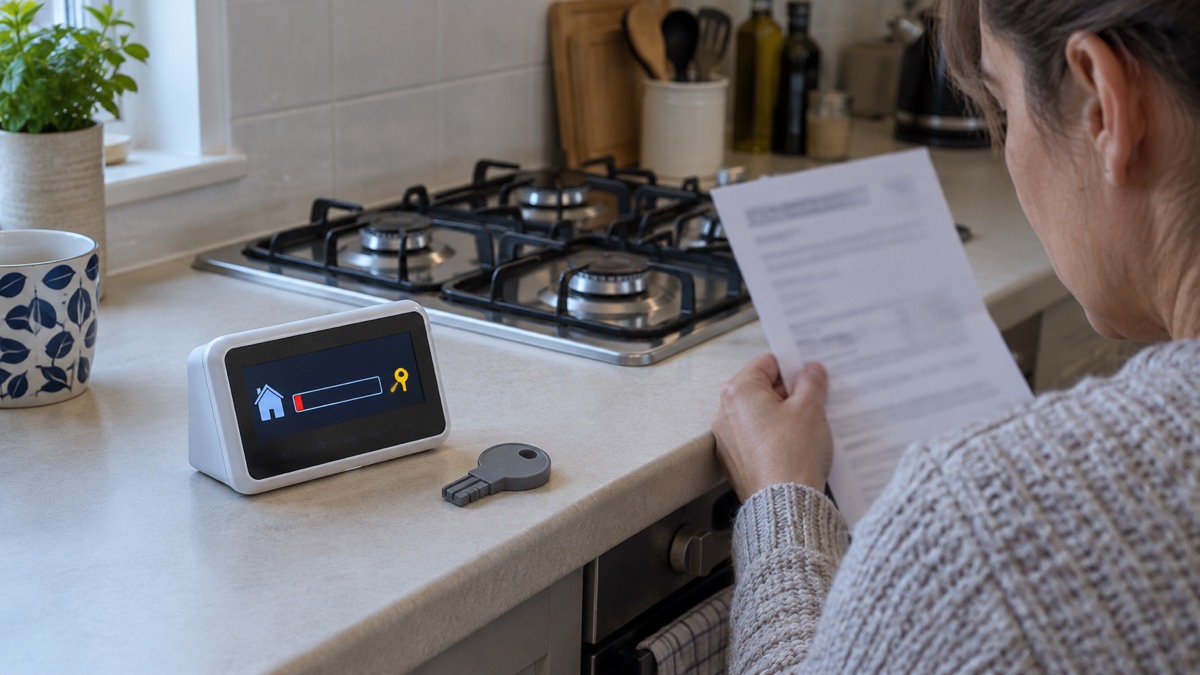
The important thing to understand is that emergency credit is not free energy. It is a loan against your next top-up: when you next add credit, the emergency amount, and any standing charges that built up while you were on it, are taken back off the balance first. That is why you need to have credit on your prepayment meter to pay the standing charge, even on days when you do not use any gas or electricity3. A household that runs on emergency credit repeatedly can find each new top-up disappears faster than expected, because it is repaying the last emergency amount plus the daily charge.
Suppliers are required in certain situations to offer additional credit beyond the standard emergency amount, alongside emergency credit and friendly-hours credit14. If you are struggling, ask your supplier specifically about additional support credit rather than only the standard emergency credit, and see the section on support credit below.
If you have switched supplier, note that your new supplier should tell you how much emergency credit you can get, and it might be different from your previous supplier15. And if your supplier has gone out of business, do not stop topping up: if you have a prepayment meter, you can still top it up as usual, and a new supplier will be appointed for you16.
Friendly credit: the supply stays on overnight, at weekends and on bank holidays
Friendly hours credit lets you keep using electricity at night, at weekends or on bank holidays if you run out of credit during certain times3. The purpose is simple: top-up shops close, and a household should not lose its heating at 11pm on a Friday because the credit ran out at 10.45pm. Instead of cutting you off, the meter switches to friendly credit and carries the debt until you can top up the next morning or the next working day.
The exact hours vary between suppliers, so check your supplier's website or ask them directly what their friendly credit window is. What is consistent is the pattern: nights, weekends and bank holidays3. When you do top up after a period of friendly credit, expect the borrowed amount to be deducted, in the same way as emergency credit.
In Northern Ireland, the equivalent behaviour applies to keypad meters: if friendly or emergency credit has been activated, the meter will come back on after resetting if the supply was interrupted due to a meter overload, even with no credit17. So if your keypad meter trips during the night while you are on friendly credit, resetting it should restore the supply rather than leaving you off until you can pay.
A related point for households on prepayment meters during wider disruptions: during a power cut, keep in contact with neighbours if gas supplies to appliances are unavailable, as they may be able to help with providing gas for cooking, warm drinks and so on18. Our page on what to do when the mains supply goes off covers the wider steps.
Getting the supply back on after you top up
Topping up does not always restart the supply by itself, and the reason matters for safety.
If the meter simply ran out of credit, adding credit and following the meter's prompts normally restores the supply. On a card or key meter, insert the card or key and wait for the display to confirm the new balance.
If you find yourself in a 'no gas' situation after topping up, it may be because the regulator at the meter has tripped. This is common particularly if you have recently topped up your meter following low credit, or have had your gas supply turned off for some time19. Your supplier or gas network can advise on resetting it.
If you turned the gas off at the meter yourself, do not turn it back on. Cadent advises that if you have turned off your gas supply, you should not try to turn it back on again yourself20, and Surrey County Council states that if you turned off gas it must be turned on again by a professional for safety reasons21. This applies after any emergency, not just floods.
After a fire or a flood, the supply must be checked first. Cheshire Fire and Rescue Service states it is important that either British Gas or an approved installer inspects and rectifies any problems in the system before any attempt is made to reconnect or turn on the supply22. The government's personal flood plan similarly notes you may need gas or electricity engineers to check your supply before turning it back on23, and for electricity after a flood the contact number is 1057. Our page on getting your supply back on after an outage goes through this in full.
Topping up a smart prepayment meter
How you top up depends on whether your meter is smart.
| Meter type | How you top up | Notes |
|---|---|---|
| Traditional card or key meter | Buy credit at a top-up point with your card or key3 | You have to visit a shop, Post Office, PayPoint or Payzone outlet |
| Smart meter in prepayment mode | Remotely, via your online supplier account, by app, or by phone14 | No need to visit a shop; you can also track your balance easily |
| Keypad meter (Northern Ireland) | Top-ups purchased with cash from the Post Office or using PayPoint or Payzone at your local outlet; by phone with your supplier; some suppliers have an app24 | Methods vary by supplier |
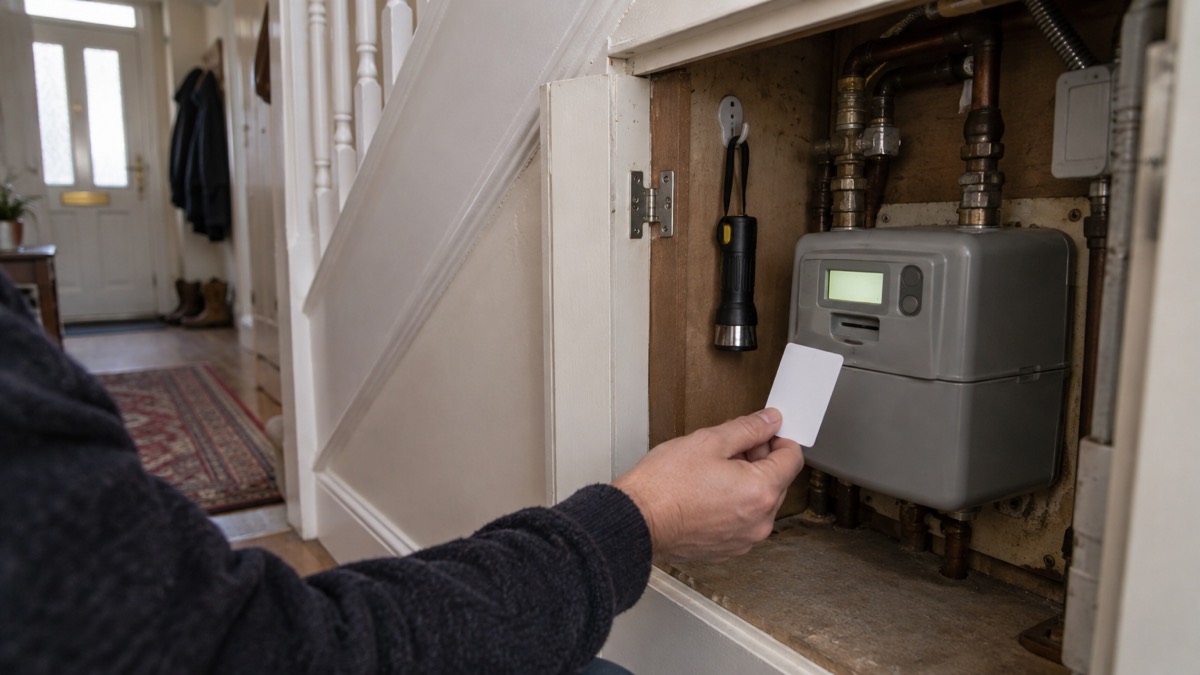
Smart prepayment customers can top up remotely and track their balance easily, which removes the main practical weakness of prepayment: being unable to add credit when shops are shut or you cannot get out14. If you already have a smart meter, your supplier can also remotely switch your meter from paying by credit to prepayment3, which means the mode can change without anyone visiting your home, so check the meter display if your payment setup has changed.
If you are repaying debt through a prepayment meter, suppliers can take no more than 40% from the amount you top up to pay off the debt24. That is the cap on how much of each top-up can disappear into debt repayment rather than energy.
If your supplier goes out of business, your new supplier should let you know how to top up your meter and provide a new prepayment meter if necessary, and they should not charge you for this15. With a smart prepayment meter, there is a chance your credit could be wiped when your account is moved; you will get your money back if this happens, but it can take a long time15. Keep top-up receipts during any supplier change. Our page on what happens if your supplier goes bust covers this in more detail.
Gas card meter error codes and what each one means
If your Pay As You Go gas meter shows an error code, the code tells you which problem you are dealing with. The table below sets out the common card meter codes and the action for each19.
| Display | What it means | What to do |
|---|---|---|
| Error 02 | You are using the wrong card | Check with your gas supplier19 |
| Error 04 | You have too much credit on your meter | Let your credit run down before topping up19 |
| Error 06 | Card reading problem | Ensure the card strip and chip is clean, and that the card is inserted with the chip facing up; if the problem persists, contact your gas supplier19 |
| Error 08 | Often follows a supplier change | Contact your gas supplier for more information19 |
| Card not accepted | An issue with your card | Contact your gas supplier19 |
| Error 09, blank screen | No information displaying | Hold down the black button B; if the problem persists, call your gas supplier, who needs to arrange an engineer19 |
Two of these come up repeatedly in practice. Error 08 is the one to expect after switching supplier, because the old card stops working against the new account19. Error 09, the blank screen, is the one that looks most alarming but has a simple first step: hold down the black button B19.
If you need a replacement card, contact your gas supplier19. A blank screen showing a message such as 'error', 'call help' or 'battery' probably means a fault with the meter2, and if the supply has already stopped, your supplier has to send someone to repair or replace the meter2.
Why the meter can run out when you have not used any energy
The most common surprise for prepayment customers is the standing charge. Charges can build up during periods in which you have not used any energy, because a fixed standing charge is applied daily regardless of use14. A household away from home for a fortnight can return to a meter with less credit than it left with, and a meter left with a very small balance can empty itself on standing charges alone. This is also why you need credit on the meter to pay the standing charge even on days you use nothing3.
If you forget or cannot afford to top up, there is a risk that you will lose access to heat and power, which the industry calls self-disconnection14. This is the prepayment equivalent of being cut off, except that you restore it yourself by paying, and it is the reason emergency, friendly and additional support credit exist.
Other explanations for credit vanishing faster than expected:
- A faulty or inaccurate meter. Your meter could be inaccurate or faulty if you are paying more than usual, you get a bill you were not expecting, or your prepayment meter shows an error message2.
- Debt repayment. Up to 40% of each top-up can go to debt rather than energy24.
- Energy theft at your property. If the meter shows credit has run out but gas is still available, that is a warning sign of energy theft6.
- A very old meter. If you have a radio teleswitch (RTS) meter, note that there is no gas supply in some areas, which could be the case in rural areas and high-rise flats, and if you do not upgrade, your supplier will not be able to confirm how much electricity you used during peak or off-peak times, which could mean higher bills25.
If none of these fits and the balance is simply falling faster than your usage explains, contact your supplier and ask them to test the meter. Our page on prepayment meters with credit but no supply deals with the opposite problem.
Support credit when you cannot top up
Suppliers are required in certain situations to offer additional credit, alongside emergency credit and friendly-hours credit14. This is the layer of help for households that cannot top up at all, rather than those who have simply run out late at night. Ask your supplier for additional support credit by name, and be clear about your circumstances, because the situations in which they must offer it are defined by the regulator's rules.
Beyond your supplier, financial support may be available if you are struggling to afford your energy bills or top up a prepayment meter, and you may be eligible for help26. Citizens Advice and similar advice services can check what you qualify for and help you apply. Do not deal with an unaffordable top-up shortfall by tampering with the meter: the dangers posed by the theft of gas are gas leaks, fires and explosions, and you are putting your own life and your neighbours' lives at risk13.
If your supplier is trying to move you to prepayment, they have to follow rules from the energy regulator Ofgem3. Your supplier cannot move you to a prepayment meter without your consent if your outstanding debt is less than £200 per fuel, or the debt has been outstanding less than three months after the bill was issued, or you are on or moving to a repayment plan14. They also cannot threaten prepayment in order to get you to pay debt back more quickly14. If they do move you to prepayment against your will, they should immediately offer £30 credit, or an equivalent non-disconnection period, to get you started, and this will have to be repaid14.
Who counts as high-risk on a prepayment meter
UK energy suppliers can install prepayment meters without your permission, but they cannot do this if you are high-risk27. This matters both for forced installation and for how quickly you should ask for help when your credit runs low, because a household in the high-risk group should never be left waiting out a self-disconnection.
You may be high-risk if27:
- your medication needs to be kept in the fridge;
- you rely on carelines and wellbeing alarms;
- you have a chronic, severe or life-limiting health condition;
- your home needs to be kept warm because of your health condition;
- you are over 75 years old and have no household support;
- you rely on electric medical equipment at home, such as ventilators and stair lifts.
The regulator's rules for England and Wales set out a do-not-install category that covers the same ground in more detail: where the debt is not yours or is in genuine dispute; a vulnerable situation where installing the meter would be severely traumatic; disability or illness that makes the meter difficult to use, or medical dependency on a warm home; a stair lift, dialysis machine, home alarms, refrigerated medicine or medical equipment needing electricity; being aged 75 or over with no other support; children aged 2 or under; and a chronic, severe or terminal health condition such as cancer14. Suppliers can also move a prepayment meter for disabled and chronically sick customers who cannot make payments through their meter due to infirmity28.
The reason the rules are this strict is stated plainly in official guidance on gas supply emergencies: vulnerable consumers could die from hypothermia through lack of heating11. If you or someone in your household falls into any of these groups, tell your supplier now, before a problem, and ask to be added to their priority records. Our page on extra support from networks and suppliers explains what registration entitles you to.
You should also not move to prepayment voluntarily if running out of credit and having no gas or electricity would cause you a serious problem because you are disabled or have a health condition3. Prepayment suits households that want to pay as they go and can reliably top up; it does not suit a household where an empty meter is a medical event.
Compensation when the meter is at fault
Prepayment meter faults are covered by the guaranteed standards. Your supplier must send someone out to repair or replace the meter within 3 hours on a working day and 4 hours on a non-working day, or £30 compensation is payable14. The same 3-hour and 4-hour response expectations appear in independent guidance on faulty meters, which also confirms that if your electricity or gas has already stopped, your supplier has to send someone to repair or replace the meter2.
Keep a note of when you reported the fault and when the engineer arrived, because that timeline is what any compensation claim turns on. Our page on compensation when mains supply is interrupted sets out the wider standards and how to claim.
Where to get help
- Your energy supplier: first call for anything to do with credit, emergency credit, friendly credit, error codes, replacement cards and meter faults2.
- The National Gas Emergency Service: for a smell of gas or a suspected leak, available 24 hours a day, 365 days a year5.
- 105: for electricity supply problems after a flood, and for power cuts generally7.
- Advice Direct Scotland: for prepayment meter technical problems in Scotland, open Monday to Friday, 9am to 5pm9.
- Citizens Advice and similar advice services: for financial support if you are struggling to afford your energy bills or top up a prepayment meter26.
For the wider picture of gas and heating failures, including planned works and long outages, see our gas and heating failures guide.
Sources (28)
- Prepare your household for emergencies, Westminster City Council
- Find out if your energy meter is faulty, Citizens Advice
- Decide if a prepayment meter is right for you, Citizens Advice
- Energy, power supply and utilities, nidirect
- What you might need in a gas outage, Wiltshire and Swindon Prepared
- Energy theft, SGN
- After a flood: further support, Nottinghamshire County Council
- Community Risk Register, Walsall Healthcare NHS Trust
- Loss of utilities, Ready Scotland
- Problems with your smart meter, Citizens Advice
- Gas supply emergencies, Health and Safety Executive
- Home fire safety, Northern Ireland Fire and Rescue Service
- Stay fire safe, Manchester Fire and Rescue Service
- England and Wales energy domestic consumer advice, Ofgem
- Your energy supplier has gone bust, Citizens Advice
- What happens if your energy supplier goes out of business, Ofgem
- Temporary power outages: keypad customers, NIE Networks
- Resilience partner information, National Grid
- Using your gas meter, Phoenix Energy
- Flood advice, Cadent
- Prepare for emergencies: homes prepared, Surrey County Council
- Power supplies after a fire, Cheshire Fire and Rescue Service
- Personal flood plan, HM Government
- Consumer Guide, Utility Regulator Northern Ireland
- RTS meters, National Energy Action
- Winter, National Grid
- Managing the cost of your medicines, Asthma + Lung UK
- PSR review consultation document, Ofgem
 Checks Before Calling Engineer
 Boiler Checks When Moving In
 Power Cut Kit Checklist
 National Gas Emergency Service
 When the Mains Supply Goes Off
 Getting Supply Back After Outage
 Compensation for Supply Cuts
 Planned Pipe Works
 Help During a Long Outage
 LPG Homes in Winter
 Oil Boiler Breakdowns
 Boiler Breakdown in Cold Weather
 Boiler Fault Codes
 Boiler Pressure Gauge
 Frozen Condensate Pipes