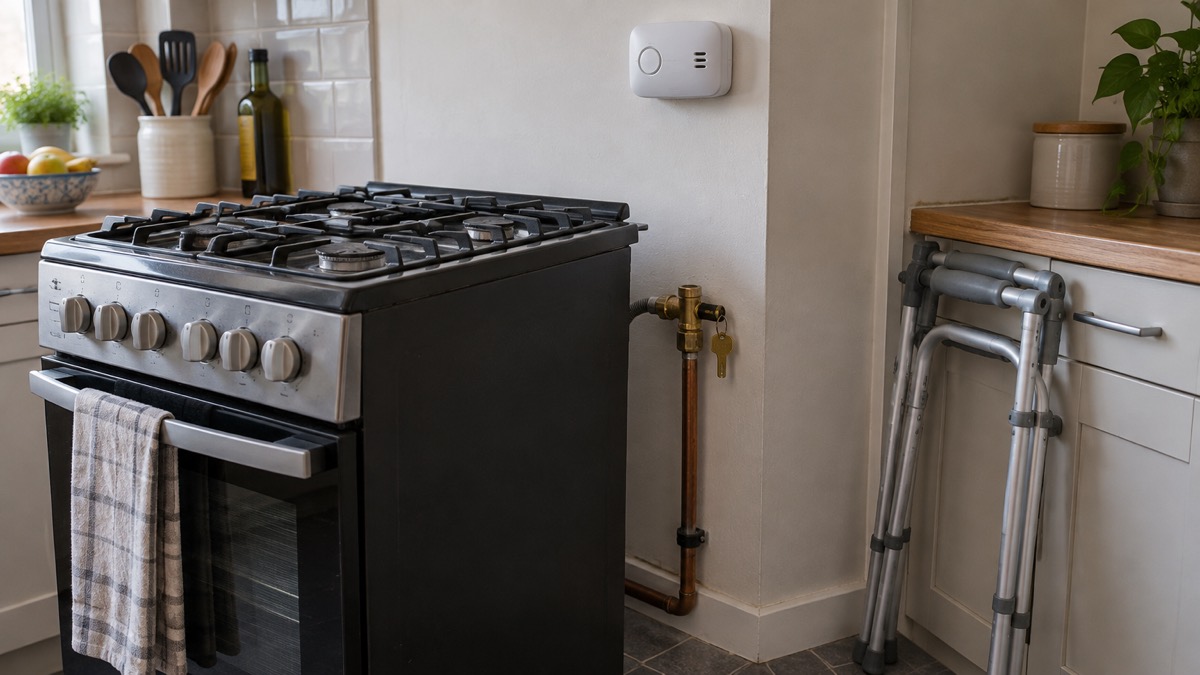
If someone in your household is older, living with a disability or long-term illness, pregnant, or caring for young children, you are entitled to more than the standard service when gas or electricity supplies fail. The main route to that help is the Priority Services Register, a free support service run by energy suppliers and network operators. If you are eligible and your gas, electricity or water supply is cut off, your suppliers will know you need extra support1. You join by contacting your water and power suppliers directly and asking to be added2.
The help goes well beyond a phone call during an outage. Gas networks fit locking cooker valves for free in homes where someone can no longer operate a gas cooker safely, such as people living with memory loss3. Fire and rescue services across the UK carry out free home fire safety visits for vulnerable households and can advise on heating safety4. And for households that use bottled gas rather than mains gas, the advice is the same in principle: contact your provider directly and ask to be recorded as needing additional support5.
This page sets out what each form of help is, who qualifies for it, and how to ask for it. For the wider picture of what to do when supply fails, see Gas and Heating Failures: A Household Guide, and for the broader schemes covering electricity and water too, see Extra Help in an Emergency: Older, Disabled and Medically Dependent Households.
Join the Priority Services Register
The Priority Services Register is the single most useful step a vulnerable household can take before anything goes wrong. It is a free support service that helps people in vulnerable situations, and you join it by contacting your water and power suppliers to see if you can be on it2. Once you are registered, if your gas, electricity or water supply is cut off, your suppliers will know you need extra support1. In practice that means the network or supplier holds a note against your address, so when engineers are working through an outage or a planned interruption, your home is flagged.
You or someone you know may be eligible for extra support in the event of interruptions to power, gas or water supplies8. Eligibility is broad, and the register is not means-tested in the way many benefits are: it turns on circumstances such as age, illness and disability rather than income alone, though people on a low income are also recognised as at risk during cold weather9. Surrey County Council, describing the register for its own residents, lists what suppliers provide to those on it: priority help in an emergency, and help with prepayment meter access10. Prepayment meter access matters because households on prepayment are more likely to run into supply problems, and registered customers get practical assistance rather than being left to work through the problem alone.
A few points are worth knowing when you sign up:
- Register with each supplier separately. Your gas and electricity supplier, and your water company, each hold their own register, so contact all of them6.
- Register the person, not just the household. If you are registering a relative, give the supplier their circumstances so the right support is triggered8.
- Update details when circumstances change, for example a new diagnosis or a move to a prepayment meter10.
- If you use a prepayment meter, ask specifically about the access help available to registered customers10.
If you are unsure who your gas network is, see Which Network Operator Covers Your Home. For what networks do during a prolonged interruption, see Help From Networks During a Long Outage.
Who counts as vulnerable
The official definitions of vulnerability are wider than most people expect, and they matter here because they decide who gets onto the register and who qualifies for the free services described later on this page. UK Health Security Agency guidance for health and care professionals sets out the groups at risk during cold weather: older people aged 65 and over; people with cardiovascular conditions; people with respiratory conditions, in particular chronic obstructive pulmonary disease and childhood asthma; people with mental health conditions; people with learning or physical disabilities; young children, particularly those aged under 5; pregnant women; and people on a low income9.
NHS and local authority winter advice repeats the same core list. Cheshire and Merseyside NHS guidance names people aged 65 and older, babies and children under the age of 5, people on a low income who cannot afford heating, people with a long-term health condition, people with a disability, pregnant women, and people with a mental health condition11. West Midlands Ambulance Service and North Cumbria winter advice add further groups: people with learning disabilities, people at risk of falls, people living alone and unable to care for themselves, and people who are housebound or have low mobility12. The government's own cold weather tips, updated in April 2026, list the same categories for England, including people living in deprived circumstances14.
| Group | Named in official guidance |
|---|---|
| Older people | Aged 65 and over; London's guidance highlights those aged 75 and over, frail or isolated9 |
| Babies and young children | Particularly those aged 5 and under11 |
| Pregnant women | Listed across cold weather guidance9 |
| Long-term health conditions | Cardiovascular and respiratory disease, including COPD and asthma; diabetes; mental health conditions9 |
| Disability | Learning and physical disabilities9 |
| Circumstances | Living alone, housebound, low mobility, at risk of falls, on a low income, fuel poor, homeless13 |
Essex preparedness guidance adds a practical note on why these groups matter during utility failure: elderly and disabled individuals are more dependent on heating, power and medical equipment, and remote and rural communities face particular difficulties reaching help15. London's cold weather guidance also names people with dementia within mental ill-health that makes it harder to look after yourself, and people living in houses with mould1. If you are unsure whether your household qualifies, the answer is to ask: contact your water and power suppliers to see if you can be on the Priority Services Register6.
Getting your supply back on after an appliance is condemned or a fire or flood
When a gas appliance is condemned as unsafe, or your home has been through a fire or flood, the rules on restoring supply are strict, and they apply to everyone, vulnerable or not. The reason is simple: gas systems that have been damaged, or that were shut off in an emergency, can be dangerous to restart without professional checks. Warwickshire's guidance on dealing with the aftermath of a fire is direct: get trusted professionals to assess and repair damaged gas and electric systems before use16. Its follow-up advice adds that you should ensure a gas engineer evaluates safety before using gas appliances, and not turn anything on if damage or leaks are suspected17.
If you turned the gas off yourself during an emergency, it must be turned on again by a professional for safety reasons once you are home18. After a flood, Nottinghamshire's easy-read guidance says to contact a qualified electrician and gas engineer to check that it is safe to turn your gas and electricity back on19, and Belfast City Council's flooding advice states plainly: do not turn on gas or gas appliances until your system has been checked by a Gas Safe registered engineer20. For a fuller walkthrough of the restoration process, see Getting Your Supply Back On After an Outage and What Help Is There If Your Appliance Is Condemned?.
For a vulnerable household, the practical steps in order are:
- Do not attempt to relight appliances or turn the supply back on yourself18.
- Ask for a Gas Safe registered engineer to check the system before any gas is used20.
- Tell the engineer or the network that the household is on the Priority Services Register, so any follow-up visits are prioritised1.
- If an appliance is condemned, ask about the free checks and support described in the next section before paying for anything7.
If you suspect a gas leak at any point, the advice from Warwickshire's home heating safety page is to open windows, avoid using electrical switches, and contact a Gas Safe registered engineer or the emergency gas helpline on 0800 111 999 immediately7. That line and what happens when you ring it are covered in The National Gas Emergency Service: When to Ring and What Happens.
Free gas safety checks, repairs and safety equipment
Several services exist that vulnerable households often do not know about, because nobody is obliged to advertise them to you individually. The first is the free gas safety check. Warwickshire's safe home heating guidance describes what happens: an engineer will inspect and service your gas appliances, ensuring they are operating safely and efficiently7. Regular servicing matters for safety as well as efficiency: Devon and Somerset Fire and Rescue Service advise that you service and maintain all gas appliances to reduce the risks of carbon monoxide poisoning21. The Health and Safety Executive adds that gas appliances need an adequate supply of air to help the complete combustion of gas, so keep vents and airbricks clear22. Who qualifies for a free check, and how often, is covered in Appliance Safety Checks: How Often and Who Gets Them Free.
The second is the free home fire safety visit. Lincolnshire Fire and Rescue asks households to get in touch if you or anyone you live with is a vulnerable person, and a free visit can be organised to work out the right fire detection system and help get it installed4. Belfast City Council's family home safety check offers tips on all aspects of home safety, specialist advice on heating and energy saving, tailored advice, delivery of safety equipment subject to eligibility and stock, and referral for a free smoke alarm installation subject to eligibility23. These visits are free, they are not means-tested in the way a benefit would be, and they exist across the UK's fire and rescue services, though the exact equipment offered varies by service and by what is in stock23.
What to ask for when you contact a service:
- A free home fire safety visit, mentioning anyone in the household who is vulnerable4
- Advice on heating and energy saving, and on carbon monoxide detection4
- Safety equipment delivery, subject to eligibility and stock availability23
- A referral for free smoke alarm installation, subject to eligibility23
- A gas appliance safety check, if the network or supplier offers one to your household7
Carbon monoxide deserves a special mention because it is the risk that vulnerable households are least likely to notice in themselves. The NHS Learning Hub includes a dedicated module on carbon monoxide awareness and vulnerable adults24, and Wakefield's NHS stop smoking service carries carbon monoxide information for the public25. The combination that protects a household is simple: serviced appliances, clear ventilation, and working detection21. For warning signs and alarms, see Home Emergencies: Fire, Carbon Monoxide, Gas Leaks and Burst Pipes.
Locking cooker valves: keeping a home with dementia safe from gas
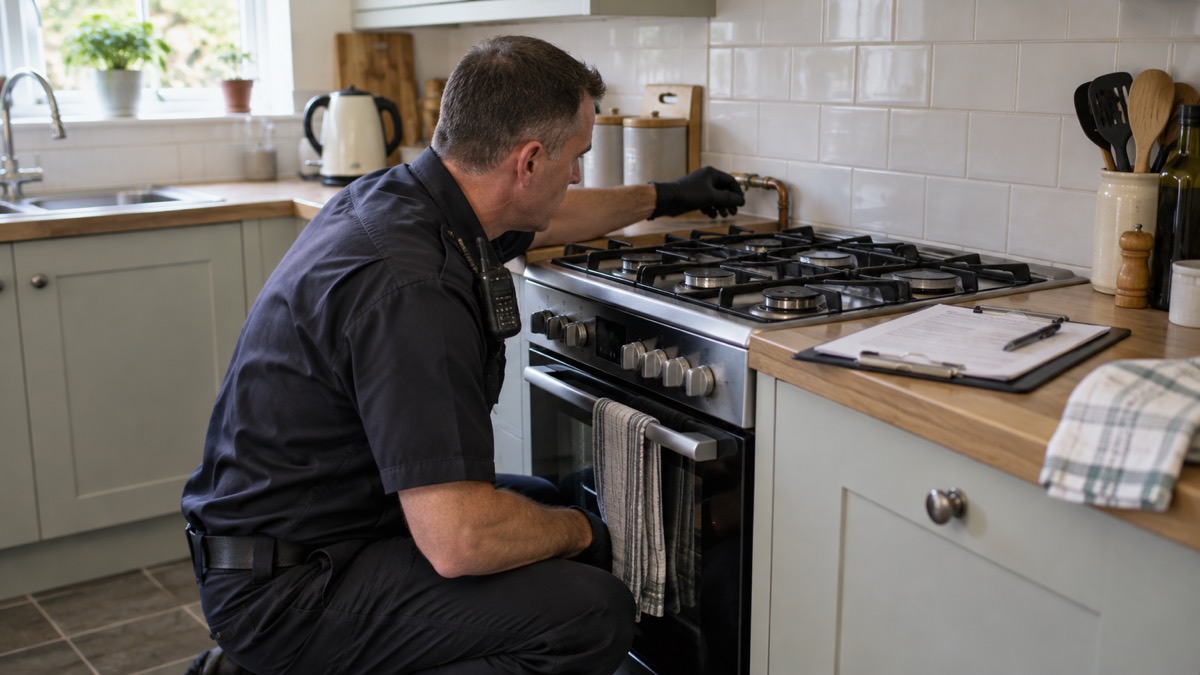
A locking cooker valve is a safety device that can be fitted to existing gas cooker pipework. When the valve is locked, the gas supply to the cooker is stopped26. The valve is installed with a key to lock it, so that only the gas hob is isolated rather than the whole gas supply to the house27. That last point is the one families most often get wrong in their expectations: the valve does not shut the home's gas off, so the boiler, heating and hot water continue to work normally. Only cooking is controlled.
The valve is designed for a specific situation. Manchester Fire and Rescue Service explains that locking cooker valves are useful in homes where cooking becomes high risk due to conditions such as Alzheimer's and dementia, disabilities or learning difficulties26. Devon and Somerset Fire and Rescue Service, which operates the service in its area, describes the people it suits: those who can no longer operate their gas cooker safely, such as people living with memory loss, who may be at risk of harming themselves and their home by leaving gas un-ignited or forgetting to turn the hob off27. Once the valve is fitted, a carer can easily control, with a key, when gas can and cannot be used safely26.
North Wales Fire and Rescue Service puts the trade-off plainly: you can have a special gas tap fitted that friends and family can turn off when they leave your home, known as a lockable cooker valve, and this does mean that you will not be able to cook unless someone is with you3. Families should weigh that honestly. The valve removes the risk of an unattended hob being left on or gas left un-ignited, at the cost of independent cooking. For many households where someone lives alone with dementia, that is a worthwhile exchange; for someone who cooks safely most days and has only occasional lapses, a stove guard may be worth considering instead. Stove guards can be particularly useful in homes where using the hob becomes high risk due to conditions such as Alzheimer's and dementia, disabilities or learning difficulties26.
Two practical points make the service easier to use than many families expect:
- It is free. Your gas distributor will fit one for free if you request it3.
- It does not affect your supply arrangements. The service is provided regardless of your gas supplier, and you do not need to change energy supplier or inform your supplier of the device27.
To arrange one, contact your gas network, whose extra-help or customer care team handles the fitting. If you are not sure who your network is, see Which Network Operator Covers Your Home.
Energy safety support for households living with dementia
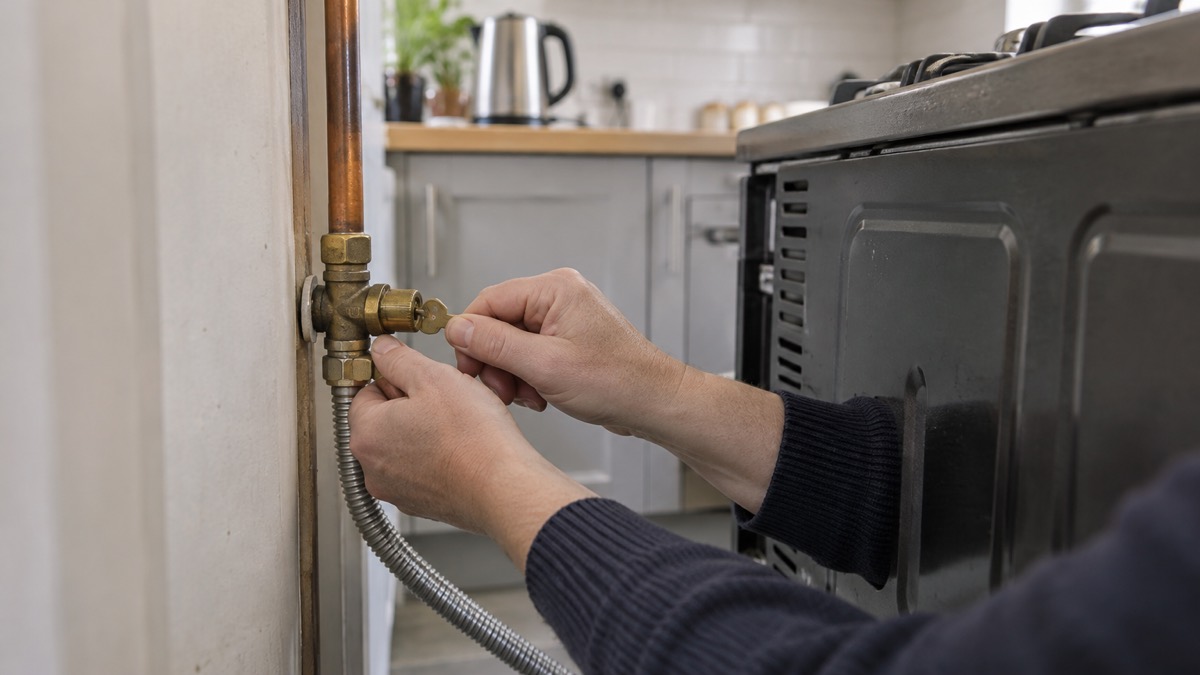
Dementia changes the risks in a home in ways that standard safety advice does not always address, and several services exist specifically for this situation. North Wales Fire and Rescue Service states that if you or someone you know has dementia, they can visit and make your home, or their home, as safe as possible3. That visit covers the whole home, not just the cooker, and it is the natural first call for any family adjusting to a new diagnosis. The same service advises considering an isolation valve on a gas cooker, so that the cooker cannot be turned on and left on if the person is at home alone3, which is the locking cooker valve described above.
Beyond the fire service, an occupational therapist can advise on the full range of ways to make your home safer, and you can contact one through your doctor's surgery or through social services3. This route matters because an occupational therapist sees the home as a whole: heating controls, cooking, falls, and how the person actually moves through the house day to day. For a family weighing up a locking cooker valve, a stove guard or other measures, that whole-home view is a sound starting point26.
The wider vulnerability guidance also recognises dementia directly. London's cold weather guidance names people with mental ill-health that makes it harder for them to look after themselves, including dementia, among the groups to watch out for in cold weather, alongside people who are housebound or find it hard to get out and about1. That recognition matters practically: it places a household living with dementia among the groups to watch out for when cold weather threatens, so the household can be flagged for support alongside the dementia-specific schemes.
A short checklist for families:
- Ask the fire and rescue service for a dementia home safety visit3
- Ask the gas network about a free locking cooker valve3
- Request an occupational therapist assessment through the GP surgery or social services3
- Join the Priority Services Register with every supplier6
- Keep gas appliances serviced and ventilation clear, and fit carbon monoxide detection21
Advice in British Sign Language and contact routes for Deaf households
Deaf and hard-of-hearing households face a specific problem during gas and power emergencies: the standard contact routes assume a voice phone call. The government's preparedness guidance for phone and broadband outages advises people with additional communication needs to continue to use established accessibility services where available to contact the emergency services, including Relay UK, Emergency SMS and 999 BSL5. The same guidance carries an important caveat: during a widespread communications outage these services may also be affected, in which case you should seek help directly from emergency responders or go to your nearest police station, fire station, ambulance station or hospital5.
For contacting organisations in British Sign Language, an example of what is available is Convo, a free online interpreting service offered by National Highways for British Sign Language users contacting them. Convo connects you to a qualified BSL interpreter, who then connects you with an advisor at the customer contact centre and relays the conversation between you28. Gas networks and suppliers increasingly offer similar BSL and text relay routes; when you join the Priority Services Register, tell the supplier your preferred contact method so it is recorded against your account6.
Planning ahead matters most for Deaf households, because the fallback options take time. The government's preparedness advice is to plan with your neighbours or community about who could assist you during an outage, for example identifying someone who could drive you to get help in an emergency5. The same advice applies in reverse: check in on neighbours, particularly anyone who might live alone or might need extra support, and make sure they know what is happening and have the help they need5.
Community-level planning strengthens all of this. The government's volunteering guidance notes that neighbours with additional medical needs, new to the area, not able to use technology well or not speaking English well might need checking on in person during an emergency29, and the Be Ready campaign asks households to talk to their neighbours about what extra support they might be able to share during an outage, and to swap contact details30. For how to build that local network, see Community Resilience: A Guide for Neighbours and Local Groups and Staying Informed and in Touch in an Emergency: A Household Guide.
Bottled gas customers: vulnerable customer registers and cylinder safety
Households on bottled or bulk LPG are not connected to the mains network, so the Priority Services Register as run by gas networks does not reach them in the same way. The government's outage guidance gives the direct answer: contact your provider directly and ask to be recorded as needing additional support5. Calor, the main bottled gas supplier, keeps a vulnerable customer register on this basis, so if someone in your home is older, ill or disabled and you depend on bottled gas for heating or cooking, make that call before winter rather than after you run out. For the wider picture of LPG supply in cold weather, see LPG Homes: Bulk Tanks, Cylinders and Running Out in Winter.
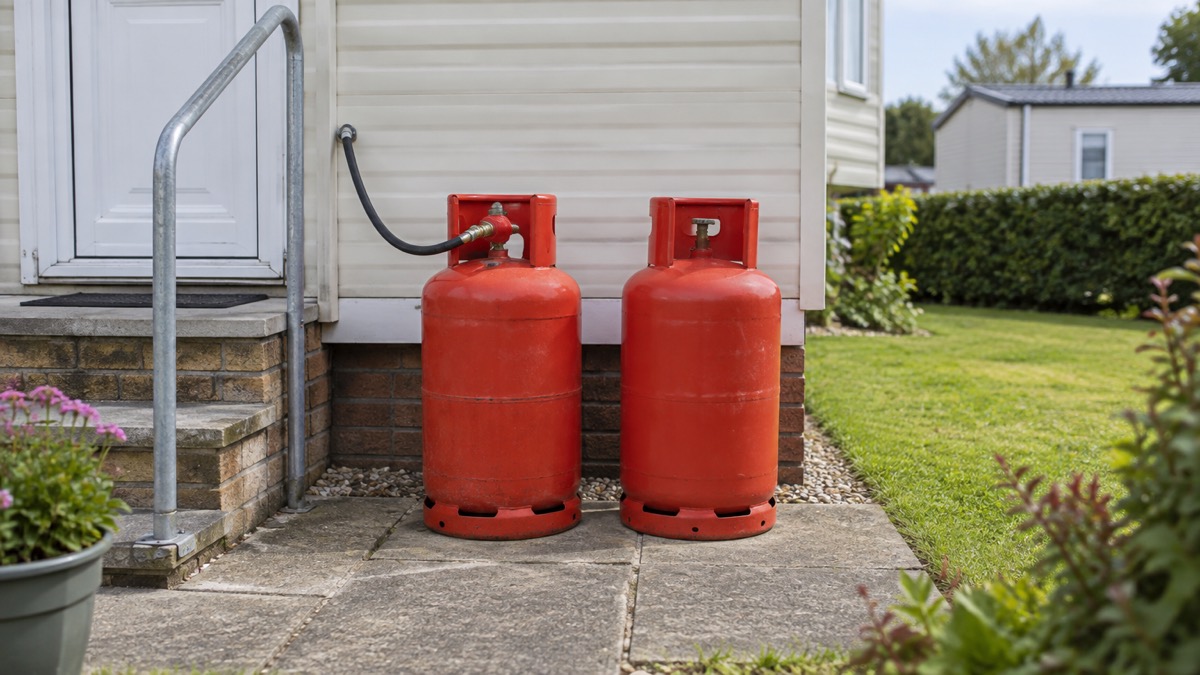
Cylinder safety has its own rules. Devon and Somerset Fire and Rescue Service's camping and caravanning guidance, which covers portable gas use, advises: make sure the gas pipe connection is secure, and if you suspect a leak, turn off the main cylinder valve21. The same guidance repeats the servicing message for all gas appliances, to reduce the risks of carbon monoxide poisoning21. One product-level warning is also worth knowing: in June 2024 a product recall was issued for Vango folding gas stoves, because the gas hose may degrade over time, leading to a gas leak and possible hose ignition, and the affected products do not meet the requirements of Regulation 2016/42631. If you keep a portable gas stove as backup cooking, check it is not one of the affected units.
A note on how seriously gas supply failures are taken at the local level: Surrey's Community Risk Register for 2026 lists the failure of gas supply infrastructure as a risk with a very high warning level, handled under the National Emergency Plan for Fuel with Surrey County Council as lead agency32. That is background, but it explains why networks and suppliers maintain the vulnerable customer services described on this page: they are part of the planned response to a major supply failure, not a goodwill extra.
Frequently asked questions
Does it cost anything to have a locking cooker valve fitted? No. Your gas distributor will fit a lockable cooker valve for free if you request it. The valve is installed with a key so that only the gas hob is isolated rather than the whole gas supply to the house, which means your heating and hot water keep working. You do not need to change energy supplier or inform your supplier of the device. Contact your gas network to arrange the fitting.
How do I contact my network's extra help team? Start with your gas network's customer care or extra help team, using the general enquiries number rather than the emergency line, which is reserved for gas leaks. If you are already on the Priority Services Register with your supplier, ask them to pass your details on. Vulnerable customers of bottled gas suppliers should contact their provider directly and ask to be recorded as needing additional support.
How long does it take to get an appointment for a free safety check or valve fitting? Appointment times vary by network and by demand in your area, so ask when you call. The National Gas Helpline is open 24 hours a day, 7 days a week, so you can make an enquiry at any time, but the fitting or check itself is scheduled like any other visit. If the person's safety is at immediate risk, say so when you call, as that may affect how quickly you are seen.
Why is carbon monoxide awareness part of vulnerable household support? Carbon monoxide has no smell or taste and comes from gas appliances that are not burning fuel properly, often because they are unserviced or poorly ventilated. People who are older, ill or living with dementia are less likely to notice the symptoms in themselves. Service and maintain all gas appliances to reduce the risk, keep ventilation clear, and fit an audible carbon monoxide alarm.
What are the OPSO regulator checks on Calor cylinder deliveries? Since 18 October 2021, Calor drivers have carried out safety checks on fixed LPG cylinder installations at every delivery, and they leave a leaflet reminding customers who do not have an OPSO regulator. Calor has said it will stop delivering gas to fixed cylinder installations that lack an OPSO regulator, so affected customers were given time to upgrade their pipework.
How do I set up the Convo app to contact services in British Sign Language? Convo is a free online interpreting service. It connects you to a qualified BSL interpreter, who then connects you with an advisor at the organisation's customer contact centre and relays the conversation between you. It is offered by National Highways for British Sign Language users contacting them. For emergency services, Deaf households can also use Relay UK, Emergency SMS and 999 BSL.
Can a community partner or carer refer someone for this support? Yes, in practice carers, family and community groups all help people join these schemes. Ask the person's energy supplier or gas network whether a third party can request Priority Services Register membership on their behalf. Neighbourhood groups are also encouraged to make a plan to check in on people who might need help if an emergency happens, particularly if the power or gas goes out.
Who pays for all this extra support? The Priority Services Register is a free support service that helps people in vulnerable situations, and energy suppliers provide priority help in an emergency to those registered. Gas networks fund safety services such as free locking cooker valve fitting through their own programmes. Free home fire safety visits and safety equipment from fire and rescue services are subject to eligibility and stock availability.
Sources (32)
- Keeping warm, healthy and safe in cold weather, Greater London Authority
- Top tips for keeping warm, UK Health Security Agency (UKHSA) and Age UK
- Dementia fire safety, North Wales Fire and Rescue Service
- Fire alarms and carbon monoxide detectors, Lincolnshire County Council
- Phone and broadband outages, Prepare Campaign, 2026-10-12
- Be Winter Ready, Lancashire County Council
- Safe home heating, Warwickshire County Council
- Help from energy supplier, Buckinghamshire Council
- Supporting vulnerable people before and during cold weather, UK Health Security Agency, 2025-09-24
- Priority Services Register, Surrey County Council
- Stay well this winter, NHS Cheshire and Merseyside
- Cold weather advice, West Midlands Ambulance Service NHS Foundation Trust
- Cold weather warning advice, NHS North Cumbria Integrated Care
- Top tips for keeping warm and well this winter, UK Health Security Agency, 2026-04-28
- Utility failure, Essex Prepared
- Dealing with the aftermath of a fire, Warwickshire County Council
- Utilities after a fire, Warwickshire County Council
- Recovering from an emergency, Essex Prepared
- After a flood, easy read, Nottinghamshire County Council, 2025-11-02
- Flooding advice, Belfast City Council
- Camping and caravanning, Devon and Somerset Fire and Rescue Service
- Gas safety FAQs, domestic, Health and Safety Executive
- Home safety, Belfast City Council
- Preventing exposure to carbon monoxide, NHS Learning Hub
- Carbon monoxide information, NHS Wakefield Stop Smoking Service
- Cooking fire safety devices, Manchester Fire and Rescue Service
- Equipment for carers, Devon and Somerset Fire and Rescue Service
- Accessible services for disabled road users, National Highways
- Volunteering and helping others, Prepare Campaign, 2026-10-19
- Get prepared for emergencies, Prepare Campaign, 2026-10-21
- Product recall: Vango folding gas stoves, Office for Product Safety and Standards, 2024-06-06
- Community Risk Register 2026, Surrey County Council, 2026
 Finding a Gas Safe Engineer
 Appliance Safety Checks