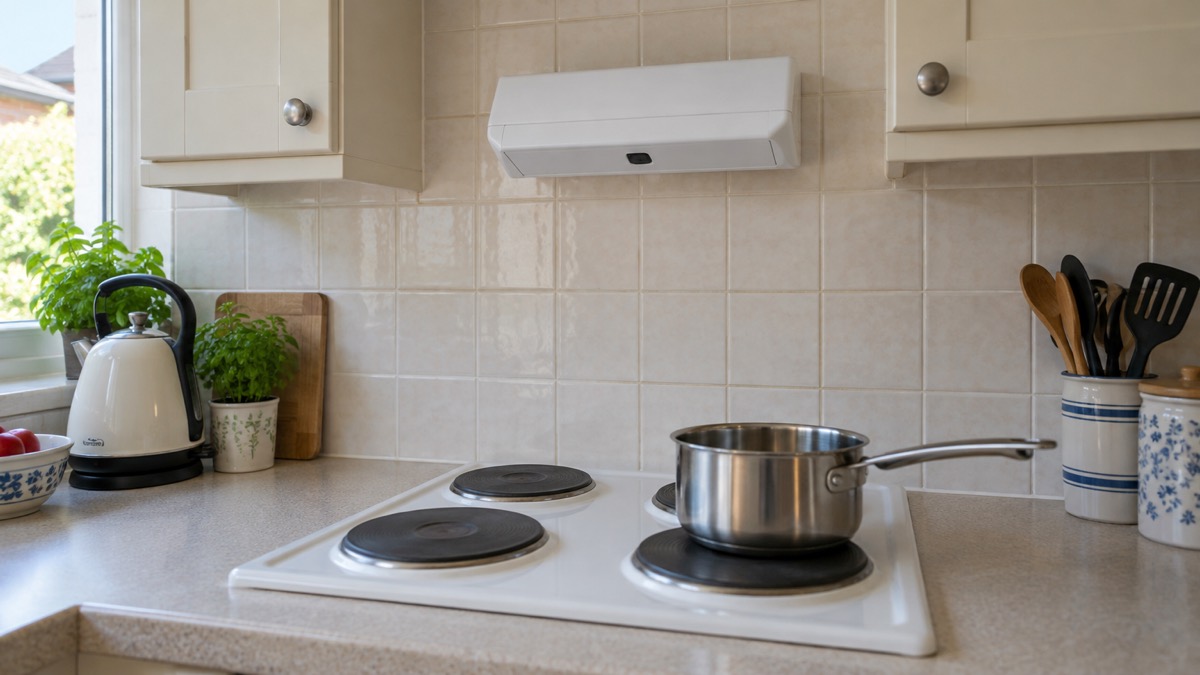
Cooking is the leading cause of accidental house fires, and the single most common trigger is a pan left on with nobody watching. The FireChief FSW1 Kitchen Stove Guard is a fitted device that addresses that directly: it watches the hob with a heat sensor and, if the cooking becomes dangerous, cuts the electricity to the cooker before a fire can start1.
It is not a smoke alarm and it does not replace one. It is a last line of defence for the specific moment when a hob is left on, a pan boils dry or food starts to burn, and nobody is in the room to notice. The unit is installed by a qualified electrician, runs automatic fault checks so there is no monthly test button to press, and can be linked to a Telecare system so a carer is alerted1.
This page sets out what the FSW1 does, who it suits, how it is fitted and how to live with it. It is a description of one product, not a comparison, and it gives no prices.
What the FireChief FSW1 does: it cuts power to an electric hob before a pan fire starts
The FSW1 is described by its distributor as an intelligent, automatic fire-prevention system that monitors cooking activity and shuts off the power supply before a fire can start1. The mechanism is straightforward. A heat sensor watches the hob. A control unit sits between the power supply and the cooker. When the sensor decides the situation is dangerous, it instructs the control unit to cut the power, and the heat source is removed before anything ignites2.
Fire and rescue services describe the same principle in their own guidance: stove guards use a heat sensor to cut the power to the cooker to prevent a fire, and the power control unit is fitted between the power output and the hob2. That is the whole idea. It is the electrical equivalent of standing over the pan and turning the ring off, done automatically.
The conditions that trigger a cut-off are worth knowing, because they describe the accidents the device is built for. According to fire service guidance, a stove guard will cut the power if2:
- food has started to burn, or a pan has boiled dry
- the temperature is becoming dangerously high
- the hob or cooker has been left unattended
- the temperature is rising too quickly
- the cooker or hob is inadvertently left on after cooking has finished
That last one matters more than it sounds. A ring left on with an empty pan, or a hob knocked on by accident, is exactly the kind of thing that goes unnoticed until something on the surface starts to smoke.
It helps to understand what the FSW1 is not. It does not detect smoke, so it is not a substitute for a smoke alarm, and fire services are consistent that every home should have working smoke alarms that are tested regularly3. It does not extinguish anything. It does not work on a gas hob, because there is no electricity supply to the burner for it to switch off1. And it cannot stop a fire that starts somewhere other than the hob.
What it does is close one specific gap, the one fire services keep returning to. Northern Ireland Fire and Rescue Service states plainly that cooking is the number one cause of accidental dwelling fires in the home, and advises never leaving cooking unattended, not even for a minute4. Cheshire Fire and Rescue Service notes that kitchen fires often start when cooking is left unattended5. The FSW1 is a device for the times when that advice is not followed, whether through a moment's distraction, a phone call at the door or a medical episode.
Who it suits: homes where cooking may be left unattended
The distributor lists the FSW1 as ideal for homes, sheltered accommodation, student housing and assisted-living environments where unattended cooking is a major risk1. That list is a fair summary of where the device earns its place, and the reasons differ by setting.
In an ordinary family home, the risk is distraction. Fire services across the UK repeat the same instruction: never leave cooking unattended, and if you need to leave the kitchen, turn electrical appliances off and take pans off the heat6. Warwickshire Fire and Rescue Service notes that many kitchen fires start when you are not paying attention or if you leave things unattended7. A stove guard does not depend on anyone paying attention.
In student housing, the pattern is sharper. Most fires in student accommodation start in the kitchen, usually when cooking has been left unattended4. Shared kitchens, late nights and unfamiliar equipment all push in the same direction, which is why the distributor names student housing as a setting the unit suits1.
In sheltered and assisted living, the calculation changes again. A resident may have memory difficulties, mobility problems or a condition that makes it unsafe to stand at a hob, and a carer cannot be in the kitchen every minute. The distributor names assisted-living environments specifically1, and the ability to link the unit to a Telecare system so carers can be alerted to potential fires is the feature that makes it work in that setting1.
It is worth being clear about the limits of suitability. The FSW1 protects against fires that begin at the hob. It does not protect against a chip pan that has already caught, a grill pan left under heat, a toaster, a tumble dryer or an electrical fault elsewhere in the kitchen. For those, the ordinary precautions apply: keep the grill and toaster clear, unplug appliances that are not designed to be left on, and know what to do if an electrical fire starts9. If you want the wider picture on cooking risk, the guide to kitchen fires covers prevention and what to do when a pan goes up.
How it detects danger and learns cooking habits to cut false alarms
The FSW1 uses intelligent heat-sensing technology that identifies rapid temperature rises and abnormal patterns associated with pan fires1. In practice, the sensor is not looking for a single high reading. It is watching how temperature behaves over time, which is what allows it to distinguish a hob coming up to heat from a hob that has been left running with nothing in the pan.
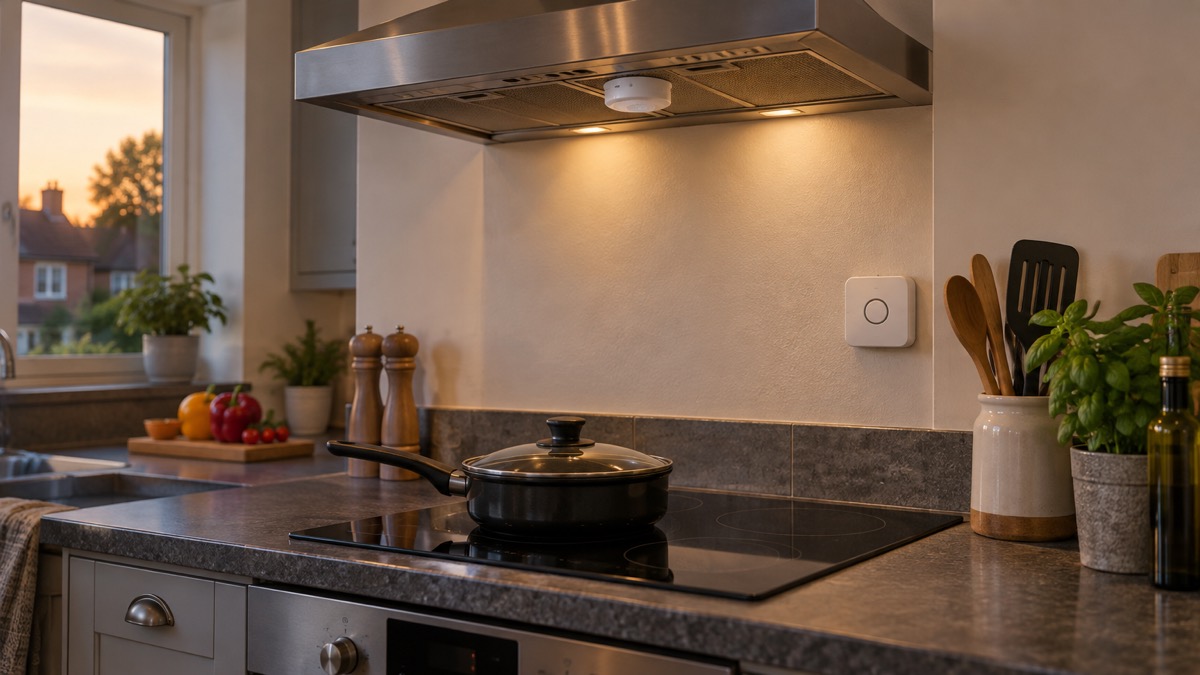
The unit provides 24/7 monitoring and learns the user's cooking styles to reduce false alarms1. That learning behaviour is the answer to the obvious objection: a device that cuts the power every time someone fries a steak would be switched off within a week. By building up a picture of how a particular household cooks, it can set its threshold where it belongs for that kitchen.
The sequence when danger is detected is deliberate and gives the cook a chance to intervene. The sensor warns the user if a dangerous situation is likely to occur with a visual and audio alarm. If the user is not in attendance, does not take action and does not press the reset button on the sensor, the power to the hob or cooker is cut2. So there are three stages: a warning, a window to respond, and then automatic action.
That reset button is the part to understand before you need it. If you are in the kitchen and the alarm sounds, you can press reset on the sensor to stop the cut-off, provided you have dealt with whatever caused the warning. If you are not there, the unit acts on its own.
The distributor states that you can also alter the sensitivity of the sensor should this be required1. Treat that as an installer setting rather than something to adjust casually. The learning behaviour needs a stable baseline, and a sensor that has been repeatedly retuned will not have one. If the unit is triggering when it should not, or failing to react when it should, the right move is to ask the qualified electrician who installed it to review the setting.
False alarms from cooking are a familiar problem in kitchens, and it is why fire services point out that heat alarms can help you avoid false alarms caused by cooking fumes, for example frying food or burning toast8. The FSW1 is solving a related problem by a different route: rather than detecting smoke and accepting the nuisance, it watches heat and learns the household's normal.
Alarms and alerts: an 80dB sounder, Telecare links and sensory signals
The FSW1's built-in warning is an audible alarm sounder rated at 80dB1. It also gives audio alerts that warn occupants when cooking becomes unsafe or when a fault has been detected1. For most households that is enough: the sound carries through a typical home and gives whoever is nearby a chance to act.
For households where sound alone is not reliable, the unit can be extended. The distributor states that the Stove Guard can be linked to many Telecare Systems so carers can be alerted to potential fires1. It can also be adapted to work with some sensory signals such as vibrating pads and flashing beacons, so that those with hearing or sight impairments are also alerted1.
That matters because the alternative alerting equipment fire services recommend for deaf and hard of hearing people is exactly this kind of thing. Fire and rescue services describe specialist alarms including strobe lights and vibrating pad alarms for people with hearing impairments, alongside linked alarms and monitored alarms connected to Telecare11. London Fire Brigade notes that specialist alarms can be fitted, for example strobe light and vibrating pad alarms for those who are deaf or hard of hearing12. South Lanarkshire Council lists flashing strobe lights, vibrating pillow pads, vibrating pagers and mobile phone alerts among the sensory support equipment available13.
Telecare itself is a monitored arrangement, not just a louder alarm. One council telecare service describes it simply: if you sound the alarm, they will contact a family member, carer or the emergency services14. That is the difference between a device that makes a noise in an empty house and one that brings someone to the door.
| Alert type | What it does | Who it suits |
|---|---|---|
| 80dB audible sounder | Sounds in the kitchen when cooking becomes unsafe or a fault is detected1 | Most households with someone usually nearby |
| Telecare link | Alerts carers to potential fires through a monitored system1 | Sheltered housing, assisted living, anyone living alone |
| Vibrating pad or flashing beacon | Sensory signals for people with hearing or sight impairments1 | Deaf, hard of hearing, deafblind households |
If someone in your household is deaf or hard of hearing, the guide to smoke and CO alarms for deaf and hard of hearing people sets out the wider range of equipment and how to ask for it. In Scotland, the law goes further: specialist alarms, for example if you are deaf or have a Telecare system, must be fitted in addition to any smoke, heat and carbon monoxide alarms15. The FSW1 is not one of those statutory alarms, but its Telecare and sensory links sit in the same family of equipment.
Fitting: installation by a qualified electrician
The FSW1 requires professional installation by a qualified electrician1. That is not a suggestion to be worked around. The control unit is wired between the power supply and the cooker, and fire services are clear that you should find a certified electrician for any electrical installations, repairs or modifications16.
The kit contains everything the installer needs: the heat sensor (SGS1010), the control unit (SGC510-2), a junction box (SGI510-2JF), a CR2032 battery, an IR lens extension, the main manual, a cupboard sticker and screws1. The cupboard sticker is a small but useful detail: it labels the circuit so that anyone working on the electrics later knows what they are looking at.
Where the sensor goes affects how well the unit works. The distributor gives three mounting options1:
- directly above the centre of the cooker, under the cooker hood (the recommended position)
- on a wall, using a mounting bracket
- on to the ceiling
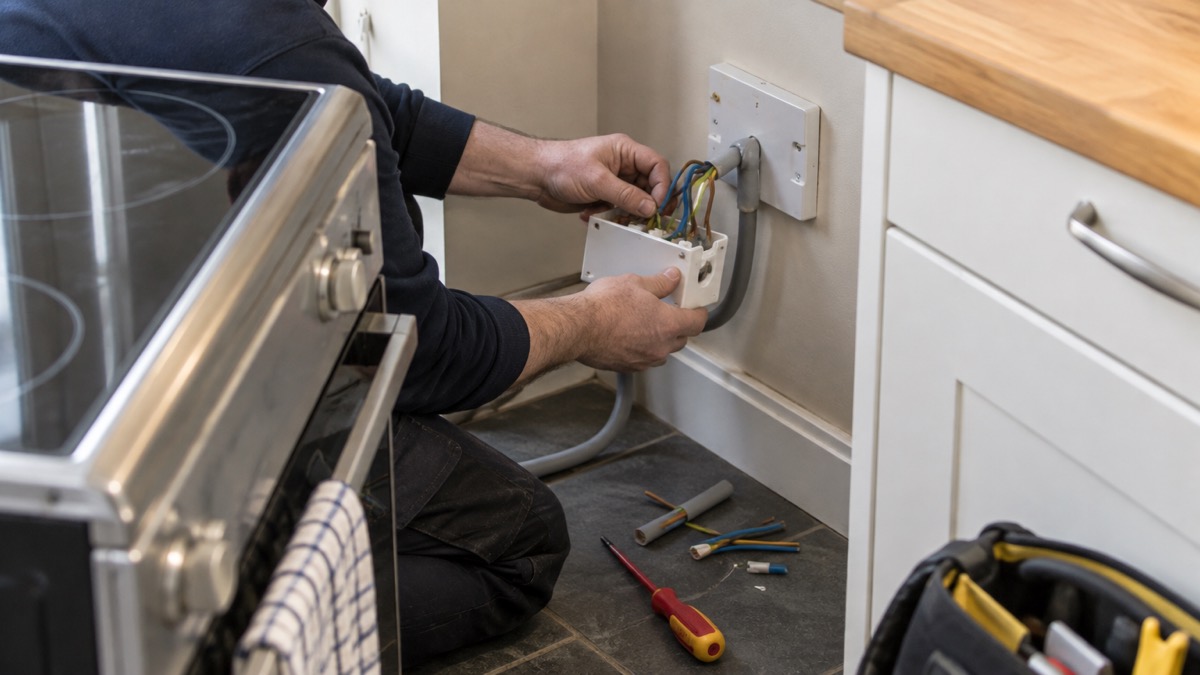
The recommended position is the one to aim for. A sensor under the hood sits closest to the heat it is watching, with the least chance of something being placed in front of it.
The power arrangements are worth knowing before the electrician arrives. The distributor lists the power as 230-400V for the control unit and a CR2032 button battery for the heat sensor1. The same product page also lists the unit as mains powered at 230V, so the two descriptions on the page do not match exactly; the control unit is a mains device either way, and the installer will confirm the supply arrangement for your kitchen.
If you rent, tell your landlord before booking anything. Fire services advise tenants to report faults or concerns to their landlord17, and a fitted electrical device is the landlord's decision to make. In sheltered or assisted living, the housing provider or care service will usually arrange installation as part of the property's fire precautions.
Fault beeps, self-checks and keeping it working
The FSW1 performs automatic fault diagnosis, which means that no monthly testing is required1. That is a genuine convenience for householders and a significant one for carers, who otherwise carry the testing routine for every alarm in the property.
The fault behaviour is designed to fail safe. If the Stove Guard detects a fault, it will alert any occupants with a series of beeps and will turn the power to the cooker off, to ensure that unsafe cooking could not take place1. Fault beeps vary to indicate which type of fault has been detected1. So a beeping unit is not a nuisance to be silenced; it is the device telling you it can no longer protect the hob, and that the hob is off until it can.
That is a different pattern from a smoke alarm, and worth understanding if you are used to alarms that chirp for a low battery. Mid and West Wales Fire and Rescue Service notes that at the end of its life an alarm will bleep once every minute for a minimum of one month17. The FSW1's fault beeps are a signal to act, not a countdown to ignore.
The heat sensor runs on a CR2032 button battery, and one is supplied in the kit1. The manual covers replacement. Fire services give the general rule for alarm batteries: change batteries when needed, or report any faults or concerns to your landlord17. If the unit is in a rented or supported property, that is the route to take.
The unit is described as partially recyclable1. When it reaches the end of its life, take it to your council's household waste recycling centre rather than putting it in the bin, and remove the button battery first so it can be handled separately.
Specifications
| Specification | Detail |
|---|---|
| Product type | Intelligent, automatic fire-prevention system for electric hobs1 |
| Part number | 140-00021 |
| Equipment type | Control unit; heat alarms1 |
| Compatibility | Electric hobs; most standard UK electric cookers1 |
| Detection | Intelligent heat-sensing technology, identifying rapid temperature rises and abnormal patterns1 |
| Warning | Audible alarm sounder, 80dB1 |
| Power | 230-400V control unit; CR2032 button battery for the heat sensor1 |
| Colour | Silver1 |
| Material | Plastic1 |
| Dimensions (packaged) | Height 280mm, width 85mm, depth 180mm1 |
| Weight | 756g1 |
| Positioning | Kitchens1 |
| Recyclability | Partially recyclable1 |
| Warranty | 2-year manufacturer's warranty1 |
The dimensions given are for the packaged unit, so they tell you what the box takes up rather than what the installed device occupies on a wall or ceiling1. The weight of 756g is likewise the packaged figure1.
Where to get help and advice
A stove guard is one part of a household's fire precautions, and the rest of the support is free. Fire and rescue services offer home fire safety visits that provide more specialist advice based on your home and individual needs, free smoke alarms fitted if needed, and specialist alarms such as strobe light and vibrating pad alarms for those who are deaf or hard of hearing12. A Safe and Well visit may suggest extra help such as fire retardant bedding or linking a smoke alarm to a Telecare system18.
If you are arranging a stove guard for an older relative or someone you care for, start with their local fire and rescue service and ask what a home fire safety visit covers in their area. Arrangements differ across the UK: Scotland has its own statutory alarm requirements, including that specialist alarms must be fitted in addition to smoke, heat and carbon monoxide alarms15, while the alarm rules in Wales and Northern Ireland differ again from England. The guide to Wales and Northern Ireland alarm rules sets out how they compare.
For the wider picture, the home emergencies section covers fire, carbon monoxide, gas leaks and burst pipes, and the fire safety checklist for your home is a practical place to start. If you are supporting someone who may need more than a stove guard, the guide to extra help in an emergency explains the Priority Services Register and other support for older, disabled and medically dependent households.
Sources (18)
- FireChief FSW1 Kitchen Stove Guard, Safelincs, 2026-10-29
- Cooking fire safety devices, Greater Manchester Fire and Rescue Service, 2026-10-29
- Cooking safety, South Wales Fire and Rescue Service, 2026-07-29
- Student safety, Northern Ireland Fire and Rescue Service, 2026-10-29
- Kitchen fire safety, Cheshire Fire and Rescue Service, 2026-05-20
- Older person safety, Mid and West Wales Fire and Rescue Service, 2026-10-29
- Christmas fire safety tips, Warwickshire County Council, 2026-10-29
- Kitchen safety, Scottish Fire and Rescue Service
- Unplug to unwind, Dorset and Wiltshire Fire and Rescue Service, 2024-11-21
- Sockets, Greater Manchester Fire and Rescue Service, 2026-10-29
- Fire alarms and carbon monoxide detectors, Lincolnshire County Council, 2026-10-29
- Sprinklers and specialist alarms, London Fire Brigade, 2026-10-25
- Sensory support, South Lanarkshire Council, 2026-10-29
- Telecare, Lincolnshire County Council, 2026-10-29
- Fire and smoke alarms in Scottish homes, Scottish Government, 2024-08-14
- Electrical fire safety, Warwickshire County Council, 2026-10-29
- Smoke alarm maintenance and problems, Mid and West Wales Fire and Rescue Service, 2026-10-29
- Smoke alarms, Surrey County Council, 2026-08-24