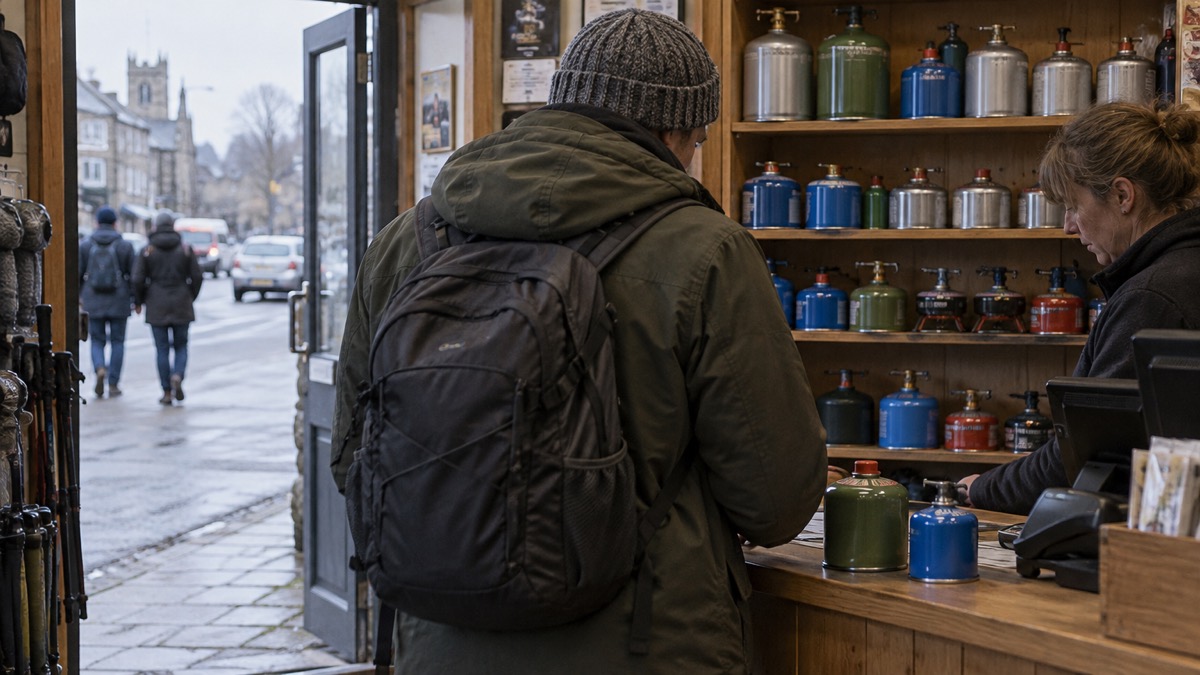
Camping gas cartridges and small cylinders are one of the most useful things a household can keep for a power cut: they run stoves that boil water and heat food when the electricity is off. They are also pressurised containers of flammable gas, and the way you store and connect them decides whether they stay safe. The rules are simple and they come from the fire and rescue services: store cylinders outside, away from direct sunlight and frost, and keep only as many as you need1.
This page covers what matters most to a household that keeps gas cartridges at home: where to store them, where they must never go, how to secure the connection before you light up, what to do if you suspect a leak, which stoves and cylinders have been recalled, and what the rules are for using a gas appliance indoors during an outage. The cartridge fittings themselves, which cartridge fits which stove, and how butane behaves in the cold are covered on Bottled Gas for Heaters and Stoves and Camping Stoves for a Power Cut; here the focus is on the cartridge you already own and how to keep it safe.
Where to store gas cylinders: outside, away from frost and sun
Every fire and rescue service that publishes guidance on this says the same thing, and it is worth following to the letter. Devon and Somerset Fire and Rescue Service advises households to "store gas cylinders outside and away from direct sunlight and frost. Don't store more gas cylinders than you need"1. The same wording appears in its barbecue and fuel storage advice2, and Warwickshire County Council says cylinders "should be stored outside, protected from frost and direct sunlight"4. Manchester Fire and Rescue Service adds that spare cylinders for gas heaters should be stored upright and outside whenever possible5.
The reasons are practical rather than fussy. Direct sunlight heats the cylinder and raises the pressure inside it; frost and freezing temperatures can affect the gas and the valve. Keeping the cylinder upright matters because the valves on these containers are designed to work in that position. And holding fewer cylinders simply means less pressurised gas in and around your home if anything goes wrong.
Where you live shapes the details:
| Situation | Where to store cylinders | Who says so |
|---|---|---|
| House with a garden | Outside, away from direct sunlight and frost; only as many as you need | Devon and Somerset FRS1 |
| Any home | Upright and outside whenever possible | Manchester FRS5 |
| Caravan or mobile home | Six metres away from the home, even when empty | Devon and Somerset FRS6; DW Fire and Rescue Service11 |
| Camping trip | Away from caravans and vehicles; change only when completely empty | North Yorkshire FRS12; gov.uk13 |
| Caravan site | Follow the site's own fire safety arrangements on storing gas cylinders | nidirect14 |
For caravans and mobile homes the guidance is stricter still. Gas cylinders should be kept outside the caravan, and turned off unless they are designed to run continuously6. Change the bottle only when it is completely empty6, and be aware of your caravan site's own fire safety arrangements, including its advice on storing gas cylinders11. An "empty" cylinder is never truly empty, which is why the turn-off rule matters even between uses.
Mid and West Wales Fire and Rescue Service adds a point that matters to flat dwellers: gas, paraffin and LPG cylinders should be stored safely outside the home and out of direct sunlight, and they should not be stored on balconies15. Cheshire Fire and Rescue Service advises avoiding storing gas cylinders in the home altogether, and says that where cylinders are needed for medical use, such as oxygen cylinders, they should be stored upright and outside where possible16.
For the full picture on storing larger bottles at home, see Where to Store Gas Cylinders at Home.
Where gas must never be stored
The fire and rescue services are equally clear about the places a gas cylinder or cartridge must never go, and these rules exist because each location has killed people or blocked escape routes in real fires.
Manchester Fire and Rescue Service's home heating guidance is blunt: "Never store them in basements, under stairs or in cupboards containing electric meters or equipment"7. Its portable heater advice adds drains to the list: never store a cylinder in a basement, near drains, under the stairs or in a cupboard containing electric meters or equipment8. The gov.uk fire safety outdoors guidance explains the escape route point directly: "Never store gas cylinders under the stairs, if there is a fire they might explode and block your escape route"13.
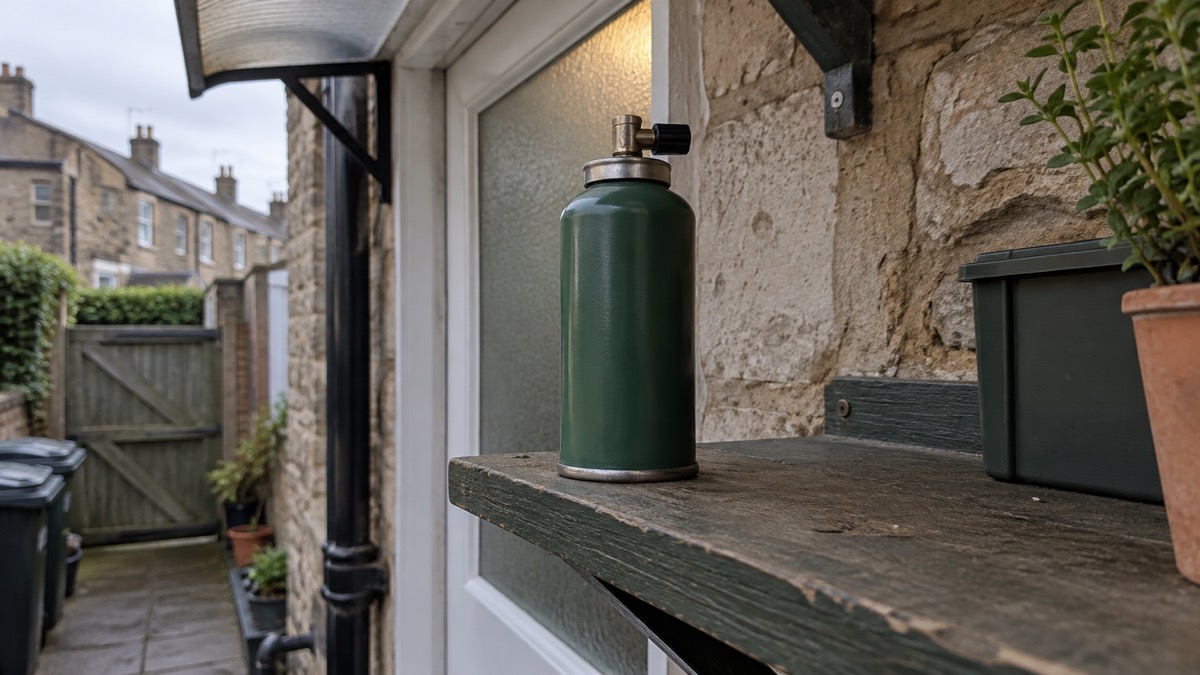
There are rules about changing cartridges as well as storing them. The Scottish Fire and Rescue Service's power cut guidance says that if you are using a camping stove outdoors, you should never change gas cartridges indoors or near ignition sources10, and Dorset and Wiltshire Fire and Rescue Service says never to use a camping stove, portable barbecue, lit charcoal or generator in an enclosed space, because they are designed for outdoor use only and can produce poisonous carbon monoxide17. The gov.uk fire safety outdoors guidance adds: "Never smoke whilst changing your gas"13.
In tents, caravans and boats the rules tighten further. Never take a gas stove, light or heater into a tent, caravan or cabin unless it is a permanent fixture, installed and maintained correctly. Never use fuel-burning devices inside a caravan, including disposable barbecues, camping stoves, camping heaters, lanterns and charcoal grills, and the same applies inside a tent. Humberside Fire and Rescue Service extends this to heaters: never run a gas, petrol or diesel-powered generator or a heater that is not designed for the purpose inside a caravan, motorhome, tent or awning18. Never smoke inside a tent14.
Securing the connection before you light up
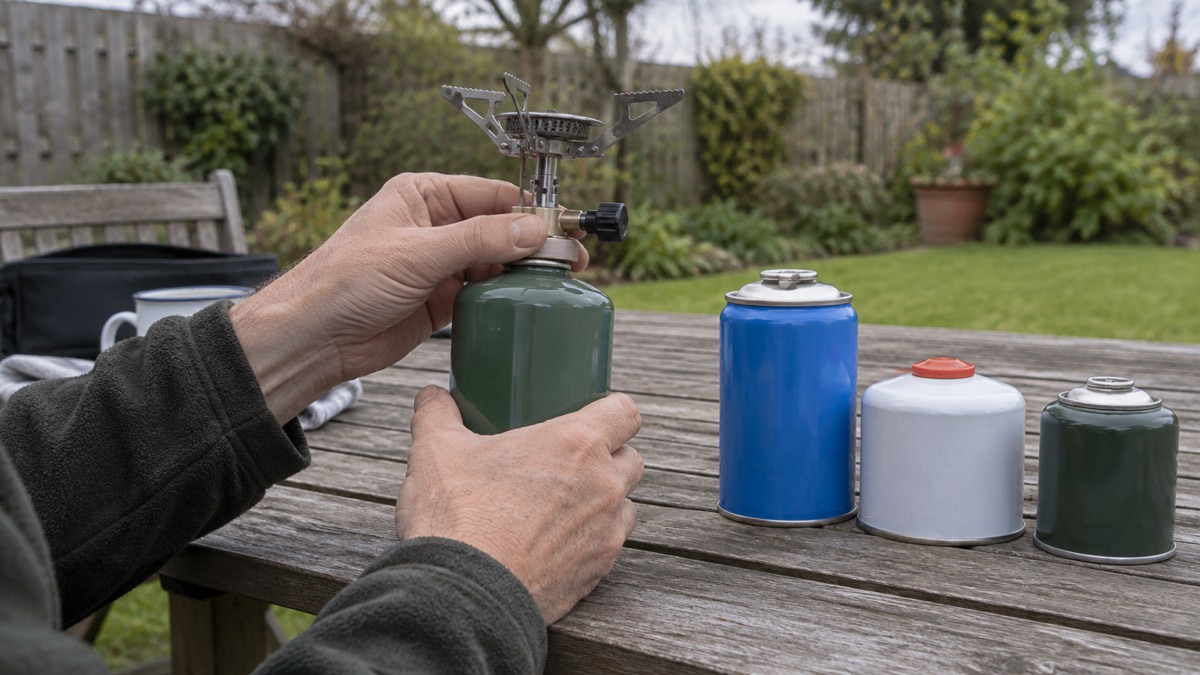
Most gas accidents with portable equipment happen at the moment of connection, not during use. The Scottish Fire and Rescue Service notes that accidents from portable gas heaters happen due to gas leaks during appliance assembly or cylinder or cartridge changes8. That makes the minutes before you light up the most important minutes of all.
Devon and Somerset Fire and Rescue Service's caravan and mobile home advice gives the core instruction: "Make sure the gas pipe connection is secure, if you suspect a leak, turn off the main cylinder valve"6. Before every use, check that the connection between cartridge or cylinder and appliance is tight and secure, and that the appliance itself is stable. nidirect's camping advice says to make sure cooking appliances are stable and cannot be knocked over easily14.
When you change a cylinder, the order matters. nidirect says to make sure the gas tap is turned off before changing the cylinder and always to disconnect the cylinder in open air14. The gov.uk fire safety outdoors guidance says only to change gas cylinders when they are completely empty, and to store them away from caravans and vehicles13. North Yorkshire Fire and Rescue Service gives the same advice for camping12, and Mid and West Wales Fire and Rescue Service says gas cylinders should be turned off unless they are designed to stay on continuously, with the bottle changed only when completely empty20. Devon and Somerset Fire and Rescue Service and DW Fire and Rescue Service both say simply: turn off gas cylinders when not in use6.
The cartridge's own design affects how you handle it. Campingaz states that its CV 470 PLUS and CV 300 PLUS cartridges are valve-operated, so they can be detached from the equipment easily21. That is what "CV" means in practice: the valve holds the gas in when the cartridge is disconnected, so a part-used CV cartridge can be removed from the stove and stored. A pierceable cartridge, by contrast, is permanently open once fitted and cannot be removed safely until empty. Always check which type your stove takes before buying spares: the Campingaz Party Grill 200, for example, must be used exclusively with Campingaz CV 470 PLUS or CV 300 PLUS cartridges, and the maker warns against using other gas cartridges with it21. The Party Grill 200 runs on butane at direct pressure21.
If you use gas on a boat, Cheshire Fire and Rescue Service advises fitting a gas and petrol vapour detector alarm in the bilge and cabin space to give early warnings of gas build-up22. For heaters used at home, the Scottish Fire and Rescue Service says to make sure a permanent safety guard is fitted8; more on that in Using a Portable Heater Safely at Home.
For the step-by-step process, see How to Change an LPG Cylinder Safely.
If you suspect a leak, turn off the cylinder valve
Every fire and rescue service that publishes caravan and camping guidance gives the same sequence of actions for a suspected leak, and it is worth learning before you need it. Lincolnshire County Council's caravan safety advice states it in full: "If you suspect that there is a gas leak turn off all appliances and the main cylinder valve, open all doors and windows and do not smoke or turn on any electrical switches or appliances until you have been given the all clear"9.
The same sequence of steps appears whichever version of the guidance you read. The steps, in order:
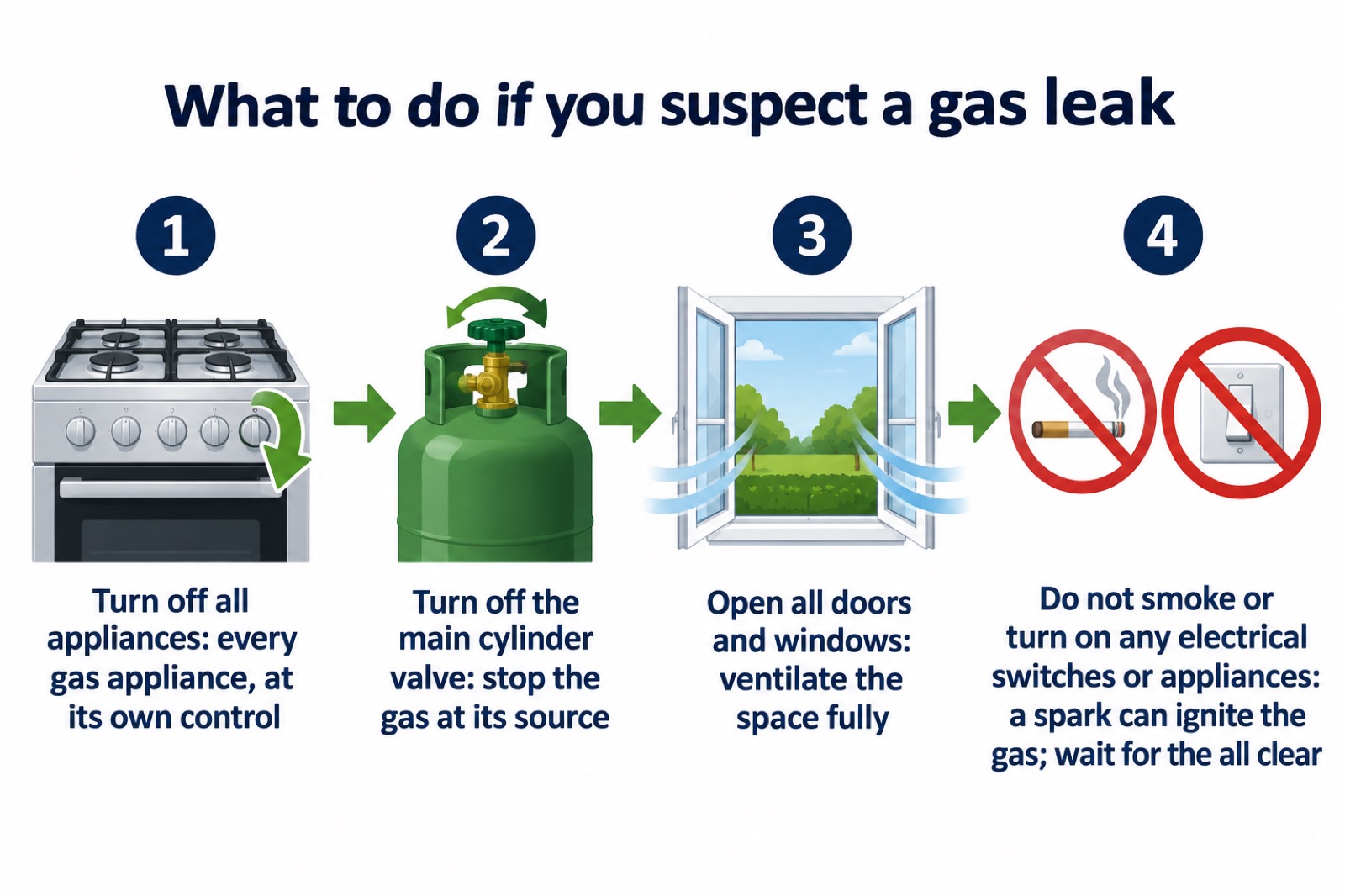
The reason for the electrical switches rule is that a single spark, from a light switch or a phone or an appliance being switched on, can ignite gas that has built up in a room. That is why the advice says to wait until you have been given the all clear before restoring power or lighting anything. If the smell of gas is strong, or it persists after ventilating, leave the property and call the gas emergency service from outside.
Prevention is better than response here. The Scottish Fire and Rescue Service's observation that leaks happen during assembly and cartridge changes8 means the check of the connection before each use, covered above, is your main protection. For a household that keeps bottled gas for heating, the wider advice on Home Emergencies: Fire, Carbon Monoxide, Gas Leaks and Burst Pipes sets out the alarms worth having.
Recalled stoves, heaters and cylinders to check for
Before you rely on any gas stove, heater or cylinder in an emergency, check it against the recalls below. Gas products are recalled more often than most household equipment, usually over hose, valve or filling faults that can cause leaks, fires or explosions. The recalls listed here are all published on GOV.UK or by local authorities, and each gives the models affected and how to return them.
| Product | What is affected | The risk | What to do |
|---|---|---|---|
| Flogas Gold Butane Gas Cylinder23 | Gold and red butane bottles in 4.5 kg, 7 kg and 13 kg, sold between 6 and 22 November 2024 | Over-pressure fire risk; filled with a butane and propane mixture outside the standard specification | Stop using it; keep it outdoors and away from heat until collection is arranged |
| OEX Folding Gas Stoves25 | Two styles: the Folding Novo Stove and Folding Savo Stove, with hose; production code 71308 - 212 | The gas hose may degrade over time, leading to a gas leak and possible hose ignition | Stop using it; return to Go Outdoors, Go Outdoors Express, Blacks, Millets, Fishing Republic or Ultimate Outdoors |
| Vango Folding Gas Stoves26 | See the recall notice for the affected styles | See the recall notice | Affected stoves can be returned to any of the following stores: Go Outdoors, Go Outdoors Express, Blacks, Millets, Fishing Republic or Ultimate Outdoors |
| MSR Trail Lite and Reactor Camping Cooking Pots27 | A variety of cooking pots and stoves sold individually and in sets, including the Trail Lite 2 L Pot (barcode 40818132357, SKU 13235), the Trail Lite 1.3 L Pot (barcode 40818132340, SKU 13234) and the PocketRocket Stove Kit (barcode 40818095676, SKU 09567) | Risk of burns | Stop using it and follow the recall notice |
| Belling, Stoves and New World gas range cookers with gas grill28 | 110, 100 and 90 cm models manufactured by Glen Dimplex Home Appliance Ltd | Safety warning affecting these cookers | Check the model list attached to the notice and follow it |
The Flogas recall deserves particular attention from households that keep butane for heating. The cylinders were recalled because they were filled with a butane and propane mixture outside the standard specification, creating an over-pressure fire risk24. If you are holding an affected cylinder, where possible keep it stored outdoors, and if you must store it indoors, keep it away from sources of heat until collection is arranged24.
The folding stove recalls matter to anyone who bought a hose-connected camping stove for emergency cooking. Both the OEX and Vango recalls were notified by Local Authority Trading Standards in June 202425, and both name the same six retail chains for returns. If your emergency kit contains a folding stove with a hose, check the brand and production code before your next power cut, not during it.
Using a gas appliance indoors during an outage
This is where households most often go wrong. During a power cut the temptation is to bring the camping stove into the kitchen to boil water, and the official advice is that you must not. Food Standards Scotland's power cut guidance says you can cook food and heat water using a camping stove, barbecue or bottled gas stove, but you must check the manufacturer's instructions for safe use, as most are designed for outdoor use only29. The UK government's consumer advice on food safety in a power cut says the same, and adds that cooking with these appliances can take longer than your usual ways of cooking, so you need to make sure food is steaming hot and cooked all the way through30.
The reason for the outdoor-only rule is carbon monoxide. Cheshire Fire and Rescue Service lists camping stoves, camping heaters, lanterns, charcoal grills and disposable barbecues among fuel-burning equipment, and warns that using these indoors can cause carbon monoxide poisoning31. Dorset and Wiltshire Fire and Rescue Service's power cut guidance states it plainly: never use a camping stove, portable barbecue, lit charcoal or generator in an enclosed space, as they are designed for outdoor use only and can produce poisonous carbon monoxide17.
For the full reasoning, see Is It Safe to Use a Camping Stove Indoors?.
If your backup heating is a proper portable gas heater rather than a camping stove, different rules apply, and they are stricter about where people sleep. The Health and Safety Executive's guidance for homeowners says that since 31 October 1998, any room converted to use as sleeping accommodation should not contain a gas fire, gas space heater or gas water heater (including a gas boiler) over 14 kilowatts gross input unless it is room sealed34. An appliance of 14 kilowatts gross input or less, or any instantaneous water heater, must be room sealed or have an atmosphere-sensing device in such a room34. In plain terms: do not sleep in a room with an open-flued gas heater, and check any heater in a bedroom against these rules. The Scottish Fire and Rescue Service also advises making sure a permanent safety guard is fitted to portable heaters8, and gas heaters in caravans and mobile homes should be checked or fixed by a Gas Safe engineer6.
When a power cut leaves you cooking outdoors in the cold, plan for it to be slower than usual. Camping stoves, barbecues and bottled gas stoves can take longer than your usual ways of cooking, so take extra care that food is steaming hot and cooked all the way through before eating. Keep the appliance stable so it cannot be knocked over easily, and read the manufacturer's instructions for safe use before you start, as most of these appliances are designed for outdoor use only.
For everything else that goes with cooking and heating through an outage, see Heating and Cooking Without Mains Power or Gas and Power Cuts: A Household Guide.
Sources (34)
- Gas heaters: home safety advice, Devon and Somerset Fire and Rescue Service
- Barbecue safety: gas cylinders, Devon and Somerset Fire and Rescue Service
- Storing fuel safely at home, Devon and Somerset Fire and Rescue Service
- Electric blankets and portable heaters safety, Warwickshire County Council
- Portable heaters: heating safety, Manchester Fire and Rescue Service
- Caravans and mobile homes: fire safety, Devon and Somerset Fire and Rescue Service
- Portable heaters: home heating guidance, Manchester Fire and Rescue Service
- Heating and gas safety at home, Scottish Fire and Rescue Service, 2024-11-21
- Caravan safety, Lincolnshire County Council, 2026-10-29
- Power cuts: what to do, Scottish Fire and Rescue Service, 2026-10-25
- Caravans and mobile homes, Dorset and Wiltshire Fire and Rescue Service, 2025-06-20
- Caravans and camping safety, North Yorkshire Fire and Rescue Service, 2026-05-13
- Fire safety outdoors: accessible version, GOV.UK, 2022-05-25
- Fire and summer safety advice, nidirect, 2026-07-03
- Heating your home safely, North Yorkshire Fire and Rescue Service, 2026-03-09
- Hoarding and fire safety, Cheshire Fire and Rescue Service, 2026-05-20
- Power cuts: storms and safety, Dorset and Wiltshire Fire and Rescue Service, 2023-11-30
- Caravan, motor home and campervan safety, Humberside Fire and Rescue Service, 2026-10-29
- Camping safety, Manchester Fire and Rescue Service, 2026-10-29
- Caravan safety advice, Mid and West Wales Fire and Rescue Service, 2026-10-29
- Campingaz Party Grill 200 instructions and cartridge information, Campingaz, 2021
- Boat safety, Cheshire Fire and Rescue Service, 2026-05-28
- Product recall: Flogas Gold butane gas cylinder (2411-0181), GOV.UK, 2024-12-03
- Recall notice: Flogas Gold Butane Gas Cylinder, London Borough of Bromley, 2024-12-10
- Product recall: OEX folding gas stoves (2405-0060), GOV.UK, 2024-06-06
- Product recall: Vango folding gas stoves (2405-0054), GOV.UK, 2024-06-06
- Product recall: MSR Trail Lite and Reactor camping cooking pots (2402-0314), GOV.UK, 2024-03-25
- Product safety report: Belling, Stoves and New World gas range cookers with gas grill (2205-0240), GOV.UK, 2022-08-15
- Food safety in the kitchen during power cuts, Food Standards Scotland, 2026-10-25
- Food safety in a power cut: advice for consumers, GOV.UK, 2023-07-26
- Camping safety, Cheshire Fire and Rescue Service, 2025-07-26
- Carbon monoxide dangers if camping, caravanning or boating, nidirect, 2026-04-02
- Safety outdoors: camping and caravanning, Cumbria Fire and Rescue Service, 2026-10-29
- Gas appliances: frequently asked questions for homeowners, Health and Safety Executive, 2026
 Before-Winter Heating Checks
 Backup Stove Kit Checklist
 Wood Burner Lighting Kit
 Keeping One Room Warm
 Clothing and Bedding for Cold
 Stopping Draughts
 Hot Water Bottle Safety
 Wheat Bags and Fire Risk
 Electric Blanket Safety
 Portable Heater Types
 Portable Heater Safety
 Wood Burners in a Power Cut
 Using a Wood Burner Safely
 Open Fires and Fire Guards
 Firewood and Seasoning Logs