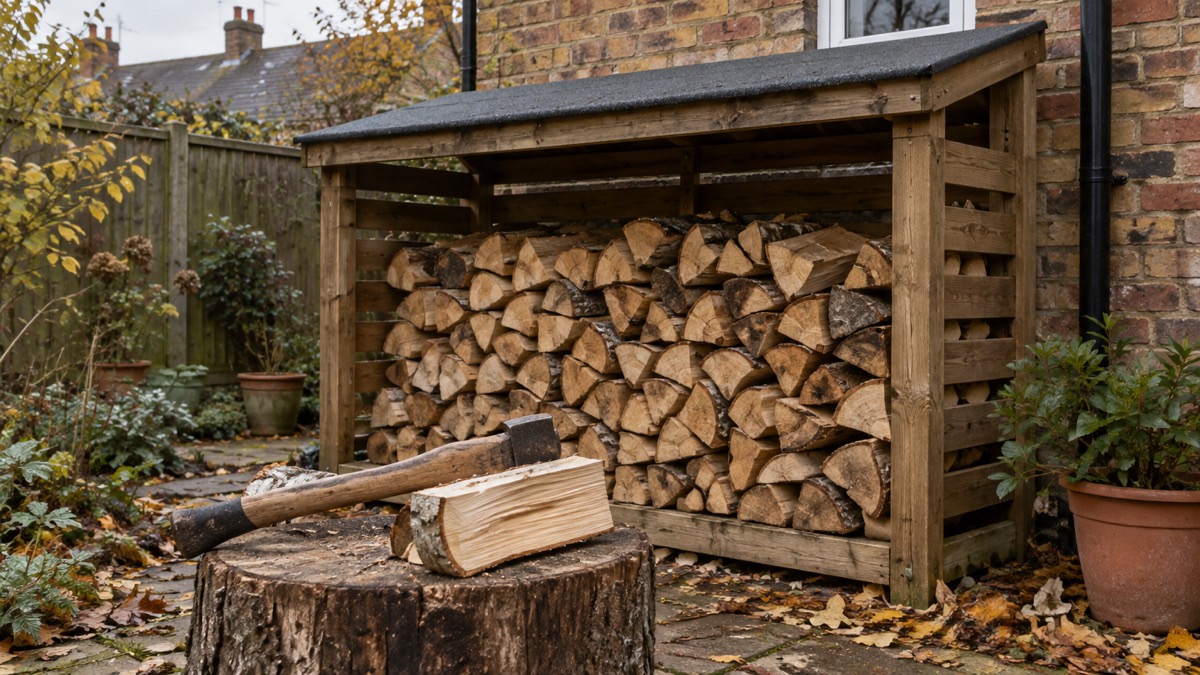
Firewood should have a moisture content of 20% or less before it goes on the fire. That single number is the difference between a stove that heats your room cleanly and one that smokes, coats your chimney in flammable tar and wastes your money. Oxford City Council's air quality guidance is blunt about it: "You should not burn wood until it has a moisture content of 20% or less."1 Defra, the government department responsible for air quality, gives the same figure: dry wood should have 20% moisture or less.2
Getting there takes patience. Fire and rescue services across the UK agree that wood must be dry and well-seasoned, and that this usually takes about two years.3 If you buy wood rather than season your own, look for the Ready to Burn logo, which confirms the fuel meets moisture, sulphur and smoke emission limits and is certified at no more than 20% moisture.1
This page explains how dry firewood needs to be, how to season and stack logs yourself, how to check them with a moisture meter, and why burning wet wood causes tar, creosote and chimney fires. It sits alongside our guides on wood burners and multi-fuel stoves in a power cut, using a wood burner safely and how often a chimney should be swept.
The 20% rule: how dry firewood must be
Every official source in the UK points to the same ceiling. Defra's guidance for households says dry wood should have 20% moisture or less2, and its Burn Better campaign explains that wood sold in volumes of less than 2 cubic metres must have a moisture content of 20% or less5. Oxford City Council, running a local air quality campaign, tells residents the cleanest fuel for a wood burner is dry untreated wood with less than 20% moisture, and that you should not burn wood until it has a moisture content of 20% or less1. North Yorkshire Fire and Rescue Service puts it the same way in its chimney fire safety campaign: only burn dry, seasoned wood with a moisture content below 20%.7
Some fire and rescue services go further and recommend an even drier target. Manchester Fire and Rescue Service says all wood burnt should have a moisture content of less than 17%, adding that retailers of wood for burning should only sell wood with a water content less than 17%.8 Treat 20% as the hard limit and anything below it as better: drier wood means less smoke, less tar and more usable heat.
The reason the limit matters so much is what happens above it. Defra warns that when burnt, wet wood with a moisture content above 20% produces lots of smoke, particles and tar deposits which can damage your health and the environment.5 A significant part of the energy in a wet log goes into boiling off its own water instead of heating your room, so wet wood is also poor value. If you rely on a stove during a power cut or heating failure, dry wood is what makes it a dependable source of heat rather than a smoking nuisance.
Seasoning logs: expect about two years
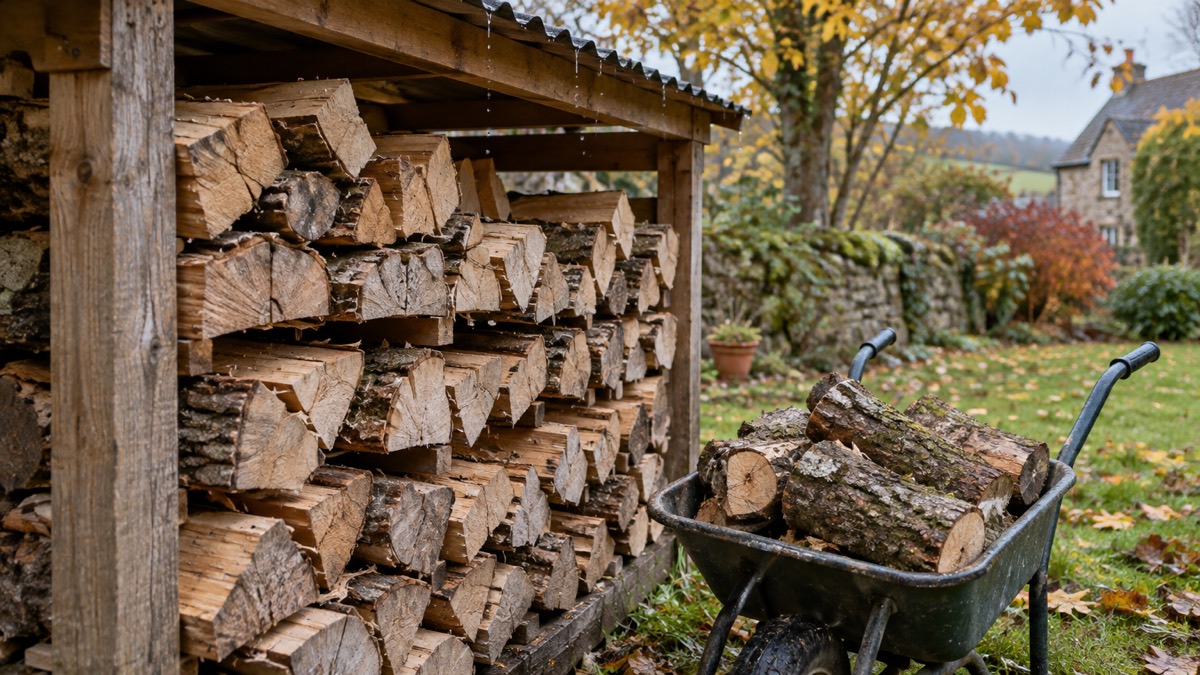
Fire and rescue guidance is consistent that seasoning takes about two years. Mid and West Wales Fire and Rescue Service says wood should be dry and well-seasoned, and that this usually takes about two years3; Devon and Somerset Fire and Rescue Service says the same for open fires and log burners9, and again for solid fuel burners in caravans and mobile homes10. Defra's household leaflet says wet or unseasoned wood needs to be seasoned before burning: let it dry for up to 2 years.2 Oxford City Council advises storing wet logs in a dry area for at least two years before burning.1
Two years is the rule of thumb, not a fixed sentence. The drying time depends on the wood, how it is split and where it is kept, so some logs will be ready sooner and others later. The only reliable test is a moisture meter, not the calendar.
Forestry Commission guidance gives a practical year-round rhythm for anyone seasoning their own wood: fell by April (earlier for broadleaves), stack for summer, cover in autumn, and bring logs into the house in winter.11 It also notes that standing timber is driest in winter, and that bringing cut, split logs indoors for a few days or more before use helps achieve a low moisture content for burning.11 That last step is worth adopting as habit: a basket of logs by the stove for a few days before burning finishes the drying.
How to stack logs so they dry
The Forestry Commission's sequence gives you the plan11:
- Fell or buy by April, earlier if you are dealing with broadleaves, so the wood has a full summer of drying.
- Stack for summer in a place where air can move freely through the pile.
- Cover in autumn to keep rain off, once the main drying season is over.
- Bring logs indoors in winter, a few days or more before burning, to finish them off.
Keep the stack off the ground and away from the house wall so air can circulate. Never seal a stack in plastic or a closed container: trapped moisture cannot escape and the wood will not dry.
How to tell if wood is dry enough
There are two checks, and the meter is the one that counts.
The visual check is drying cracks. Mid and West Wales Fire and Rescue Service says a well-seasoned log will have drying-out splits in the ends3, and its Welsh-language guidance says the same: dry firewood shows drying cracks at both ends of the pieces.12 These splits appear because the wood shrinks as moisture leaves it, so they are a sign of drying that has genuinely happened. But cracks alone cannot tell you whether a log has reached 20%, only that it is on the way.
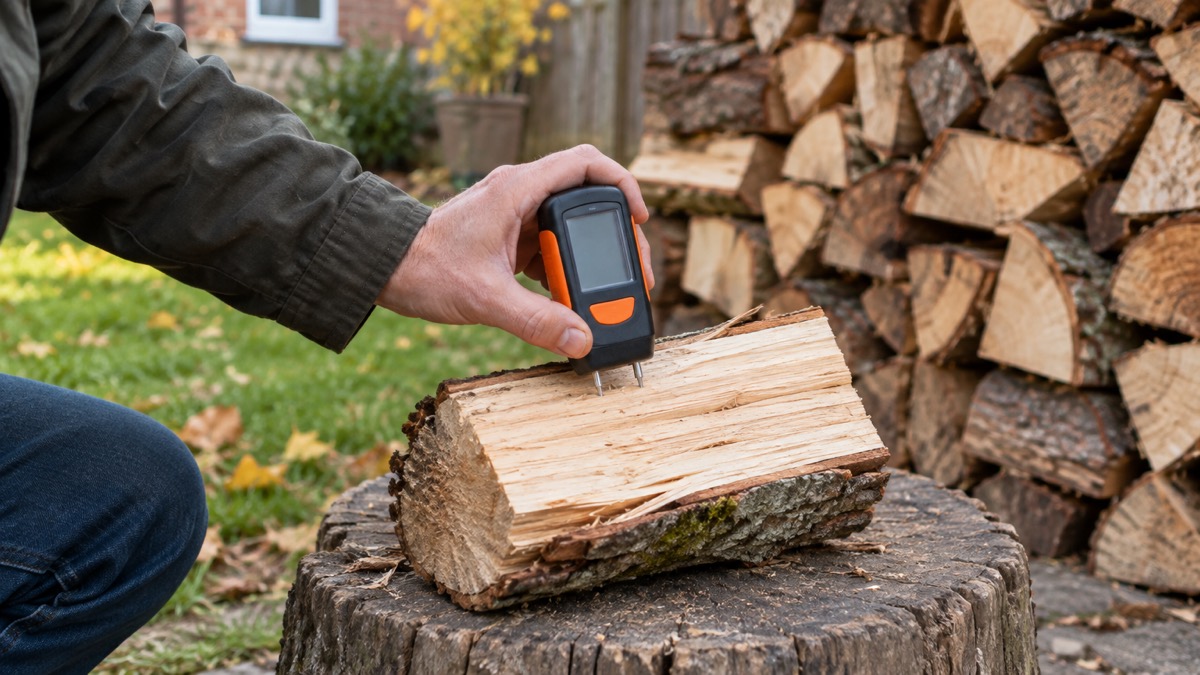
The reliable check is a moisture meter. Defra's advice for wood you source yourself or buy in volumes over 2 cubic metres is simple: "Use a moisture meter to check that moisture levels are 20% or less before burning."5 A meter costs little, is pressed against a freshly split face of the log, and gives you a number instead of a guess. Test several logs from different parts of the stack, and split a log to test the inside, since the outside of a log always dries first.
Ready to Burn wood: what the label guarantees
If you want to burn wood straight away rather than wait two years, buy it certified. The Ready to Burn mark identifies fuels certified as no more than 20% moisture content4, and helps consumers easily identify solid fuels that are legal to burn at home in compliance with the Air Quality Regulations.4 Oxford City Council explains that the logo confirms the fuel meets the sulphur, moisture and smoke emission limits, and advises always looking for the approved Ready to Burn logo when buying fuel1; Surrey Fire and Rescue Service tells wood burner users to burn only fuels marked ready to burn13; Manchester Fire and Rescue Service says to look for the logo when buying small bags of firewood and solid fuel briquettes8; and Defra says that if you want to burn immediately, look for the logo as a guarantee of good quality dry wood.14
The label matters most for small purchases. Defra's rules cover wood sold in volumes of less than 2 cubic metres5, so a net bag or small load from a garage forecourt carries the certification. A bulk delivery of several cubic metres sits outside that guarantee, which is why Defra tells you to check such wood with a moisture meter before burning.5
Certified wood pays for itself in the long run. Oxford City Council notes that Ready to Burn wood is not only better for your appliance and chimney but will also reduce maintenance and fuel costs.1 You can read more about what you may legally burn in different areas in our guide to smoke control areas.
| What you are buying | Is it certified? | What to do |
|---|---|---|
| Small bags of firewood or briquettes (under 2m³) | Yes, if it carries the Ready to Burn logo5 | Burn straight away14 |
| Bulk load over 2m³ | Not covered by the certification5 | Check with a moisture meter before burning5 |
| Wood you cut or source yourself | No | Season about two years, then meter-test to 20% or less3 |
Why wet or freshly felled wood is a problem
Wet wood fails on every count at once. Oxford City Council explains that wet wood contains moisture which creates smoke and harmful particulates when burnt, harming health and the environment, damaging the stove and chimney, and heating inefficiently.1 Defra's guidance says the same: wet wood burned above 20% moisture produces lots of smoke, particles and tar deposits which can damage your health and the environment.5
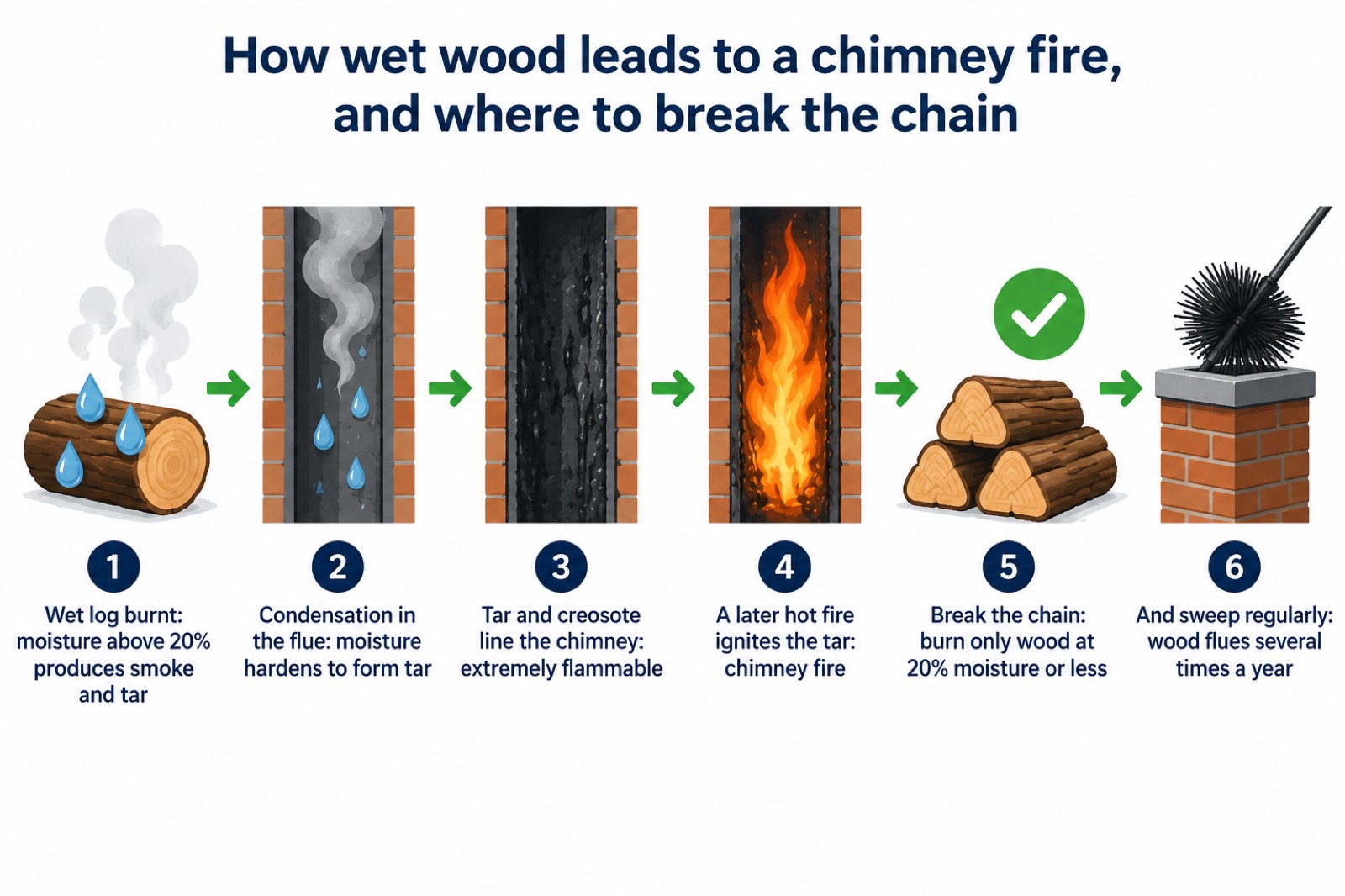
Burning wet or unseasoned wood is also a direct cause of chimney fires. North Wales Fire and Rescue Service lists burning wet or unseasoned wood among the causes of chimney fires15, and Devon and Somerset Fire and Rescue Service warns that burning wet wood can create creosote tar, which is extremely flammable and can lead to chimney fires.9 The risk is sharpest for thatched properties, where Devon and Somerset advises only burning well-seasoned wood that has been left to dry so all the moisture has evaporated, because burning wet wood creates condensation that hardens to form tar.10
The same rules apply to wood-burning stoves and boilers anywhere in the home, and to fires in caravans and mobile homes, where Devon and Somerset repeats that wood must be dry and well-seasoned, usually taking about two years.3 If you are preparing your household for power cuts or heating failures, plan your firewood supply at least two winters ahead, and see our before-winter checklist for your heating and stove.
Tar and creosote in the stove and chimney
Tar and creosote form when the moisture in wet wood meets a cool flue. Mid and West Wales Fire and Rescue Service warns that wet or freshly felled wood can cause tar or creosote to form in the burner and chimney3, and Devon and Somerset Fire and Rescue Service gives the mechanism for thatched homes: burning wet wood creates condensation that hardens to form tar, which is extremely flammable and can lead to chimney fires.10 Once that tar lines the flue, a hot fire later in the winter can ignite it, and that is a chimney fire.
"Wet or newly-felled wood can cause tar or creosote to form in the wood burner and chimney."
The fix is upstream of the chimney: burn only dry wood. Beyond that, two habits keep the flue clear.
First, do not let the stove crawl. Mid and West Wales Fire and Rescue Service advises that if the burner has burned slowly, overnight for example, this should be followed by a period of faster burning to dry out any creosote and warm the chimney again.12 The Scottish Fire and Rescue Service is more specific: if the wood burner has been used at a low output for a long period, this should be followed by a controlled high burn for at least 30 minutes to dry out any creosote and to warm up the chimney again.6
Second, have the chimney swept regularly. Surrey Fire and Rescue Service notes national guidance recommends chimneys are cleaned at least once a year, and for those burning wood fuel every six months13; Devon and Somerset says wood burners need sweeping every three months9; Lincolnshire Fire and Rescue says wood means four times a year16; Manchester Fire and Rescue Service says smokeless coals need sweeping at least once a year8; and Cornwall Fire and Rescue Service says once a year for smokeless fuel and twice a year for coal.17 The services differ on exactly how often wood flues need sweeping, so follow your own sweep's advice, but the direction is clear: wood-burning flues need sweeping several times a year. Lincolnshire Fire and Rescue Service adds that regular sweeping also reduces the risk of a build-up of carbon monoxide.16 Our guide to chimney fires covers the warning signs.
Smoke, slow burning and the flue
Smoke pouring back into the room from a stove or open fire is a sign something is wrong, and wet wood is the first suspect. Because wet wood produces lots of smoke and particles5, a flue that would carry away the output of dry wood can struggle with the extra volume from wet logs, and a cool flue draught makes it worse. The Scottish Fire and Rescue Service's controlled high burn of at least 30 minutes after slow burning exists precisely to warm the chimney again6, because a warm chimney draws properly and a cold one does not.
If smoke fills the room during a fire rather than merely drifting from it, treat it as a fire emergency. Surrey Fire and Rescue Service's action plan advice is to keep low where the air is clearer if there is smoke, and never go back into the building once you are safely outside.18 Get out, stay out and call 999. Our guide to home emergencies covers fire, carbon monoxide and gas leaks in full.
Wood you should never burn
Dryness is only half of the fuel question; the other half is what the wood is. Several types must never go on a fire, whatever their moisture reading:
- Painted, stained, coated or chemically treated wood. Defra says do not burn treated wood, including old furniture, pallets and medium density fibreboard, because these release dangerous pollutants which could have a serious impact on human health.5
- Glued wood. Oxford City Council says do not burn wet or treated, painted or glued wood.1
- Household waste and wet timber. North Yorkshire Fire and Rescue Service says avoid burning these, as they can produce toxic fumes and contribute to dangerous tar build-up in the flue.7
- Anything contaminated with paint, varnish or preservatives. Forestry Commission guidance says contamination can affect tar build-up and release noxious chemicals into the smoke.11
The same prohibition applies outdoors: Mid and West Wales Fire and Rescue Service says never use painted, coated or pressure treated wood in firepits, chimineas and outdoor fireplaces, as these can release toxic chemicals into the air, and advises using kiln dried wood to reduce the risk of sparks and smoke.19 Our page on what wood and rubbish you should never burn lists these in full.
Getting your firewood ready before winter
If you burn wood for heat, your firewood plan belongs with the rest of your winter preparations. Work backwards from the fire:
- Buy certified for this winter. Small bags and loads under 2 cubic metres carrying the Ready to Burn logo can be burnt immediately.5
- Meter-test anything uncertified. Wood bought in volumes over 2 cubic metres, or sourced yourself, should be checked to 20% or less with a moisture meter before burning.5
- Start seasoning now for two winters' time. Stack logs by spring, leave them through summer, cover in autumn and bring them indoors before use.11
- Book the sweep. Wood-burning flues need sweeping several times a year; smokeless fuel flues at least once a year.9
- Burn clean fuel only. Dry untreated wood and DEFRA-certified manufactured solid fuels give less smoke and better heat efficiency.1
For the wider picture of keeping warm when the heating fails, see our guides to heating and cooking without mains power or gas, keeping one room warm and open fires: lighting, fire guards and staying safe.
Sources (19)
- Fuel Good campaign: wood burner fuels, Oxford City Council
- Ready to Burn: practical guide for open fires and wood-burning stoves, Defra UK Air, April 2023
- Chimneys, open fires and wood burning stoves, Mid and West Wales Fire and Rescue Service
- Chimney fire safety campaign, North Yorkshire Fire and Rescue Service
- Burn Better: guidance on burning, Defra UK Air
- Chimney safety leaflet, Scottish Fire and Rescue Service, January 2024
- Chimney Fire Safety Week: residents encouraged to act now, North Yorkshire Fire and Rescue Service
- Chimney safety and heating advice, Manchester Fire and Rescue Service
- Open fires and log burners, Devon and Somerset Fire and Rescue Service
- Thatched properties, Devon and Somerset Fire and Rescue Service
- Wood as fuel: a guide to choosing and using logs, Forest Research, October 2009
- Simneiau, tanau agored a stofiau llosgi pren, Mid and West Wales Fire and Rescue Service
- Fire safety at home, Surrey County Council Fire and Rescue Service
- Ready to Burn web guidance, Defra UK Air, October 2023
- Chimney fires, North Wales Fire and Rescue Service
- Chimney safety, Lincolnshire County Council
- Chimney fires, Cornwall Fire and Rescue Service
- What to do if fire breaks out: action plan, Surrey County Council Fire and Rescue Service
- Firepit safety advice, Mid and West Wales Fire and Rescue Service
 Before-Winter Heating Checks
 Backup Stove Kit Checklist
 Wood Burner Lighting Kit
 Keeping One Room Warm
 Clothing and Bedding for Cold
 Stopping Draughts
 Hot Water Bottle Safety
 Wheat Bags and Fire Risk
 Electric Blanket Safety
 Portable Heater Types
 Portable Heater Safety
 Wood Burners in a Power Cut
 Using a Wood Burner Safely
 Open Fires and Fire Guards
 Smoke Control Areas