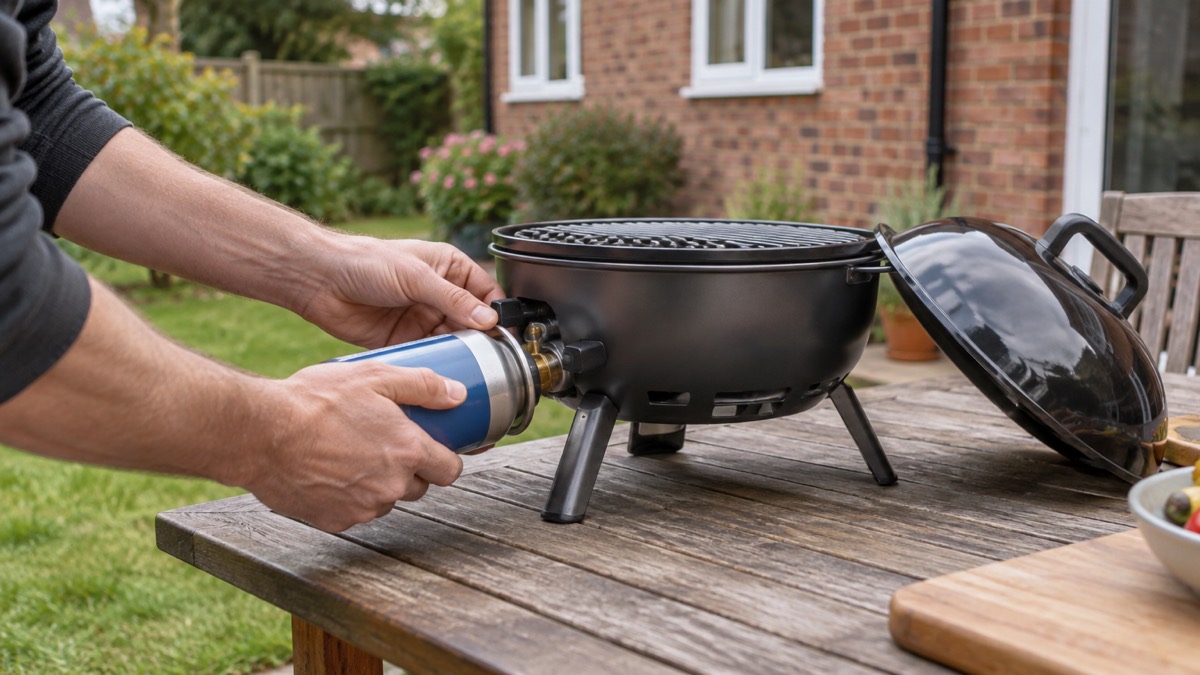
The Campingaz Party Grill 200 is a small gas stove and grill that runs on a Campingaz CV 470 PLUS or CV 300 PLUS cartridge. It is an outdoor cooking appliance: the maker's manual says it must not be used in caravans, cars, tents, huts, sheds or any small enclosed area, and every UK fire and rescue service gives the same warning for gas and charcoal cooking appliances1.
What a household usually wants to know first is how long it will cook for. On a CV 470 PLUS cartridge the maker gives 3 hours 15 minutes grilling at maximum power, or 3 hours 45 minutes preheating and cooking1. Gas consumption is 145 g/h, which is 2 kW, through a number 30 injector1. That is enough for a hot meal or two outdoors, not a substitute for a kitchen.
It works two ways. With the cooking plate fitted it is a grill, with the strongest heat in the centre of the plate. With the plate removed and a pan on the pan support it is a stove. The maker's manual sets out both uses, the clearances, the cleaning routine and what to do if something goes wrong, and those instructions are the basis for everything below1.
What the Party Grill 200 is and what it runs on
The Party Grill 200 is a cartridge appliance in the Campingaz range, built around a burner fed by a screw-on gas cartridge. The maker describes its category as butane direct pressure, so it runs on the butane cartridges in the CV PLUS range rather than on a refillable bottle with a regulator1. If you are weighing up cartridge stoves against other options, our guide to camping stoves for a power cut sets the types side by side, and gas cartridges explains valve types, cold weather behaviour and storage.
The maker's manual lists six components: the lid, the cooking plate, the pan support, the legs, the water reservoir and the base1. The cooking plate has a high quality non-stick coating that allows cooking without added fat or oil, and fats collect in the water reservoir below1. That reservoir is part of how the grill is meant to be used, not an optional extra.
The appliance must be used exclusively with Campingaz CV 470 PLUS or CV 300 PLUS cartridges; the maker warns against other gas cartridges1. Fitting one is a gentle operation: screw the cartridge in clockwise until you hear a click, which is about one-sixth of a turn, and do not force it further or you risk damaging the cartridge valve1. Lighting is by piezo ignition: turn the control knob counter-clockwise so it is completely open, then push immediately on the knob until you hear a click, repeating three or four times if needed1.
| Specification | Maker's figure |
|---|---|
| Fuel | Butane direct pressure1 |
| Cartridges | Campingaz CV 470 PLUS or CV 300 PLUS only1 |
| Gas consumption | 145 g/h (2 kW)1 |
| Injector | Number 301 |
| Ventilation requirement | Minimum 2 m3/h/kw1 |
| Minimum clearance | 20 cm from a wall or combustible object1 |
| Run time, CV 470 PLUS | 3 hours 15 minutes at maximum power; 3 hours 45 minutes preheating and cooking1 |
| Run time, CV 300 PLUS | 1 hour 45 minutes at maximum flow; 2 hours 15 minutes preheating and cooking1 |
| Cooling time before cleaning | About 15 minutes1 |
How long it runs, and what that means for a household
Run time depends entirely on which cartridge is fitted and how hard the burner is worked. The maker's figures are given for two situations: grilling at maximum power, and preheating and cooking, which lasts longer because the burner is not held at full output throughout1.
| Cartridge | Grilling at maximum power | Preheating and cooking |
|---|---|---|
| CV 470 PLUS | 3 hours 15 minutes | 3 hours 45 minutes |
| CV 300 PLUS | 1 hour 45 minutes | 2 hours 15 minutes |
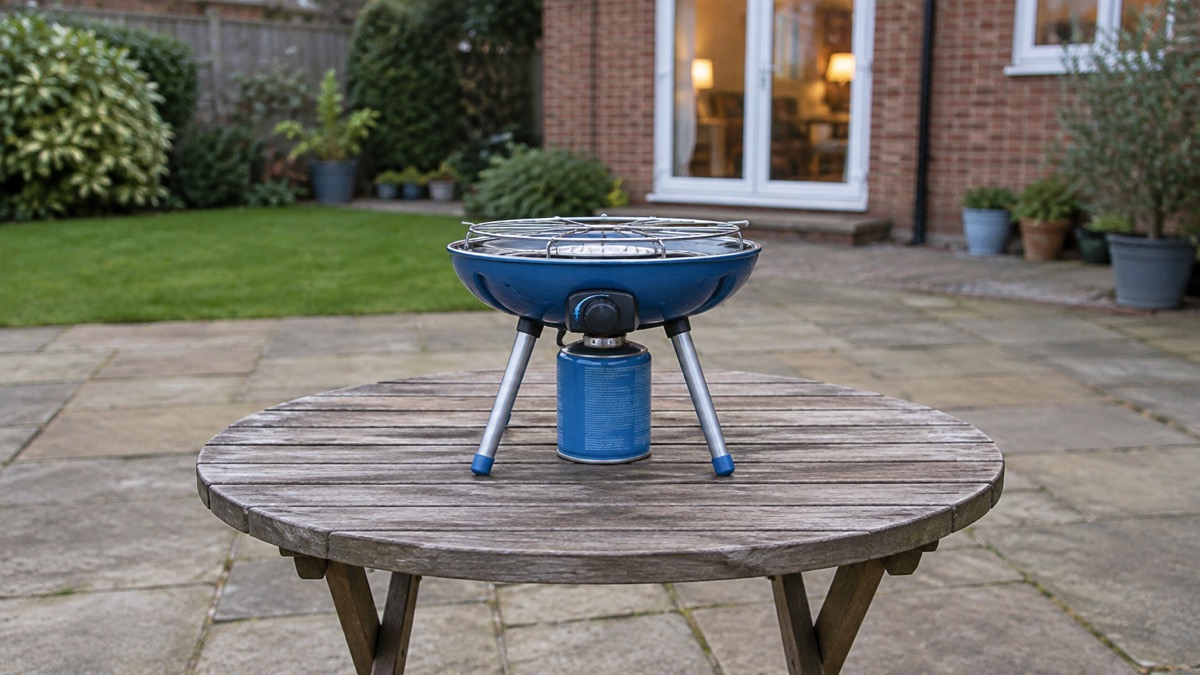
The maker's manual also lists 2 hours 15 minutes for the CV 300 PLUS in its preheating and cooking column, alongside the 1 hour 45 minutes figure for maximum flow1. The two figures describe different ways of using the burner rather than contradicting each other, but treat the shorter figure as the one to plan around if you need the stove at full heat.
For a household, the practical reading is simple. A CV 470 PLUS gives you a long outdoor cooking session, enough to boil water and cook a meal for several people in sequence. A CV 300 PLUS is the smaller cartridge and suits a shorter meal. Because the appliance is outdoor only, the run time matters most in the context of a power cut on a fine day, a garden meal, or a camping trip, rather than as an indoor fallback. Our power cuts guide covers the wider question of feeding a household when the electricity fails, and the backup stove kit checklist lists what to keep with a stove.
The manual also sets a ventilation requirement of a minimum of 2 m3/h/kw, and says the equipment must be used only in areas that are properly ventilated and away from inflammable materials1. Outdoors, that is straightforward. Indoors, it is not achievable in the way the maker intends, which is why the next section matters more than any other on this page.
Where it must never be used
The maker's instruction is unambiguous: do not use this appliance in caravans, cars, tents, huts, sheds or any small enclosed areas1. That is not a cautious suggestion. Every UK fire and rescue service in the material behind this page says the same thing about gas and charcoal cooking appliances, and they say it because people die.
The reason is carbon monoxide. The maker's own manual states that all appliances running on gas consume oxygen and emit other potentially dangerous substances and gases such as carbon monoxide1. Carbon monoxide has no colour, taste or smell, which is why the danger is so easy to walk into.
Fire and rescue services across the UK repeat the warning in almost identical terms. Never use a barbecue, lit charcoal or disposable barbecue inside a tent, caravan or other enclosed space4. Never use fuel-burning appliances inside a caravan, including disposable barbecues, camping stoves, camping heaters, lanterns and charcoal grills5. Never use a portable or disposable barbecue inside your tent, vehicle or awning2. Only use a barbecue outdoors and in well-ventilated areas, and never in a tent or caravan3. Northern Ireland's guidance is the same: never bring a barbecue into a caravan or tent7.
The point about tents deserves emphasis because it is the one people get wrong. Tents might seem well-ventilated, but they are not8. Carbon monoxide poisoning can occur when people bring gas and charcoal barbecues into tents and other small enclosed spaces, sometimes in an attempt to keep warm9. Incidents and fatalities also happen in holiday homes, caravans and on board boats where faulty gas cookers or appliances have led to carbon monoxide poisoning9. The Health and Safety Executive for Northern Ireland makes the same point about small enclosed spaces10.
"Never take a smouldering or lit BBQ (charcoal or gas) into a tent, caravan or cabin."
The warning extends to the appliance after it is out. When barbecues cool, they release carbon monoxide, which can be deadly, so do not put the barbecue or burnt charcoal in your car or tent8. A cold-to-the-touch barbecue can still emit carbon monoxide; the Gas Safe Charity records the death of Hazel Woodhams and the near death of Roland Wessling in exactly that circumstance, both of whom knew about carbon monoxide and had an alarm at home12. Never take portable or disposable barbecues into your home or any confined space such as a tent or caravan, and remember that a smouldering barbecue can continue to produce carbon monoxide for many hours afterwards13.
If you are cooking in a tent or caravan because you have no other option, the answer is not a gas grill indoors. Our guide to keeping warm and cooking in tents and caravans covers what is safe, and barbecues in an emergency sets out the outdoor-only rule in full. For the wider picture on symptoms and what to do, see home emergencies.
Using it as a grill or as a stove
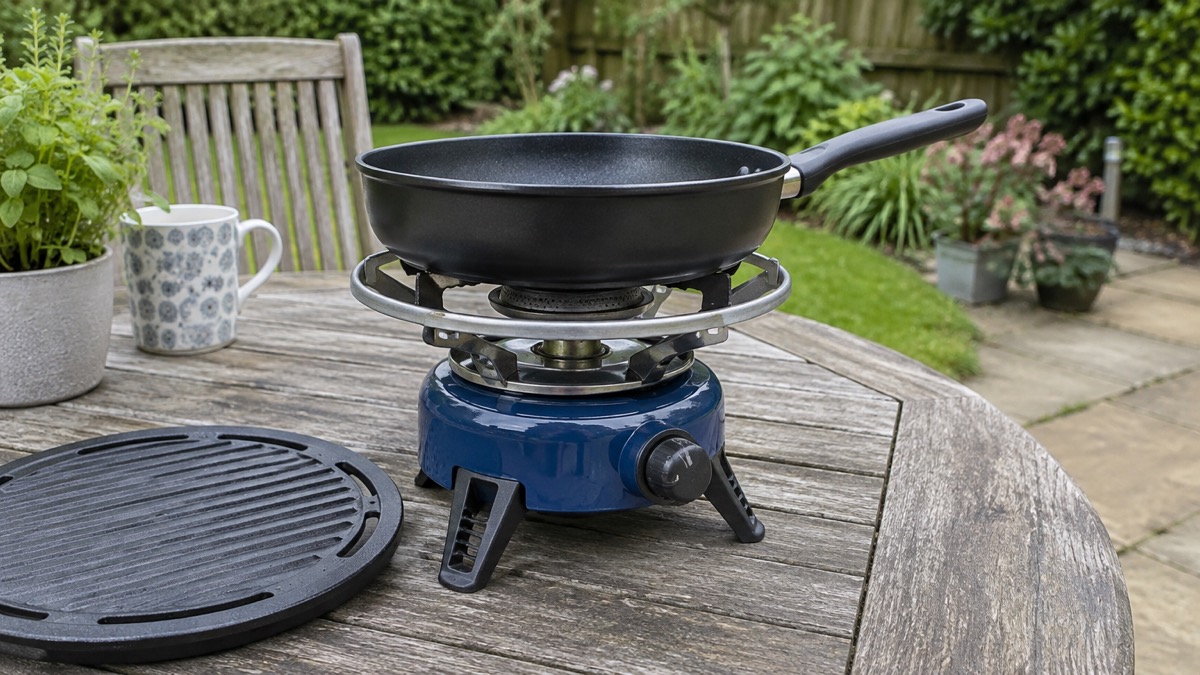
The Party Grill 200 does two jobs, and the maker's manual is clear that they need different set-ups.
As a grill, fit the cooking plate and preheat it for one minute at maximum to reach the ideal cooking temperature1. Cooking intensity is maximum in the centre of the plate and less intense towards the edge, so you can adjust the speed of cooking by where you place the food1. The non-stick coating allows cooking without added fat, and fats are collected in the water tray below1.
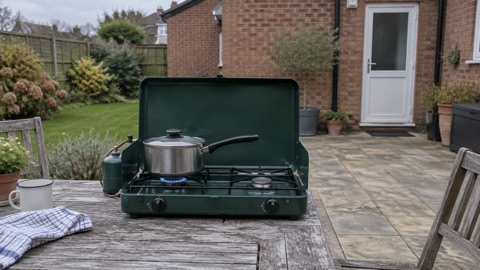
As a stove, the cooking plate must be taken away, and you must never place cooking vessels on the cooking plate itself1. Place the pan, wok or other vessel on the pan support, centred over the burner, and make sure the flame does not exceed the underside of the cooking vessel1. That last point protects both the pan and the burner.
Cooking outdoors on gas is a recognised way to keep feeding a household when the mains supply is interrupted. Food Standards Scotland notes that you can cook food and heat water using a camping stove, barbecue or bottled gas stove, checking the manufacturer's instructions for safe use14. The manufacturer's instructions for this appliance are the ones above.
A few practical points follow from the maker's figures. Because the burner puts out 2 kW and uses 145 g/h, a long cooking session on a cold day will use the cartridge faster than a short one, and the run times in the table are the ones to plan against1. Keep the appliance level so the water reservoir does not spill, and keep the lid and plate where they belong for the job in hand.
Keeping it clean, and storing and carrying it safely
Cleaning is easiest if you let the appliance cool first. The maker says to wait until the unit is cold, approximately 15 minutes, before removing the cooking plate and pan support1. Clean the greasy parts with soapy water or a non-abrasive detergent, and do not use a scouring agent on the cooking plate or the water reservoir1.
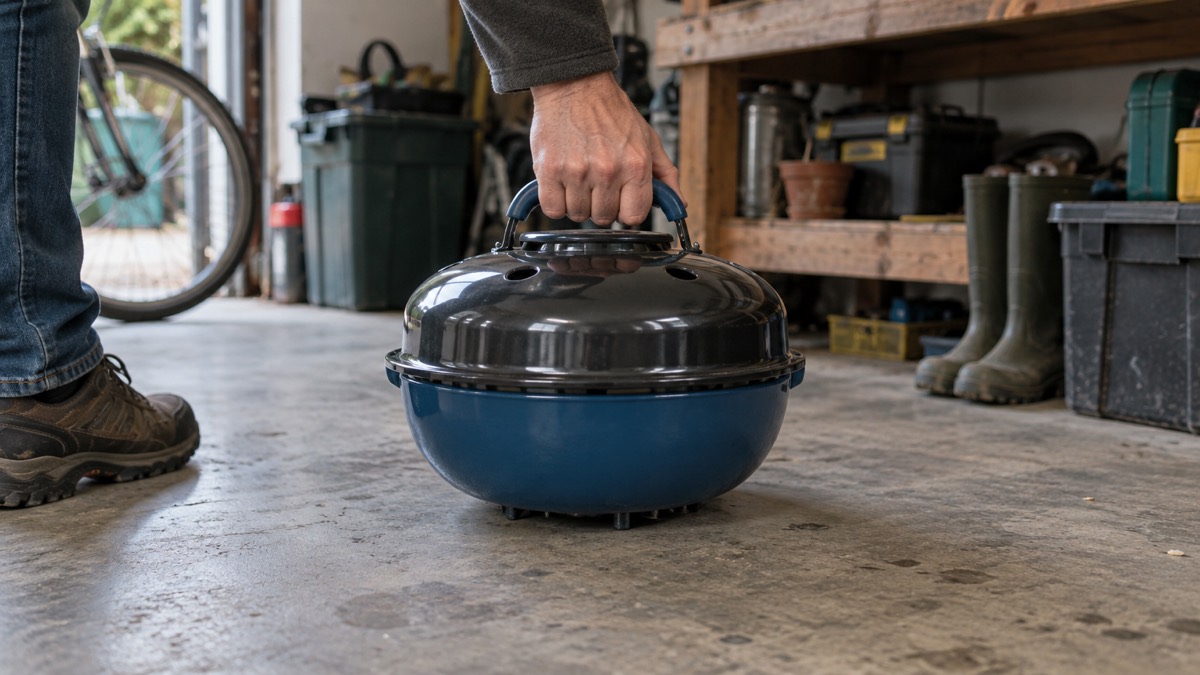
The lid, cooking plate, water reservoir and pan support can all be washed in a dishwasher1. The legs cannot: clean them with a sponge and no washing powder1. Keeping the grill clean is not just about looks. Lincolnshire Fire and Rescue advise keeping the grill clean to avoid a build-up of fat or food, which is a fire risk in any cooking appliance15.
For storage, the maker says the unit should be stored in a safe, secure and dry place, out of the reach of children, and never in a cellar1. Disconnect the cartridge if the appliance is not going to be used for a long period1. For carrying, the legs can be placed in the reservoir to give a compact transportation size1.
Cartridges need care of their own. Camping gas canisters can leak, ignite or explode if damaged during waste processing, according to fire service advice on binning batteries and gas cylinders16. Do not put part-used cartridges in the general waste. Our guide to gas cartridges covers valve types and storage, and where to store gas cylinders at home covers the larger bottles.
If something goes wrong
Two faults have specific instructions from the maker, and both are worth knowing before you light the appliance.
Burn back means ignition under the burner cap. The maker's instruction is to switch the product off, allow it to cool down for approximately five minutes, then re-ignite; if the problem persists, contact your local Campingaz representative1. Do not keep clicking the ignition while the burner is hot.
A bluish discolouration of the cooking plate is not a fault. The maker says it is due to strong heat development and has no impact on the quality of the used material1. The plate does not need replacing because of it.
For anything else, the maker's rule is firm: do not use an appliance which leaks, is damaged or functions incorrectly, and instead return it to your retailer, who will inform you of your nearest after-sales service1. You can check for leaks outdoors using soapy water, never with a flame1. Fire and rescue services note that accidents most frequently occur as a result of gas leaking when people are assembling appliances or changing cylinders or cartridges, so take the fitting step slowly and check it before lighting17.
Carbon monoxide: the risk that decides how you use it
Carbon monoxide is the reason this appliance is outdoor-only, and it is worth understanding properly rather than filing away as a warning label.
The gas is produced whenever gas, oil, wood or charcoal burns without enough air. The Health and Safety Executive describes carbon monoxide as a colourless, odourless gas produced by the incomplete burning of carbon-based fuels18. Northern Gas Networks lists holiday accommodation among the places where risk is elevated, because appliances there may be unfamiliar or poorly maintained6. The maker of this appliance states plainly that all gas appliances consume oxygen and emit potentially dangerous substances and gases such as carbon monoxide1.
The fire and rescue services' advice is consistent across the four nations. Using fuel-burning equipment indoors can cause carbon monoxide poisoning19. Indoor use of a barbecue grill or outdoor heater is a recognised cause of carbon monoxide build-up20. Barbecues, camping stoves and patio heaters are designed for use outdoors in well-ventilated areas and pose a fire risk and a risk of carbon monoxide poisoning21. The Health and Safety Executive notes that where petrol, LPG or confined spaces are involved you may also have to consider fire and explosion risks18.
Symptoms are easy to mistake for something else, which is why prevention matters more than detection. If you use any fuel-burning appliance, a carbon monoxide alarm is a sensible backstop at home, and our home emergencies guide covers what to do if one sounds. But an alarm does not make indoor use of an outdoor grill safe. The only safe place for the Party Grill 200 is outdoors, in the open air, with clear space around it.
Support, spares and where to get help
The maker's route for a faulty appliance is through the retailer: return it to your retailer, who will inform you of your nearest after-sales service1. Keep your receipt and the manual, which carries the model's specifications and the component list you will need if you are ordering parts.
The manual identifies the components by number: lid, cooking plate, pan support, legs, water reservoir and base1. Knowing which part has failed makes the conversation with a retailer or service centre much quicker.
If you are building a cooking backup for your household, the heating and cooking section covers the wider picture, and the backup stove kit checklist lists what to keep alongside a stove. If you want a larger cartridge grill from the same range, the Campingaz Party Grill 400 CV is the bigger model, and the Campingaz Camping Kitchen 2 CV is a two-burner stove for the same cartridges.
Sources (21)
- Campingaz Party Grill 200 assembly and use manual, Campingaz, 2021
- Camping and caravanning safety, Devon and Somerset Fire and Rescue Service, 2026
- Carbon monoxide, Devon and Somerset Fire and Rescue Service, 2026
- Barbecue safety, Devon and Somerset Fire and Rescue Service, 2026
- Caravan safety, Lincolnshire County Council, 2026
- Carbon monoxide advice away from home, Northern Gas Networks, 2026
- Guide to safer barbecues, Scottish Fire and Rescue Service, 2024
- Carbon monoxide poisoning, CO Awareness, 2025
- Carbon monoxide, Health and Safety Executive for Northern Ireland, 2026
- Stay warm safely in winter, Devon and Somerset Fire and Rescue Service, 2026
- Gas Safe carbon monoxide campaign leaflet, Gas Safe Charity, 2012
- Q and A about carbon monoxide, Gas Safe Charity, 2015
- Carbon monoxide safety booklet, London Fire Brigade, 2019
- Food safety in the kitchen: power cuts, Food Standards Scotland, 2026
- Kitchen safety, Lincolnshire County Council, 2026
- Residents urged to think before binning batteries, Devon and Somerset Fire and Rescue Service, 2026
- Portable heaters, Mid and West Wales Fire and Rescue Service, 2026
- Carbon monoxide, Health and Safety Executive, 2026
- Camping safety, Cheshire Fire and Rescue Service, 2025
- Carbon monoxide awareness, Warwickshire County Council, 2026
- Safety outdoors, Cumbria Fire and Rescue Service, 2026
 Campingaz Camping Kitchen 2 CV
 Campingaz Party Grill 400 CV
 Optimus Gemini II Stove