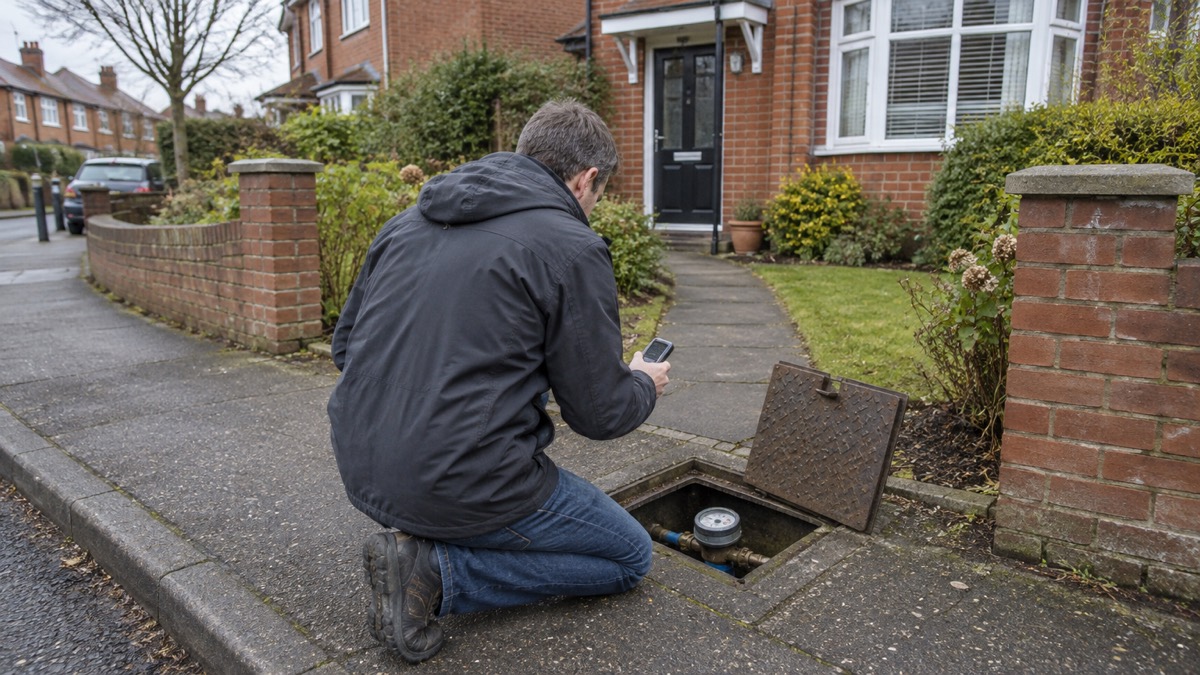
A hidden water leak can run quietly for weeks, pushing up your bill, dampening your home and weakening the ground under your drive. The quickest way to tell whether you have one, if your home has a water meter, is a simple two-reading test: turn off every tap and water-using appliance, read the meter including its red digits, use no water for 30 minutes or overnight, then read it again. If the second reading is higher, water is escaping somewhere between the meter and your inside stop valve, and you have a leak1.
What you do next depends on where the leak is. Leaks inside your home or within your property boundary are your responsibility to fix as the owner, or your landlord's if you rent3. Fixing a leak promptly matters for your pocket as well as your property: if you fix a leak within 30 days you may qualify for a leak allowance, which adjusts your bill for the water wasted4, and unattended leaking water can cause flooding and ground movement5.
Signs of a leak: what to look for before you touch the meter
Some leaks announce themselves, but many do not. Water companies and the independent WaterSafe register list the signs that point to a leak indoors, outdoors and underground, and they are worth checking for regularly rather than waiting for a bill to land1.
Outdoors and underground, the signs are often visible from the garden or the pavement. Wet or damp patches in the garden during dry weather are a classic indicator, as are cracks in paving, potholes or sinkholes appearing, dirt or air in your water, and a noticeable reduction in water pressure1. A patch of greener, faster-growing grass on the lawn can mark the line of a leaking pipe below, and a damp patch on the ground outside may mean a leak under your driveway9. Areas of unusually lush vegetation, or oddly reduced vegetation, can both point to water escaping where it should not be9.
Indoors, watch for damp or mouldy spots, noisy pipes or low water pressure10. Damp patches on walls, floors or carpets, mould on ceilings and walls, and a constant noise of flowing water from the pipes all suggest water is going somewhere it should not9. A drip or damp patch anywhere in the home is reason to investigate further11. If you are on a meter, an unexpected increase in usage, or a bill that has risen without you knowingly using more water, is often the first sign1.
| Where | Signs to look for |
|---|---|
| Garden and lawn | Wet patches in dry weather; greener, faster-growing grass; lush or oddly reduced vegetation1 |
| Driveway and paving | Damp patches; cracks in paving; potholes or sinkholes1 |
| Inside the home | Damp or mouldy spots; damp patches on walls, floors or carpets; noisy pipes; low pressure9 |
| At the tap | Dirt or air in your water; reduced pressure1 |
| On your bill | Higher usage or a bill increase without knowingly using more water, if metered1 |
If you are not on a meter, the bill will not warn you, so the physical signs carry more weight: loss of pressure, rust, damp patches, mould, and the constant sound of flowing water are the ones WaterSafe highlights for unmetered homes9.
How to tell if you have a water leak using your meter
The meter test is the most reliable check a household can do without a plumber, and every water company describes a version of it. The principle is the same everywhere: if water is passing through the meter when nobody in the house is using any, it is escaping somewhere on your side of the meter.
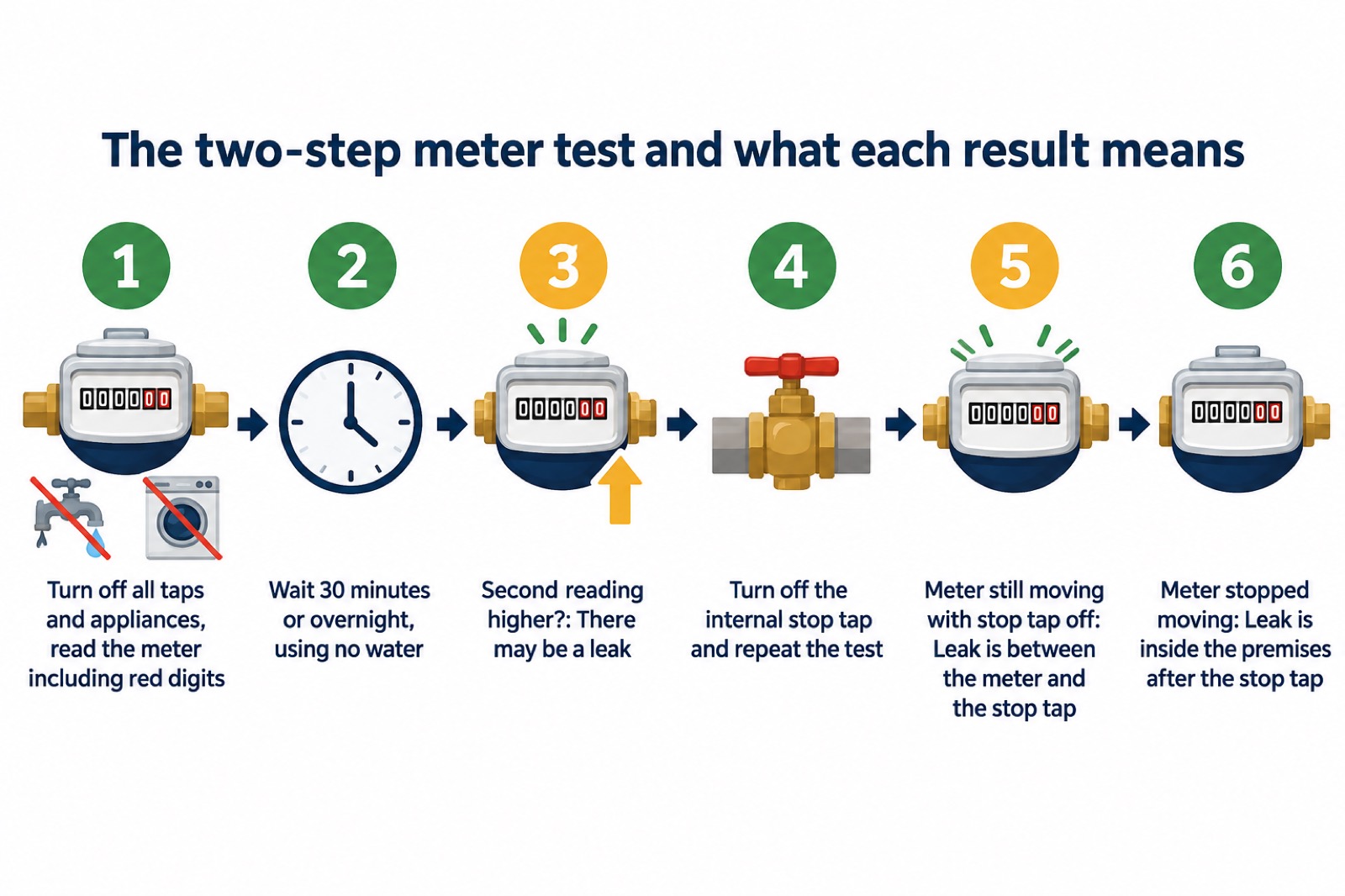
The basic test, for metered customers, runs as follows1:
- Turn off all taps and water-using appliances in the house.
- Take a meter reading, making sure you read all the digits and dials, including the red digits13.
- Use no water for a set period. You can wait 30 minutes, or leave it overnight or while you are out for the day1.
- Take a second reading. If the second reading is higher than the first, there may be a leak1.
A 30-minute wait with no water used is enough: take a reading, wait 30 minutes, take another, and if the reading has changed you have a leak2. A longer window, such as overnight, gives a clearer result for slow leaks and is what several companies recommend1.
Narrowing it down: inside or out?
One reading tells you that water is escaping. A second step tells you roughly where. Turn off your internal stop tap and repeat the test. If the meter dials still move with the stop tap closed, the leak is between the meter and the internal stop tap, on the supply pipe under your drive or garden15. If the meter has stopped moving, the leak must be inside the premises after the stop tap, and you are responsible for locating and repairing it12.
Some companies set this out as a two-part test. If the meter reading is higher after the first part but not the second, the leak is on your private pipework, which is the homeowner's responsibility to fix4. If the reading is higher after both parts, contact your water company so it can work out whether the leak is on its pipes or on private pipes17.
If you have a smart meter, the same logic applies with less effort: smart meters let you monitor water use and quickly identify issues or leaks18, and you can track your usage through your water company's online account, where unexpectedly high readings suggest you have a leak10.
Finding your water meter and reading it safely
You will usually find your meter in your kitchen or bathroom, under the driveway or path outside, or in the road13. If you are not sure where it is, your online account with your water company will show its location13.
When you read it, take in all the digits and dials, not just the main numbers. The red digits record the smallest volumes and are the ones most likely to move during a short test, so companies specifically tell you to include them13. A slow leak may barely shift the black digits in 30 minutes but will show in the red ones.
If the meter itself is leaking, contact your water company rather than attempting any repair: the meter is its equipment6. And if the meter has stopped moving during a leak test, that tells you the leak is inside the property after the stop tap, which is yours to locate and repair12.
Checking inside the home: toilets, loft tanks and appliances
If the meter test points indoors, or you want to rule out the easy wins first, work through the fittings that leak most often. Toilets are the classic hidden leak because the water runs straight down the pan: official preparedness guidance for drought conditions tells households to check the toilet and other household appliances for leaks, because these can sometimes go unnoticed19.
A toilet leak can be checked without any kit. Dry the back of the bowl with tissue, do not flush, and after 30 minutes place a leak detection strip, which some water companies will post to you free, then check back in a few hours3. A leaking overflow pipe may indicate a problem with the float valve, so a constantly running overflow is a fault to get fixed14.
Work through the rest of the plumbing in a logical order:
- Toilets: check for leaks into the pan and for a faulty float valve3.
- Loft tank: if you have a tank in the loft, check the ball valve to make sure it is not running constantly3. Overflows from a water tank or cistern in the loft are a common source of lost water9.
- Appliances: pull out water-using appliances such as the dishwasher or washing machine and check for visible water trickling from pipes or connectors3. Poorly plumbed appliances are another common leak source9.
- Outside taps: check them for drips and leaks9.
- Stop tap: make sure the water is off by turning the kitchen tap on until the water stops. If water continues, the internal stop tap may not be fully off, or it could be faulty and need replacing17.
Knowing how to shut the water off quickly is part of the same job. Your stop tap is usually where the water supply comes into the home, or outside near the property's boundary under a cover20. Fire and rescue services and councils, in their winter advice, all make the same point: check that you know where your stop tap is located in case a pipe bursts21, and the Met Office's WeatherReady campaign advises the same so you can cut off the water supply23. Our guide to stop taps covers finding and using both the inside and outside valves, and what to do if a pipe bursts takes over if a leak becomes a flood.
Supply pipe leaks between the boundary and your stop tap
The pipe that brings water from the mains to your home changes owner partway along its length, and the dividing line matters when there is a leak. The Drinking Water Inspectorate, the regulator for water quality in England and Wales, is clear on where responsibility falls: the part of the service pipe leading from the stop valve outside your property to the point where it enters your home is the responsibility of the owner, as is all the plumbing inside the home to the kitchen tap24.
In practice, that means the stretch of pipe under your front garden, driveway or path, from the boundary stop valve to the wall of your house, belongs to you. A leak there will usually show as a damp patch, a greener strip of grass, or a sinkhole, and the meter test with the internal stop tap closed will confirm it1.
Leaks on this stretch of pipe happen for reasons mostly outside your control. Water companies list ground movement caused by extreme weather or traffic, pipe corrosion, damage to pipes, faulty pipes and fittings, and simple pipe deterioration as the main causes3. Temperature changes throughout the year put pressure on the pipes in your home, which weaken as they expand and contract, making a leak or burst pipe more likely11. Internal pipework can burst especially during cold winter weather3. Our guide to frozen pipes covers the cold-weather side of this in detail.
Prevention is limited but real. Check that pipes are adequately lagged, particularly anywhere exposed to cold, and know where your stop tap is located21. A dripping pipe can push up water bills, damage your home and could mean a full burst is more likely, so fix leaks as soon as you can10.
Who repairs the leak: owners, landlords and the water company
Responsibility follows ownership of the pipe, and the rules are consistent across water companies.
If you own your home, leaks in your home or on your property are your responsibility to fix8. That covers everything from the boundary stop valve inwards: the supply pipe under your garden, the internal plumbing, and the fittings24. If the leak is on a private pipe, the owner is responsible for repair, though your water company will ensure it gets resolved26.
If you rent, repairs are the responsibility of your landlord, letting agent or housing association7. Tell your landlord as soon as possible if the home needs repairs; they must complete repairs within a reasonable time27. After a fire, similarly, it is the landlord's or building owner's responsibility to repair any damage to gas, electricity or water supplies28. If the leak has been ongoing for more than 60 days and repairs have not been scheduled, contact your water company, which can follow it up3.
| Your situation | Who repairs |
|---|---|
| You own your home | You, for leaks in the home or within your property boundary8 |
| You rent privately or from a housing association | Your landlord, letting agent or housing association7 |
| Leak on the water company's mains, in the street | The water company8 |
| Leak on a shared private supply pipe | The households that share it, jointly26 |
For a leak on your supply pipe outside your home, check with your water supplier as it may be able to help repair it; for a leak inside your property you will need to contact a plumber9. Some companies publish an approved plumber directory for exactly this3.
Shared supply pipes
Older properties, particularly terraces, sometimes share one supply pipe serving several homes. If you share a water supply with your neighbours, talk to them so you can work together to get it fixed26. Let your neighbours know they may have a shared responsibility to repair the leak, and tell them when the water supply is being turned off for the work25. Check whether you have insurance cover for your water supply pipe, for example through a plumbing and drainage policy; if the insurance does not cover leaks, you will have to fix the leak privately6.
Repair or replace: when an old supply pipe should be renewed
A leak on a supply pipe is not always a one-off. Leaks are a sign that your supply pipe is wearing out, and often repairing one leak may cause a leak on other parts of the pipe, especially for older pipes in poor condition26.
The age of the pipe is the key question. Supply pipes older than 30 years can be prone to developing further leaks, and in that case it may be cheaper and easier to replace the whole pipe rather than fix the leak29. When you get a plumber's quote for a repair, ask about the pipe's age and material and whether a full replacement is the better long-term answer.
One material deserves particular attention. If your supply pipe is old enough to be made of lead, the Drinking Water Inspectorate's guidance on lead in drinking water is the reference point, and replacing the pipe is the permanent solution24. Your water company can tell you what your pipe is likely made of.
If you do decide to fix the leak yourself rather than use a company scheme, tell your water company the details of the contractor you are using and the repair date29.
Leak allowance: fix within 30 days to have your bill adjusted
A leak allowance is an adjustment to your bill for the water a leak wasted, and the qualifying condition is time. If you find a leak and fix it within 30 days, you can apply for a leak allowance4. South Staffs Water puts the same rule as direct advice: if you have a leak on your property you should get it fixed within 30 days6.
One deadline can be shorter. If you have had a Leakage Notice from your water company, check the repair deadline on it: some are less than 30 days if a substantial amount of water is being lost12.
How the allowance is calculated varies in detail but follows a common pattern. The company agrees your average water use, compares it against the water used during the leak period, and clears the difference against the higher readings taken during the leak3. For metered customers, charges are adjusted back to the previous bill; for customers who have not previously received a bill, recalculated charges are back-dated to the beginning of the financial year16. If you are on a meter, apply for a leak adjustment to cover the cost of the water wasted by the leak25.
Claiming more than once
A second leak allowance is possible but harder to get. You will normally need to show all of the following: that you have been checking for leakage regularly and spotted the leak as early as possible, that the previous allowance was not within the last 5 years, and that you had it repaired quickly26. Regular leak checks, including the meter test above, are therefore worth doing not just to catch leaks early but to support any future claim.
Help with repair costs if you cannot afford them
Repairing a supply pipe can be expensive, and water companies run schemes that reduce or remove the cost for households that struggle. What is on offer differs by company, so the first step is always to contact yours and ask.
- Assisted pipe repairs: Cambridge Water may be able to assist with leak repairs at private household properties, subject to terms and conditions, and in some cases may contribute up to £300 towards the cost29.
- Leak Assistance Scheme: SES Water will locate and fix the leak, and if unable to repair it, will offer free and independent advice on what to do next25.
- Free leak detection: Southern Water offers a free leak detection service for up to an hour when you report a leak, which can help find burst or broken pipes outside your home, though the exact source cannot always be guaranteed16.
- Hardship and support tariffs: customers on a support tariff, or struggling to get a repair, can contact their water company for further assistance3. South East Water says it may be able to assist customers who cannot afford to repair a private leak3.
- Insurance: check your household insurance, as the repair might be covered15. Some households hold separate plumbing and drainage cover, for example through HomeServe, which can be called on for supply pipe repairs3.
Catching issues early could save you up to £300 a year, Affinity Water notes, which is a further reason to run the meter test now and then rather than waiting for signs11.
Reporting a leak and what to tell your water company after the repair
Report a leak on your property to your water company as soon as you are aware of it. South Staffs Water, for example, will visit, identify whether there is a leak and advise how best to proceed6. Many companies take reports through an online account or portal3. When you find a leak, fix it fast: the longer you leave it, the more damage it can cause to your property and the water supply, and on a meter it can increase your bill1.
Leaks you spot away from home, in the street or on the footpath, are the water company's problem and it wants to know: report it online so it can be investigated, and check whether it has already been reported8. Cumberland's winter-ready advice makes the same point: if you spot a leak when you are out and about, let the water company know so it can fix it30. More generally, if you identify an issue with the water supply, alert your water company, and make sure you know the emergency supply number for your water company31. Our water in an emergency guide covers supply interruptions and what to keep ready.
After the repair
Once the leak is fixed, tell your water company so it can update its records7. Give it three things: the date of the repair, who repaired the leak, and a meter reading following the repair3. Take that reading immediately after the repair is finished; your contractor can do this for you, and the reading is needed to process any leak allowance16.
If you are on a monthly payment plan, it will normally continue at the same amount you were previously paying while the company carries out its investigation3. Some companies place your account on hold once they are aware of a leak and will not bill you until it is resolved3. Ask yours which applies when you report.
What to do now: a short checklist
- Walk round the house and garden and look for the signs: damp patches, greener grass, cracks in paving, mould, noisy pipes1.
- Run the meter test: two readings, 30 minutes or overnight apart, no water used in between1.
- If the reading has moved, turn off the internal stop tap and repeat to narrow the leak down15.
- Check the toilet, loft tank ball valve, appliance connections and outside taps3.
- Report the leak to your water company and, if you rent, to your landlord6.
- Get it fixed within 30 days, and take a meter reading straight after the repair6.
- Apply for a leak allowance and ask about repair assistance schemes4.
If a leak turns into a burst, the priorities change: turn off the water at the stop tap, and follow our guides on burst pipes and frozen pipes. If your home floods, tell your landlord as soon as possible if you rent, as they must complete repairs within a reasonable time27, and see our flooding guide for the wider response.
Sources (31)
- Identifying leaks at home, Thames Water
- Drought risks and checks, Wiltshire and Swindon Prepared
- Customer side leaks, South East Water
- Self leak test, Essex & Suffolk Water
- Leaks on your property, Cambridge Water
- Leaks FAQs, South Staffs Water
- Leaks at home, Thames Water
- Help with leaks, Essex & Suffolk Water
- How do I know if I have a leak in or around my home, WaterSafe
- Cold weather and water pipe responsibility, South West Water
- Home leaks, Affinity Water
- Help with leaks, Bournemouth Water
- Water meter leak test, Northumbrian Water
- Leaks in your home, South Staffs Water
- Help with leaks, South West Water
- How to find and fix leaks in your house, Southern Water
- Self leak test, Northumbrian Water
- Drought advice, Westminster City Council
- Be informed about hazards: droughts, Prepare Campaign
- Prepare yourself, Greater Manchester Combined Authority
- Seasonal winter safety advice, Suffolk Fire and Rescue Service
- Keep warm in winter, Derbyshire County Council
- WeatherReady, Met Office, 2018-11-20
- Lead in drinking water, Drinking Water Inspectorate, 2026-05-01
- Noticed a problem: leaks, SES Water
- Leaks FAQs, Bournemouth Water
- Housing help if your home is flooded, Somerset Council, 2026-06-04
- After an incident: fire, Devon & Somerset Fire and Rescue Service
- Assisted pipe repairs, Cambridge Water
- Snow, ice and winter ready advice, Cumberland Council
- Loss of essential services, Lancashire Resilience Forum
 Home Fire Safety Checklist
 Bedtime Fire Safety Checks
 Fire Risk Checks for Carers
 What to Do If Fire Starts
 How to Make a Fire Escape Plan
 Fire in a Block of Flats
 Kitchen Fires and Cooking Safety
 Electrical Fires and Sockets
 Smoking, Matches and Lighters
 E-bike Charging Safety
 Hoarding and Fire Risk
 Thatched Properties Fire Risk
 Fireworks and Bonfire Safety
 What to Do After a House Fire
 How Fire Services Respond