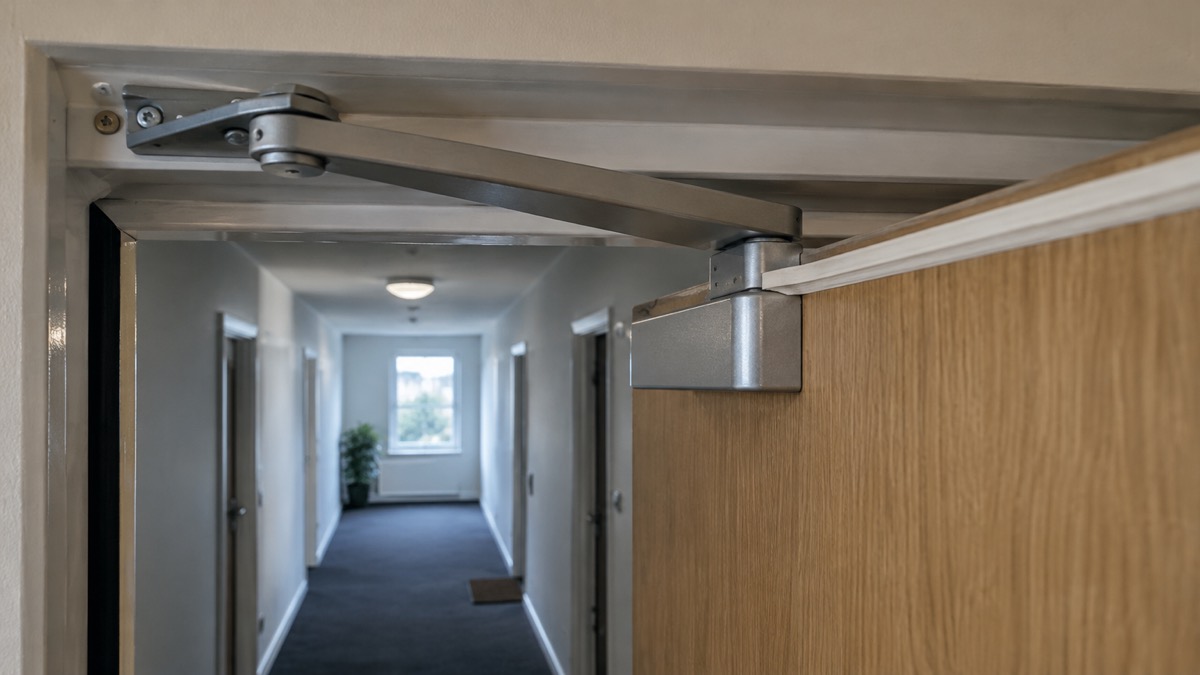
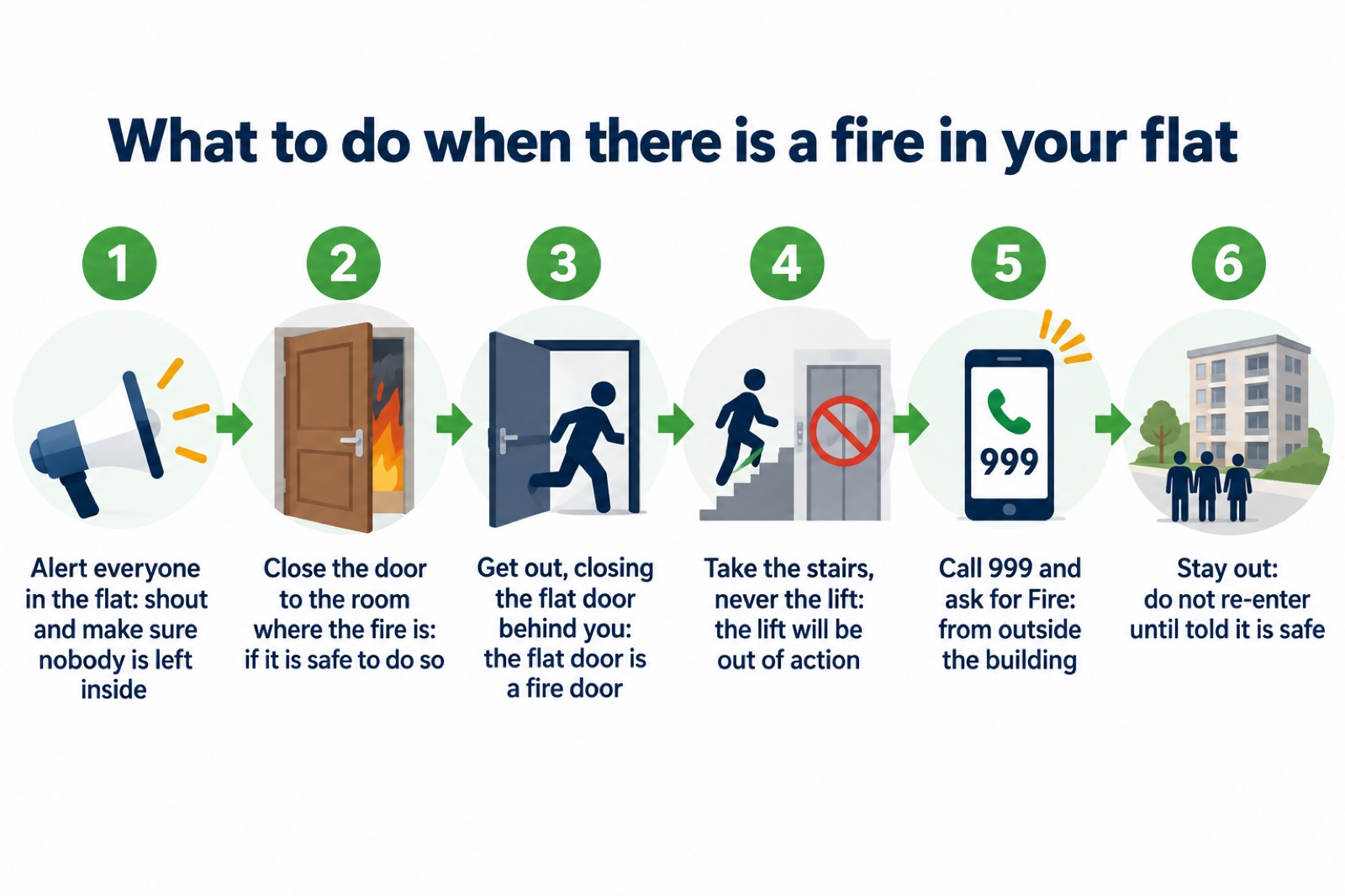
If a fire starts inside your flat, the advice from fire and rescue services is the same across the UK: alert everyone in the flat, close the door to the room where the fire is, get out making sure the flat door closes behind you, and call 999 and ask for Fire1. Use the stairs, never the lift, and do not stop to collect anything on the way1. Once you are out, stay out.
If the fire is somewhere else in the building, the advice is different and this is where many flat residents get it wrong. Blocks of flats are designed so that a fire in one flat is contained there, and in most cases you should not need to leave your own flat because of a fire in another part of the building1. But you should still call 999 yourself, never assuming someone else has, and you must leave if heat or smoke affects your flat or if firefighters tell you to2.
What your block's own evacuation strategy is matters too. Some blocks operate a "stay safe" or "stay put" policy, others a full evacuation strategy, and your landlord or managing agent should have told you which applies to your building3. This page sets out what to do in each situation, what never to do, and how to deal with blocked escape routes and other fire safety problems in the shared parts of your block.
Fire in your own flat: get out, close the door, call 999
A fire inside your own flat is the one situation where you always leave, whichever strategy your building operates. Manchester Fire and Rescue Service's advice for residents of flats is to work through these steps in order1:
- Alert anyone else in your flat. Shout, bang on doors, make sure everyone knows, including anyone asleep or in the bathroom.
- Close the door to the room where the fire is, if you can do so safely. A closed door holds back fire and smoke and buys time.
- Get out of your flat, making sure the flat door closes behind you. The flat front door is a fire door and is part of what protects your neighbours and the communal corridor.
- Call 999 and ask for Fire.
- Leave the building using the stairs if you can.
Other services give the same sequence in slightly different words. Cheshire Fire and Rescue Service sums it up as "Get out, stay out and call 999"2, and North Wales Fire and Rescue Service gives the same three actions for a fire in your flat or a neighbour's flat: leave, close the door, use the stairs, call 9994. Lincolnshire Fire and Rescue adds that when a fire is contained within a single flat, the occupants should evacuate closing doors behind them, leave via the stairs, and call 999 as soon as they are in a place of relative safety9.
Where the fire blocks your way out, or smoke is already thick, the sequence changes: keep low if there is smoke, and if you cannot get out at all, move to the safest room and call 999, as covered below. If your building operates a full evacuation strategy, Manchester Fire and Rescue Service also advises activating any manual alarm points on your way out and staying on the phone to the control room while you evacuate, keeping left on the stairs3.
What not to do when your flat is on fire
The list of things not to do is short and every item on it is there because people have died doing it. Fire and rescue services are blunt about this.
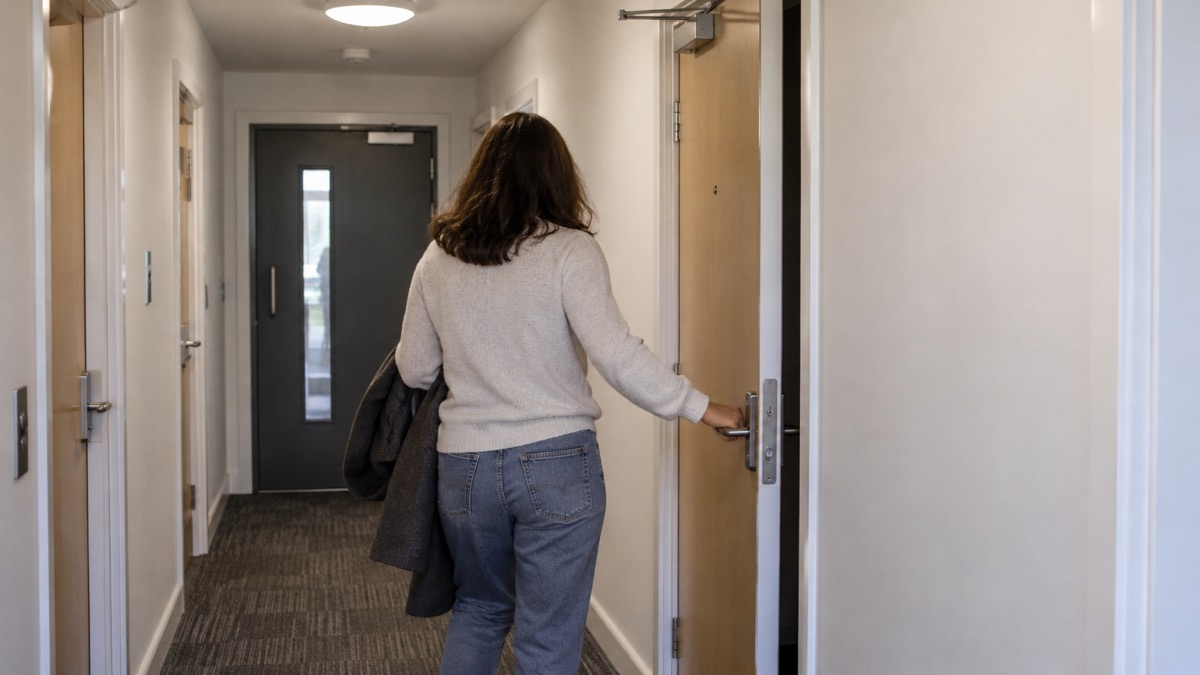
Manchester Fire and Rescue Service gives that list in full for residents of flats with a fire or smoke in their flat1, and its advice for blocks operating an evacuation strategy adds: "You should never try to fight the fire yourself"10. Essex Prepared puts the reasoning plainly: "Don't tackle fires yourself. Leave it to the professionals. Get out, stay out, call 999"7. Cheshire Fire and Rescue Service also warns against stopping to investigate the fire as well as collecting belongings2, and Essex Prepared adds: "Don't waste time investigating what's happened or rescuing valuables"7.
Two points deserve emphasis for flat residents specifically. First, a small fire can look manageable and turn fatal in the time it takes to fetch water or an extinguisher; the fire service would rather arrive to a small fire than to a person overcome by smoke. Second, going back in is not only a risk to you: an opened flat door feeds the fire with air and can undo the containment the building is designed for. London Fire Brigade's instruction on calling 999 is simple: "If there's a fire in your house or flat, get out and call us. Don't go back in for any reason"6.
Cooking fires deserve a special mention because cooking accidents are the main cause of fires in the home7. A pan fire on your hob is still a fire in your flat: the steps above apply, not an attempt to carry a burning pan outside. Our page on kitchen fires covers prevention, and how to put out a chip pan or saucepan fire covers the one situation where the official advice on tackling a pan fire yourself is set out in full.
Use the stairs, not the lift
In a fire, always leave by the staircase and never use the lift. North Yorkshire Fire and Rescue Service's instruction for residents of high rise buildings is "Exit using the stairs, do not use the lift"11. Fire safety guidance for high rise flats gives the same instruction: "If you have to leave the building, always use the staircase and never use the lift"12.
The reason is practical. Oxfordshire's emergency preparedness guidance explains that in a flat, the lift will be out of action in a fire, so your escape plan should be a route that does not require one, and you should regularly check that you can open the fire and security doors on that route5. The same guidance applies when a whole block or building is evacuated: use the stairs to make your way out of the building, never the lift.
This has a planning consequence before any fire happens. Know your stair route from your flat to ground level, and check regularly that you can open the fire and security doors along it5. If you would struggle with the stairs, because of mobility, age or a young family, that is worth discussing with your housing provider now, not during an emergency: your building's evacuation strategy and any personal plan for you should account for it. Suffolk's home fire safety guidance also advises avoiding balconies as a way out during a fire13.
The stairs only work if they are clear, which is where every resident has a part to play. Manchester Fire and Rescue Service instructs residents not to obstruct the communal areas, stairs, corridors and landings, because these are the building's escape routes14. The London Fire Brigade's easy-read fire safety booklet makes the same point: keep communal corridors and staircases free from clutter, keep your balcony clear of anything that might cause a fire, and report any damage to firefighting equipment to your housing provider15.
Call 999 as soon as you are clear of the building
Call 999 as soon as you are out and safe. Mid and West Wales Fire and Rescue Service's advice is: "When you are out of the building, find a phone and call 999, and remember to keep calm and speak clearly"12. The London Fire Brigade's easy-read booklet says the same: as soon as you are safely outside, use your mobile phone to dial 999, ask for the fire brigade, give the address, and do not go back inside15.
Give the control room what they need: the full address of the block, your flat number, and what is on fire. If you were in the flat where the fire started, Manchester Fire and Rescue Service asks residents to tell firefighters where your flat is, where the fire started and what is on fire10. If you cannot get out and are calling from inside, tell the operator your flat number, how many people are with you, and that you cannot leave, then follow their advice2.
One habit worth building now: never assume someone else has called. North Wales Fire and Rescue Service's instruction for a fire elsewhere in your building is "Call 999 - Never assume someone has called"4, and the Northern Ireland Fire and Rescue Service gives the same warning for a fire inside your flat: call 999, never assume someone else has16. Control rooms would far rather take ten calls about the same fire than none. Our page on how fire and rescue services respond to a call explains what happens after you dial.
If you are deaf or cannot use a voice phone, register in advance for the emergency SMS service so you can text 999; this is worth doing before you need it, not during a fire.
If you cannot get out: one room, a window and a phone
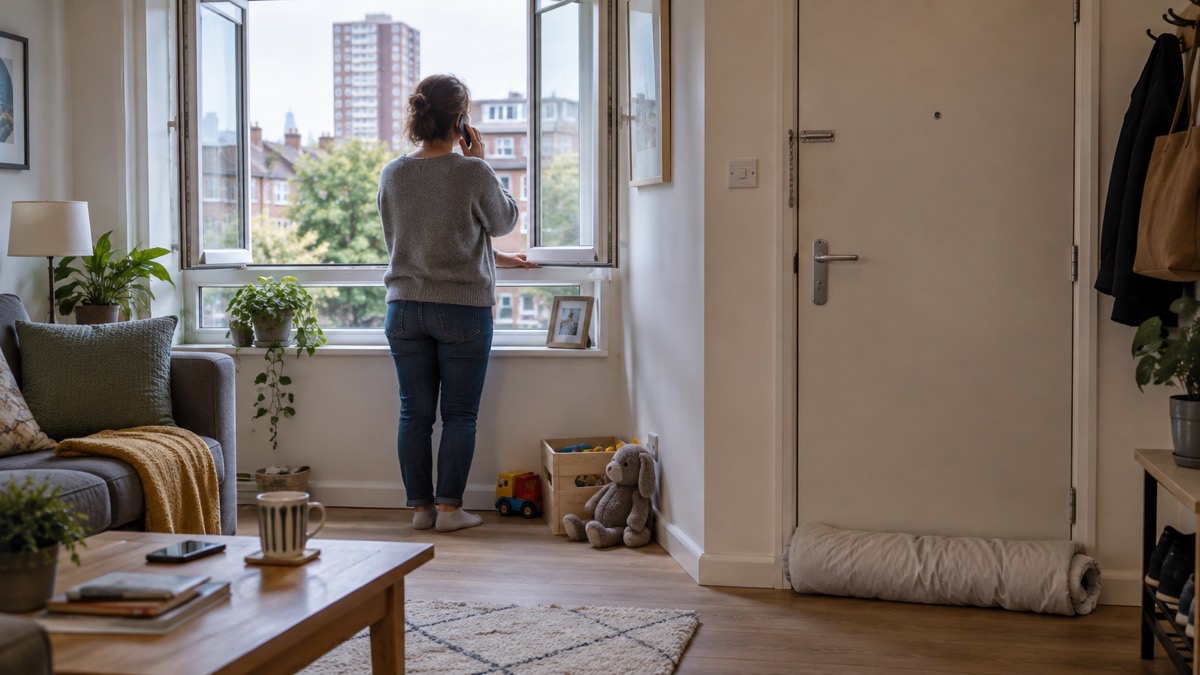
If your escape route is blocked by fire or smoke, the advice is to gather everyone into one room, ideally with a window and a phone7. Dorset and Wiltshire Fire and Rescue Service advises choosing a room whose window opens easily and, if possible, has a phone for calling 99917.
Once everyone is in the room:
- Close the door and keep it closed. Block the gap at the bottom with towels or bedding to stop smoke getting in1.
- Call 999 and tell the operator you cannot leave your flat, and why3.
- Open the window and, if you have no phone, shout for help2.
- Shout "HELP FIRE" so neighbours and arriving crews know where you are13.
Suffolk's home fire safety guidance gives the full sequence: get everyone into one room with a window and a phone, put bedding around the bottom of the door, call 999, then open the window and shout "HELP FIRE"13. The Scottish Fire and Rescue Service's high rise advice is similar if the fire is not in your flat and you cannot leave: go to a window and wait for help18. Our page on what to do if you cannot escape a fire covers this situation in more detail.
Do not break the window entirely unless you must: a broken window can draw smoke toward you, and an opened window is usually enough to signal from. Follow the 999 operator's instructions, stay calm, and stay where you are until firefighters reach you; they are trained to search every flat.
Stay Put: what the advice for blocks of flats means
Many blocks of flats operate what fire services call a "stay put" or "stay safe" policy, and it is widely misunderstood. It does not mean ignore fires, and it does not apply to the flat where the fire is.
Warwickshire's guidance for high rise residents sets out what it means: the building is designed to contain a fire in the flat where it started, and only those in the flat where the fire has started, flats affected by smoke or heat, or those directed by the fire service leave19. Surrey's guidance gives the same core rule: if a fire starts within a flat, everyone in that flat should be alerted, make their way out of the building and call the fire and rescue service20. Manchester Fire and Rescue Service puts it as a pair: if there is a fire in your flat you should leave the flat and the building; if there is a fire somewhere else in the building, you can remain in your flat and do not need to leave1.
If you live in a block where your landlord has advised you to stay put, Dorset and Wiltshire Fire and Rescue Service explains that this is the landlord's advice, based on an individual fire risk assessment for that building21. That matters because the strategy is building-specific: a block with a full evacuation strategy will expect everyone to leave when the alarm sounds, and Warwickshire's advice for such buildings is to evacuate immediately and calmly when the fire alarm sounds in your flat22. Find out which strategy your block uses before you need it.
If you are staying put because of a fire elsewhere, North Yorkshire Fire and Rescue Service advises closing your doors and windows and staying in your flat unless advised by the fire service11. And the stay put policy always has limits, stated the same way by every service: if fire, heat or smoke begins to affect your flat, or you feel unsafe, get out if you can and call 999, and you should always evacuate if asked to do so by firefighters8.
"You should always evacuate if asked to do so by firefighters."
Fire in another flat or elsewhere in the building
When the fire is not in your flat, your first action is the same as ever: call 999 yourself. North Wales Fire and Rescue Service is explicit: "Call 999 - Never assume someone has called"4. Lincolnshire Fire and Rescue adds that even occupants of a flat unaffected by the fire should still call the fire service for advice and to make sure they have been mobilised, and should prepare to evacuate9.
Then follow your building's strategy. Cheshire Fire and Rescue Service explains that in most cases, if there is a fire elsewhere in your building, your flat should be designed to provide you with appropriate protection, and you should consider staying safe where you are unless the fire, heat or smoke begins to affect you23. Lincolnshire's guidance is that if there is a fire in another part of the block it is usually safer to remain in your flat unless affected by heat or smoke9. Manchester Fire and Rescue Service states it most directly: if there is a fire in another part of the building, you should not need to leave your flat or the building1.
Know how alarms work in your block, because this catches people out. Dorset and Wiltshire Fire and Rescue Service explains that each flat has its own stand-alone detection and alarm, which alerts the occupants of the affected flat, and that this alarm will not normally be linked to any other area of the block21. So you may hear nothing at all when a fire starts two floors down, which is another reason to call 999 the moment you see or smell smoke, and never to assume a quiet building means a safe one.
If you hear a neighbour's smoke alarm, Manchester Fire and Rescue Service advises: don't ignore it, alert the resident, and if they don't respond, call 999 and ask for Fire24.
Who is responsible for fire safety in the shared parts
Fire safety in the communal areas of your block is not your responsibility to fix, but it is your responsibility to report. Dorset and Wiltshire Fire and Rescue Service advises that if you have a fire safety concern in your building, you should contact the person responsible for fire safety, which could be the owner, the landlord, the residents' committee, the housing provider or the managing agent25. If you rent, your landlord has legal obligations under the Fire Safety Order and the Housing Act for areas shared with other tenants26.
The Fire Safety (England) Regulations introduced new legal requirements to ensure the safety of residents living in blocks of flats, and in all multi-occupied residential buildings the responsible person for fire safety must provide residents with relevant fire safety instructions27. So if you have never received fire safety information for your block, ask for it: providing it is a legal duty, not a courtesy. Your housing association or building management team can give you specific advice on how and when to evacuate your flat23.
Fire doors are a particular shared responsibility. The London Fire Brigade explains that in a block of flats you will find fire and smoke doors on the stairwells, the corridors and on the flat front doors, and that your landlord or building owner has legal responsibility for the fire doors in the common areas of the building28. Report damage to fire doors to your housing provider or managing agent8.
What to report, and what not to do, from Manchester Fire and Rescue Service's advice on keeping your building safe8:
- Do not obstruct communal areas, stairs, corridors and landings.
- Do not prop open fire doors in communal areas.
- Do not store prams, bikes or mobility scooters in corridors.
- Check before doing any work in your flat that it will not affect fire safety.
- Allow access for your flat's front door to be checked.
- Report damage to fire doors and firefighting equipment promptly.
If you get nowhere with the responsible person, you can escalate. Dorset and Wiltshire Fire and Rescue Service asks tenants to email its fire safety helpdesk to report concerns about shared areas, and notes that in some cases concerns are passed to the local authority, which is the lead authority for houses in multiple occupation and blocks of flats26. Other services have similar routes: your local fire and rescue service's website will have a fire safety concern or protection team contact. The Northern Ireland Fire and Rescue Service also asks residents never to tamper with internal fire mains inlets on landings, to report a vandalised or damaged riser immediately, never to use or store gas cylinders in high rise flats, and never to park so as to block access for fire engines16.
Smoke alarms, and children who may not wake
Your own flat needs its own alarms, whatever the block has. Warwickshire's guidance for high rise residents is to fit at least one smoke alarm in your flat, fit a heat alarm in the kitchen and nothing in the bathroom because of false alarms, test alarms once a week, never take the batteries out, and always follow the manufacturer's advice19. If your alarm doesn't work, contact your housing association or building management to get it repaired23. If it goes off by mistake, do not take out the batteries: just wait for it to stop24. Our guides to smoke alarms and heat alarms cover choosing and placing them.
In Scotland the rules are set in law. The Scottish Government's guidance on fire and smoke alarms explains that in a shared property like a tenement or block of flats there is no need for alarms in different properties to be linked to each other29, so your flat's alarm protects your flat and no one else's. In shared ownership with a housing association, it is generally the proportion owner's responsibility, rather than the registered social landlord, to meet the alarm standard29.
One warning that every household with children should take seriously:
The government's fire safety advice for parents and child carers gives the same warning30, and Suffolk's home fire safety guidance repeats it13. In practice this means your escape plan should assume an adult goes to each child rather than relying on the alarm to wake them. The government's advice for parents and child carers is: if there's a fire, raise the alarm without investigating, get everyone up and out of the building, call 999 and stay outside and wait for the fire and rescue service31. Keep matches, lighters and candles out of reach of children24.
Childminders working in a flat
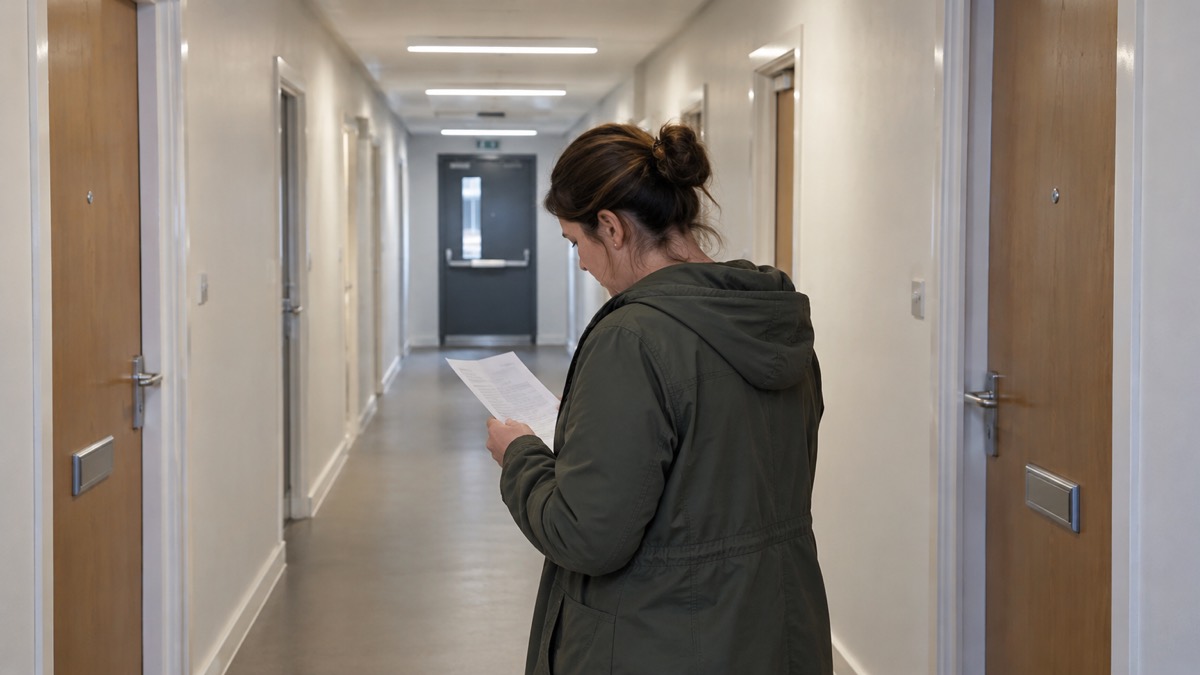
If you look after other people's children in your home, the law goes further. Dorset and Wiltshire Fire and Rescue Service explains that a childminder who looks after children in their home must comply with the Regulatory Reform (Fire Safety) Order, which requires a fire risk assessment of the home, recording and acting on any significant findings, and reviewing it if anything changes, such as looking after younger children31. The fire and rescue service can be contacted for advice but will not do the assessment for you, and you should not need to employ a specialist unless your house is very large and complex31.
Fire extinguishers in communal areas
Many residents worry that their block's corridors have no extinguishers. This is usually correct and not a fault. Dorset and Wiltshire Fire and Rescue Service explains that you would not usually see firefighting equipment in the communal area of flats, because those areas do not contain anything which could catch fire25. The design principle is the opposite of what intuition suggests: a bare, empty corridor is a safe corridor, which is why clutter, storage and propped-open doors are the real hazards.
Where a building does have firefighting equipment, the law sets conditions on it. Under the Regulatory Reform (Fire Safety) Order, the responsible person must ensure the premises are equipped with appropriate firefighting equipment where necessary, and that any non-automatic equipment is easily accessible, simple to use and indicated by signs32. If equipment in your block is damaged, missing or blocked in, report it to your housing provider or managing agent15. Our page on fire extinguishers and fire blankets covers what to keep in your own flat, though the standing advice remains: never try to fight a fire yourself10.
Getting help and information before a fire
The best time to learn your block's fire plan is now. Surrey's guidance is that if you live in a block of flats, make sure you are familiar with the escape plan or strategy for your building in the event of a fire, and that the managing agent or building owner should provide this information20. Warwickshire's advice for high rise residents adds: report any fire safety concerns or maintenance issues to building management promptly22.
Some services publish material specifically for flat and high rise residents. Cheshire Fire and Rescue Service has produced resident fire safety videos in two versions, one explaining advice for blocks operating a stay safe policy and one on how residents should evacuate a residential block in the event of fire, including making an escape plan, what to do and where to go27. The Scottish Government published an information leaflet in December 2019 giving residents of high rise buildings information on how to prevent fires and what to do if there is a fire33. Mid and West Wales Fire and Rescue Service advises high rise residents to know their escape route and what to do if there is a fire inside their home or somewhere else in the building12, and to ensure cigarettes are put out and disposed of carefully4.
High rise blocks themselves are designed with fire safety in mind: Dorset and Wiltshire Fire and Rescue Service explains that roads and areas outside are designed so emergency vehicles can get near, and walls, doors and floors are designed to resist fire and stop the spread of smoke34. That design only works if residents keep escape routes clear and doors closed, which is why the reporting duties above matter as much as the escape steps.
For the wider picture, see our fire safety checklist for flats, our guide to making a fire escape plan, and what to do after a fire, including the fact that you may not be able to re-enter your flat for a few hours and will not be able to use the lift1.
Sources (34)
- Fire safety information for residents living in flats operating a Stay Safe policy, Manchester Fire and Rescue Service
- High rise homes, flats and apartments, Cheshire Fire and Rescue Service, 2026-05-20
- What is your building's evacuation strategy?, Manchester Fire and Rescue Service, 2026-10-29
- High rise living, North Wales Fire and Rescue Service, 2026-10-25
- Be prepared for an emergency, Oxfordshire County Council
- Calling 999, London Fire Brigade, 2026-10-25
- Fire: protecting your family, Essex Prepared, 2026-10-29
- Flat fire safety: Stay Safe policy (over 18m), Manchester Fire and Rescue Service, 2026
- Flats and high rise buildings, Lincolnshire County Council, 2026-10-29
- Fire safety information for residents living in flats operating an evacuation strategy, Manchester Fire and Rescue Service, 2026-10-29
- High rise building safety, North Yorkshire Fire and Rescue Service, 2026-07-07
- Fire safety in high rise flats, Mid and West Wales Fire and Rescue Service, 2026-10-29
- Fire safety in the home, Suffolk County Council, 2021-11
- What you can do to help keep your building safe, Manchester Fire and Rescue Service, 2026-10-29
- Easy read fire safety booklet, London Fire Brigade, 2026
- Home fire safety, Northern Ireland Fire and Rescue Service, 2026-10-14
- What to do if you have a fire, Dorset and Wiltshire Fire and Rescue Service, 2026
- High rise safety, Scottish Fire and Rescue Service, 2026-03-09
- High rise buildings, Warwickshire County Council, 2026-10-29
- Evacuation strategy, Surrey County Council, 2026-10-28
- FAQs about safety in high rise premises, Dorset and Wiltshire Fire and Rescue Service, 2024-09-03
- Fire safety advice for residents in high rise buildings, Warwickshire County Council, 2026-10-29
- Flats and apartments, Cheshire Fire and Rescue Service, 2026-06-11
- Fire safety advice in your flat, Manchester Fire and Rescue Service, 2026-10-29
- Fire safety in flats and high rise buildings, Dorset and Wiltshire Fire and Rescue Service, 2026
- Tenants: fire safety, Dorset and Wiltshire Fire and Rescue Service, 2026
- High rise fire safety videos for residents, Cheshire Fire and Rescue Service, 2024-03-22
- Fire doors, London Fire Brigade, 2026-10-25
- Fire and smoke alarms in Scottish homes: what the alarms must have, Scottish Government, 2024-08-14
- Fire safety for parents and child carers, HM Government, 2022-05-25
- Fire safety for parents, child carers and babysitters, Dorset and Wiltshire Fire and Rescue Service, 2021-01-04
- Fire extinguishers, Warwickshire County Council, 2026-10-29
- Home fire safety policy, Scottish Government, 2019-12
- Living in high rise flats, Dorset and Wiltshire Fire and Rescue Service, 2023-09-21
 Home Fire Safety Checklist
 Bedtime Fire Safety Checks
 Fire Risk Checks for Carers
 What to Do If Fire Starts
 How to Make a Fire Escape Plan
 Kitchen Fires and Cooking Safety
 Electrical Fires and Sockets
 Smoking, Matches and Lighters
 E-bike Charging Safety
 Hoarding and Fire Risk
 Thatched Properties Fire Risk
 Fireworks and Bonfire Safety
 What to Do After a House Fire
 How Fire Services Respond
 Alarms for Deaf People