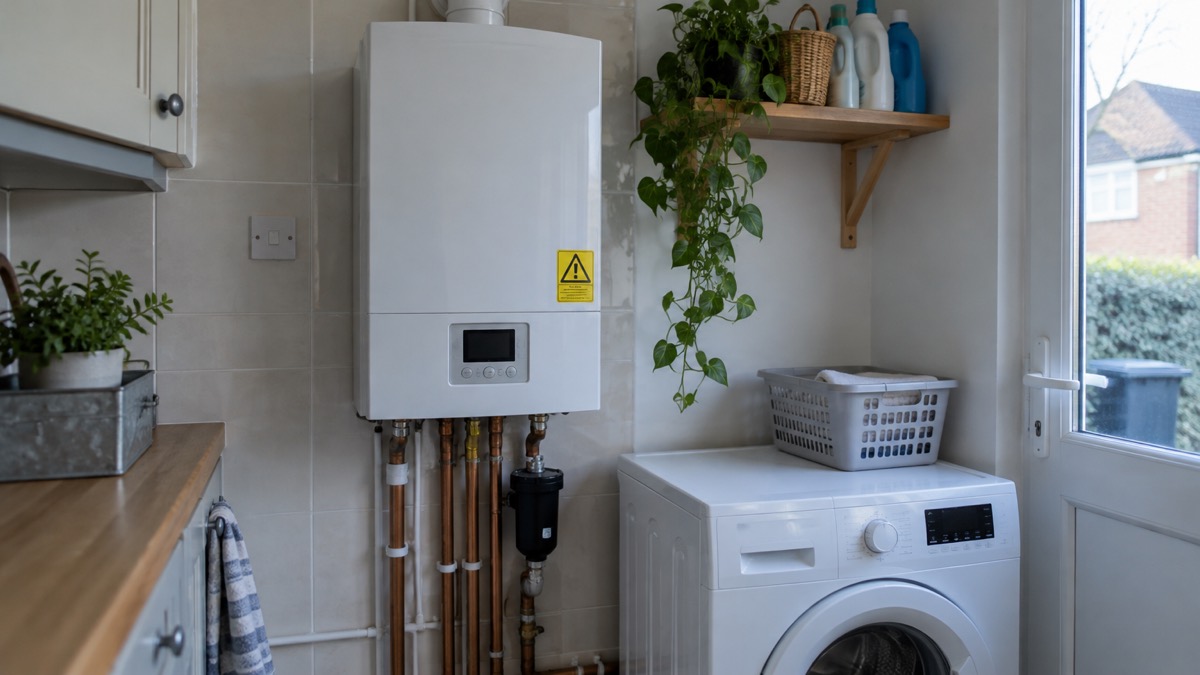
If your Ideal Logic Max Combi2 has stopped and the display is flashing a letter and a number, start with the code. Ideal Heating's fault code list gives a meaning and an action for each one, and several are things a household can check without tools: a flashing L and 1 means check that all radiator valves are open, L and 2 means check the gas meter has credit, and F and 1 means the water pressure needs topping up to between 1 and 1.5 bar1. A flashing L and 5 is cleared by turning the power to the boiler on and off again to reset it1.
The second thing to check is the pressure gauge. Ideal Heating gives the correct boiler water pressure as 1 to 1.5 bar, and that is the figure to fill to when the system is cold2. If the gauge is in that band and the boiler still will not fire in freezing weather, suspect the condensate pipe: water in it can freeze, the boiler shuts itself down to protect itself, and you may hear gurgling from the boiler or the pipe outside3.
Third, know what not to do. Never use a naked flame or blowtorch to thaw a frozen pipe, and do not attempt to thaw a condensate pipe you cannot reach from ground level4. Pour warm, not boiling, water over the pipe using a jug or watering can3. If you smell gas, that is a different emergency and you should not be working on the boiler at all.
Check the recall and safety notice before anything else
Before you troubleshoot a fault, check whether your boiler is covered by either of the two safety actions on Ideal Heating's Logic range. In February 2024 the Office for Product Safety and Standards published a recall of the Ideal Heating Logic 2 Combi and System boiler range, covering 30 boiler models produced before 8 January 2024, following three fire incidents and one report of a customer extinguishing flames6. Separately, Ideal Heating issued a safety notice in August 2022 requiring a thermostat upgrade on boilers made from August 2022 to 7 January 2024, covering ten boiler ranges across the Logic, iMini, Independent and Keston lines, to prevent a potential boiler overheat7.
Both notices turn on the model and the date of manufacture, so have your boiler's data plate and serial number to hand when you check. If your appliance falls within either notice, follow the maker's instructions for the recall or the thermostat upgrade rather than treating a fault code as an ordinary breakdown. A boiler that has overheated or shown signs of fire is not something to reset and carry on with.
Flashing L and F codes: what each one means and what to do
Ideal Heating publishes a table of fault codes for its boilers, each shown as a letter and a number flashing on the display, with a meaning and an action1. The codes divide into two groups. The L codes are mostly things a household can check or reset. The F codes are more often faults that need an engineer, though F and 1 is the exception, because it is simply low pressure.
| Code | What Ideal Heating says it means | What the maker says to do |
|---|---|---|
| L and 1 | Not listed as a fault; a check | Ensure that all radiator valves are open1 |
| L and 2 | Flame loss or ignition lockout | Check prepaid gas meter credit; if it still will not fire, call Ideal Heating quoting L21 |
| L and 3 | Not listed as a fault; a check | Turn the boiler off, bleed the radiators, confirm pressure is 1 to 1.5 bar, turn it back on1 |
| L and 5 | Not listed as a fault; a reset | Turn the power to the boiler on and off again to reset1 |
| L and 6 | Not listed as a fault; an engineer job | Call Ideal Heating quoting L6, as this requires an engineer visit1 |
| F and 1 | Low pressure | Top up to between 1 and 1.5 bar1 |
| F and 2 | Flame loss or ignition lockout | As for L21 |
| F and 3 | Fan fault | Engineer attention1 |
| F and 7 | Low mains volume; voltage may be too low | Contact a local electrician to inspect the electrics1 |
| F and A | Flow and return differential wrong, possible crossed pipes | Contact the installer8 |
| F and D | No water flow | Engineer attention2 |
| S and E | Service interval timer | Contact the installer2 |
Two codes deserve a word of their own. A flashing L and 2 is the one to check against your gas supply first: if your meter is pay-as-you-go, check there is credit available, and if that does not fix it, call Ideal Heating quoting error code L21. The maker adds that if the boiler is making a gurgling or gargling noise while trying to fire, contact your installer, as there may be a blockage1. A flashing F and 7 is a warning about the electricity feeding the boiler, and the maker's instruction is to contact a local electrician to inspect the electrics of your property1.
If you are unsure whether a code is one to reset, our guide to boiler fault codes, flashing lights and lockouts sets out the general pattern, and how many times it is safe to reset a boiler lockout covers the reset question in more depth.
Boiler pressure should read 1 to 1.5 bar
The pressure gauge is the single most useful dial on a combi boiler, and Ideal Heating is specific about where the needle should sit: 1 to 1.5 bar2. British Gas gives the same figure, saying your boiler will run best at around 1 to 1.5 bar, checked via the gauge on the front of the unit, and recommends giving the pressure a check-up as the cold weather starts9. The Red Cross puts the general range for most boilers slightly wider, at between one and two bars10.
Read the gauge with the heating off and the system cold, because pressure rises as water heats. Ideal Heating's guidance for filling a system is to keep filling until it is between 1 and 1.5 bar, then close the valve2.
Low pressure is not dangerous to you, but it is bad for the system. Ideal Heating says low boiler pressure will not harm you physically, but the main danger is that it can harm the heating system, reduce efficiency, make the boiler louder and reduce hot water2. Pressure loss might happen a couple of times a year, and it is very easy to fix11. If it happens more often than that, something is wrong: Ideal Heating's own fault page on why boilers lose pressure is the place to start, and our guide to boiler pressure covers both low and high readings.
High pressure is the more serious direction. If the needle is creeping into the red area, the boiler pressure is rising and needs your attention12. Unless you have accidentally overfilled the system yourself, it could be a sign of a more serious issue, and if you leave it too long it could cause serious damage to the boiler and central heating system11. One common cause is a radiator removed for decorating and the system overfilled when it was replaced12. Do not attempt to release pressure yourself: British Gas says that while it may seem straightforward, especially if you find DIY guides online, it is not something they recommend11.
Topping up low pressure after bleeding radiators
Bleeding a radiator releases trapped air, and that lowers the pressure in the system. Ideal Heating explains it plainly: as air is released from your central heating system, it lowers the pressure, so make sure you check the pressure gauge after bleeding a radiator2. That is why the two jobs go together, and why the maker's own sequence for a low pressure fault is fill, bleed, refill.
Ideal Heating's manual for its Vogue Max System boiler sets out the order: with the boiler off and the system cold, fill the system to between 1.0 and 1.5 bar, bleed the radiators, then refill4. If the fault persists, contact Ideal Heating on 01482 498660; if the pressure loss re-occurs, contact your installer4. The same logic applies to the Logic Max Combi2: the fill point and the gauge are on the boiler, and the target is the same 1 to 1.5 bar.
You can tell a radiator needs bleeding if it is colder at the top than the bottom, meaning excess air is trapped13. But the Gas Safe Register warns that if bleeding is needed regularly, it is likely hiding a wider issue, and a Gas Safe registered engineer should check the system13. Our step-by-step guide to bleeding a radiator and our guide to how to repressurise a combi boiler walk through both jobs.
A gurgling noise and no heat in freezing weather usually means a frozen condensate pipe
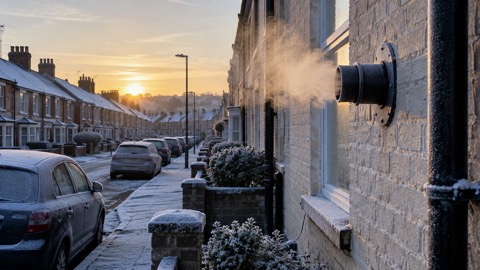
A condensing boiler, which the Logic Max Combi2 is, produces acidic water as it runs, and that water leaves the property through a plastic condensate pipe. In cold weather the water inside that pipe can freeze, and this will stop your boiler from working14. Northern Gas Networks describes the symptom precisely: a frozen condensate pipe can stop your boiler from working, leaving you without heating or hot water, and you might also hear a gurgling noise from the boiler or the condensate pipe outside3. Ideal Heating's own support article says that in winter your condensate pipe may freeze and become blocked, and that usually a gurgling noise can be heard from the boiler during attempted ignition when the condensate is blocked15.
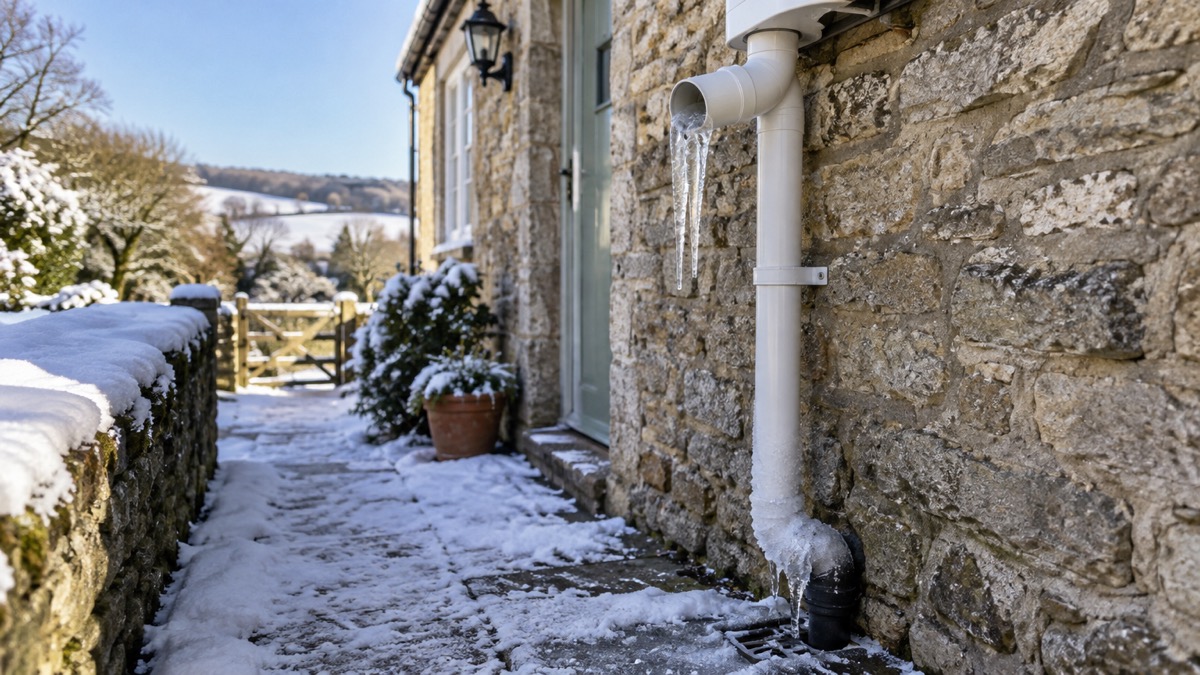
The pipe is most at risk where it is most exposed. Alpha, a boiler maker, says there is a far higher risk of a frozen condensate pipe when the weather turns cold with a high wind chill factor on external condensate pipes16. Pipes normally freeze at their most exposed points, so check the open end or any bends first, and run your hand down the pipe to find an area colder than the rest16. Visible frost on the pipe, or gargling noises, indicate it is partially or fully frozen16.
If the weather is milder and the boiler still will not fire, the cause may be a blockage rather than ice. Ideal Heating suggests that if the weather is milder it may be worth checking where the condensate pipe terminates for blockages such as leaves15. WaterSafe notes that condensate pipes are commonly found in properties with a combi boiler, and that in winter the condensation in the pipe can freeze and burst the pipe, and cause pipes inside your home to do the same17. Our guide to frozen condensate pipes covers the full diagnosis, and how to stop a condensate pipe freezing covers prevention.
How to thaw a frozen condensate pipe safely
Thawing a condensate pipe is a job a household can do, but only within limits, and the limits are set by the makers and by the water industry. The first is reach: Ideal Heating's manual says do not attempt to thaw a condensate drain pipe if you cannot reach it from ground level4. The second is heat: Northern Gas Networks says to pour warm, not boiling, water over the pipe using a jug or watering can3. The Met Office is firmer still: never use a naked flame or blowtorch to thaw the pipe, as direct heat may cause permanent damage to the pipes and could start a fire4.
The sequence, drawn from maker guidance, is:
- Turn off your boiler completely to ensure safety, via the fuse spur switch5.
- Locate the condensate pipe, which runs from the boiler to the outside, and check for ice or frost on the pipe5.
- Use a warm cloth or hot water bottle to gently warm the frozen section5.
- If needed, use a hairdryer on a low setting, keeping a safe distance to prevent overheating5.
- Repeat with warm water poured down the side of the pipe until it starts thawing, having carefully removed any pipe lagging first16.
Ideal Heating's own support article says the problem can easily be fixed by using a hot water bottle, or pouring warm water over the pipe itself15. If you have tried to thaw your condensate pipe several times and the boiler is still underperforming, the next step is a Gas Safe registered engineer16. Our guide to finding a Gas Safe registered engineer explains how to check their card.
Preventing the freeze before the cold arrives
Prevention is cheaper and calmer than a midnight thaw. WaterSafe and Scottish Water both advise insulating the plastic condensate pipe with foam pipe insulation to keep it warmer and prevent the condensate water from freezing and blocking the boiler19. That is the single most useful job to do before winter, and it is within reach of most households where the pipe runs down an outside wall.
Insulation is not a guarantee. Alpha cites the 2018 Beast from the East as an example of extreme cold where pipe insulation alone was often not enough to prevent frozen condensate pipes16. Worcester Bosch's advice for its own boilers includes turning the heating control on the boiler to maximum, which keeps the system running and the condensate flowing16. Our guide to leaving the boiler on when away in winter covers the holiday question.
The wider winter picture matters too. Ready Scotland lists frozen or burst pipes among the effects of cold, snow and ice21, and Welsh Water's winter safety advice covers the same ground for households in Wales22. A frozen pipe elsewhere in the house can usually be spotted by a light coating of frost around it23, and the signs include no running water or only a trickle, frost on a visible pipe, unpleasant smells from taps or drains, and the boiler or central heating not switching on or making gurgling sounds24. If you find one, our guide to frozen and burst pipes sets out what to do.
When the heating is off but the hot water still works
A combi boiler that gives hot water but no heat is usually a control problem rather than a breakdown, and Ideal Heating has a specific check. Turn your thermostat to its maximum position and check if a C appears on the boiler display. If the boiler fires and the radiators come on, this means the room thermostat was not set higher than the room temperature8. That is the whole fault: the room was already warmer than the thermostat setting, so the boiler had no reason to heat.
If the boiler still does not fire after that check, contact Ideal Heating, as this will require a visit from an engineer8. There is a second pattern to know: if hot water is running and the central heating is getting warm at the same time on a combi boiler, contact the maker, as this also requires an engineer visit8. Our guide to hot water but no radiators covers the checks in order, and cold radiators covers air, sludge and valves.
Getting help, and what to have ready when you call
When you ring Ideal Heating or your installer, the call goes faster if you have four things ready: the fault code exactly as it flashes, the pressure gauge reading, whether the boiler is gurgling, and your model and serial number from the data plate. The maker's fault pages ask you to quote the error code when you call, for example error code L2 or L31. For a persistent low pressure fault, Ideal Heating's number in its manual is 01482 4986604.
If your boiler cannot be fixed quickly, the priority shifts to keeping warm safely. The British Red Cross advises preparing for snow and winter before it arrives10, and the Met Office's guidance on frozen or burst pipes is worth reading before the first cold snap4. Our guide to boiler breakdowns in cold weather covers what to do while you wait for an engineer, and heating and cooking without mains power or gas covers the alternatives. Households with someone older, disabled or medically dependent should also look at extra support from networks and suppliers.
If you are in a rented home, the landlord carries the repair duty, and our guide to broken boilers in rented homes explains what they must do. If you have a prepayment meter and the boiler has locked out, our guide to prepayment meters covers emergency credit and restarting.
Sources (24)
- Boiler fault codes, Ideal Heating, 2026
- Boiler fault codes and pressure guidance, Ideal Heating, 2026
- Boiler not working, Northern Gas Networks, 26 October 2026
- Vogue Max System user guide, Ideal Heating, September 2023
- Why condensate pipes freeze, Baxi, 29 October 2026
- Product recall: Ideal Heating Logic 2 Combi and System boiler range, Office for Product Safety and Standards, 22 February 2024
- Thermostat upgrade kit instructions, Ideal Heating, August 2022
- Boiler fault codes, page 2, Ideal Heating, 2026
- Managing home dialysis during a power cut or energy blackout | Kidney Care UK, Kidney Care UK
- Snow and winter, British Red Cross, 25 October 2026
- Boiler pressure guide, British Gas, 29 November 2023
- How to fix high Boiler pressure | Baxi Guides, Baxi
- Boiler appliance guide, Gas Safe Register, 2026
- My boiler isn't working, SGN, 2026
- Why does my boiler lose pressure, Ideal Heating, 2026
- Frozen condensate pipes, Alpha Innovation, 6 November 2025
- Winter advice, WaterSafe, 29 October 2026
- Adverse weather events: snow, Llangattock Community Council, 12 October 2023
- Protect your pipes, Scottish Water, 29 October 2026
- Winter safety, Welsh Water, 28 October 2026
- Cold, snow and ice, Ready Scotland, 25 March 2026
- No water or low pressure, Thames Water, 28 October 2026
- Winter advice: what should I do if a pipe freezes, WaterSafe, 29 October 2026
- Winter advice, Consumer Council for Water, 12 May 2023
 Navien NCB300
 Navien NCB500
 Navien NCB700
 Ideal Logic Combi2
 Ideal Logic+ Heat2 H