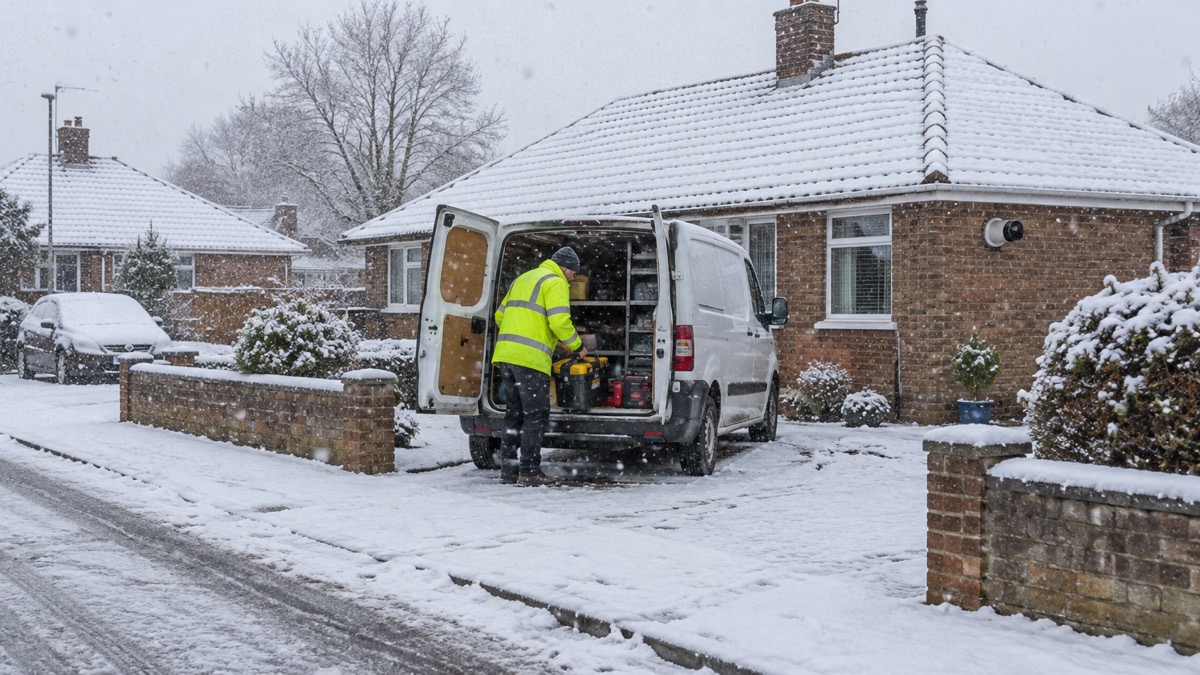
If your Navien NCB300 has stopped in cold weather, three things account for most of it: system pressure has fallen, the condensate pipe outside has frozen, or the power has gone off. Start at the display. A code beginning E302 means low water pressure, and the maker's default minimum is 1 bar1. A boiler that stopped during a frost, with no code you recognise, points to the condensate pipe2. A boiler that went quiet with the lights is a power cut, and the NCB300 restarts itself when power returns3.
What you can do yourself is limited but useful: read and record the code, top up pressure through the filling loop if you know how, and thaw a frozen condensate pipe from the outside with warm water or a hot water bottle. What you must not do is open the boiler casing, touch gas-carrying parts or reset a lockout over and over. Installation and service must be performed by a Gas Safe registered installer, service agency or the gas supplier, the maker states1, and only Gas Safe registered engineers can legally work on gas in your home4.
This page covers the NCB300's own codes and settings, its cold-weather behaviour, its specifications, and the jobs that belong to an engineer. For the wider picture, the gas and heating failures guide covers boilers of every make, and the boiler breakdowns in cold weather page walks through the same checks step by step.
Low pressure and error E302: topping up to 1 bar
E302 is the NCB300's low water pressure code. The maker's manual says that if the pressure is lower than the minimum pressure set, 1 bar by default, error code E302 will appear on the display1. The service manual gives the threshold it works to: a low water level error is generated if water pressure is 0.5 bar or less for 3 seconds7. The manual also tells householders that when boiler water pressure drops below 0.4 bar, they should follow the filling the system instruction1.
Topping up is a household job on many combis, done through the filling loop, and the service manual's instruction for clearing E302 is to check the filling loop and pressurise the system to 1.0 to 1.3 bar7. The expansion vessel is pre-charged to 1.0 bar1. If you are not confident with the filling loop, or pressure keeps falling after you top up, stop and call an engineer: repeated loss of pressure usually means a leak or a failed component, not something a top-up will cure. Our guide to boiler pressure explains what the gauge should read, and how to repressurise a combi boiler takes the filling loop step by step.
| Reading | What it means | What to do |
|---|---|---|
| Below 1 bar (default minimum) | E302 low water pressure on the display1 | Top up via the filling loop to 1.0 to 1.3 bar7 |
| 0.5 bar or less for 3 seconds | Low water level error generated7 | Top up, then watch whether it holds |
| Below 0.4 bar | Maker says follow the filling the system instruction1 | Top up if competent, otherwise call an engineer |
| 3 bar | Pressure relief valve activation point1 | Do not keep topping up; call an engineer |
A frozen condensate pipe can shut the boiler down in cold weather
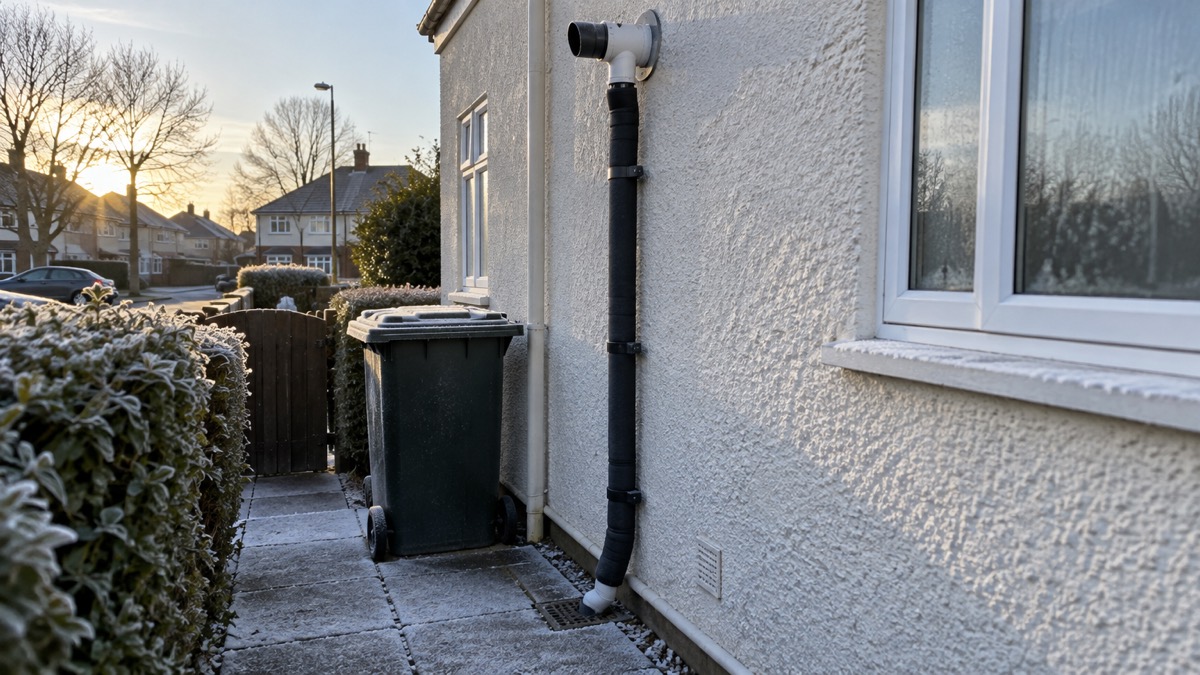
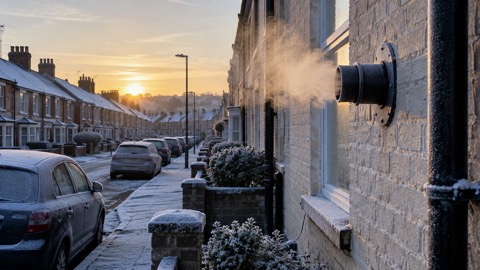
A condensing boiler produces acidic water as it runs, and that water leaves through the condensate pipe. In cold weather the water inside an external condensate pipe can freeze and cause a blockage, and the boiler may automatically switch off to protect itself8. The Chartered Institute of Plumbing and Heating Engineering puts it plainly: when temperatures drop below freezing, the condensate pipe on condensing boilers may freeze, and this will cause the boiler to shut down5. Scottish Water says that if your boiler has stopped working in the cold, the chances are you have frozen boiler condensate pipes9.
The signs are a boiler that stopped during a frost, no heating or hot water, and sometimes a gurgling noise from the boiler or the pipe outside8. Navien's own manual warns that even with protective measures an external condensate pipe could freeze, causing boiler shutdown and possibly a chargeable engineer call-out1.
Thawing is something a household can do. Scottish Water suggests holding a hot water bottle or heat wrap around the affected pipe, or pouring hot, but not boiling, water over the frozen end9. WaterSafe says to start from the end nearest the ground10. Do not use boiling water, and do not climb or reach where it is unsafe.
Prevention is better than thawing. WaterSafe advises insulating the pipe with foam insulation11, and the Gas Safe Register says an external condensate pipe can be insulated by asking a Gas Safe engineer4. The frozen condensate pipes page covers the signs in more detail, and how to stop a condensate pipe freezing covers lagging and routing.
Freeze protection: the boiler fires at 10°C by default
The NCB300 protects itself from frost. A sensor inside the boiler automatically detects the temperature and, if necessary, initiates a safety heating cycle to prevent internal equipment damage due to freezing temperatures3. Navien's support pages describe a built-in frost thermostat that automatically turns on the boiler and pump if the water in the boiler falls below 10°C, providing the electrical supply is on6. The boiler will operate until the water temperature in the system reaches approximately 10°C measured on the flow sensor6.
On the NCB300 the freeze protection setting has a range of 6°C to 10°C, with a default of 10°C1. That default is what most households will have, and it is why the boiler may fire briefly on a cold night even when the heating is off. It only works if the boiler has power and gas. If you switch the boiler off at the wall, or the power is out, the protection cannot run.
For homes without built-in frost protection, Scottish Water suggests setting the room thermostat to 10C and the programmer to 'On' or '24h' so it fires up the boiler if needed12. The same principle applies to any household going away in cold weather: leave the heating on a low setting rather than off. Our page on whether to leave the boiler on when away in winter sets out the options.
What happens to the boiler in a power cut
A power cut stops a combi boiler dead: no fan, no pump, no ignition. The NCB300 handles the interruption well. The maker states that the boiler will retain your settings during a power outage1, and that when the power is restored after a power failure, the boiler will automatically start and return to normal operation, with no manual reset required3. That is worth knowing, because it means you should not start pressing buttons when the lights come back on.
The boiler's electrical supply is 230V/50Hz1, and it has an electrical protection rating of IPX4D1. Any short circuit in the boiler's electrical circuit immediately blows the internal glass fuses and automatically cuts off the gas supply3. The fuse rating is 250 V, 3.15 A, in a 5 mm by 20 mm fuse, and the supply must run through one common isolator fused at 3.15 A maximum, with a 3 A fuse on the supply side and a 3.15 A fuse in the boiler fuse holder1. Replacing a fuse inside the boiler is not a household job.
If the power is off for hours in cold weather, the freeze protection cannot run, and pipework in an unheated house is at risk. The power cuts guide covers what to do during an outage, and the backup power guide covers what can and cannot keep a boiler running. A boiler needs a proper supply, not a small portable battery.
Hot water temperature and scalding: factory set at 50°C
The NCB300 leaves the factory with its hot water set to 50°C for your safety and comfort1. That is a deliberate safety setting. The maker warns that water temperatures at or above 52°C can cause instant scalding or severe burns1. The hot water temperature is adjustable, so it is possible to set it hotter, and possible to set it cooler.
The maker's own scald table shows why the factory setting matters. At 70°C a young child can suffer a full thickness (3rd degree) burn in less than 1 second; at 60°C in 1 second; at 55°C in 10 seconds; at 49°C in 10 minutes1. At 37°C the maker describes the scald risk as very low13. If anyone in the household is very young, elderly or has reduced sensation, keep the hot water setting where it is or lower, and test bath water before use.
"Water temperatures at or above 52°C can cause instant scalding or severe burns."
| Water temperature | Time to a full thickness burn on a young child |
|---|---|
| 70°C | Less than 1 second1 |
| 60°C | 1 second1 |
| 55°C | 10 seconds1 |
| 49°C | 10 minutes1 |
| 37°C | Very low scald risk13 |
NCB300 specifications
The NCB300 is a wall-mounted combi boiler in four outputs: 28kW, 30kW, 37kW and 41kW1. It is approved for use in the UK and Ireland only, and using it in any other country voids the manufacturer's warranty1. It carries a seasonal central heating energy efficiency class of A and a water heating energy efficiency class of A across all four models3.
| Specification | Figure |
|---|---|
| Models | 28kW, 30kW, 37kW, 41kW1 |
| Dimensions (W x D x H) | 395 x 283 x 680 mm1 |
| Electrical supply | 230V/50Hz1 |
| Nominal current | 0.6 A1 |
| Fuse | 250 V, 3.15 A, 5 mm x 20 mm1 |
| Protection rating | IPX4D1 |
| Heating temperature range | 40 to 90°C, maximum 90°C1 |
| Maximum heating pressure | 2.5 bar1 |
| Maximum hot water pressure | 10 bar1 |
| Minimum hot water flow | 2 l/min1 |
| Expansion vessel | 6 L, pre-charged to 1.0 bar1 |
| Pressure relief valve | Activates at 3 bar maximum1 |
| Connections | Heating 22 mm, hot water 15 mm, gas 22 mm1 |
| Flue | Coaxial 60/100 mm1 |
| Flue types | B23-C13-C33-C53-C831 |
| NOx classification | Class 61 |
| Gas category | II2HY203P1 |
| Efficiency at full load, 80/60°C | 88.4%1 |
| Efficiency at full load, 50/30°C condensing | 106.5%1 |
| Efficiency at partial load (30%) | 108.5%1 |
| Minimum top clearance | 200 mm1 |
The flue is an installer's calculation in any case, not something a household needs to settle.
The boiler can run on natural gas or LPG, and an LPG conversion kit is included with the boiler1. It arrives configured for natural gas; if LPG conversion is required, the supplied kit is used and the LPG converted label attached1. The front panel DIP switches are set for LPG G31 as 1-ON, 2-ON, and the LPG inlet pressure at maximum firing rate is 37 mbar normal, 25 mbar minimum and 45 mbar maximum1. LPG G30 is marked not in UK1. Conversion is engineer work. Our LPG homes page covers bulk tanks and cylinders.
Jobs only a Gas Safe engineer can do
The line is clear. Navien states that installation and service must be performed by a Gas Safe registered installer, service agency or the gas supplier1. The law backs it: only Gas Safe registered engineers can work on gas and fit, fix and service boilers, gas fires and most types of gas cookers in your home, and it is the law4. Argyll and Bute Council puts it just as plainly: only a Gas Safe registered engineer should carry out the work, and anyone else is breaking the law14.
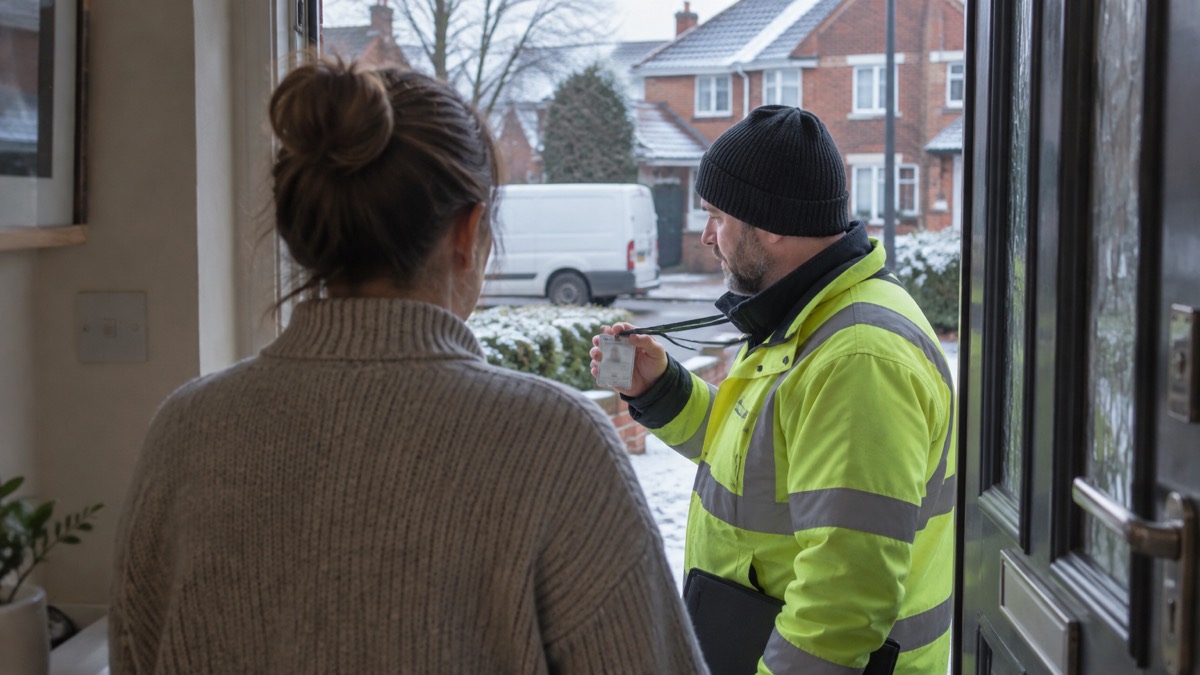
Anyone employed to work on gas appliances in domestic premises must be Gas Safe registered and competent in that area of gas work, and those competencies are marked on the back of the engineer's Gas Safe Register ID card15. Not every registered engineer can work on every appliance, so check the card or look the engineer or business up on the Gas Safe Register website16. The Health and Safety Executive advises checking that the engineer is competent to work in that specific area of gas16.
So what stays with you? Reading the display, noting codes, topping up pressure through the filling loop if you are shown how, thawing an external condensate pipe, and keeping vents and flues clear. What goes to an engineer: anything inside the casing, gas-carrying parts, the flue, electrical work including the fuse, LPG conversion, and any repair. If you smell gas, do not touch electrical switches; the National Gas Emergency Service number is 0800 111 999, and extra work on appliances such as ovens, boilers and fires requires a Gas Safe Registered Engineer17. Our finding a Gas Safe registered engineer page explains how to check a card, and the emergency line page covers when to ring.
Warranty, water quality and getting support
Navien undertakes to rectify any manufacturing defect that occurs within 5 years of the installation date3. For the warranty to be valid, an annual service must be carried out by a suitably qualified and Gas Safe registered installer every year after installation, and the cost of that service is not included in the guarantee7. Register the boiler on the Navien Installers Warranty App within 30 days of installation, or email a photo of the completed benchmark form to service@navienuk.com7.
Water quality matters to the warranty. If problems occur when using sanitary water with a chlorine content higher than 150 mg/l, no recourse can be made to the terms of the warranty1. Damage from operating the boiler without water is not covered by the warranty, and may result in property damage or severe personal injury1. On hardness, the maker gives a domestic hot water range of 1 to 12 degrees German hardness, or 17 to 224 ppm, and says that in areas with hardness exceeding 200 ppm it is important to install a scale reducer and seek the advice of the local water authority1.
If your Navien boiler develops a fault, your first action should be to contact your installer, as their professional assessment comes first; if you cannot, phone Navien Service on 0344 332 2323 or visit www.navien.co.uk7. When contacting the Technical Helpdesk, have the model number, serial number, date purchased, installation location and type, and any error code to hand1. The boiler keeps a list of the 10 most recent errors on the screen, with the most recent shown first1, so note them down before you reset anything.
The Navien brand page covers the maker's range, and the boiler servicing page explains what an annual service involves. If you are moving into a home with an NCB300, the moving-in checks checklist is a sensible first pass.
Sources (18)
- NCB300 Combi Installation and Operation Manual, Navien, 2026-01
- My boiler isn't working, SGN, 2026
- NCB300 Combi User's Information Manual, Navien, 2024-07
- Boiler appliance guide, Gas Safe Register, 2026-10-29
- Plumbing emergencies, CIPHE, 2026-10-29
- Navien FAQs, Navien, 2026
- NCB300 Combi Service Manual, Navien, 2025-02
- Boiler not working, Northern Gas Networks, 2026-10-26
- Winter safety, Wessex Water, 2026-10-28
- Avoid a boiler breakdown, WaterSafe, 2026-10-29
- Winter advice, WaterSafe, 2026-10-29
- Protect your pipes, Scottish Water, 2026-10-29
- NCB300 Combi Installation and Operation Manual, Navien, 2024-10
- Gas safety, Argyll and Bute Council, 2026
- Gas safety in the home, Health and Safety Executive, 2026
- Safety checks and who can do them, Health and Safety Executive, 2026
- Smell gas, Cadent Gas, 2026-10-29
- Emergency engineer visit, Cadent Gas, 2026-10-29
 Navien NCB500
 Navien NCB700
 Ideal Logic Combi2
 Ideal Logic+ Heat2 H
 Ideal Logic Max Combi2