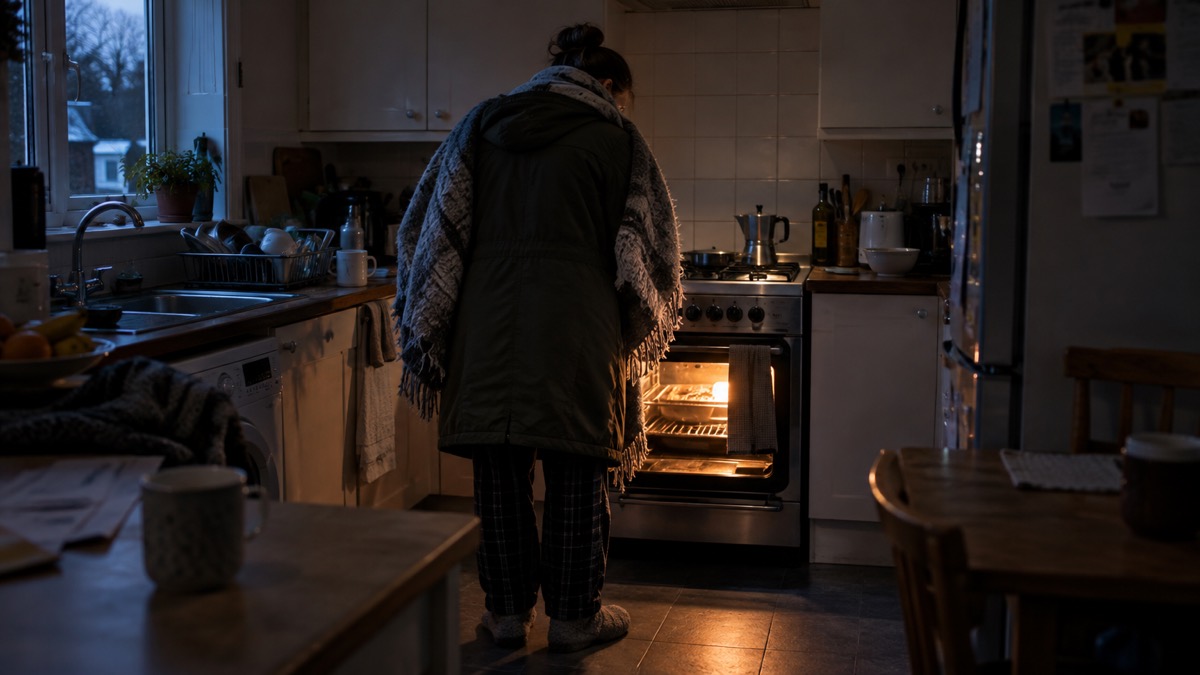
No. Do not heat your home with a gas cooker or oven. The London Assembly's cold weather guidance is blunt about it: doing so is inefficient and "could put you at risk of carbon monoxide poisoning, which can kill"1. The City of London Corporation says the same, warning of carbon monoxide poisoning that can kill2, and the Met Office's snow safety advice goes further still: "Never use a hob or oven to heat your home, they can increase carbon monoxide levels"3.
The temptation is understandable. When the central heating has failed, or the bill has arrived and the thermostat has gone down, a hot oven with the door open feels like free warmth in the room you are already in. But a gas oven is a combustion appliance built to cook food, not to heat a room, and running it for warmth is one of the recognised causes of carbon monoxide building up in a home4. Carbon monoxide is a gas you cannot see, taste or smell, and the fire and rescue services treat ovens used as heaters as a hazard to life.
What should you do instead? Keep the heat you have in one or two rooms rather than trying to warm the whole house, dress for the cold, and use a heater that is designed for the job, checked against recall lists first. If you are on a low income or older, check whether you qualify for the Warm Home Discount or help from your council. And if anyone in the house develops a headache, dizziness or nausea while a fuel-burning appliance is running, treat it as carbon monoxide until proved otherwise and act at once6.
Why a gas oven or hob must never heat your home
The case against using the oven for warmth rests on one fact that overrides everything else: burning gas in a room that is not designed for it produces carbon monoxide, and carbon monoxide kills. The London Assembly's guidance lists using a gas cooker or oven to heat your home among the things not to do, calling it inefficient and a carbon monoxide risk1. The City of London Corporation's cold weather advice says the same2. The Met Office, in its advice for snow and cold, tells people never to use a hob or oven to heat the home because it can increase carbon monoxide levels3.
Fire and rescue services across the country name cooking appliances used as heaters as a cause of carbon monoxide build-up. Warwickshire Fire and Rescue Service lists "using cooking appliances for heating" among the causes of carbon monoxide in the home4, and Dorset and Wiltshire Fire and Rescue Service lists "using cooking appliances as heaters" in the same way5. This is not a rare or theoretical risk: it is a recognised route to poisoning that the services see often enough to warn about every winter.
There is a second reason, which matters more in a power cut. A gas oven will not work without electricity12. The ignition, the fan and the controls all need power, so in the very situation where people are most tempted to improvise, the oven may not light at all. Planning to cook and heat without mains power means planning for appliances that do not depend on the grid, not relying on the oven.
Where a gas appliance must never be left running: rooms where people sleep
The danger is greatest where people are least able to notice it: asleep. The Health and Safety Executive's guidance for owner-occupiers sets out the rules for gas appliances in rooms used as sleeping accommodation. Since 31 October 1998, a room converted to use as sleeping accommodation should not contain a gas fire, gas space heater or gas water heater (including a gas boiler) over 14 kilowatts gross input unless it is room sealed14. For smaller appliances, of 14 kilowatts gross input or less, or any instantaneous water heater, the appliance must be room sealed or have an atmosphere-sensing device14. The HSE's general gas safety questions repeat the same restriction15.
The NHS advice is simpler and applies to every home, not just converted rooms. Doncaster and Bassetlaw Teaching Hospitals advise that you should not use a gas appliance in a room you will be sleeping in unless it has a flame safety device fitted or is a sealed unit with an external flue, and that you should seek professional advice from a Gas Safe registered engineer to confirm this is the case7. The trust issued a patient leaflet on the risks of sleeping in a room with a gas appliance on in December 202516.
In practice, this means:
- Never leave a gas oven, hob or portable gas heater running in a bedroom, or in any room where someone will sleep.
- If a gas appliance is fitted in a room used for sleeping, have a Gas Safe registered engineer confirm it is room sealed or has the right safety device7.
- Do not improvise: a camping stove or portable heater brought into a bedroom to take the chill off is exactly the situation the advice is written to prevent.
Both agree that a gas appliance in a sleeping room needs to be room sealed or fitted with a safety device, and that a Gas Safe registered engineer should confirm it. If in doubt, keep gas appliances out of bedrooms altogether.
Carbon monoxide: the warning signs and what to do at once
Carbon monoxide poisoning can come on gradually, and the symptoms are easy to mistake for a cold or flu. The Armagh City, Banbridge and Craigavon Borough Council's safety guidance lists the warning signs as headache, dizziness, nausea, confusion and fatigue6. Warwickshire Fire and Rescue Service adds sooty stains on the walls around fires and water heaters as a visible sign of a leak4. If you suspect carbon monoxide because of symptoms such as headaches, dizziness or nausea, the service says to take immediate action18.
What that action is, in order:
- Turn off the appliance6.
- Leave the area immediately and get everyone into fresh air6.
- Seek medical help6.
Do not stop to open windows and wait to see if things improve, and do not go back inside to fetch belongings. Get out, and call for help from outside.
A carbon monoxide alarm is your early warning. Manchester Fire and Rescue Service recommends placing one in rooms where you have a fixed combustion appliance, such as a gas fire, gas boiler, log burner or open fireplace19. Fit one wherever a fuel-burning appliance sits, test it regularly, and replace it as the maker instructs. An alarm is not a substitute for safe appliances, but it is the only way to know carbon monoxide is present before symptoms start.
Safer ways to stay warm when heating fails or costs too much
The safe answer to a cold home is not a hotter oven. It is to keep the heat you have in fewer rooms, to dress and bed for the temperature, and to use appliances designed for the job. The fire and rescue services' message is to use heating safely during the colder months to keep warm and reduce the risk of fire at home20.
Start with the room. To conserve existing heat, use just one or two adjacent rooms, isolated by closing doors and hanging blankets over doorways; the kitchen and an adjoining room are usually good choices21. This is the principle behind our guide to keeping one room warm when the heating fails, and it works whether the heating has broken or you are trying to spend less.
Then look at what you are wearing and sleeping under. Layers trap warmth, and a hot water bottle or a wheat bag in the bed does more for comfort than a lukewarm oven ever will. Our guides to clothing and bedding to stay warm in a cold home and to hot water bottles cover the practical detail.
If you use a portable heater, choose one designed for the job and use it safely. The London Fire Brigade's guidance on portable heaters, gas fires and open fires sets out the risks9, and our guide to using a portable heater safely at home explains how to site and run one. If your home is powered mainly by gas, Buckinghamshire Council suggests having alternative electrical products such as electric heaters to keep you warm, and a microwave or other electrical appliance so you can still cook if the gas oven or hob are not working22.
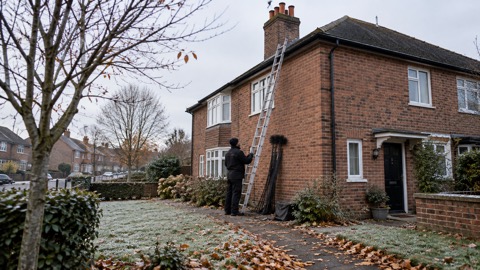
Before the cold arrives, have your appliances checked. The NHS advises contacting a Gas Safe registered engineer to make sure heating and cooking appliances are working properly23, and the same advice appears in cold weather guidance from the West Midlands Ambulance Service24. A gas safety check covers boilers, gas cookers, heaters and any other gas-fired appliances in your home25.
Check plug-in heaters against recall notices before you use them
A heater bought years ago, or borrowed from a neighbour, may be subject to a safety recall you never heard about. Both Manchester Fire and Rescue Service and the London Fire Brigade tell people to check that their heater is not on a recall list8. It takes a few minutes and it is the single most useful check you can make before relying on a heater through a cold spell.
Recent recalls show why it matters. In September 2024, the Office for Product Safety and Standards recalled affected batches of the Pifco 2KW Convector Heater with Turbo and Timer, sold between 1 November and 12 December 2023, over mixed fuse sizes posing a fire risk. In December 2024, the ELPINE Plug-In Heater was recalled over a serious risk of electric shock from the accessible heating element. In July 2026, the Kobe 2kw Oil-Filled 9 Fin Radiator, sold from January 2024 onwards, was recalled over a plug defect that may overheat and catch fire.
Gas appliances have been recalled too. In December 2024, Flogas Gold Butane Gas Cylinders in 4.5 kg, 7 kg and 13 kg sizes, sold between 6 and 22 November 2024, were recalled because they were filled with a butane and propane mixture outside the standard, posing an over-pressure fire risk. In June 2024, OEX Folding Novo and Folding Savo gas stoves and two Vango folding gas stove models were recalled because the gas hose may degrade over time, leading to a gas leak and possible hose ignition.
What to do:
- Check any heater, gas cylinder or stove against the recall notice before you use it8.
- If yours is affected, stop using it and follow the recall instructions.
- When you finish cooking on a gas appliance, turn off the gas cylinder before the controls, so any gas in the pipeline is used up26.
- Have gas appliances checked by a Gas Safe registered engineer23.
Help with heating costs: Warm Home Discount and the Crisis and Resilience Fund
If the reason you are considering the oven is cost, there is help designed for exactly that. The Warm Home Discount is a one-off payment giving eligible older and low-income consumers £150 off their energy bill10. The scheme has been confirmed for a new five-year period up to scheme year 2030/31, so it is worth checking whether you qualify. Our guide to Winter Fuel Payment, Cold Weather Payment and Warm Home Discount explains the schemes side by side.
The Household Support Fund's prevention focus moved to the new Crisis and Resilience Fund from April 2026, so your council is the place to ask what is available. If you heat with oil, our guide to the Cold Weather Priority Scheme for heating oil explains how priority deliveries work.
Local schemes add to the national ones. In Suffolk, the Warm Homes Suffolk service offers help with fuel payments, can lend electric heaters, assesses people for financial assistance towards repairs or replacements if a boiler or heater stops working, discusses energy efficiency improvements, and helps people access grants for insulation and basic draught proofing27. In London, the Mayor's Warmer Homes programme offers grants for heating and insulation to homeowners and private tenants1. Arrangements differ between England, Scotland, Wales and Northern Ireland, so check with your own council or devolved government.
Keeping warm during a power cut
A power cut is when the oven temptation is strongest, and when it is most dangerous. Gas ovens, boilers, heat pumps and home internet will not work without power, and the mains water supply could also be disrupted during and after a power cut12. That removes the oven as an option anyway, and it means your plan needs to work without electricity.
The safest approach is the one-room plan. Use just one or two adjacent rooms, keep them isolated by closing doors and hanging blankets over doorways, and choose the kitchen and an adjoining room, which are usually good choices21. Have blankets, warm clothing and a hot water bottle ready before the power goes. Our guide to power cuts covers the wider household plan.
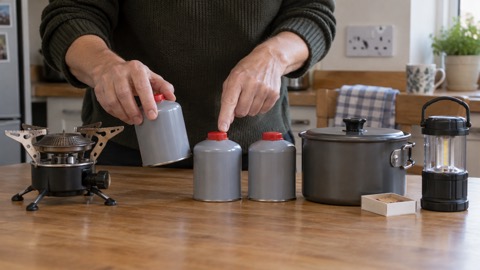
For cooking, a camping stove, barbecue or bottled gas stove can be used to cook food and heat water, checking the maker's instructions for safe use28. But these appliances are not room heaters, and cooking with them can take longer than usual, so make sure food is steaming hot and cooked all the way through28. Never bring a barbecue indoors, and never use a camping stove in a tent. Our guides to camping stoves for a power cut and camping stove safety indoors set out the rules.
If you use home oxygen, the fire and rescue services are clear: never cook with gas or an open flame while using your oxygen equipment29, and keep the device at least 3 metres away from any appliance that uses an open flame, such as a gas cooker or gas fire29. Our guide to extra help in an emergency covers support for households with medical equipment.
Sources (29)
- Keeping warm, healthy and safe in cold weather, London Assembly, 2026-10-25
- Advice on coping in cold weather, City of London Corporation, 2025-08-15
- Stay safe in snow, Met Office, 2026-10-25
- Carbon monoxide awareness, Warwickshire County Council, 2026-10-29
- Carbon monoxide, Dorset and Wiltshire Fire and Rescue Service, 2025-11-18
- Carbon monoxide detectors, Warwickshire County Council, 2026-10-29
- Carbon monoxide, Doncaster and Bassetlaw Teaching Hospitals NHS Foundation Trust, 2026-10-25
- Stay warm safely this winter, Manchester Fire and Rescue Service, 2026-10-29
- Portable heaters, gas fires and open fires, London Fire Brigade, 2026-10-25
- Keeping your home warm in winter, Met Office, 2026-10-26
- Seasonal winter advice, Suffolk County Council, 2026-10-29
- Carbon monoxide, Manchester Fire and Rescue Service, 2026-10-29
- Christmas safety tips, Warwickshire County Council, 2026-10-29
- Gas safety in the home: owner-occupiers, Health and Safety Executive, 2026
- Gas safety: frequently asked questions, Health and Safety Executive, 2026
- Sleeping with a gas appliance on, Doncaster and Bassetlaw Teaching Hospitals NHS Foundation Trust, 2025-12
- Sleeping in a room with a gas appliance, coal or log fire, Doncaster and Bassetlaw Teaching Hospitals NHS Foundation Trust, 2026-03-06
- Stay well this winter, NHS Cheshire and Merseyside, 2026-10-28
- Power cuts, UK Government, 2026-10-21
- Staying warm, Cheshire Fire and Rescue Service, 2026-08-06
- Are you ready?, Culham Parish Council, 2025-09
- Keeping your home warm in winter, Met Office, 2026-10-26
- Use the right service this winter, Hampshire Hospitals NHS Foundation Trust, 2026-10-29
- Gas supply issues, Buckinghamshire Council, 2026-10-29
- Safe home heating, Warwickshire County Council, 2026-10-29
- Barbecue safety, Manchester Fire and Rescue Service, 2026-10-29
- Power cuts, UK Government, 2026-10-21
- Power cuts and food safety, Food Standards Scotland, 2026-10-25
- Safe use of heaters and generators, Armagh City, Banbridge and Craigavon Borough Council, 2026-10-29
 Before-Winter Heating Checks
 Backup Stove Kit Checklist
 Wood Burner Lighting Kit
 Paraffin Heater Indoors
 Changing an LPG Cylinder Safely
 Storing Gas Cylinders at Home
 Wood You Should Never Burn
 Disposing of Ashes Safely
 Open Fire in an Unused Chimney
 Oil Tank Leaks After a Storm
 Trangia Spirit Burner Fuel