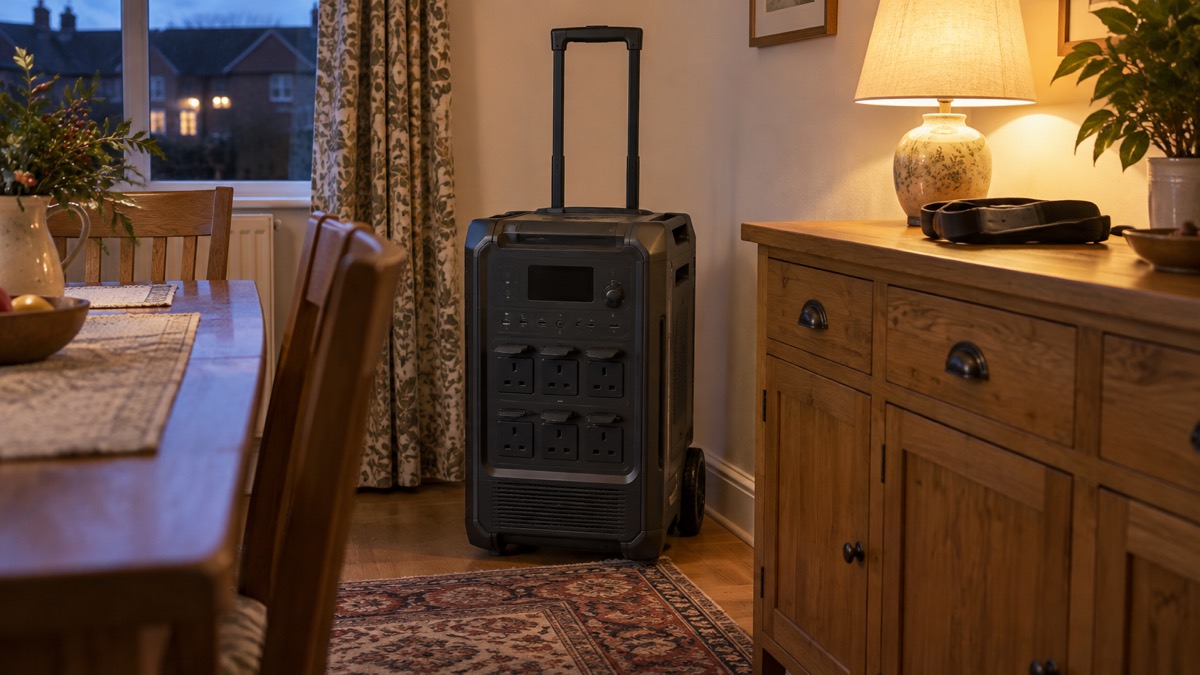
The BLUETTI Elite 400 is a large portable power station: a battery in a wheeled case that you charge from the mains, from solar panels or from a car, and then plug household appliances into when the power goes off. BLUETTI rates it at 2,600 W output from a 3,840 Wh LiFePO4 battery, with 3,900 W of surge or "lifting" power for appliances that draw a burst of current when they start1.
For a household, the headline is that this is a whole-evening, possibly whole-day unit rather than a phone top-up. The maker quotes 7.68 hours at a 500W load, and 78.8 hours running a refrigerator at about 1 kWh a day3. It weighs 39kg and has handles and wheels, so it is movable but not something you carry up a ladder4.
This page sets out what the Elite 400 can and cannot do, how to charge it, how to move and store it, and the safety points that matter with any lithium battery of this size. It does not give a price, and it does not rank the unit against other products.
Power and capacity: 2,600 W output from a 3,840 Wh battery
Two numbers decide what a power station can do. The watt figure is the ceiling on what it can run at any one moment; the watt-hour figure is the size of the tank, and sets how long it keeps running. The Elite 400 is rated at 2,600 W continuous, with 3,900 W of surge power for the first moments after a motor or compressor starts1. BLUETTI's own summary is that this "easily powers fridges, routers, and small appliances"2.
The battery is LiFePO4, lithium iron phosphate. BLUETTI states it was one of the first to adopt the LiFePO4 battery type in portable power stations8. That chemistry is the one named in the maker's specification line for this model1.
| Specification | Figure | Source |
|---|---|---|
| Battery capacity | 3,840 Wh | 1 |
| Rated AC output | 2,600 W | 1 |
| Surge ("lifting") power | 3,900 W | 2 |
| Battery chemistry | LiFePO4 | 1 |
| Solar input | 1,000 W max, 12V to 60V, 20A max | 5 |
| UPS switchover | 15 ms | 6 |
| Weight | 39kg | 3 |
If watts and watt-hours are new to you, the difference between a rating and a capacity is worth ten minutes of your time before you buy anything this size: see Watts, Watt-Hours and Surge Explained.
What it can run in a power cut, and for how long
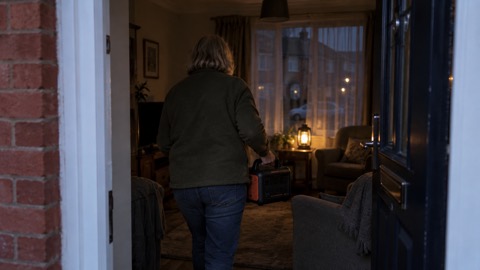
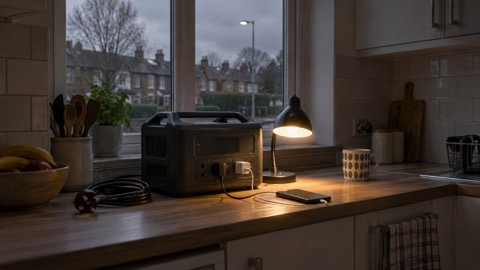
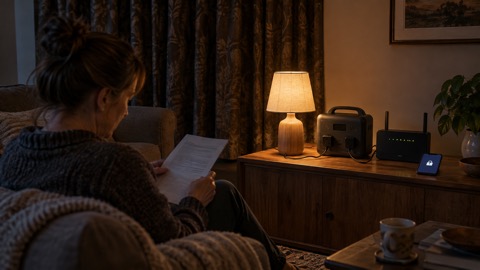
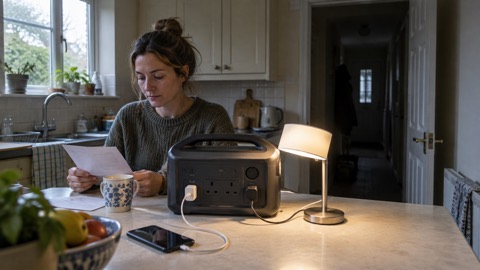
BLUETTI positions the Elite 400 for home backup first: keeping "your fridge, lights, Wi-Fi, and essential devices running during a power outage"7. The same page lists RV and camping, outdoor work with tools, lights and drones, and market stalls with lights, sound systems, cash registers and hot drink machines6. For a household, the first of those is the one that matters.
Run times depend entirely on the load, and the maker gives worked examples:
| Load | Run time stated by the maker | Source |
|---|---|---|
| Refrigerator, about 1 kWh a day | 78.8 hours | 3 |
| 500W load | 7.68 hours | 3 |
| Audio equipment at 500W | 6.4 hours | 3 |
| Electric saw at 1,200W | 2.7 hours | 3 |
| Drone at 62Wh per charge | Up to 43.8 charges | 3 |
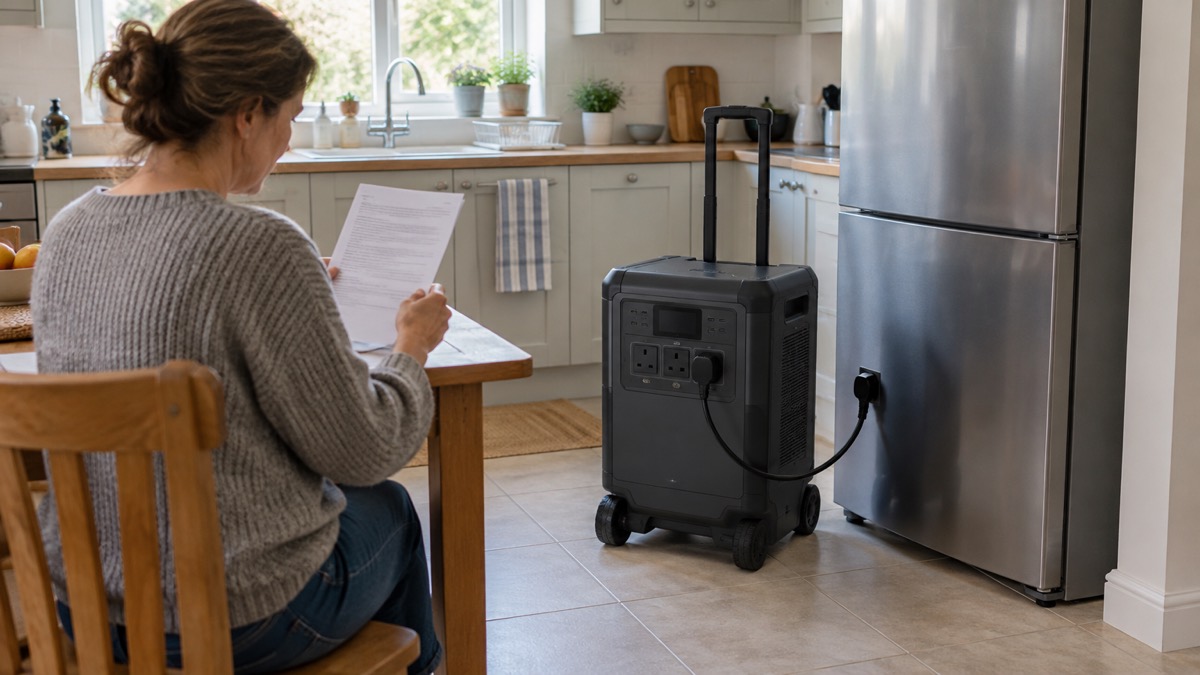
Read those as the maker's own estimates at steady loads. A fridge cycles on and off, so its real draw varies through the day, and a device that surges on start-up uses more than its label suggests. The maker quotes a 3,900 W lifting power alongside the 2,600 W rated output2.
The unit also has a 15 ms UPS mode, which the maker says keeps devices running without a blink when the mains drops6. That is fast enough for most household electronics, though whether a particular device rides through depends on the device. For how switchover times work in practice, see Using a Power Station as a UPS.
Deciding what to keep running is the step before buying anything. A fridge, the broadband router, a few lights and phone charging is a realistic list for a unit this size; an electric shower, an oven or a heat pump is not. Deciding What to Keep Running When the Mains Fails walks through that list, and How Long Will a Power Station Run a Fridge or Laptop? covers the arithmetic.
Solar and car charging: up to 1,000 W input
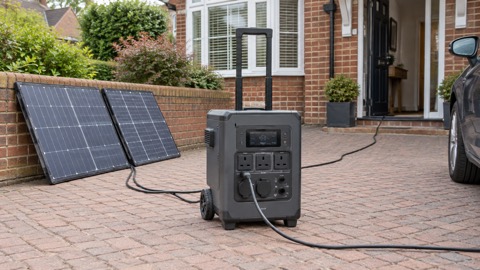
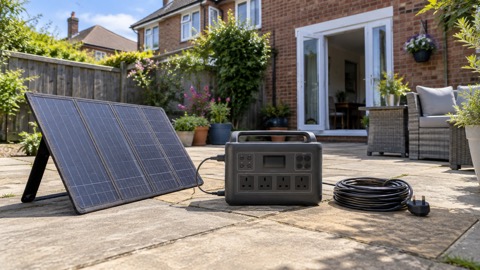
There are three ways to fill the battery: a wall outlet, solar panels, or your car6. The solar input accepts up to 1,000 W at 12V to 60V and 20A maximum, and the maker states a full charge in 6 hours on solar alone at that input5.
Charging times the maker gives:
- Solar alone: full charge in 6 hours at up to 1,000 W5.
- Car plus solar together: full charge in 4.2 hours at up to 1,000 W with the dual charger5.
- Mains plus solar: 0 to 80% in 1 hour at 3,300 W combined5.
- Mains alone: 80% in 1.8 hours on 2,300 W AC5.
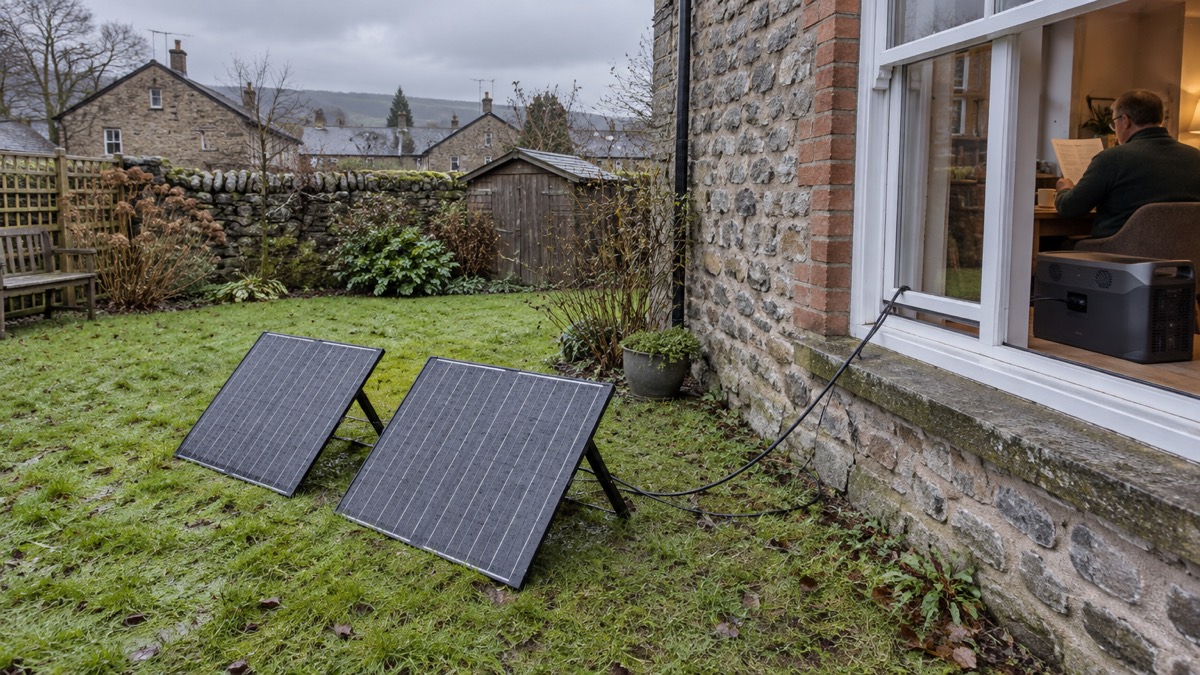
The maker gives two charging times for the same unit: a full charge in 6 hours on solar input up to 1,000 W, and a full charge in 4.2 hours with the car and solar dual charger at up to 1,000 W5. Both are the maker's figures for different set-ups, so treat solar charging time as dependent on how much panel you can deploy and how much sun there is.
The maker also states that its kit can charge from both a car and solar panels at once, powering the main storage and leisure battery while driving with no drain on the reserve1, and that it delivers up to 800W of reverse charging power to revive a vehicle battery1. For the practical limits of charging from a vehicle, see Can You Charge a Power Station from Your Car?, and for panel sizing, What Size Solar Panel Do I Need to Charge a Power Station?.
The unit can recharge and power devices at the same time, so you can run a lamp off it while it is topping up6. BLUETTI's TurboBoost feature is stated to recharge devices from 0 to 80% much faster than traditional power adapters9.
Weight, handles and wheels: moving a 39kg unit
At 39kg, the Elite 400 is heavy: about the weight of a large suitcase packed for a long trip. BLUETTI describes it as portable with handles and wheels, suited to an outdoor trip4, and separately claims it is the lightest 3.8 kWh power station, up to 35% lighter10. Treat that as the maker's claim rather than a measured comparison.
Practical points for a household:
- Keep it on the ground floor where you are most likely to need it, rather than carrying it upstairs.
- Use the wheels and telescopic handle for moving it between rooms; the maker lists a telescopic handle and wheels as part of the design5.
- Plan the route before an outage, so you are not dragging 39kg in the dark.
- Do not lift it alone up or down stairs if you have any doubt about your back or grip.
The maker's app lets you monitor and manage the unit, see real-time energy use, set low and full battery alerts, wake it remotely from sleep mode and set on and off timers9. That is useful if the unit lives in a cupboard or garage and you want to know its state without moving it.
Charging, using and storing it safely
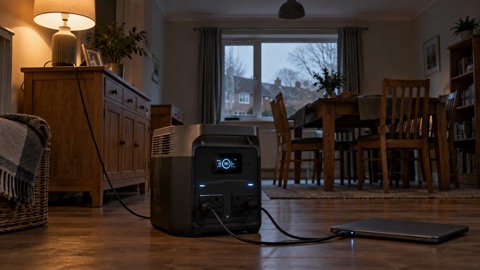
The Elite 400 has no exhaust and BLUETTI describes it as clean, sustainable power with zero emissions3. That is the central safety difference from a petrol generator, which must never be run indoors. It does not make the unit risk-free: it is a large lithium battery, and the fire risk from lithium batteries is real. Keep it on a hard, non-flammable surface while charging, away from soft furnishings and exit routes, and follow the maker's manual. For the wider picture, see Lithium-Ion Battery Safety at Home and Are Portable Power Stations a Fire Risk?.
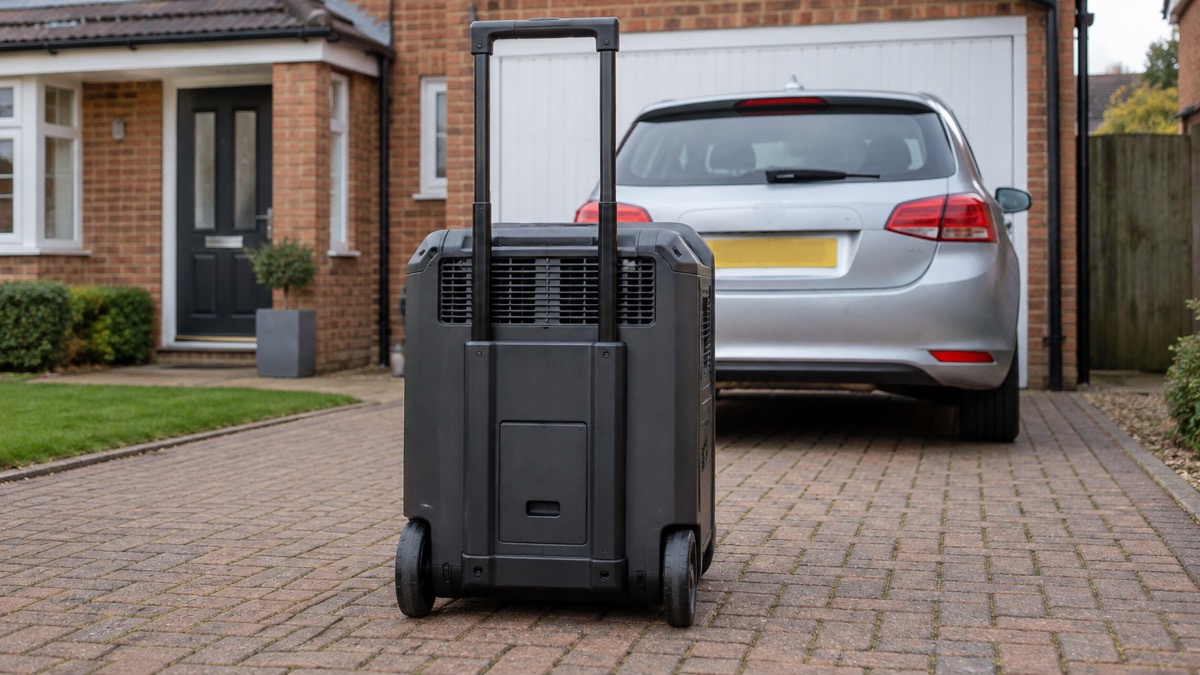
The box contains the unit, an AC charging cable, a grounding screw (M5*10mm) and the user manual4. The grounding screw is listed among the contents but the maker's pages here do not explain when to fit it; the manual that comes with the unit is the place to check. If you are unsure, ask a qualified electrician rather than improvising.
For storage, the general rules for lithium batteries apply: keep it out of freezing conditions and away from damp, and check the charge level periodically. How to Store a Power Station When Not in Use and What Temperature Should Batteries Be Stored At? cover this in detail.
The unit can power 7 devices simultaneously9. If you are plugging in several items, watch the total load against the 2,600 W rating, and avoid daisy-chaining extension leads: see Extension Leads and Overloading With Backup Kit.
Where it fits in a household plan
The Elite 400 is a large-capacity unit aimed at keeping a fridge and essentials going through an outage, and at outdoor and site work6. It is not a whole-house battery and it is not wired into your consumer unit; it powers what you plug into it. If you are weighing up a power station against a generator, Portable Power Station or Petrol Generator for a Power Cut sets out the trade-offs, and Portable Power Stations: What They Do and How to Choose covers the category as a whole.
For a household starting from scratch, the sensible order is: decide what must keep running, work out the load, then choose a unit that covers it with margin. What Capacity Power Station Do I Need? and the Power Cut Backup Power Checklist are the practical starting points.
BLUETTI states it has over 3.5 million users in 110+ countries and 1,000+ patents worldwide10. Those are the maker's own figures. For the brand's wider range, see the BLUETTI brand page.
Sources (10)
- Camping Portable Power Station range, BLUETTI, 2026-10-25
- Elite 400 product page (2,600 W, 3,840 Wh), BLUETTI, 2026-10-25
- BLUETTI Elite 400 Portable Power Station, BLUETTI, 2026-10-25
- Elite 400 with 200W solar panel, BLUETTI, 2026-10-25
- Elite 400 with 2 x 200W solar panels, BLUETTI, 2026-10-25
- Elite 400 Portable Power Station, BLUETTI, 2026-10-25
- Disaster Preparedness, BLUETTI, 2026-10-25
- Home Backup, BLUETTI, 2026-10-25
- Elite 400 with 500W solar panel, BLUETTI, 2026-10-25
- BLUETTI Portable Power Station range, BLUETTI, 2026-10-25

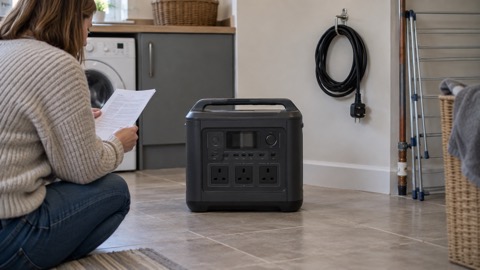 BLUETTI Apex 300 Power Station
 BLUETTI Elite 100 V2
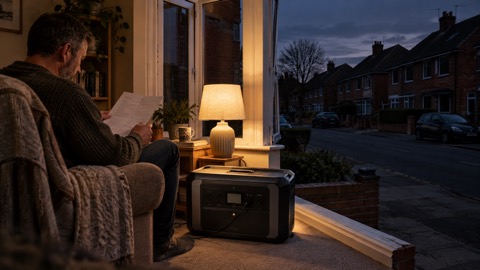 Anker SOLIX C2000 Gen 2
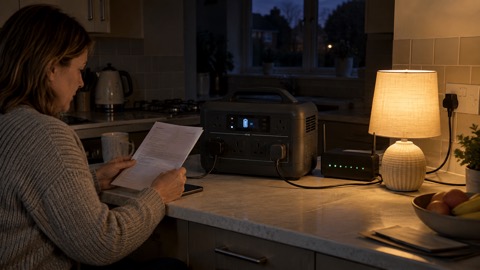 Anker SOLIX C1000 Power Station
 EcoFlow DELTA Pro
 Anker SOLIX C300 Power Station
 EcoFlow DELTA 3
 EcoFlow DELTA 2 and DELTA 2 Max
 EcoFlow DELTA and DELTA Max
 EcoFlow RIVER 3 and RIVER 3 Plus
 EcoFlow RIVER 2 and RIVER 2 Max
 BLUETTI Elite 30 V2