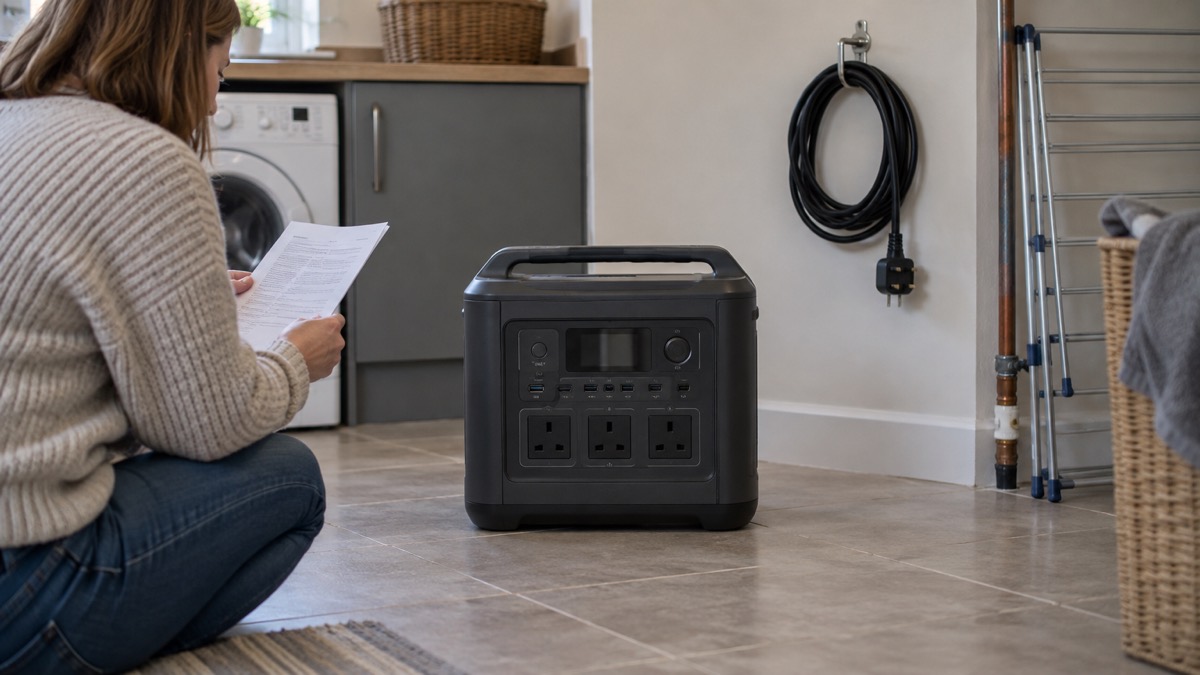
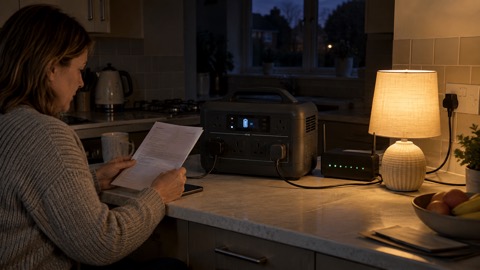
The BLUETTI Apex 300 is a large portable power station that the maker also sells as a home backup battery. It holds 2,764.8Wh of lithium iron phosphate (LiFePO4) storage, delivers 3,840W of AC output with 7,680W of surge, and can be expanded with add-on batteries from 2,764Wh up to 58kWh1. For a household, that means one unit can run a kettle, a fridge, a boiler or a CPAP machine through a cut, and a stack of units and batteries can carry more of the house for longer.
What sets it apart from a simple camping battery is the way it is meant to sit in the home. The maker states a 20ms UPS switchover, so connected equipment keeps running when the mains drops, and a 12kW bypass that lets heavy loads such as heating, ventilation and EV charging pass through it2. It is heavy at 38kg, it is not waterproof, and it is charged from the mains, solar, a generator or a car3.
This page sets out what the Apex 300 is, what it can run and for how long, how to charge it, and how to use and store it safely. Figures are the maker's own, dated 25 October 2026, and where the maker's pages disagree the disagreement is shown.
What the Apex 300 is and who it suits
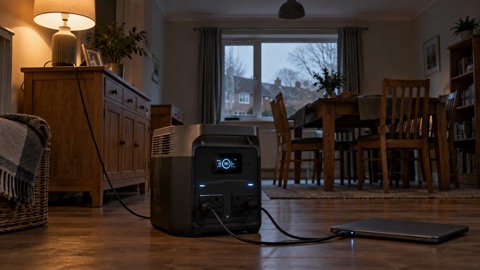
The Apex 300 is a portable power station with a base capacity of 2,764.8Wh and 3,840W of AC output3. The maker describes it as a home backup battery that can also be carried into a campervan and used as the primary power system there, and it lists a DIY backup window of 1 to 7 days3. That dual role is the point of the product: it is meant to live in the house most of the time and travel when needed.
It suits a household that wants a battery it can move, rather than a fixed wall battery wired into the consumer unit. The maker states the unit is hot-swappable, so a battery or the Apex 300 itself can be swapped without shutting the system down, and that whole-home backup can be reached in about 5 minutes of expansion3. Those are the maker's claims about its own product, and they describe a plug-in approach rather than a fixed installation.
It is less suited to anyone who wants to lift it regularly. The maker's own support material asks how to install a 38kg unit, which tells you it is not a carry-in-one-hand device3. Treat it as something you site once and leave in place.
If you are still deciding what kind of backup you need at all, the guide to portable power stations sets out the categories, and home battery storage explains what a fixed battery does differently.
Specifications
The table below collects the maker's headline figures. Where two maker pages give different numbers, both are shown.
| Specification | Maker's figure |
|---|---|
| Battery capacity | 2,764.8Wh base; 2,764Wh to 58kWh with expansion1 |
| Battery chemistry | Lithium iron phosphate (LiFePO4)3 |
| AC output | 3,840W continuous2 |
| Surge output | 7,680W3 |
| Scalable output | 3,840W to 11.52kW with expansion2 |
| Bypass power | 12kW2 |
| UPS switchover | 20ms2 |
| AC outlets | 43 |
| Cycle life | 6,000 cycles at 80% capacity retention2 |
| Stated lifespan | Up to 17 years1 |
| Weight | 38kg3 |
| Weather resistance | Not waterproof; keep dry during use5 |
| Certification | MIL-STD-810G military certified4 |
| Idle loss | 20W6 |
Two points in that table matter more than the rest for a household. The first is the 3,840W continuous output against a 7,680W surge: motors and heating elements draw a burst of power when they start, and the surge figure is what covers that3. The second is the 20ms switchover, which is fast enough that the maker says CPAP devices keep running4. If you want to understand why watts and watt-hours are different things, the guide to watts, watt-hours and surge explains it.
What it can run, and for how long
Run time depends on what you plug in. The maker publishes figures for common appliances, and they show the range clearly: a kettle is a short burst, a CPAP machine is an overnight job, and a fridge sits in between.
| Appliance | Configuration | Run time |
|---|---|---|
| Electric kettle (1,500W) | Apex 300 alone | 0.8 hours6 |
| Electric kettle (3,000W) | Apex 300 with B500K | 2.2 hours6 |
| Microwave (1,200W) | Apex 300 with B500K | 5.5 hours6 |
| CPAP (40W) | Apex 300 with B300K | 78.8 hours9 |
| CPAP (40W) | Apex 300 with B500K and SolarX 4K | 112.4 hours6 |
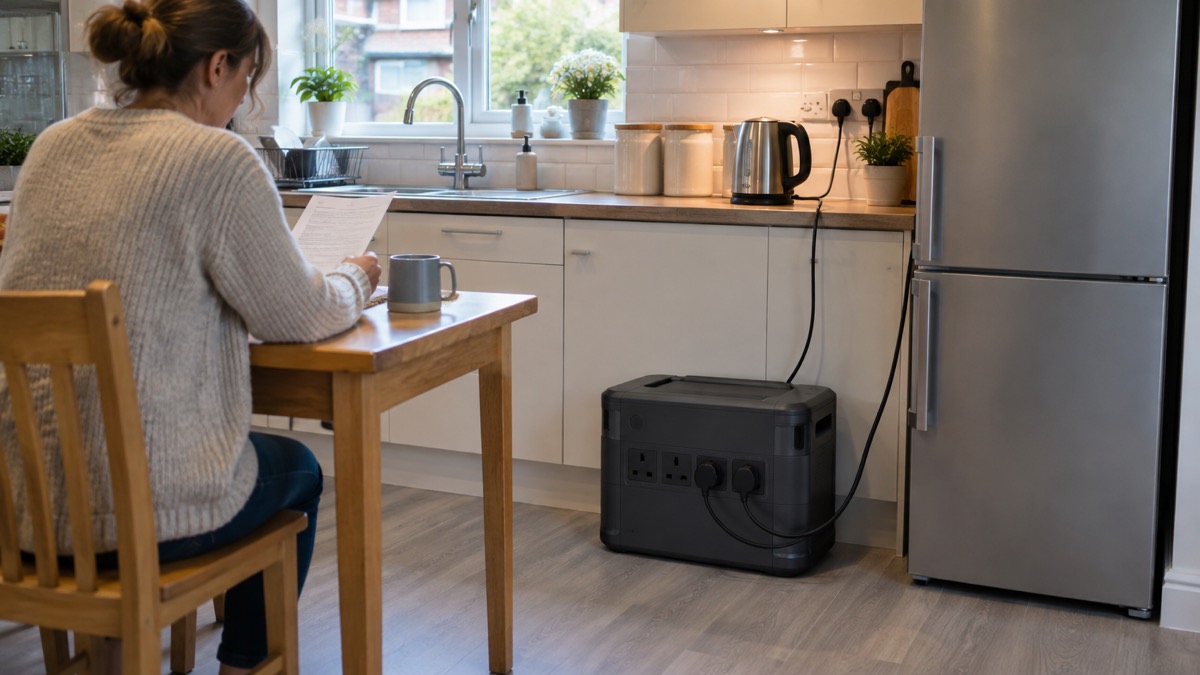
The maker's pages do not agree on every run-time figure. One page gives 5.5 hours for a 3,000W kettle on an Apex 300 with a B500K, while another gives 2.2 hours for the same pairing5. Both are the maker's own numbers and they disagree, so treat kettle run time as a rough guide rather than a specification. The same caution applies to the 13.9 hours and 1.9 hours figures that appear for unspecified loads on the maker's winter storm page6.
For a household, the practical lesson is to work out your own critical loads first. The guide to deciding what to keep running helps you list them, and the guide to power station run time explains how to estimate from appliance wattages. A 1,500W kettle for 0.8 hours is a lot of energy for a cup of tea; a 40W CPAP machine for 78.8 hours is the same battery doing something that matters overnight6.
Keeping the power on in a cut
The Apex 300 is sold as a home backup battery as well as a portable unit, and the backup features are what justify that. The maker states a 20ms seamless transition, which it says keeps CPAP devices running, and a 12kW bypass that powers heating, ventilation, air conditioning and EV charging2. In practice the bypass means heavy household loads can pass through the unit rather than being fed by the battery, which is how a relatively small battery can sit in front of a whole circuit.
The maker also states that three units can be paralleled for 100.45kWh and 11.52kW of output, which it describes as ideal for whole-home backup5. That is a large installation by any standard, and it is the maker's description of its own product rather than an independent test.
Connecting any battery to a home's wiring is not a plug-in job in the way that running an extension lead is. The guide to connecting a generator or battery to your home's wiring sets out what is involved and why a qualified electrician should do it. The maker's 5-minute figure is for expanding to whole-home backup, not a description of the wiring work itself3.
Expanding from 2.7kWh with B300K and B500K batteries
The base unit is the start, not the limit. The maker states the Apex 300 begins at 2,764.8Wh and adds up to six B500K batteries for 33,484.8Wh in total, and elsewhere describes a scalable range of 2,764Wh to 58kWh with 3,840W to 11.52kW of output2. A separate page describes the system as freely expandable from 2.7kWh to 100kWh, plug and play10. The maker's pages give different ceilings, so the honest answer is that the top end depends on which combination you build.
Expansion is done with cables rather than tools. The maker states that B300K expansion batteries are connected with long and short expansion cables according to your energy needs3. The Hub D1 is an add-on that the maker says lets the Apex 300 be stored out of sight while the hub stays accessible, using a 60-inch (1.5m) cable3. Bundles are sold with the hub included, and the maker notes that each unit is delivered separately11.
| Configuration | Capacity | Output |
|---|---|---|
| Apex 300 alone | 2,764.8Wh3 | 3,840W2 |
| Apex 300 with B300K | 5,529.6Wh5 | 3,840W5 |
| Apex 300 with B500K | 7,884.8Wh5 | 3,840W5 |
| Apex 300 with B500K and Hub D1 | 13,004.8Wh5 | 3,840W5 |
| Apex 300 with six B500K | 33,484.8Wh5 | 3,840W to 11.52kW2 |
If you are weighing up expansion batteries against a second unit, the page on the BLUETTI B500K expansion battery covers that battery on its own. The general guide to power station sizing helps you decide how much capacity your household actually needs before you buy more.
Charging options: mains, solar, generator and car
The Apex 300 can be charged four ways, and the maker's figures for each are worth reading carefully because they vary by method and by which accessory is used.
- Mains, Turbo Boost AC: the maker states 80% in 50 minutes and 100% in about 70 minutes5. Another maker page gives 80% in 55 minutes and full in 75 minutes for standard solar charging, and the two figures disagree on the exact times2.
- Mains and solar together: the maker states AC plus solar dual charging at 2,990W maximum, with a full charge in 65 minutes3.
- Generator: the maker states generator charging at up to 2,990W, reaching a full charge in 70 minutes, and separately that the unit supports up to 11.52kW of generator charging at 230V2. It also reports that the unit accepts split-phase power for charging and so is compatible with most petrol generators6.
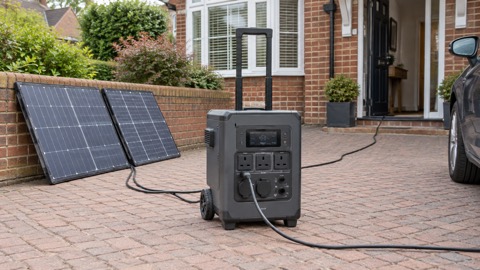
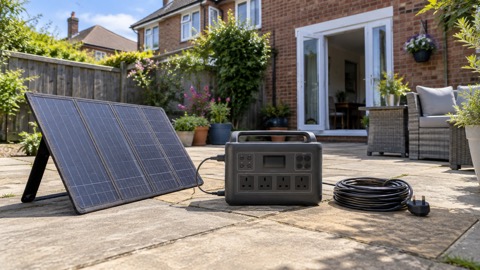
- Solar: the maker gives 2,400W maximum for standard solar charging, 4,000W for super-fast solar charging with a full charge in 1.9 hours, and up to 19.2kW or 30,000W with the SolarX 4K depending on the page2. The maker's pages disagree on the solar ceiling, so check the accessory you are buying.
- Car: alternator charging through Charger 1 is rated at 560W maximum, with a full charge in 5.5 hours, and dual charging through solar plus Charger 1 is rated at 1,760W maximum with a full charge in 1.8 hours2.
The maker notes that charging data is tested by BLUETTI Labs and that actual charging times may vary3. Solar charging in the UK is slower in winter and on cloudy days, which the guide to solar charging time in the UK explains. If you plan to charge from a car, the guide to car charging covers what the alternator can and cannot deliver.
Safe use and storage
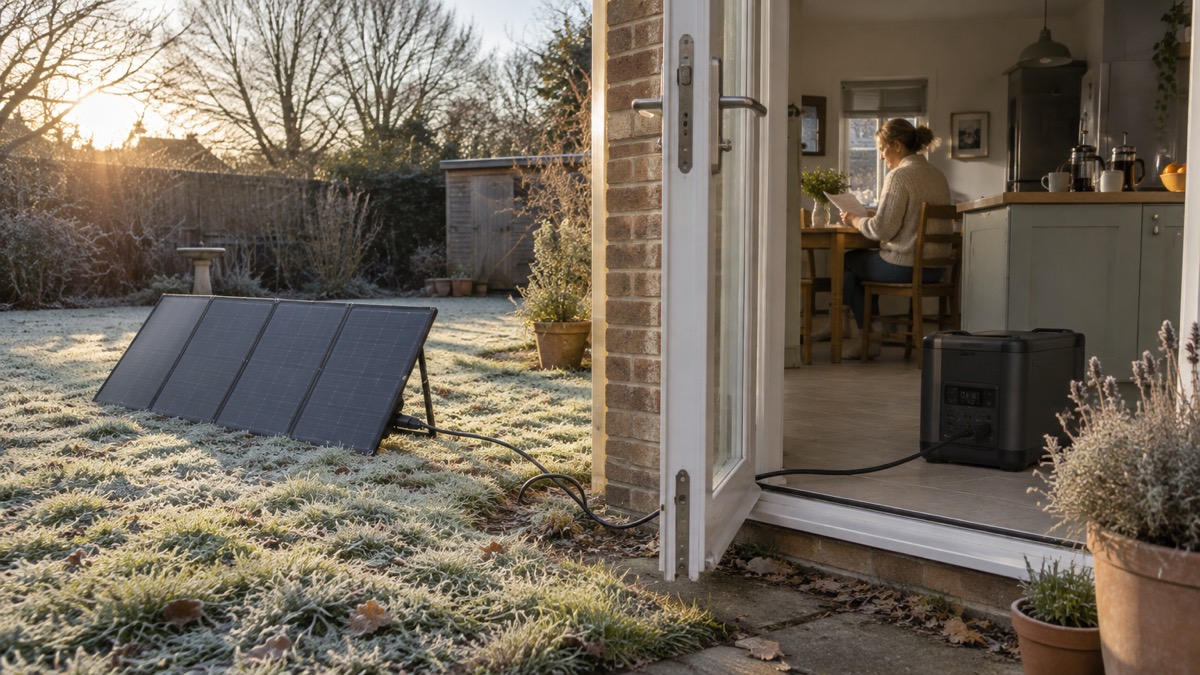
The maker's own instructions are short and worth following exactly. The unit is not waterproof: asked whether it can be used in rain, the maker answers "No. Please keep it dry during use."1. That applies to storage as well, so keep it out of damp sheds and away from leaks.
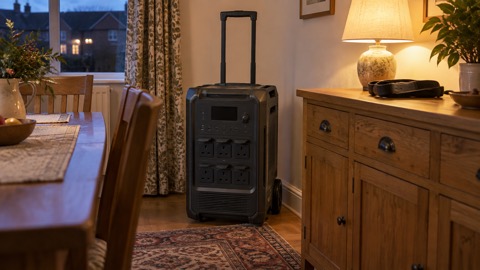
The weight is the other practical hazard. At 38kg, the Apex 300 is not something to shift about casually3. Plan where it will live before delivery, and do not carry it up a ladder or onto a high shelf.
Idle loss is small but real. The maker states 20W of idle loss and describes the unit as using only 20W when self-powered, which it says allows the battery to be stored for several months10. That is the maker's claim; the general guide to storing a power station explains why you should still check and top up stored lithium batteries periodically.
The maker states built-in battery management system protection against overcharging, overheating and short circuits10. That is a safety feature, not a licence to charge carelessly: the general guide to lithium-ion battery safety at home and the safe charging setup checklist cover siting, ventilation and what to do if a battery gets hot. If a battery ever swells, the guide to what to do if a battery starts swelling sets out the steps.
App control and extreme weather alerts
The Apex 300 connects to the BLUETTI app over Wi-Fi or 4G. Through the app, the maker states, users can remotely switch the unit on and off, check the battery level and control output11. The maker also lists real-time Extreme Weather Alerts through the app, which flag severe weather that might affect your power12. For a household, that is a useful prompt to charge the unit before a named storm rather than during one.
The app is a convenience, not a substitute for knowing your kit. If the app or the mobile network is down, the unit still works from its own controls, and you should know where they are and what the display shows before you need them. The guide to using generators and power stations during an outage covers the practical routine.
The maker's winter storm page describes the Apex 300 with a B500K as delivering long-lasting power for cooling, communications and everyday essentials through extended outages, and suggests adding solar charging to extend backup time during daylight13. That is the maker's own suggested use case, and it matches the way most households would use the unit: a few essentials, kept going, topped up when the sun is out.
What comes in the box, and buying it
The maker lists the box contents as the Apex 300 itself, one AC charging cable, one car charging cable, one grounding screw and one user manual2. Bundles that include the Hub D1 add the hub to that list11. Expansion batteries and solar panels are separate products, and the maker notes that each unit will be delivered separately11.
On the grounding screw, the maker supplies it but the product pages do not explain its use. The user manual in the box is the place to check, and if you are in any doubt about earthing, ask a qualified electrician. The general guide to UKCA and CE safety markings explains what the markings on the unit mean.
The maker's UK product page carries the line "Get it on Indiegogo!"3. Crowdfunding is a different route from buying from a shop: delivery dates can move and consumer protections differ, so check the current status and terms before committing. The maker also states that the Apex 300 was launched on May 20, without giving a year on the page3.
On lifespan, the maker states 6,000 charge cycles with 80% capacity retention and up to 17 years of reliable use1. Those are the maker's figures for its own cells. Real life depends on depth of discharge, temperature and how often the unit is cycled, which the guide to how long power banks last discusses in general terms.
The maker claims 50% higher drop resistance and MIL-STD-810G military certification3. Those are durability claims, not a waterproof rating, and they do not change the instruction to keep the unit dry5.
Where to get help and support
BLUETTI is the maker and the first point of contact for support, manuals and warranty terms. The brand's own page on this site is BLUETTI, and the maker's UK site carries the product pages and support material cited here. Keep your proof of purchase and the user manual, and register the product if the maker asks you to.
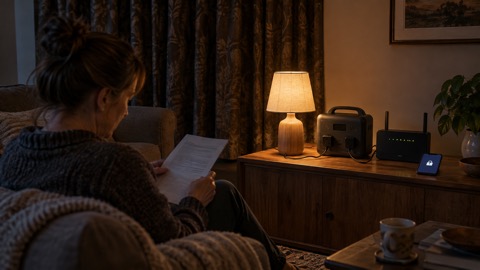
If the unit fails during a power cut, the priority is the household, not the kit. The guide to power cuts covers what to do while the mains is off, and the power cut backup power checklist lists what to have ready. For medical devices, the guide to powering CPAP, oxygen and other medical devices explains what to plan for and who to tell.
For anyone who needs extra help in a power cut, the Priority Services Register is the route to support from energy suppliers and network operators. Ask your supplier to add you, and tell them about any medical equipment that depends on electricity.
Sources (13)
- BLUETTI Apex 300 product page, BLUETTI, 2026-10-25
- BLUETTI Apex 300 home battery backup, BLUETTI, 2026-10-25
- BLUETTI Apex 300 overview, BLUETTI, 2026-10-25
- BLUETTI Apex 300 Charger 2, BLUETTI, 2026-10-25
- BLUETTI home battery backup, BLUETTI, 2026-10-25
- BLUETTI winter storm backup power, BLUETTI, 2026-10-25
- BLUETTI portable power station, BLUETTI, 2026-10-25
- BLUETTI Apex 300 Charger 2 DC Hub, BLUETTI, 2026-10-25
- BLUETTI off-grid solar power, BLUETTI, 2026-10-25
- Apex 300 + B300K + Charger 2 + DC Hub + 2× 350W - BLUETTI UK, BLUETTI UK
- BLUETTI Apex 300 B300K Charger 2 DC Hub, BLUETTI, 2026-10-25
- Apex 300 + B500K + SolarX 4K - BLUETTI UK, BLUETTI UK
- BLUETTI disaster preparedness, BLUETTI, 2026-10-25

 BLUETTI Elite 100 V2
 Anker SOLIX C2000 Gen 2
 Anker SOLIX C1000 Power Station
 EcoFlow DELTA Pro
 BLUETTI Elite 400
 Anker SOLIX C300 Power Station
 EcoFlow DELTA 3
 EcoFlow DELTA 2 and DELTA 2 Max
 EcoFlow DELTA and DELTA Max
 EcoFlow RIVER 3 and RIVER 3 Plus
 EcoFlow RIVER 2 and RIVER 2 Max
 BLUETTI Elite 30 V2