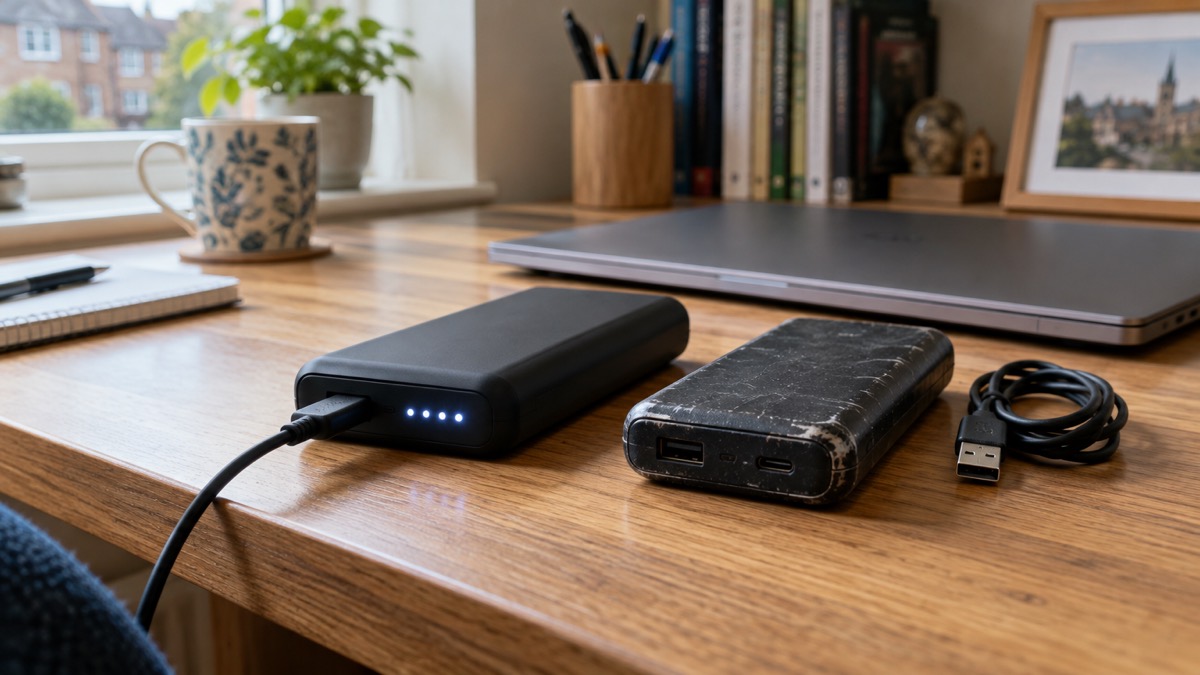
A power bank is a battery, some circuitry and one or more charging ports, often USB or USB-C1. Most use lithium-ion cells, and those cells naturally get warm as they charge and discharge1. That warmth is normal. What shortens a power bank's life, and what makes it dangerous, is heat that is not managed, charging that carries on after the battery is full, and physical damage.
There is no single number of years a power bank lasts, because it depends on the cells inside, how often you use it and how you treat it. What you can control is the pattern: charge it during the day while you are awake, unplug it once it is full, keep it out of extreme heat and cold, and check it for swelling before you rely on it. A power bank that has begun to bulge, swell or change shape is failing and must not be used2.
For an ordinary household, the power bank is the piece of backup kit that keeps a phone alive in a power cut. That matters more than it used to: phone lines are moving to a system that needs mains power at home, so a charged phone and a charged power bank are part of being ready3. Keep phones, laptops, tablets and power banks fully charged so you have battery power for a short time at least4.
What is inside a power bank, and why it gets warm
A power bank is a battery, circuitry and one or more charging ports, often USB or USB-C1. The battery is usually lithium-ion, and lithium-ion cells naturally get warm during charge and discharge cycles1. The same is true of the lithium-ion battery in a laptop9. Warmth is a by-product of moving energy in and out, not a fault in itself.
The problem is what sustained heat does over time. Heat can cause the chemicals inside a lithium-ion battery to break down more quickly, reducing its lifespan, affecting charging performance and increasing the risk of overheating or failure10. Exposure to high temperatures speeds up battery ageing and increases the chance of battery failure6. So a power bank left on a sunny windowsill, or in a hot car in summer, will not last as long as one kept at a steady room temperature, and it is more likely to fail.
Cold matters too, in a different way. If a battery has been left in freezing conditions, allow it to warm up slowly indoors before using or charging it10. Charging a battery when it is extremely cold can damage it10. A power bank kept in a cold porch or shed over winter should be brought inside and allowed to reach room temperature before it goes on charge.
The maker of one 20,000mAh power bank, the EcoFlow RAPID Pro, states that it should be stored in an environment between -20°C and 40°C and recharged at least once every three months8. That three-month recharge is worth copying as a habit whatever model you own: a lithium-ion battery left flat for a long time is not being looked after. For more on matching a power bank to your devices, see Power Banks: Keeping Phones Charged in an Emergency.
Charge it in daylight, and unplug it when it is full
The fire and rescue services are consistent on this point. Don't leave items continuously on charge after the charge cycle is complete, for example don't leave your phone plugged in overnight5. Don't charge devices overnight when anyone is asleep or leave them on charge when you've left the home11. Charge your devices and equipment during the day, instead of at night while you're sleeping, and ensure they're charged away from escape routes6.
For power banks specifically, the advice is the same: don't charge your power bank overnight or whilst you are out of the house2. Electrical Safety First gives the same instruction for USB chargers: don't use USB chargers overnight or while you are out of the house12. The National Fire Chiefs Council's Charge Safe campaign puts it plainly: never leave a battery charging unattended, and don't charge it while you are asleep or away from home13.
"Only charge items and batteries during the daytime and unplug once charged."
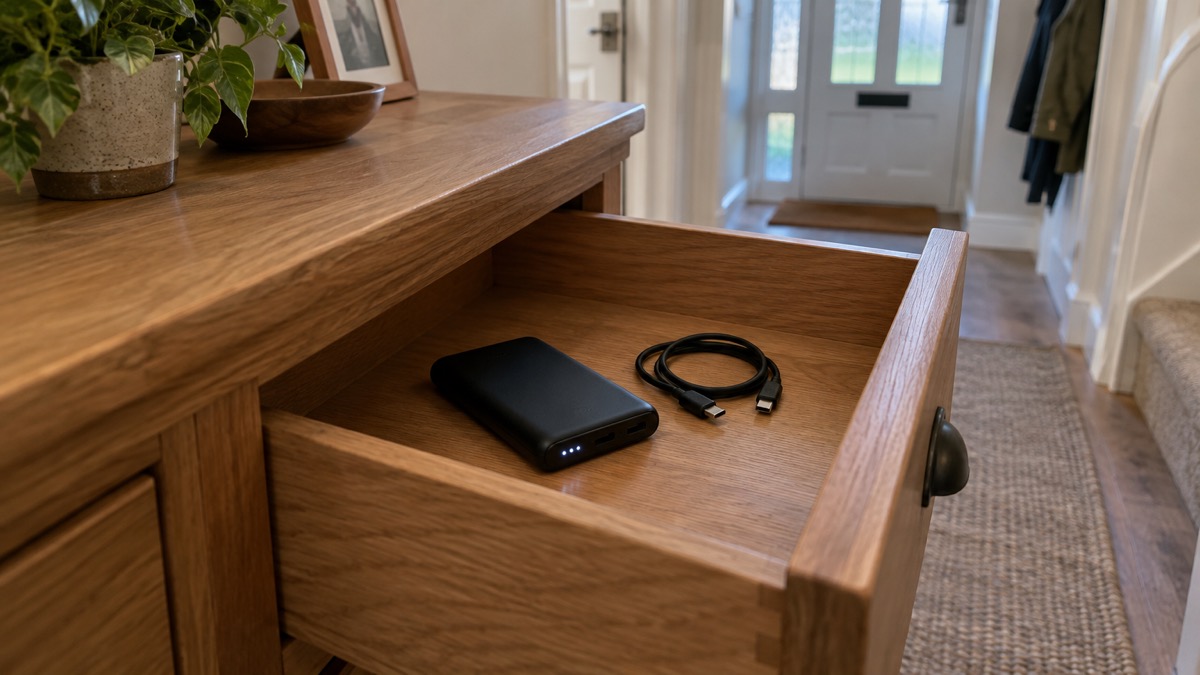
The reason is response time. If a lithium-ion battery fails while it is charging, you need to be awake, alert and in the building to notice and act. Fire services in Scotland make the same point: to make sure you can respond quickly in the event of a fire, you should not charge your battery while you are asleep or away from home11. The Fire and Rescue Service in Northern Ireland advises never leaving a device on charge when you're out of the house or asleep, following the manufacturer's instructions for charging times and always unplugging the charger once it's finished15.
A few practical points follow from this:
- Charge in a room with a working smoke alarm, and not on an escape route such as a hallway or stairs6.
- Use the approved charger and unplug it when charging is finished6.
- Don't cover the power bank or charger while charging16.
- Don't overload sockets or rely on extension leads for charging batteries6. For the wider picture, see Extension Leads and Overloading With Backup Kit.
- Don't leave mobile phones, tablets or e-cigarettes charging overnight either, as part of your bedtime routine17.
If you want a simple routine to follow, the Safe Battery Charging at Home Checklist sets one out step by step. For the specific question of charging while you sleep, see Is It Safe to Charge Overnight?.
Bulging or swelling is the biggest sign a power bank is failing
If you check one thing on a power bank, check its shape. The biggest tell-tale sign is if your power bank starts to bulge, swell or change shape2. A power bank that has swollen is not a power bank with a cosmetic problem. It is a battery that is failing, and it should be taken out of use.
The same checks you would make on a plug or socket apply to the charger and cable you use with it. Do regular checks of plugs and sockets for burn marks, sounds of arcing (buzzing or crackling), fuses blowing, circuit-breakers tripping or if it feels too hot to touch18. Don't ignore burn marks, arcing sounds, fuses blowing, circuit-breakers tripping, or a plug that feels hot to touch19. Never use a charger that shows signs of damage or appears to not be working properly20.
| What to check | What is normal | What means stop |
|---|---|---|
| Shape of the case | Flat, unchanged | Bulging, swelling or a change of shape2 |
| The charger and plug | Cool, undamaged | Burn marks, buzzing or crackling, too hot to touch18 |
| The cable | Intact insulation | Fraying, exposed wire, damage20 |
| Performance | Charges as it always has | Sudden loss of capacity or repeated cut-outs20 |
A power bank that shows any of the warning signs in the right-hand column should be retired. Do not charge it again to "see if it is fine". For a closer look at the warning signs, see Warning Signs a Lithium Battery Is Dangerous, and for what to do with one that has already started to swell, What to Do If a Battery Starts Swelling.
Why a damaged power bank must not be used
A damaged lithium-ion battery is a fire risk, and a lithium-ion battery fire is not like a chip pan fire. When overcharged or overheated, batteries rapidly overheat, release toxic fumes, and ignite, causing intense fires that are hard to extinguish21. The high energy density allows them to burn at temperatures over 700°C to 1000°C21. Lithium-ion battery fires can spread rapidly and produce toxic smoke22.
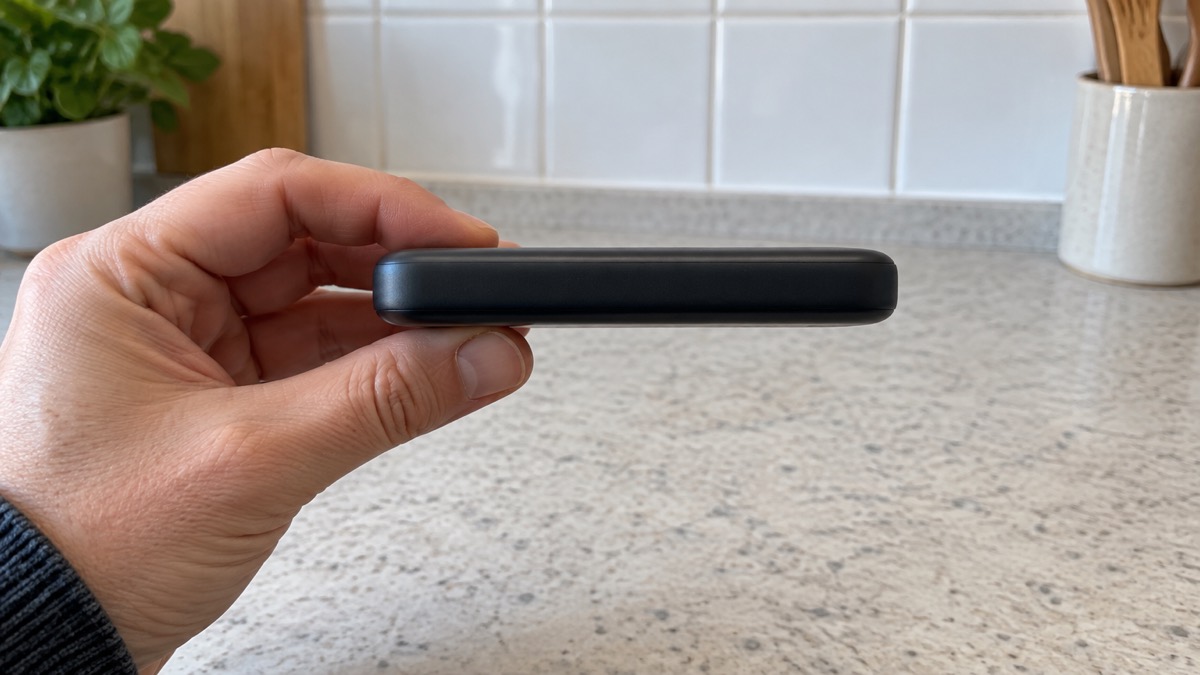
Water is one route to damage. Protect your power bank from damage and don't immerse it in water1. A power bank that has been through a flood, dropped in a sink or left out in the rain should not go back into your emergency kit. For the wider question of what to do with electrical items after a flood, see Electrical Safety After a Flood19.
Heat and cold are the other routes. Don't leave a power bank in a parked car where it could get cold in winter or hot in summer1. A car in the sun can get far hotter than the air outside, and a car in a frost can drop below freezing, both of which stress the cells.
Never use a charger that shows signs of damage or appears not to be working properly23, and never touch damaged electricity equipment3. Do not immerse a power bank in water6. For the full sequence, see What to Do If a Lithium Battery Catches Fire, and for safe disposal of one that has failed, How to Dispose of a Damaged Lithium Battery.
Charging and using at the same time, and other limits
Most portable battery packs do not support charging and discharging at the same time1. In practice that means a power bank plugged into the wall will not reliably charge your phone at the same time. Charge the power bank first, unplug it, then use it. Check your own maker's instructions, because a few models do allow it.
The maker's instructions are the authority for your model. Read the manufacturer's instructions carefully and always follow them1. They will tell you the charging time, the approved charger and any storage conditions. The EcoFlow RAPID Pro, for example, carries a two-year warranty8, but the terms that matter for safety are the charging and storage instructions, not the warranty length.
Register the power bank when you buy it. Register your power bank so you can be contacted easily if there is a safety recall of your product, and so it is easier to return a faulty item or order a repair if it's registered24. If you choose not to register your product, product recalls can be checked via Electrical Safety First or the UK government website11.
A power bank is not the only way to keep a phone alive. The British Red Cross suggests preserving phone battery life by reducing screen brightness, closing unused apps and limiting unnecessary use, and using a power bank only when needed25. That is good advice for stretching whatever charge you have. For the alternatives, see Wind-Up and Small Solar Chargers for Phones and Radios and USB-C Charging, Power Delivery and Cables Explained.
Where a power bank fits in a household's power cut kit
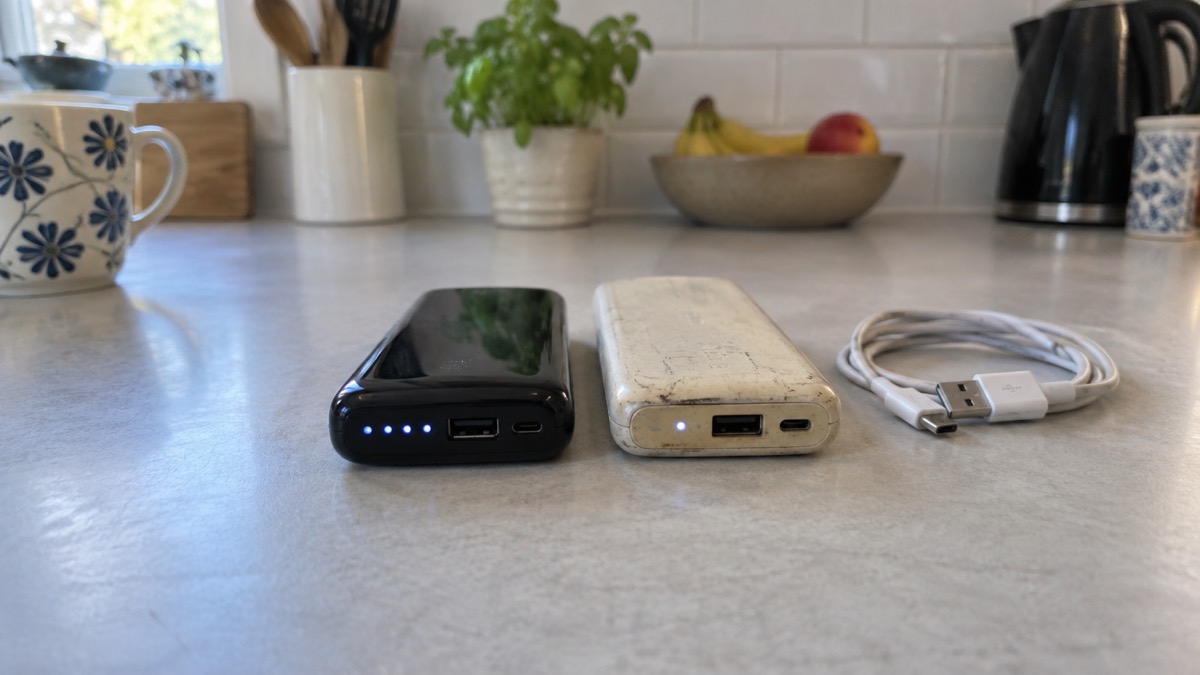
A power bank is the smallest piece of backup power, and it does one job well: it keeps a phone, tablet or radio going for a short time. Official advice for a power cut is to have a fully charged power bank available, in case you need to charge your phone, tablet or other devices23. The same advice appears in Northern Ireland's severe weather guidance: keep mobile phones, laptops, tablets and power banks fully charged, so you will have use of battery power for a short time at least4.
That "short time" is the honest limit. A power bank will not run a fridge, a boiler or a heater. For those you need a portable power station or a generator, and the choice between them is set out in Power Bank or Portable Power Station. For the wider kit, see the Power Cut Backup Power Checklist.
Some households have a higher stake. If someone at home relies on medical equipment, make sure its backup systems work properly and it has a backup battery that lasts at least 3 hours during a power cut26. That is a different class of backup from a phone power bank, and it is covered in Powering CPAP, Oxygen and Other Medical Devices From a Battery.
It is also worth knowing how long a power cut is likely to last. Most power cuts do not last very long28. That is why a charged power bank and a charged phone are often enough to see a household through, and why the effort of charging them safely is worth making.
Sources (28)
- Power banks, Electrical Safety First, 2026-10-26
- Is your power bank a flight risk?, Electrical Safety First, 2026-10-25
- Future of landline calls, Ofcom
- Strong winds weather warning information and advice, nidirect, 2026-10-24
- Batteries and chargers, London Fire Brigade, 2026-10-25
- Battery fires, Devon and Somerset Fire and Rescue Service, 2026
- Lithium battery fire safety, Mid and West Wales Fire and Rescue Service, 2026-10-26
- EcoFlow RAPID Pro Power Bank, EcoFlow, 2026-10-25
- Laptops and notebooks, Electrical Safety First, 2026-10-25
- Heat, cold and rain: how weather conditions affect e-bikes and e-scooters, London Fire Brigade, 2026-10-25
- Lithium-ion batteries, Scottish Fire and Rescue Service, 2025-11-27
- Chargers, Electrical Safety First, 2026-10-26
- Charge Safe, National Fire Chiefs Council, 2026-10-09
- Digital easy read fire safety booklet, London Fire Brigade, 2026
- Reminder not to cut corners with electrical safety this Christmas, Wiltshire and Swindon Prepared, 2026-10-25
- Home Fire Safety - Northern Ireland Fire & Rescue Service, Northern Ireland Fire & Rescue Service
- Bedtime checks, London Fire Brigade, 2026-10-25
- Looking after the electrics, North Wales Fire and Rescue Service, 2026-10-25
- Electrical safety after a flood, Electrical Safety First, 2026-10-25
- Electrical safety, North Yorkshire Fire and Rescue Service, 2026-09-14
- E-scooter, e-bike and mobility scooter fire safety advice, North Yorkshire Fire and Rescue Service, 2026-03-25
- What to do if there's a fire caused by an e-bike or e-scooter, London Fire Brigade, 2026-10-25
- 12 tips to prepare for a power cut, Horsted Keynes Parish Council, 2026
- Power banks, Electrical Safety First, 2026-10-25
- Power cut, British Red Cross, 2026-10-25
- Important information: preparing for a power cut, SP Energy Networks, 2026-10-26
- SP Energy Networks customer leaflet, SP Energy Networks, 2025-06
- Generators, Wiltshire and Swindon Prepared, 2026-10-25
 Power Cut Backup Power Checklist
 Backup Power Before Winter
 Safe Battery Charging at Home
 Running a Generator Indoors
 Carbon Monoxide from Generators
 Generator Sizing for a Power Cut
 Generator Run Time on a Tank
 Storing Petrol at Home
 Diesel Storage at Home
 Storing a Generator
 Generators in Cold Weather
 Generator Noise and Neighbours
 Power Station Capacity Sizing
 Power Station Run Time
 Power Station for a Gas Boiler