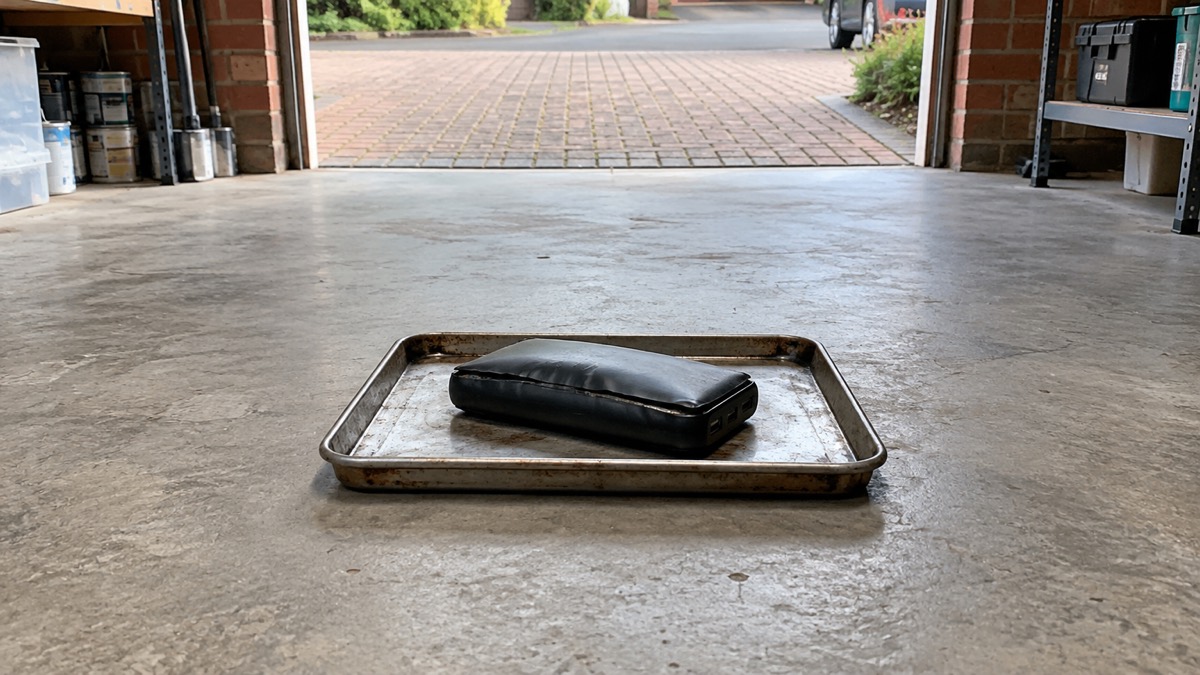
A battery that is swelling, hot or hissing is a battery that is failing, and the first thing to do is the same whatever the device: stop using it and stop charging it straight away. Unplug it if it is on charge. Do not press the swollen part, do not try to open the casing, and do not put it in the bin. The London Fire Brigade's advice is to stop charging immediately and contact the manufacturer or a certified technician1.
That applies to a phone, a laptop, a power bank, a power tool battery, a vape or an e-bike battery. The National Fire Chiefs Council says you must stop using or charging your battery immediately if you notice overheating, deformation, noise, smell, performance problems or smoke2. The Scottish Fire and Rescue Service puts it just as plainly: do not use or charge your device if the battery is producing smoke, feeling extremely hot to touch, looking swollen or has any type of lump or leak, making a hissing or cracking sound, smelling unusual, or taking longer to charge or not fully charging3.
What follows is what to do in the first few minutes, where to put the battery while you wait for advice, who to contact, and why the temptation to puncture it, press it flat or bin it is the one thing you must resist.
Stop using and charging it straight away
The moment you notice swelling, heat, a hiss or a smell, the battery has told you it is no longer safe to use. The London Fire Brigade's instruction is to stop charging immediately1. Merseyside Fire and Rescue Service says to stop using batteries that are swollen, damaged or overheating4. The National Fire Chiefs Council's Charge Safe campaign is equally direct: stop using or charging your battery immediately if you notice any of the warning signs2.
If the device is plugged in, unplug it. Oxfordshire County Council's fire safety guidance says to stop charging immediately and unplug the device if it is charging5. Do not simply switch off at the wall and leave the charger connected; take the plug out.
Then leave it alone. Do not try to squeeze the swollen case back into shape, do not press the screen or lid flat, and do not attempt to remove the battery yourself. The London Fire Brigade says do not remove the casing or tamper with the equipment1. Oxfordshire County Council is blunt about the same point: do not ever try to open or fix it yourself5.
Once it is unplugged, keep it away from anything that could catch fire. The Scottish Fire and Rescue Service advises avoiding charging batteries near flammable materials, not overloading power sockets and not using unsuitable extension cords3. Those are charging rules, but the same instinct applies to a battery you have just taken off charge: give it space, keep it off soft furnishings, and do not cover it.
Where to put it while you wait for help
There is no single official instruction that says "put a swollen battery in a metal tin in the shed", so do not invent one. What the guidance does say is consistent: stop using it, unplug it, do not tamper with it, and keep it away from flammable materials1. A hard, non-flammable surface away from curtains, bedding, paper and other soft furnishings meets that description.

Keep it where you can see it and where children and pets cannot reach it. Do not put it in a cupboard, a drawer, a bag or a box, and do not cover it. The London Fire Brigade warns against covering batteries that are on charge in case of overheating6, and the Scottish Fire and Rescue Service says do not cover the charger, battery or device while charging because this can cause overheating or even a fire3. A battery that has already shown warning signs deserves at least the same care.
If the battery is hissing, smoking or getting hotter, do not handle it. Move yourself and others away, and be ready to call 999 if a fire starts. The London Fire Brigade's guidance for vape batteries is to stop using the battery immediately if it gets unusually hot, starts to bulge or starts hissing, and to leave it in a safe place until you can dispose of it properly6.
For more on what to do if a battery actually ignites, see what to do if a lithium battery catches fire.
Contact the manufacturer or a certified technician
The London Fire Brigade's advice for a swelling battery is to contact the manufacturer or certified technician1. That is the route to take for any device, whether it is a phone, a laptop, a power bank or a portable power station.
Electrical Safety First gives the same instruction in slightly different words for each type of device. For mobile phones and tablets, if you notice odd smells, sparking, smoke, swelling, cracks or damage while charging, unplug immediately and contact the retailer and/or manufacturer7. For laptops, the wording is identical8. For power banks, again: unplug immediately and contact the retailer and/or manufacturer9. For chargers generally, unplug immediately and contact the retailer and/or manufacturer10.
If the battery is in an e-bike or e-scooter, the London Fire Brigade says to stop using the battery and seek advice from the manufacturer or retailer11. Electrical Safety First adds that if you suspect a sub-standard or faulty e-bike charger or battery, you should stop using it immediately and report the fault to the manufacturer or retailer, or call the Citizens Advice helpline on 03454 04 05 0612.
For a faulty product more generally, Electrical Safety First says to unplug it and contact the retailer, manufacturer or a qualified repair technician13.
When you call, have the model number and proof of purchase to hand. The National Fire Chiefs Council advises registering your product with the manufacturer to validate any warranties, noting that batteries are usually included in warranties, and that registering makes it easier for manufacturers to contact you in the event of safety or recall information14.
Why you must never puncture, press or bin it
A swollen battery is full of stored energy, and damaging it further can release that energy as heat and fire. Electrical Safety First warns that damaged batteries, including those that have been dropped, crushed or punctured, can become volatile and should not be used8. The London Fire Brigade says to protect batteries against being damaged, crushed, punctured or immersed in water1. The same guidance appears for vape batteries: protect them against being damaged, crushed or punctured and do not immerse in water6.
So do not press the bulge, do not pierce the casing to "let the gas out", do not put it in water, and do not try to prise the battery out of the device. Oxfordshire County Council's instruction is not to open or fix it yourself5.
Nor should it go in the household bin. The London Fire Brigade's guidance for vape batteries is to leave a hot, bulging or hissing battery in a safe place until you can dispose of it properly6. The Scottish Fire and Rescue Service says a damaged battery should be recycled and should not be used or charged3. Devon and Somerset Fire and Rescue Service says that if a battery shows signs of overheating, swelling or other forms of damage, do not use it, dispose of it appropriately and report the defect to the manufacturer16.
For disposal, Oxfordshire County Council says to contact the manufacturer for specific advice on how to dispose of a damaged battery or device safely, and to confirm that it is safe to transport it5. In Wales, household waste recycling centres accept damaged or swollen batteries, but you should handle them with care and tape the terminals, and check with the centre first4.
Signs a battery is swelling, and what they mean
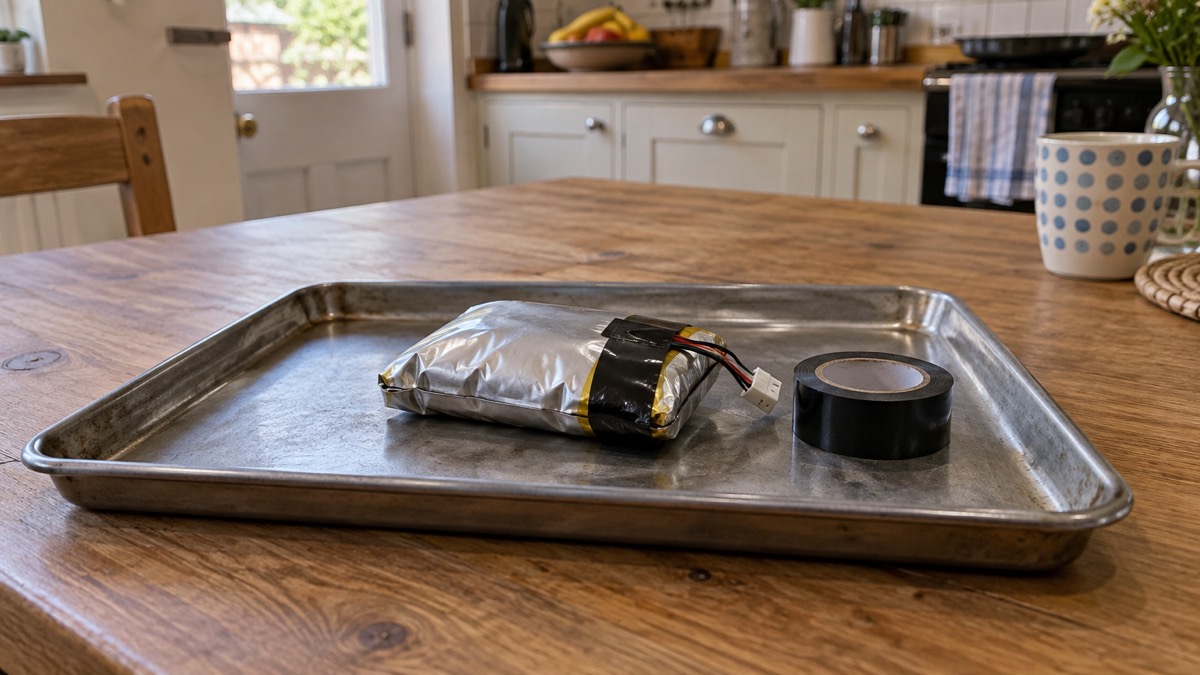
Swelling is the most visible sign, but it is not the only one. The National Fire Chiefs Council lists swelling or deformation, where the battery appears swollen, misshapen or has developed a lump2. The London Fire Brigade says a battery that appears swollen or misshapen is a strong sign that it is failing11. Oxfordshire County Council lists a battery that is swelling or expanding as a warning sign5.
The Scottish Fire and Rescue Service gives the fullest list: producing smoke, feeling extremely hot to touch, looking swollen or having any type of lump or leak, making a hissing or cracking sound, smelling unusual, or taking longer to charge or not fully charging3. The London Fire Brigade adds unusually hot, swelling or bulging, unusual smells and significantly reduced performance11.
| Warning sign | What it can mean | What to do |
|---|---|---|
| Swollen, misshapen or lumpy case | The battery is failing and may be building up pressure inside11 | Stop using and charging, unplug, contact the maker1 |
| Extremely hot to touch | Overheating, which can lead to fire3 | Stop using, let it cool, do not cover it3 |
| Smoke, hissing or cracking | A serious failure is under way3 | Move away, call 999 if a fire starts, do not handle it |
| Unusual smell | Chemicals or heat breaking down the battery3 | Stop using and charging, ventilate the room, contact the maker1 |
| Takes longer to charge or will not fully charge | Reduced performance, a sign of damage3 | Stop using and charging, replace the battery3 |
Check your batteries regularly. Electrical Safety First says to regularly check the condition of the battery for signs of swelling, dents, deformities and signs of overheating, and if you notice any damage, stop using and charging the battery immediately and replace it18. The same advice appears for e-bikes17 and e-scooters12. The Scottish Fire and Rescue Service says batteries can be damaged by dropping them or crashing e-bikes or e-scooters, and where the battery is damaged it can overheat and catch fire without warning and should be replaced, not used or charged19.
For a fuller guide to the warning signs, see warning signs a lithium battery is dangerous.
Swollen phone, laptop or power station battery: what differs
The core instruction is the same for every device, but the detail differs slightly by what the maker and the safety bodies say about that type of product.
Phones and tablets. Electrical Safety First says that while charging, if you notice odd smells, sparking, smoke, swelling, cracks or damage, unplug immediately and contact the retailer and/or manufacturer7.
Laptops. The same wording applies: unplug immediately and contact the retailer and/or manufacturer8. Electrical Safety First also warns that damaged batteries, including dropped, crushed or punctured ones, can become volatile and should not be used8.
Power banks and portable power stations. Electrical Safety First says that while charging, if you notice odd smells, sparking, smoke, swelling, cracks or damage, unplug immediately and contact the retailer and/or manufacturer9. A portable power station contains the same kind of lithium cells as a power bank, so the same caution applies. For more on power stations specifically, see portable power stations: what they do and how to choose.
E-bikes and e-scooters. The London Fire Brigade says to stop using the battery and seek advice from the manufacturer or retailer if you notice warning signs11. The National Fire Chiefs Council says to stop using or charging immediately if you notice overheating, deformation, noise, smell, performance problems or smoke2. Electrical Safety First says to stop using and charging the battery immediately and replace it if you notice any damage17.
Vapes. The London Fire Brigade says that if the battery gets unusually hot, starts to bulge or starts hissing, stop using it immediately and leave it in a safe place until you can dispose of it properly6.
Power tools. Electrical Safety First's guidance for cordless heat guns says that if the battery emits any unusual odours, sparks, smoke, swelling, cracks, or you see any form of damage, stop using the battery immediately and make sure it is unplugged from the charger20.
Hoverboards and self-balancing boards. Electrical Safety First says to regularly check the condition of the battery for signs of swelling, dents, deformities and signs of overheating, and if you notice any damage, stop using and charging the battery immediately and replace it18.
Battery hot or smoking: when to call 999
A battery that is hot, smoking or hissing has moved beyond a swelling battery into something that could catch fire. The London Fire Brigade's advice for vape batteries is to stop using it immediately if it gets unusually hot, starts to bulge or starts hissing, and to leave it in a safe place until you can dispose of it properly6. Fire and rescue service advice for e-bike and e-scooter batteries is that if a battery becomes unusually hot to the touch, stop using it and allow it to cool21.
If it is smoking, do not pick it up. Move away, keep others away, and call 999 if a fire starts. The London Fire Brigade's easy-read fire safety booklet says to keep an eye out for warning signs that a battery might be failing and becoming a fire risk22. Fire and rescue service advice is that if a battery shows signs of swelling, overheating or emitting smoke, safely remove it and report the incident to appropriate authorities23.
If a fire does start, get out, stay out and call 999. Do not try to move a burning battery. For more, see what to do if a lithium battery catches fire.
Charging safely to prevent the next one
Most of the advice that prevents a swollen battery is the same advice that prevents a battery fire. The National Fire Chiefs Council's Charge Safe campaign says to stop using or charging your battery immediately if you notice any of the warning signs2. The London Fire Brigade says to protect batteries against being damaged, crushed, punctured or immersed in water1.
The Scottish Fire and Rescue Service advises avoiding charging batteries near flammable materials, not overloading power sockets and not using unsuitable extension cords, and always using uncoiled extension leads that are properly rated for your devices3. It also says not to cover the charger, battery or device while charging, as this can cause overheating or even a fire3. The London Fire Brigade says not to charge under pillows or blankets4.
For a full set of charging habits, see the safe battery charging at home checklist. For the wider picture on lithium battery safety, see lithium-ion battery safety at home.
Sources (23)
- Batteries and chargers, London Fire Brigade, 2026-10-25
- Charge Safe, National Fire Chiefs Council, 2026-10-09
- Lithium-ion batteries, Scottish Fire and Rescue Service, 2025-11-27
- Lithium battery fire safety, Merseyside Fire and Rescue Service, 2026-10-26
- Charging safety, Oxfordshire County Council, 2026
- Vaping and e-cigarettes, London Fire Brigade, 2026-10-25
- Mobile phones and tablets, Electrical Safety First, 2026-10-25
- Laptops and notebooks, Electrical Safety First, 2026-10-25
- Power banks, Electrical Safety First, 2026-10-26
- Chargers, Electrical Safety First, 2026-10-26
- Spot the warning signs, London Fire Brigade, 2026-10-25
- E-scooters, Electrical Safety First, 2026-10-25
- Fire prevention tips, Electrical Safety First, 2026-10-25
- E-bikes and e-scooters fire safety guidance, National Fire Chiefs Council, 2025-01-21
- Product recalls, Electrical Safety First, 2026-10-26
- Battery fires, Devon and Somerset Fire and Rescue Service, 2026
- E-bikes, Electrical Safety First, 2026-10-26
- Hoverboards and self-balancing boards, Electrical Safety First, 2026-10-25
- E-bike and e-scooters, Scottish Fire and Rescue Service, 2026-10-25
- Heat guns, Electrical Safety First, 2026-10-25
- Heat, cold and rain: How weather conditions affect e-bikes and e-scooters | London Fire Brigade, London Fire Brigade
- Digital easy read fire safety booklet, London Fire Brigade, 2026
- Recycle your batteries to prevent fires | Devon and Somerset Fire and Rescue Service, Devon and Somerset Fire and Rescue Service
 Power Cut Backup Power Checklist
 Backup Power Before Winter
 Safe Battery Charging at Home
 Running a Generator Indoors
 Carbon Monoxide from Generators
 Generator Sizing for a Power Cut
 Generator Run Time on a Tank
 Storing Petrol at Home
 Diesel Storage at Home
 Storing a Generator
 Generators in Cold Weather
 Generator Noise and Neighbours
 Power Station Capacity Sizing
 Power Station Run Time
 Power Station for a Gas Boiler