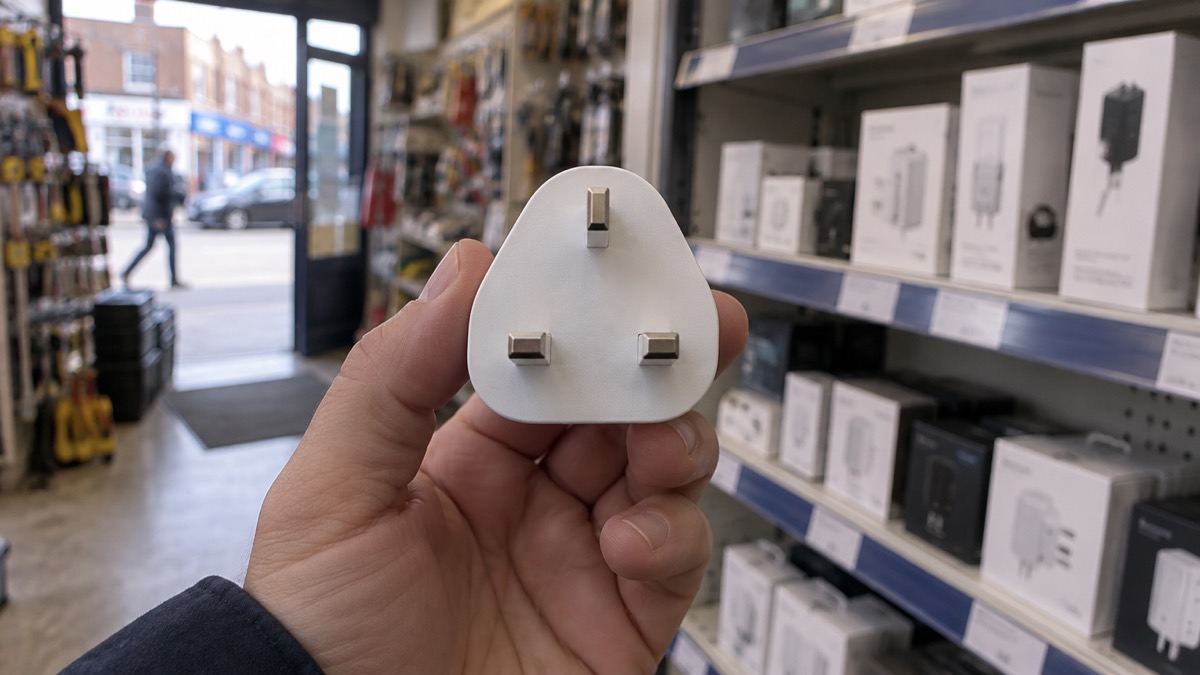
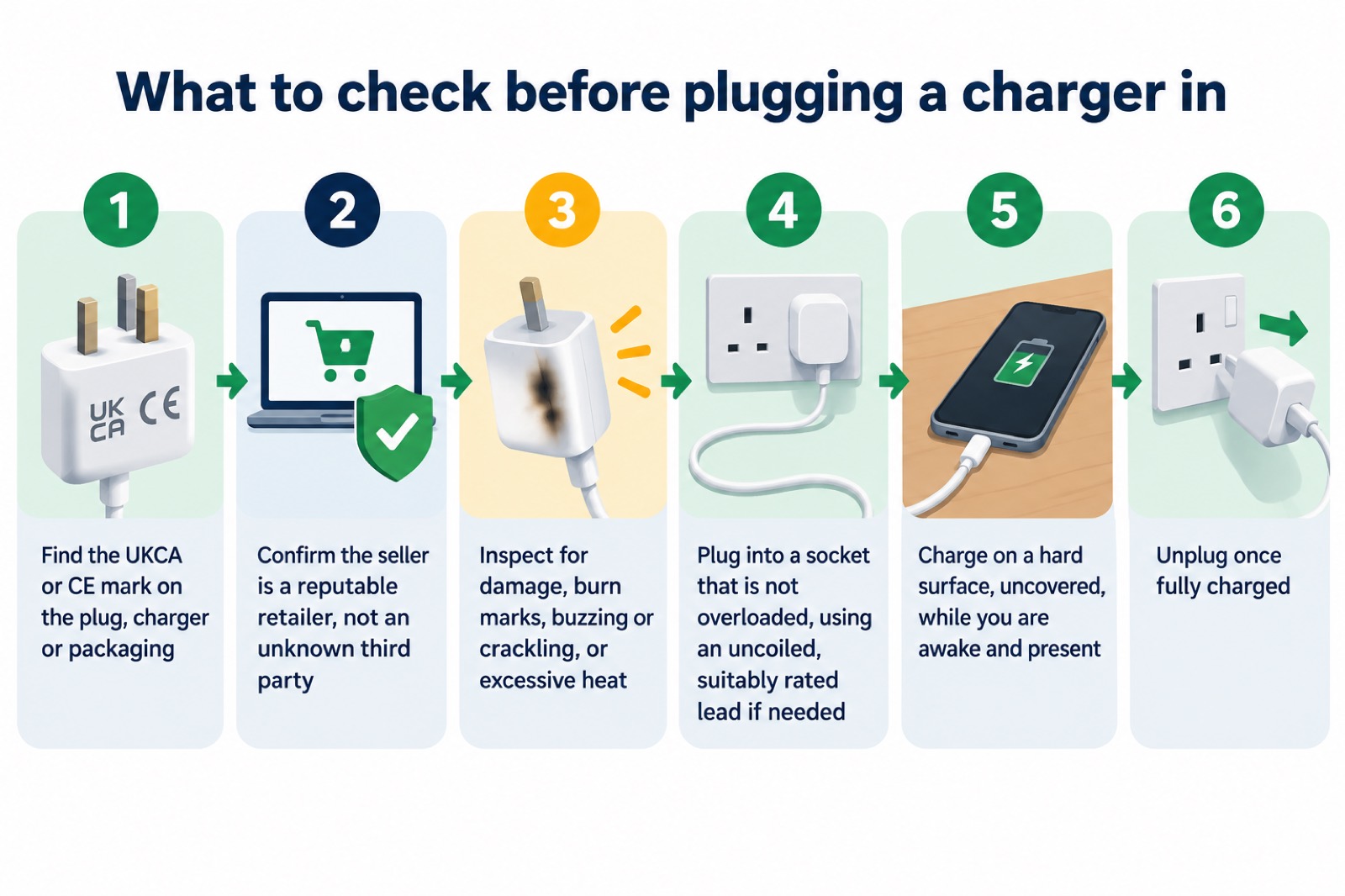
Before you plug any charger into a wall socket, turn it over and look for the UKCA or CE mark. Fire and rescue services across the UK give the same advice for everything from phone chargers to e-bike batteries: buy from reputable retailers and check for the UKCA or CE safety mark, because it shows the product complies with UK or European safety standards1. A charger with no mark may never have been through product safety testing at all.
The reason the advice is so consistent is that the stakes are real. In 2024, the Office for Product Safety and Standards received reports of 211 e-bike and e-scooter fires, nearly half of which occurred indoors3. Government guidance on avoiding e-bike and e-scooter fires is blunt about the cause: fake or substandard chargers can cause fires, and there is no guarantee a product bought from a market stall or a third-party seller on an online marketplace has been through product safety testing4.
This page explains what the marks mean, how to check a plug or charger looks genuine, what the battery safety icons and warnings are asking you to do, and how to dispose of batteries safely. It applies to the same kit covered across our backup power guide, from power banks to portable power stations.
Look for the UKCA or CE mark before you plug a charger in
The habit to build is simple: whenever a charger, plug, battery or cable comes into your house, check it for the UKCA or CE mark before it goes anywhere near a socket. North Yorkshire Fire and Rescue Service gives this advice for electrical gifts: buy from reputable retailers and check for the UKCA or CE safety mark1. The same service advises that electrical products bought as gifts should come from a reputable retailer and carry the UKCA mark (or CE mark), which indicates they comply with safety standards7. Councils and fire chiefs repeat the message ahead of the festive season, reminding people to check that electrical appliances, including toys and devices, are from reputable sellers and that CE or UKCA marks are visible, a requirement of UK product safety regulations8.
The check takes seconds. The mark is usually moulded into the plug body or printed on the label of the charger or cable. If you cannot find it on the product itself, check the packaging and any instruction leaflet. If it is nowhere to be found, treat the product as unverified and do not use it.
The same rule applies beyond chargers. North Yorkshire Fire and Rescue Service advises people who use e-cigarettes to always check the device carries a UKCA or CE certification9. Mid and West Wales Fire and Rescue Service puts it plainly for lithium battery products generally: only buy items from the right shops, and make sure the battery and charger meet UK safety standards10.
What the UKCA and CE marks actually tell you
North Yorkshire Fire and Rescue Service explains the marks' purpose directly: always look for the UKCA or CE mark, which indicates chargers comply with UK or European safety standards2. In other words, the mark is the manufacturer's declaration that the product has been designed and tested to meet those standards before being placed on the market.
UKCA or CE: does the difference matter to you?
For a household buyer, the practical answer is no. The CE mark is the long-standing European conformity mark, and the UKCA mark is the UK's equivalent. Official safety advice in this area is consistent: look for a UKCA or CE mark on the packaging, and if it is missing, the product might not meet legal safety requirements1. You do not need to work out which one applies to which product category. What matters is that one of them is there, visibly, on the product or its packaging.
What the mark does not tell you
The mark tells you the product was intended to meet safety standards. It does not tell you the product in your hand is genuine. Counterfeit chargers carry fake marks, which is why the mark check comes second in the advice, after buying from a reputable retailer. Devon and Somerset Fire and Rescue Service advises purchasing any electrical or battery items from a trusted or reputable seller and looking for the CE mark11. Electrical Safety First warns against substandard or counterfeit USB chargers from third-party sellers online, which have serious safety concerns and may present a higher risk of exploding or catching fire6.
There is also a legal backdrop worth knowing. Electrical Safety First notes that USB chargers are required to meet the requirements of the Electrical Equipment (Safety) Regulations 20166. A product safety notice issued through Bromley Council in December 2025 shows what enforcement looks like in practice: two Belkin power banks were found not to meet the requirements of the General Product Safety Regulations 2005, and the notice stated the products presented a risk of fire12. Even branded products can fall short, which is why recalls and notices exist, and why registering your products matters.
E-bike and e-scooter batteries: check the mark before you buy
E-bike and e-scooter batteries are where the safety marking advice matters most, because these are large lithium-ion batteries that store a lot of energy and are often charged inside homes. Every UK fire and rescue service that publishes guidance on them starts in the same place.
Oxfordshire Fire and Rescue Service tells buyers to check for the CE or UKCA safety marking so the product meets safety standards13. Devon and Somerset Fire and Rescue Service says to check the product is marked with a CE or UKCA mark to ensure it complies with UK product safety standards14. The National Fire Chiefs Council's Charge Safe campaign, a collaboration between Fire Kills and NFCC, tells buyers the product meets the relevant safety standards if they look for products with the UKCA or CE mark15. London Fire Brigade advises making sure your battery and charger meet UK safety standards16, and UK government guidance says to look for the UKCA or CE mark on e-bikes and e-scooters, which is required by UK product safety regulations4.
Where you buy matters as much as what you buy
Devon and Somerset Fire and Rescue Service is specific about the risk: buy your e-bike or e-scooter from a reputable retailer that you know and trust; if you need a replacement charger or battery, get it from the original manufacturer; fake or substandard chargers can cause fires; and avoid buying from market stalls or from third-party sellers on online marketplaces, as there is no guarantee the product has been through product safety testing14. South Wales Fire and Rescue Service adds that you should always use the manufacturer approved charger for the product, and if you spot any signs of wear and tear or damage, buy an official replacement charger from a reputable seller17. The NFCC's published guidance on e-bikes and scooters repeats both points: buy from reputable retailers, and always use the manufacturer approved charger18.
Charging safely once you have the right kit
Having a marked, genuine battery and charger is the first step. How you charge is the second. UK government guidance is to charge your battery in a safe location that does not block fire escape routes or exits, not to cover the charger or battery, to charge when awake and present, and to unplug once fully charged4. Devon and Somerset Fire and Rescue Service adds that you should follow the manufacturer's charging instructions and regularly check the battery and charger for damage, and unplug after charging14. The Charge Safe campaign advises switching off and unplugging the charger when charging is complete, and allowing the battery and charger to cool before storing them15.
211 fires reported to the regulator, nearly half indoors
The numbers behind the advice come from the Office for Product Safety and Standards, the UK's product safety regulator. In 2024 it received reports of 211 e-bike and e-scooter fires, nearly half of which occurred indoors3. That figure deserves two caveats that the National Fire Chiefs Council itself gives: reporting to OPSS is voluntary, so these figures are likely to represent an underestimate3.
The NFCC has used these figures to call for change. It has recommended updating Building Regulations guidance to reflect fire risks from storing and charging energy technologies in homes and public spaces3. Its position is that lithium-ion batteries are everywhere, but safety standards have not caught up3. For a household, that gap is exactly why the UKCA or CE mark, genuine chargers and careful charging habits carry so much weight: the protections are real but not yet complete, so your own checks fill the space.
Battery safety icons and what each one asks you to do
Batteries, chargers and devices carrying lithium-ion cells come with safety markings and instructions, and the icons and warnings follow a consistent pattern across official guidance. Here is what each instruction is asking of you.
| The instruction or icon | What it asks you to do | Who gives the advice |
|---|---|---|
| UKCA or CE mark | The product meets the relevant safety standards; look for it before buying15 | NFCC Charge Safe campaign |
| Meets UK safety requirements | Make sure the battery and charger meet UK safety standards and are compatible with the product and intended use19 | NFCC lithium-ion battery campaign |
| Do not cover | Never cover a charger, as it may build up heat during charging; never cover devices that are charging2 | North Yorkshire Fire and Rescue Service; London Fire Brigade |
| Unplug when full | Unplug the charger once the battery is full20 | London Fire Brigade |
| Charge on a hard surface | Put your device on a hard surface like a table before you start to charge it20 | London Fire Brigade |
| Stop using if warning signs appear | Stop using or charging your battery immediately if you notice any of the warning signs15 | NFCC Charge Safe campaign |
The warning signs themselves matter as much as the icons. The Charge Safe campaign's instruction is to stop using or charging your battery immediately if you notice any of the warning signs15. Oxfordshire Fire and Rescue Service goes further on what to do next: remove the battery and device, if the battery cannot be removed, from your home and store it outside and away from other items, preferably in a metal container13. Our page on warning signs a lithium battery is dangerous covers the signs in detail, and what to do if a battery starts swelling covers the swelling that often comes first.
The National Fire Chiefs Council's lithium-ion battery campaign sums up the buying rule that sits behind all the icons: always make sure the product meets the relevant UK safety requirements and is compatible with the product and intended use19. A charger that meets the standards but is not compatible with your device is still the wrong charger.
Power banks, torches and jump starters: the safety warnings that come with them
The same lithium-ion battery technology that powers e-bikes also sits inside the smaller kit households keep for emergencies: power banks, rechargeable torches and lithium jump starters. London Fire Brigade's warning on counterfeit chargers is stark:
"Counterfeit electrical chargers can be deadly, many fail to meet UK safety regulations leading to fires and injury."
Mid and West Wales Fire and Rescue Service makes the same point for cheap products generally: cheap chargers and batteries may not meet UK safety standards and can be dangerous10. The NFCC's e-bike and e-scooter guidance notes that many fires involve counterfeit electrical goods, and that items which do not meet British or European standards pose a huge fire risk18.
A real example shows that even established brands can be affected. A product safety notice issued in December 2025 covered the Belkin BoostCharge USB-C BPB002 and Playa USB-C PB0003 power banks. The notice stated:
"The product presents a risk of fire as the lithium-ion batteries can overheat whilst in use. This can lead to localised smoking, melting and/or a risk of fire."
The notice also stated that the products did not meet the requirements of the General Product Safety Regulations 200512. For households, the lesson is not to avoid power banks, which are useful emergency kit, but to buy them from reputable sellers, check the marks, and register them so a recall can reach you.
Charging habits apply to this small kit too. The Northern Ireland Fire and Rescue Service warns students that charging devices incorrectly can significantly increase the risk of fire, and advises always using approved chargers, charging on a hard, flat surface, and never charging devices on beds, sofas or under pillows where heat cannot escape22. London Fire Brigade's easy-read fire safety booklet gives the same basics for any device: unplug the charger once the battery is full, put your device on a hard surface like a table before you start to charge it up, and never cover devices that are charging because they can get hot20.
Where a plug must never go: sockets, extension leads and heat
The markings on a product are only half the safety picture. The other half is where and how you plug it in. North Yorkshire Fire and Rescue Service gives four rules for chargers: never use a charger that shows signs of damage or appears not to be working properly; never cover a charger, as it may build up heat during the charging process; never leave a phone charger plugged in and turned on when not in use; and always use the genuine charger designed for the product, as substandard and counterfeit electrical chargers can be dangerous2.
Electrical Safety First adds a regular check to that list: regularly check the charger and plug, and your socket outlet, for burn marks, sounds of arcing (buzzing or crackling), or if it feels too hot to touch6. It also advises against dismantling or attempting to repair faulty chargers6.
On sockets and leads, the NFCC's guidance is: do not overload socket outlets or use inappropriate extension leads; use uncoiled extensions and ensure the lead is suitably rated for what you are plugging into it18. Our page on extension leads and overloading with backup kit covers this in depth, because emergency kit often means several chargers and appliances running at once.
Checking for recalls and safety notices from the regulator
Products that turn out to be unsafe are withdrawn through recalls and safety notices. The Office for Product Safety and Standards issues recalls and alert notices on its website, as London Fire Brigade explains23. Checking there is the quickest way to find out whether something you own has been flagged.
Two habits make recalls work for you:
- Register your products. Electrical Safety First advises registering your USB charger so you can be contacted easily if there is a safety recall of your product6.
- Keep receipts and model details. The Belkin power bank notice shows why: it names specific models, the BoostCharge USB-C BPB002 and Playa USB-C PB0003, so owners can identify whether their own unit is affected12.
If a product you own is recalled, follow the notice's instructions. In the Belkin case, consumers disposing of the product were advised to do so safely via their local household waste disposal site, and to check first with their local centre whether it accepts that type of battery12. Our page on how to dispose of a damaged lithium battery covers the harder cases.
Never bin a battery: disposal and the waste fire problem
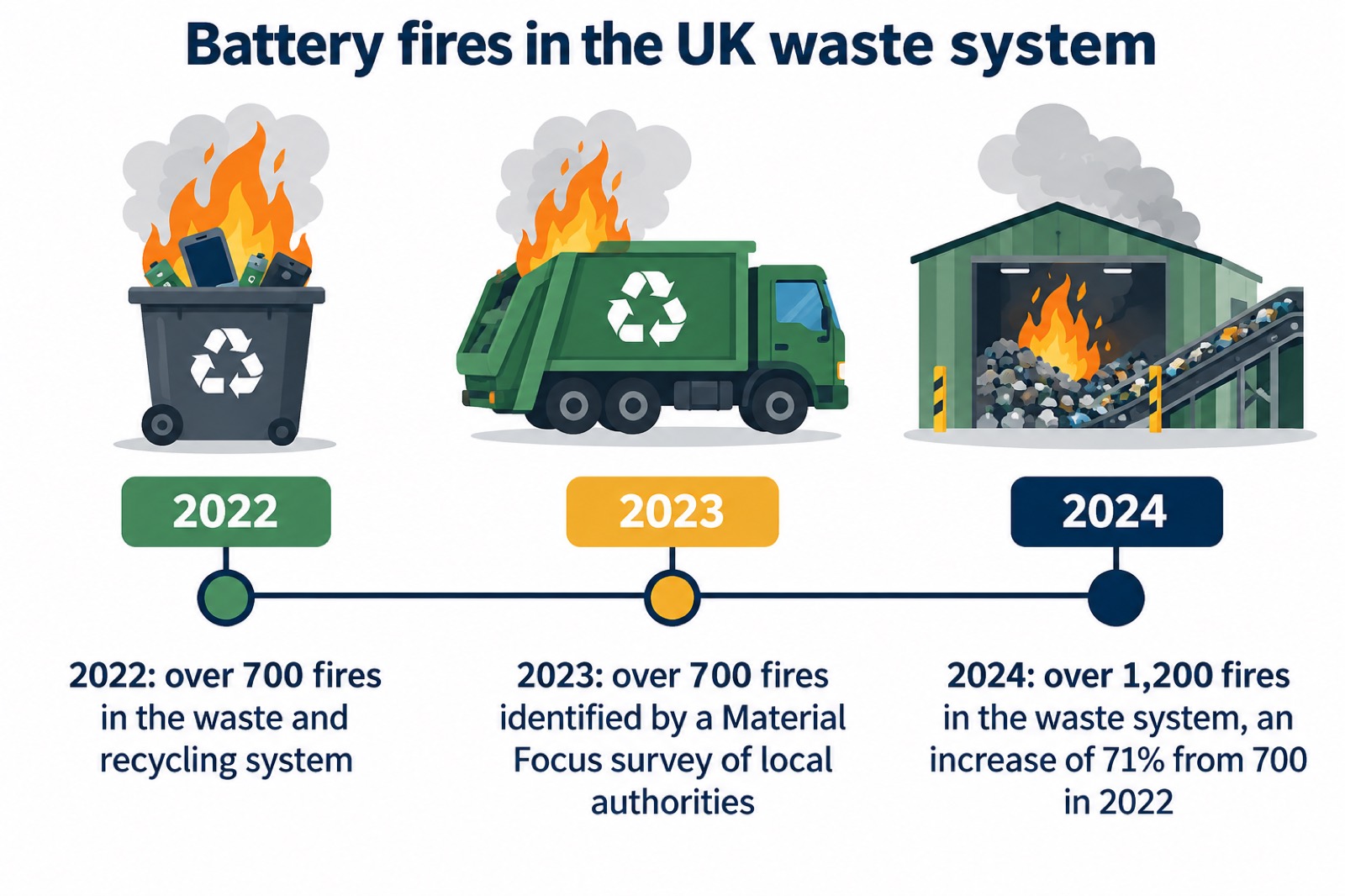
Battery disposal is the point where household habits and safety markings meet, because a battery that was safe in your device becomes a fire risk in a bin lorry. The National Fire Chiefs Council's instruction is absolute: never put batteries in household bins, because batteries can be damaged or crushed during waste collection and processing19. The campaign's figures explain why. There were over 1,200 battery fires in the UK waste system in the last 12 months as of 2024, an increase of 71% from 700 in 20225. Behind those fires sits sheer volume: 6 billion batteries were thrown away in the last year, over 3,000 a minute5.
The advice is consistent across the UK's fire services and nations:
- Remove batteries from electricals where you can, and recycle the batteries and electricals separately at your local recycling centre, supermarket or other battery recycling point5.
- Use a recycling locator to find your nearest electrical recycling point, often found in supermarkets and shops, or check your council's website to see if it collects batteries for recycling25.
- Set aside a bag just for batteries, and each time you remove a battery from a gadget, put it in the bag ready to take to a recycling point; do not put them in the general rubbish bin25.
- Never dispose of a damaged or end-of-life battery in household waste or normal recycling. South Wales Fire and Rescue Service and Scottish Fire and Rescue Service both warn that these batteries, when punctured or crushed, can cause fires in bin lorries, recycling and waste centres17.
- In Wales, retail battery recycling bins accept AA, AAA, 9V and button cell batteries and batteries from small electronics such as phones and cameras; household recycling centres accept lithium-ion batteries from laptops, phones and power tools, and battery packs from e-bikes or scooters (check with the centre first). Damaged or swollen batteries should be handled with care, with terminals taped10.
- If the battery cannot be removed from a device, recycle the entire device at a Household Waste Recycling Centre or through a WEEE collection point10.
Oxfordshire's Household Waste Recycling Centres have procedures to safely accept, store and dispose of damaged batteries and devices, if the manufacturer advises it is safe to transport the battery or device13. If you have a damaged battery, do not put it in the bin or the normal recycling: follow the guidance on our damaged battery disposal page.
Who regulates product safety in the UK
The body at the centre of all this is the Office for Product Safety and Standards, which issues recalls and alert notices on its website23. It is also the regulator that received the 211 reports of e-bike and e-scooter fires in 20243, and its reporting system is voluntary, which is why the NFCC treats those figures as an underestimate3.
Enforcement reaches into local government too. The Office for Product Safety and Standards works with local authority trading standards to take action against unsafe products, such as products with small magnets that could be swallowed by a child12. For consumers, the practical points of contact are the OPSS website for recalls and alerts, your local authority's trading standards service for unsafe products, and the seller for returns and refunds on faulty goods.
When you are buying, the marks to look for are the ones this page has covered. South Wales Fire and Rescue Service also advises checking appliances for British or European safety marks, such as the CE mark27. The habit is the same whatever you are buying: reputable seller first, UKCA or CE mark second, and a recall check if anything you own is named in a notice.
Sharing what you know
Fire and rescue services actively encourage households to pass this knowledge on. London Fire Brigade advises sharing your fire safety knowledge with the whole family: check the kids' chargers, and make sure everyone knows how to use electrical items safely23. The national Charge Safe campaign, a collaboration between Fire Kills and NFCC, publishes e-bike and e-scooter fire safety guidance for exactly this purpose15.
In shared buildings, the responsibility extends to those who manage them. Scottish Fire and Rescue Service and South Wales Fire and Rescue Service both advise responsible persons to consider the risks posed by e-bikes and e-scooters where they are charged or left in common areas such as means of escape, bike stores and mobility scooter charging rooms, and to offer residents advice on safe use, storage and charging26. Mid and West Wales Fire and Rescue Service gives similar advice for workplaces: establish clear procedures for safe charging, including supervision and designated charging zones10.
If you are building emergency kit for your household, the same checks apply to everything from a rechargeable torch to a portable power station: buy from a reputable seller, find the UKCA or CE mark, register the product, and charge it on a hard surface, uncovered, while you are awake. Our safe battery charging checklist puts the whole routine in one place.
Sources (27)
- Christmas safety advice, North Yorkshire Fire and Rescue Service, 2025-12-15
- Electrical safety at home, North Yorkshire Fire and Rescue Service, 2026-09-14
- Lithium-ion batteries are everywhere but safety standards haven't caught up, warn fire chiefs, National Fire Chiefs Council, 2025-11-19
- Buy safe, be safe: avoid e-bike and e-scooter fires, UK Government, 2024-10-24
- Over 1,200 battery fires in bin lorries and waste sites across the UK in last year, National Fire Chiefs Council, 2024-05-10
- Charger safety guidance, Electrical Safety First, 2026-10-26
- Stay safe this Christmas, North Yorkshire Fire and Rescue Service, 2024-12-03
- Councils and fire chiefs issue reminder on home fire safety ahead of festive season, National Fire Chiefs Council, 2024-12-21
- Smoking and home safety, North Yorkshire Fire and Rescue Service, 2026-03-09
- Lithium battery fire safety at home, Mid and West Wales Fire and Rescue Service, 2026-10-26
- Staying safe this season, Devon and Somerset Fire and Rescue Service, 2025-12-01
- Product safety notice: Belkin power banks, Bromley Council, 2025-12-08
- Charging safety at home, Oxfordshire County Council Fire and Rescue Service, 2026
- Battery fires at home, Devon and Somerset Fire and Rescue Service, 2026
- Charge Safe campaign, National Fire Chiefs Council, 2026-10-09
- How to charge e-bikes and e-scooters safely, London Fire Brigade, 2026-10-25
- E-bikes and e-scooters at home, South Wales Fire and Rescue Service, 2026-07-29
- E-bikes and scooters fire safety guidance, National Fire Chiefs Council, 2025-01-21
- Lithium-ion batteries campaign, National Fire Chiefs Council, 2026-10-09
- Digital easy read fire safety booklet, London Fire Brigade, 2026
- Batteries and chargers, London Fire Brigade, 2026-10-25
- Charge safely for your own safety: NIFRS urges students to put fire safety first, Northern Ireland Fire and Rescue Service, 2026-09-21
- Electrical items in the home, London Fire Brigade, 2026-10-25
- Stop battery fires: public safety film launched, National Fire Chiefs Council, 2023-07-11
- Recycle your electricals campaign, North Yorkshire Fire and Rescue Service, 2024-05-01
- E-bike and e-scooter safety at home, Scottish Fire and Rescue Service, 2026-10-25
- Student fire safety, South Wales Fire and Rescue Service, 2026-09-08
 Power Cut Backup Power Checklist
 Backup Power Before Winter
 Safe Battery Charging at Home
 What to Keep Running in a Cut
 Power During an Outage
 Watts and Watt-Hours
 Portable Power Stations
 Portable Generator Types
 Generator Safety
 LPG Cylinders and Regulators
 Connecting to Your Home's Wiring
 Home Battery Storage
 Portable Solar Panels
 12V Inverters
 Leisure and LiFePO4 Batteries