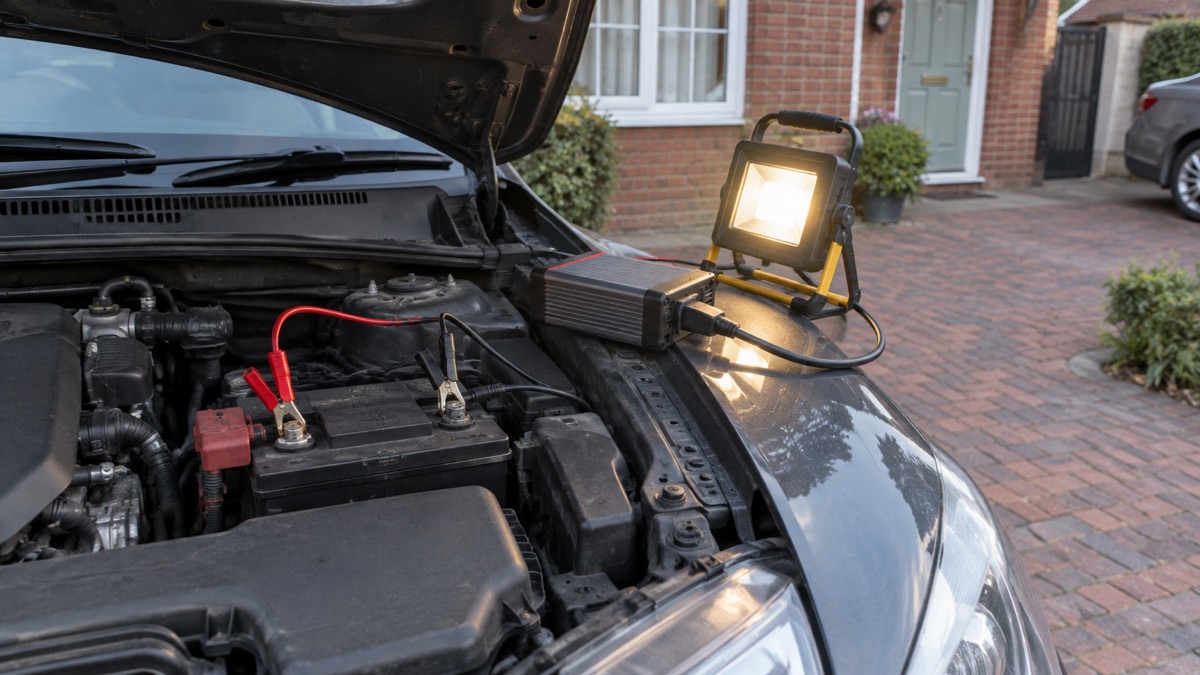
A 12V inverter is the bridge between a car battery, a leisure battery or a LiFePO4 battery pack and the ordinary 230V plugs in your house. It takes the 12-volt direct current stored in the battery and turns it into the 230-volt alternating current that UK appliances expect, so during a power cut you can run a fridge, a lamp, a phone charger or a CPAP machine from a battery instead of the mains. It is silent, needs no fuel and can be used indoors, which is why many households prefer it to a petrol generator for short outages.
The catch is that an inverter is only as good as the battery behind it. Everything on this page therefore comes in two halves: what an inverter can do for you in a power cut, and how to keep the 12V battery that feeds it charged, healthy and safely stored so it is ready when the lights go out. The battery is the part that fails quietly, months before you need it, so most of the work of preparedness is battery care.
What a 12V inverter does in a power cut
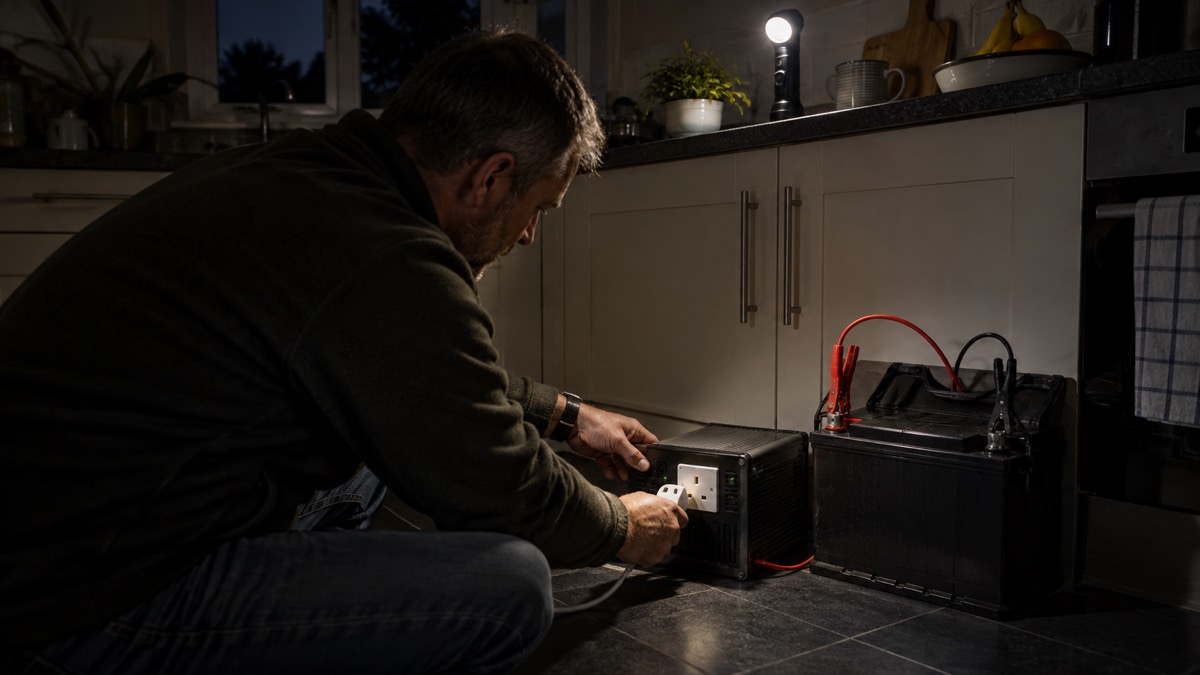
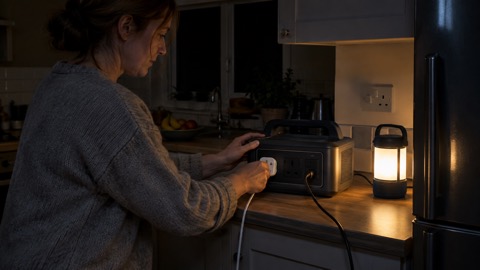
When the mains fails, an inverter lets you keep a small number of essential appliances running from a battery you already own. The battery supplies 12V DC, the inverter converts it to 230V AC, and you plug your appliance into the inverter's socket just as you would into a wall socket. Portable inverter generators and backup units commonly offer 230V 13A sockets alongside 12V DC outlets and USB ports, which shows the shape of the arrangement: mains-type sockets for household kit, DC and USB for the small stuff1.
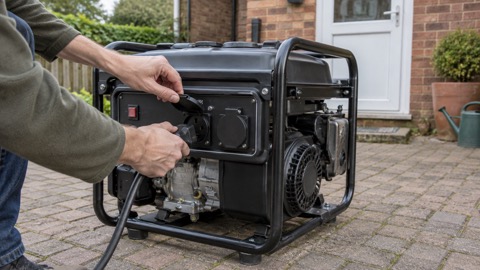
An inverter is not a generator and it is not the whole house. Which? advises that for power-cut backup, most households will be well served by a temporary portable generator small enough to carry around and store away, though it will not power the whole home as normal1. An inverter and battery arrangement sits below that in capacity: it suits a fridge, lighting, phone charging, a router or medical equipment for a bounded period, not kettles, showers or electric heating. Before choosing anything, work out what you actually need to keep running, because that decision drives everything else. Our page on deciding what to keep running when the mains fails walks through that choice, and watts, watt-hours and surge explained explains the units you will meet on every label.
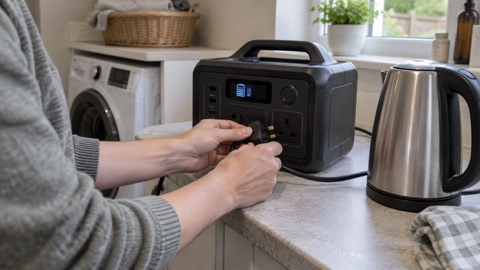
Two appliance figures from Electrical Safety First's ratings guidance give a feel for the spread. A freezer draws around 200 watts, while a portable air conditioner can draw up to 2000 watts2. The gap between those two numbers is the gap between what a modest battery-and-inverter set-up can carry and what it cannot.
| Appliance | Typical draw | What it means for an inverter set-up |
|---|---|---|
| Freezer | 200 watts2 | Within reach of a modest battery and inverter |
| Portable air conditioner | Up to 2000 watts2 | Needs a large battery and a high-output inverter, or a generator |
If your essential list is longer or hungrier than a battery can feed, compare the options on portable power station or petrol generator for a power cut and portable generators: petrol, diesel, dual-fuel and inverter types. If you are considering wiring an inverter into the house rather than running extension leads from it, read connecting a generator or battery to your home's wiring first, because that work has safety rules of its own.
Keeping the battery ready: charge, float and check
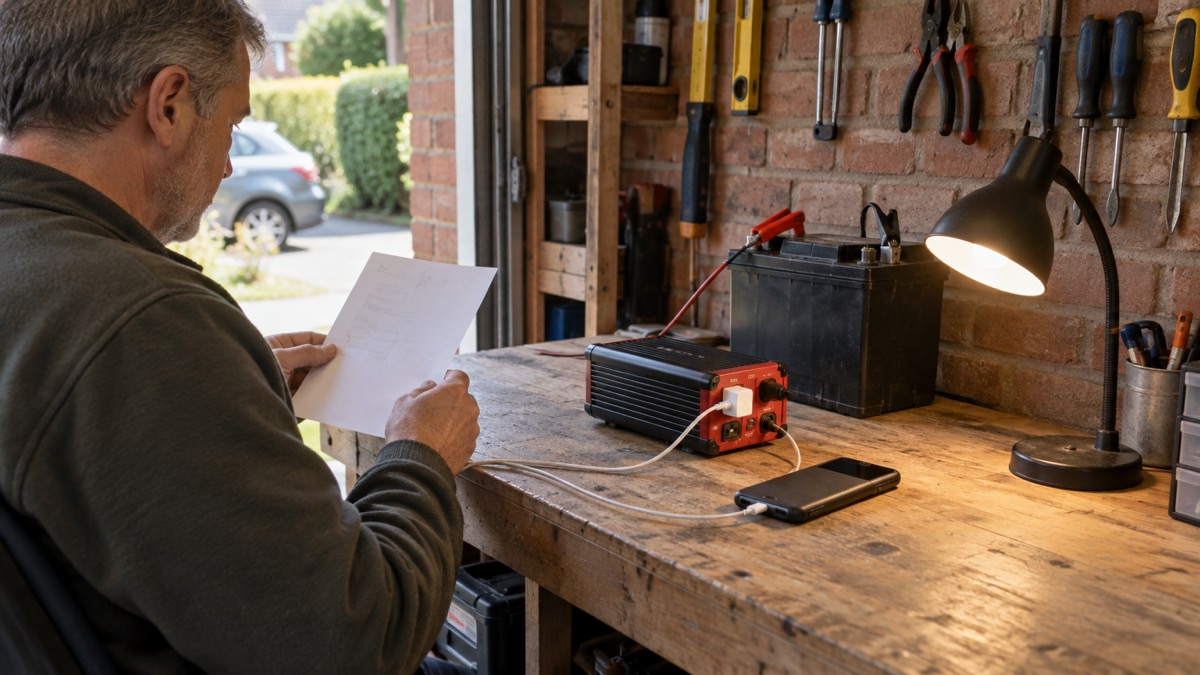
The inverter is the visible half; the battery is the half that decides whether the arrangement works. A 12V lead-acid battery that is fully charged sits at roughly 12.8 volts, and a well-designed charger will hold it there rather than pushing it harder. Sterling Power's Pro Charge Ultra Lite 12V charger, for example, has an energy-saving mode that, in the maker's words, "saves energy by dropping the output voltage down to the voltage of a full battery (~12.8V)", ensuring the battery stays full while the charger acts as a power supply when a load is applied3. It can also be forced into float mode at around 13V, intermittently or indefinitely, for long-term holding3.
That matters because a battery left on a dumb charger, or left off charge entirely, slowly loses its edge. The practical routine for a household keeping a leisure battery for emergencies is:
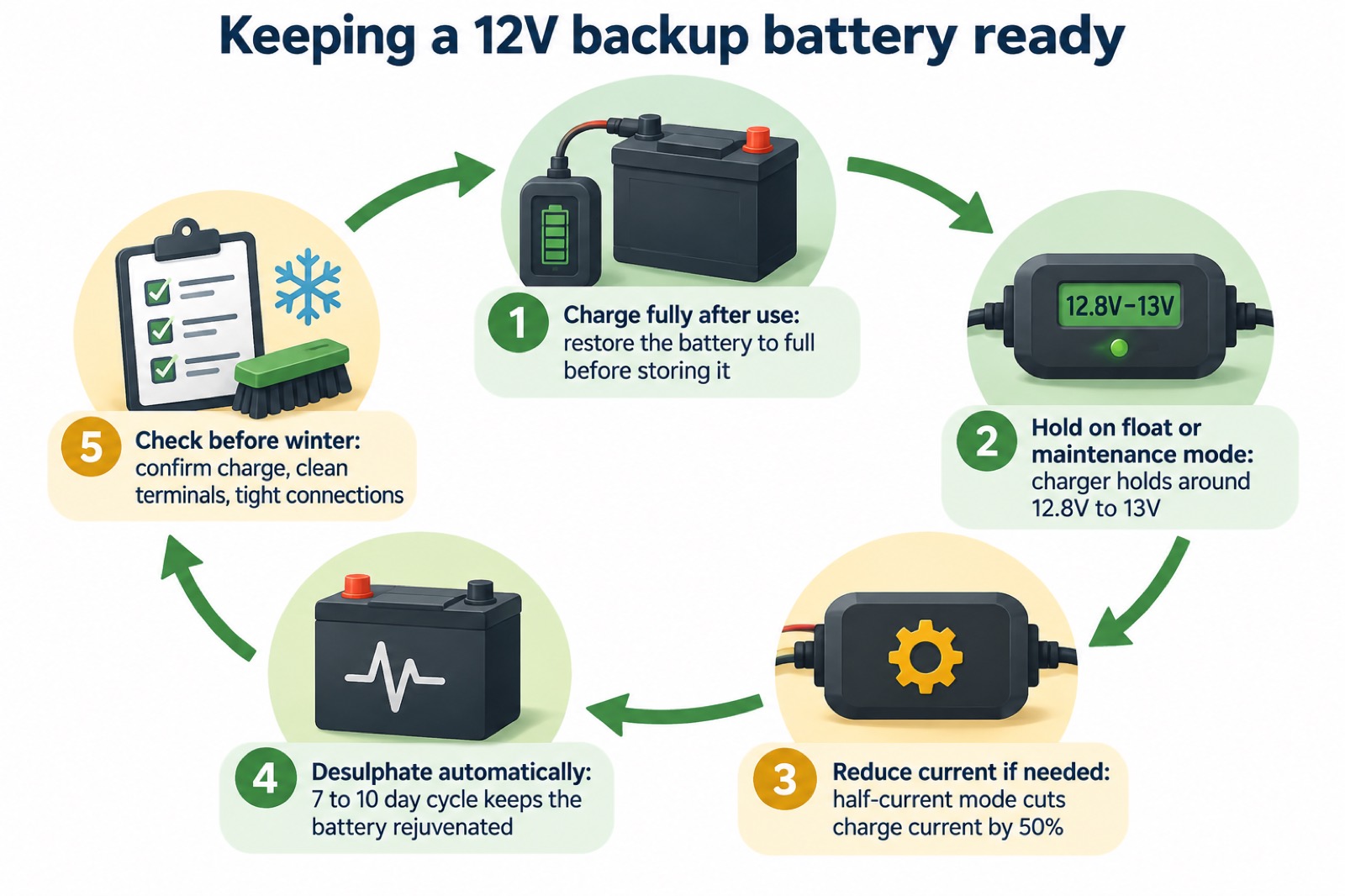
- Charge the battery fully after every use, and check it before winter each year.
- Leave it on a charger with a float or maintenance mode if you have one, so it is held full rather than drifting down3.
- If your charger has a power reduction setting, use it where your supply is limited: the Pro Charge Ultra Lite can be set to run at lower power outputs to complement a wider range of generators and low shore power connections3.
- Reduce charge current where the battery is nearly full or the supply is weak; the same charger offers a half-current mode that cuts the charger's current by 50%3.
- Check the terminals are clean and the connections tight whenever you inspect it.
A good charger also copes with imperfect mains. The Pro Charge Ultra Lite accepts a global input range of 80 to 270VAC at 40 to 70Hz, with only a minor power reduction when AC voltage drops below 100VAC3, so it will keep charging through the brownouts and voltage dips that can accompany a strained network. Our page on leisure and LiFePO4 batteries for emergency use goes into battery types in more detail.
The same readiness habit applies to everything else with a battery in it. Official advice across the UK is consistent: keep mobile phones, laptops, tablets and power banks fully charged, so you will have use of battery power for a short time at least if there is a power cut6. For a planned power cut, charge fully any equipment with batteries in advance, and for unplanned cuts make sure any items not in use are charging or charged9.
Sulfation: what happens when a lead-acid battery sits flat
A lead-acid battery that sits discharged for a long period does not just go flat; it degrades. The chemistry inside forms hard lead sulphate crystals on the plates, a process called sulfation, which reduces the battery's capacity and can eventually make it unusable. This is the quiet failure mode of emergency batteries: bought with good intentions, left flat in a shed for two years, and dead on the night you need it.
The defence is not heroic effort but routine. Keep the battery charged, keep it on a maintenance charger if possible, and if your charger has an automatic desulphation mode, let it run. Sterling Power describes the Pro Charge Ultra Lite's automatic desulphation as "7-10 days cycle with anti-stratification program to keep batteries rejuvenated"3. In other words, the recovery process is slow, measured in days rather than hours, which is exactly why prevention beats cure: a battery that is never allowed to sit flat never needs the long rescue.
If you inherit or discover a battery that has sat flat, do not assume it is scrap, but do not assume it is fine either. Put it on a charger with a desulphation mode and give it the full cycle the maker describes3. If it will not come back to a full-charge voltage, or it will not hold charge over the following weeks, treat it as end-of-life and recycle it rather than keeping a heavy, useless object that still contains lead and acid. Never try to recover a battery that is physically damaged, cracked or leaking: that is a disposal job, covered later on this page.
Storing a spare battery: charged, cool and dry
Where and how you store the battery between power cuts decides whether it is worth anything when one arrives. The National Fire Chiefs Council's Charge Safe campaign is blunt about the conditions: "Store and charge batteries in a cool, dry place"4. That applies to the big backup battery and to the small ones alike. Very low temperatures carry their own warning: London Fire Brigade advises that very low temperatures can affect the internal structure of a battery and reduce its ability to hold a charge, and repeated exposure can lead to permanent capacity loss, internal damage and reduced battery life11. A shed that swings between freezing winters and baking summers is a poor home for any battery you are counting on.
Water is the other enemy. Water entering a battery or its electrical components can cause short circuits, corrosion and battery failure11, so a dry storage spot is not just about comfort. And for households with small children, storage also means height: the NHS advice on button batteries is to "Store spare and 'flat' batteries well out of reach too"12, because a swallowed button battery is a medical emergency.
Your storage routine for the whole emergency kit, battery included, should let you find and use everything in the dark:
- Keep the battery charged and on a maintenance charger where possible3.
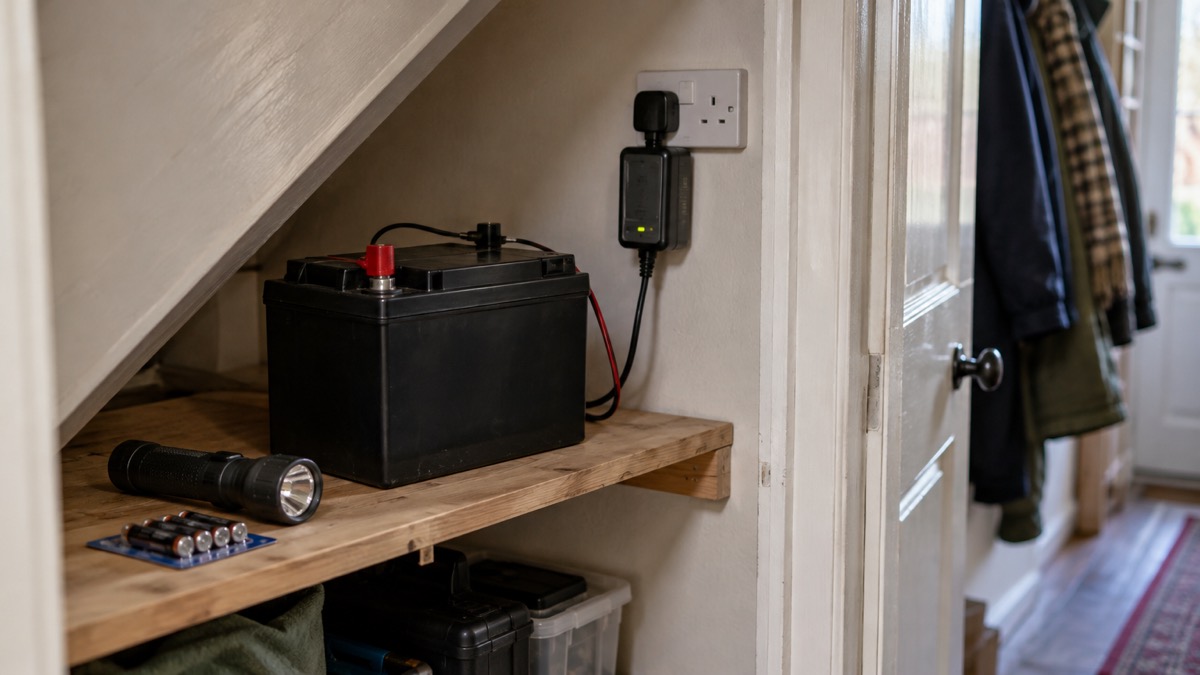
- Store it, and all spare batteries, in a cool, dry place4.
- Keep torches and batteries in an easy-to-find place, as the Scottish Fire and Rescue Service advises13; Anglesey Council similarly says to store a battery or wind-up torch somewhere you can access easily, so you can check the fuse box and move around the house safely14.
- Keep spare and flat batteries out of reach of children12.
- Keep important telephone numbers written down somewhere accessible10.
- Check the kit before winter: the NHS winter emergencies advice is to keep a charged power bank, a torch and spare batteries at home10.
Charging safely: sockets, cables and heat
An inverter set-up involves charging, and charging is where battery incidents start. The fire and rescue services' advice is consistent and worth following to the letter. The Scottish Fire and Rescue Service says: "Avoid charging your batteries near flammable materials, do not overload power sockets or use unsuitable extension cords. Always use uncoiled extension leads that are properly rated for your devices"15. The National Fire Chiefs Council adds: avoid overloading sockets or extension leads, particularly when charging high-powered devices16. If you are running several chargers and an inverter from one area of the house during an outage, that is precisely the moment to check what each socket is carrying; our page on extension leads and overloading with backup kit covers the working-out.
Other rules from the same bodies:
- Do not leave batteries charging unattended overnight as a habit.
- Use the correct charger for the battery17. A charger with the wrong voltage or connector can damage the battery or worse.
- Do not modify the battery or electrical system4. Conversions and home-made adaptations are a recognised fire risk.
- Batteries can be damaged by dropping them, or if the bike or device they are in has been involved in a crash15. Treat a dropped battery with suspicion.
- Inspect charging leads for damage before use rather than assuming old cables are safe.
Watch for the warning signs during and after charging. If a battery starts swelling, overheats badly, smokes or catches fire, get out, stay out and call 999. Our pages on warning signs a lithium battery is dangerous and what to do if a lithium battery catches fire cover this in detail.
Recycling and disposing of old batteries
Every battery eventually reaches end of life, and how you dispose of it matters more than most people expect. Batteries put in household waste or normal recycling can be punctured or crushed in bin lorries and at waste and recycling centres, where they can cause fires. The Scottish Fire and Rescue Service's guidance is explicit: "If you need to dispose of a damaged or end of life battery, don't dispose of it in your household waste or normal recycling. These batteries, when punctured or crushed can cause fires in bin lorries, recycling and waste centres"5. The National Fire Chiefs Council's guidance says the same19.
The right route is recycling. Anything with a plug, battery or cable can be reused or recycled, as the North Yorkshire Fire and Rescue Service's recycling campaign puts it20. For householders, that campaign advises using a recycling locator to find your nearest electrical recycling point, often found in supermarkets and shops, or checking your council's website to see if they collect batteries for recycling21. For larger batteries, the maker may offer a recycling service; the fire services' guidance for e-bike and e-scooter batteries is to check with the manufacturer, and alternatively with your local authority for suitable battery recycling arrangements in your area5.
A damaged battery needs more care than a merely spent one. Do not put it in the bin, do not put it in with other batteries for recycling without telling the collection point it is damaged, and keep it away from anything flammable in the meantime. Our page on how to dispose of a damaged lithium battery sets out the steps.
| Battery situation | What to do |
|---|---|
| Ordinary spent household batteries | Take to a battery recycling point, often in supermarkets and shops, or check council collection21 |
| End-of-life larger battery | Ask the maker about a recycling service, or check local authority arrangements5 |
| Damaged, swollen or leaking battery | Do not bin it or mix it with normal recycling; it can cause fires when crushed5 |
| Any electrical item with a plug, battery or cable | Can be reused or recycled20 |
During the cut: using the inverter well
When the power actually goes, the inverter earns its keep, but a few habits make the battery last. Run only what you decided in advance was essential [see /backup-power/priorities/]. Keep the fridge and freezer doors closed as much as possible: Food Standards Scotland advises that during a power cut it should be safe to store food in the fridge as long as the temperature does not rise to 8°C, and that you should keep fridge and freezer doors closed as much as possible23. Northern Powergrid gives the same advice to limit opening the fridge or freezer so food stays cold for longer24. If the freezer is on your inverter's list, that 200-watt draw2 is what you are feeding.
Keep a charged power bank to hand even if it only charges a phone, as Wiltshire and Swindon Prepared advises, to help you stay in contact with loved ones in an emergency or power cut25. Report the cut by calling 105, the free power cut helpline26. If you rely on powered medical equipment, tell your electricity network; the NHS advice for families of technology-dependent children during power shortages is to charge fully any equipment with batteries for a planned cut and to keep unused items charging otherwise9, and network companies run support schemes for those who need them, which our page on powering CPAP, oxygen and other medical devices from a battery covers. Northern Powergrid also advises that if you rely on heated tanks or aquariums, you should consider a battery-powered backup or insulation methods24.
It is worth knowing that organised, nationwide emergency power cuts are rare and are treated as a last resort. Northern Powergrid states that emergency power cuts, known in the industry as rota load disconnection, "would only be used as a last resort if there was ever a major national energy shortage that could not be dealt with by a range of other measures first"27. The outages you are realistically preparing for are weather-driven local cuts, which is why the battery-and-inverter approach, silent and indoor-safe, fits them well.
Where to get help
Help during a power cut starts with knowing who to call before you need them. Store the power cut helpline number, 105, on your phone26, and keep important telephone numbers written down somewhere accessible in case your phone dies10. The full picture of what to do, who to contact and what to expect is on our power cuts: a household guide page, and the kit to have ready is listed on the power cut backup power checklist.
For people who need electricity for health reasons, contact your electricity supplier and network operator in advance and ask to join their priority support register; the NHS letter to families of technology-dependent children during the 2022 power shortage planning shows the kind of arrangements networks make for those households9. For everyone else, the practical help in a cut is 105 for information, and 999 only for danger to life, including a battery or electrical fire.
Sources (27)
- How to buy the best generator, Which?, 2026-01-20
- Ratings of electrical appliances, Electrical Safety First, 2026-10-25
- Pro Charge Ultra Lite 12V 30A product page, Sterling Power, 2026-10-25
- Charge Safe campaign, National Fire Chiefs Council, 2026-10-09
- E-bike and e-scooter safety, Scottish Fire and Rescue Service, 2026-10-25
- Strong winds and heavy rain warning: information and advice, nidirect, 2026-01-27
- Strong winds weather warning: information and advice, nidirect, 2026-10-24
- Get prepared for emergencies, Carmarthenshire County Council, 2026-10-25
- Parental letter re power shortages, NHS North West Children's ODND Hub, 2022-11-25
- Be prepared for winter emergencies, NHS Norfolk and Suffolk Integrated Care Board, 2026-10-01
- Heat, cold and rain: how weather conditions affect e-bikes and e-scooters, London Fire Brigade, 2026-10-25
- Button batteries: keeping children safe, Wrightington, Wigan and Leigh NHS Foundation Trust, 2026-10-25
- Power cuts: safety at home, Scottish Fire and Rescue Service, 2026-10-25
- Winter ready, Isle of Anglesey County Council, 2026-10-25
- Lithium-ion batteries, Scottish Fire and Rescue Service, 2025-11-27
- Lithium-ion batteries campaign, National Fire Chiefs Council, 2026-10-09
- E-bike conversion kits: fire risks and safety advice, London Fire Brigade, 2026-10-25
- Batteries and chargers, London Fire Brigade, 2026-10-25
- NFCC guidance on e-bikes and scooters, National Fire Chiefs Council, 2022-01
- Charge Safe campaign, North Yorkshire Fire and Rescue Service, 2026-08-18
- Recycle your electricals campaign, North Yorkshire Fire and Rescue Service, 2024-05-01
- E-bikes and e-scooters fire safety guidance, National Fire Chiefs Council, 2025-01-21
- Food safety: power cuts, Food Standards Scotland, 2026-10-25
- Be prepared, Northern Powergrid, 2026-10-26
- Personal resilience: yourself, Wiltshire and Swindon Prepared, 2026-10-25
- Storms and power cuts, Power Cut 105, 2026-10-25
- Emergency power cuts, Northern Powergrid, 2026-10-25
 Power Cut Backup Power Checklist
 Backup Power Before Winter
 Safe Battery Charging at Home
 What to Keep Running in a Cut
 Power During an Outage
 Watts and Watt-Hours
 Portable Power Stations
 Portable Generator Types
 Generator Safety
 LPG Cylinders and Regulators
 Connecting to Your Home's Wiring
 Home Battery Storage
 Portable Solar Panels
 Leisure and LiFePO4 Batteries
 Power Banks for Phone Charging