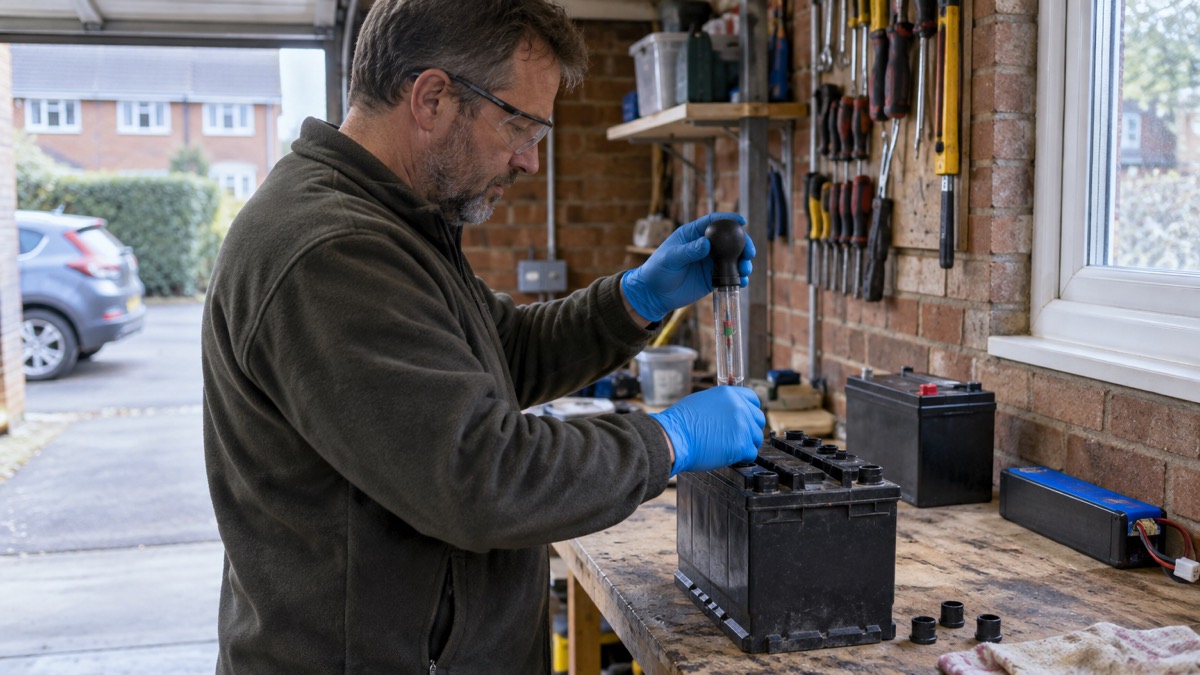
If you keep a lead-acid battery for backup power, you have probably noticed an "equalise" setting on the charger and wondered whether to press it. The answer depends entirely on what kind of battery you have. Flooded lead-acid batteries, the sort with removable caps and liquid inside, benefit from an equalisation charge now and then, but only after the fluid has been topped up. Sealed batteries and lithium batteries must not be equalised at all: the charger maker Victron states plainly that sealed and lithium batteries "don't need and therefore should not be equalized"1.
The practical rule is simple. Before you equalise anything, identify the chemistry, check the fluid if it can be checked, and confirm the charger is set to the right profile. A flooded battery that is low on water should be topped up with distilled and de-ionised water first, never tap water2. A sealed battery cannot be topped up, so overcharging it reduces the electrolyte permanently2. A lithium battery needs a lithium charging profile and the maker's own charger, and the fire risks around lithium mean the charging itself has to be done in the right place, awake and alert3.
This page sets out which batteries need equalisation, how to prepare a flooded one, how to check its charge with a hydrometer, how to bring a neglected flooded battery back, and why lithium and sealed batteries are different. It also covers the safety rules that apply to every battery in a UK home, and where to take old ones.
Which batteries need an equalisation charge, and which must never have one
Equalisation is a deliberate, controlled overcharge that stirs up a flooded lead-acid battery and brings its cells back into balance. It is only appropriate for batteries where the liquid can be checked and topped up. A flooded leisure battery is the kind that can take an equalisation cycle, because its cells can be opened, checked with a hydrometer and topped up5.
The other two families cannot. Sealed leisure batteries "must not be overcharged since this will reduce the level of the electrolyte in the cells, which cannot be replenished"2. Lithium is the same story from the charger side: Victron's SmartSolar MPPT RS manual says sealed and lithium batteries "don't need and therefore should not be equalized"1. Fogstar, which supplies lithium batteries for Victron chargers, lists an equalisation voltage of 14.2V but notes you do not need to equalise lithium and can turn the setting off10.
| Battery type | Equalise? | Why | What to do instead |
|---|---|---|---|
| Flooded lead-acid (caps, liquid visible) | Yes, periodically | Cells drift out of balance; fluid can be topped up | Top up with distilled and de-ionised water, then run the cycle2 |
| Sealed lead-acid (AGM, gel, maintenance-free) | No | Electrolyte cannot be replenished if overcharged2 | Use the sealed profile on the charger1 |
| Lithium (LiFePO4 and similar) | No | Maker says sealed and lithium should not be equalised1 | Use a lithium charging profile and the maker's charger3 |
If you are unsure which you have, look for removable caps. A battery you can open and top up is flooded; one you cannot is sealed. If the label says lithium, or the battery is a lightweight pack for a tool or an e-bike, treat it as lithium.
Preparing a flooded battery before you equalise
Equalising a flooded battery that is low on water damages it. The plates need to be covered before any overcharge cycle begins. The Caravan Club's advice is direct: "If the plates are exposed, top up with distilled and de-ionised water; never use tap water or meltwater from a 'fridge"2. Use only distilled and de-ionised water, and leave room for the electrolyte to expand.
Once the battery is topped up, connect the charger and run the equalisation cycle according to the charger's instructions. When you believe the battery is fully charged, disconnect the charger mains lead, re-check the electrolyte level, then leave the battery for at least four hours before checking its state of charge again2. That rest period matters: a reading taken straight off charge will not tell you the true state.
Checking charge with a hydrometer: 1.255 to 1.275 when full
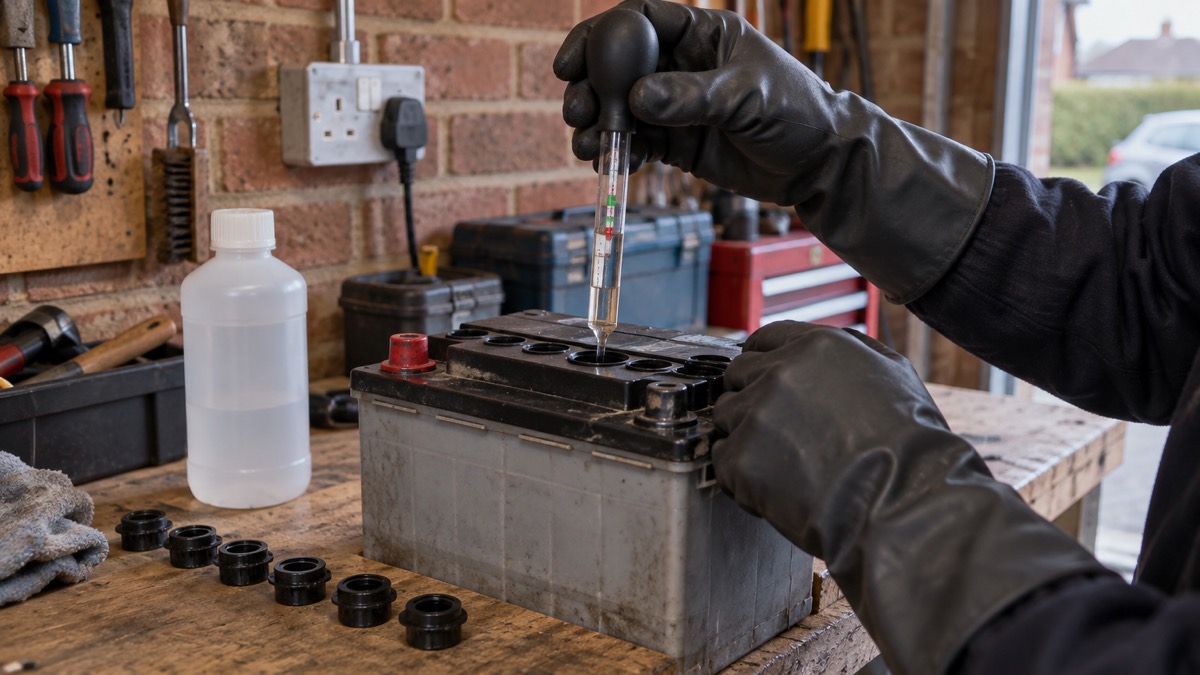
A voltmeter tells you what the charger is doing; a hydrometer tells you what is actually inside the cell. A fully charged cell reads 1.255 to 1.275 on the specific gravity scale5. Below that, the cell is partly discharged, and a wide spread between cells is a sign the battery is out of balance and may benefit from equalisation.
Take the reading after the battery has rested, not while it is charging. The same guidance says to leave the battery for at least four hours after disconnecting the charger before checking its state of charge2. Draw electrolyte into the hydrometer, read the float, and return it to the cell. Wear eye protection and gloves, because the liquid is acid.
A battery that is only partly charged will come back faster than one that is flat. The Caravan Club notes that a 75 per cent charged battery may only take a few hours to charge fully, whereas a fully discharged battery may take more than 24 hours2. That is worth knowing before you assume a battery is beyond saving.
Recovering a flooded battery that has been neglected
A flooded battery that has sat unused is not necessarily finished, but it needs patience. The Caravan Club's method is to charge it under voltage control, let it rest, and repeat: "After several cycles of voltage-controlled charging and resting, the battery is fully charged"2. Do not expect one long charge to do the job.
Check the fluid at every stage. If the plates become exposed during charging, stop and top up with distilled and de-ionised water2. Keep the battery in a well-ventilated place, because charging gives off gas, and never smoke or use a flame nearby.
If the battery will not hold a charge after several cycles, or a cell reads far below the others, it is time to retire it. A damaged battery should be recycled and must not be used or charged9. Take it to a civic amenity site, and tell the staff if it is leaking11.
Lithium batteries must not be equalised: use a lithium charging profile
Lithium batteries are not flooded lead-acid, and the charger must know the difference. Victron's manual is explicit that sealed and lithium batteries should not be equalised1. Fogstar's guidance for its lithium batteries used with Victron chargers gives an equalisation voltage of 14.2V but says you do not need to equalise lithium and can turn the setting off10. The safe course is to select the lithium profile and leave equalisation disabled.
Charging hardware matters as much as the profile. West Yorkshire Fire and Rescue Service says: "Only use chargers recommended by the manufacturer. Avoid cheap or counterfeit alternatives that may lack safety features"3. The same principle appears across fire service guidance: use the correct charger8, and do not mix lithium batteries with other types such as alkaline or NiMH9.
Lithium is now the main material in domestic battery storage, though cobalt and nickel are also used12. That makes the charging rules a household matter, not a specialist one. The fire risks are real: lithium batteries can present a fire risk when over-charged, short-circuited, submerged in water or damaged8, and fire services describe them simply as able to cause fires13.
Charging lithium safely at home
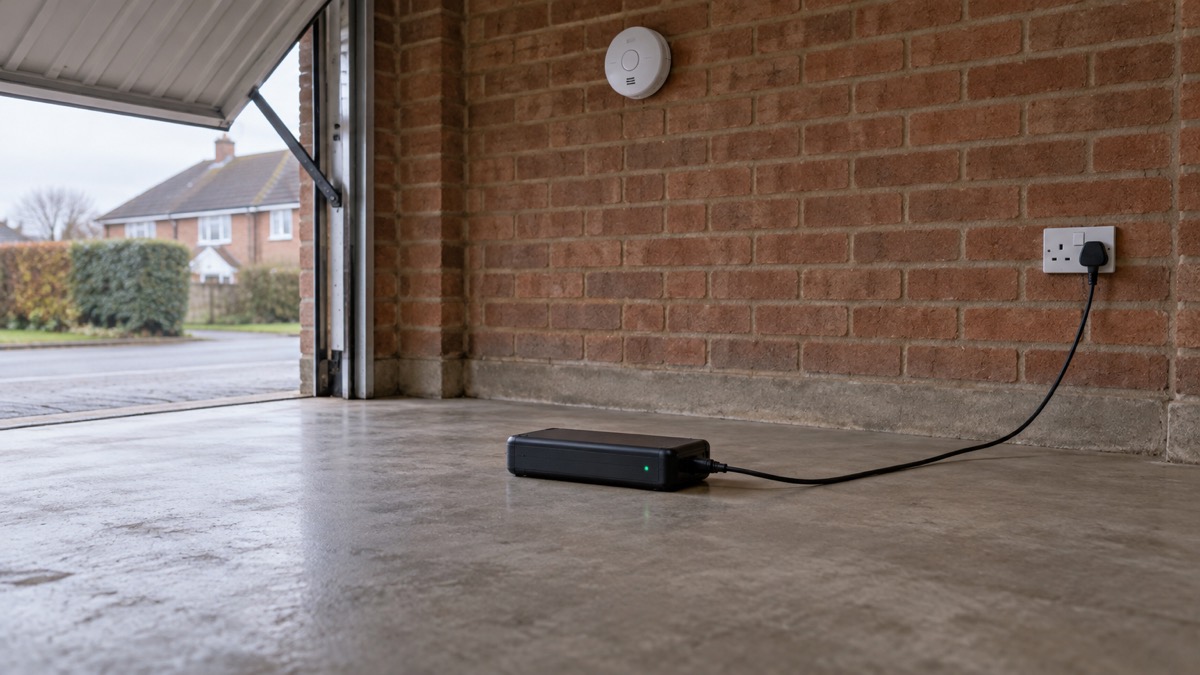
The place you charge matters as much as the charger. Fire services advise charging on a hard, flat surface where heat can dissipate6, from a socket that is RCD protected, in an area with working smoke alarms7. If an e-bike or e-scooter battery can be removed, charge it separately on a hard flat surface in an area with good ventilation14.
Stay with the battery while it charges. Essex Fire and Rescue Service says: "Charge your device while you are awake and alert so if a fire should occur you can respond quickly"15. Unplug the charger once the device is fully charged4, and never cover chargers or charging devices4. Avoid storing, using or charging batteries at very high or low temperatures15.
Watch for the warning signs that a battery is failing and becoming a fire risk18. For e-bikes and e-scooters, listen for hissing or cracking sounds14. Buy from a reputable retailer and be wary of cheaper offerings from the global marketplace17.
Sealed lead-acid batteries for low-maintenance home storage
Sealed lead-acid batteries, including AGM and gel types, suit households that want storage without checking fluid. The trade-off is that they cannot be topped up, so they must not be overcharged: doing so reduces the electrolyte level in cells that cannot be replenished2. Set the charger to the sealed profile, and do not run an equalisation cycle1.
For a low-maintenance setup, pair a sealed battery with a charger that has a dedicated sealed setting. Sterling Power's AQUA range AC to DC charger, for example, lists an absorption voltage of 14.4V and a float of 13.6V19. Those are the maker's figures for that product; check the instructions for the battery you actually own.
Sealed batteries still need periodic attention. Check every two months and re-charge if necessary2. Keep them dry: getting batteries wet is a cause of damage20. And when a sealed battery reaches the end of its life, dispose of it through a civic amenity site or a retailer's collection point, not the household bin11.
Where to get help and how to dispose of old batteries
Old batteries are a fire risk in the waste stream. Anywhere that sells batteries, such as a supermarket, should offer a collection of old batteries21. Before recycling an item, check it for hidden batteries22. Do not put a damaged or end-of-life battery in household waste or the usual recycling: when crushed or punctured they can cause fires in bin lorries and recycling centres23. Ask the manufacturer about a recycling service or the local authority about battery recycling arrangements23.
If you are preparing a battery for disposal, tape over the terminals with electrical tape to prevent short circuits and fire risk, and store it in a cool, dry place until it goes9. Do not mix lithium batteries with other types in the same collection9.
For a wider look at keeping a battery bank working through a power cut, see Charging and Looking After an Off-Grid Battery Bank Safely and Off-Grid Battery Banks: Lead-Acid, AGM, Gel and Lithium. If you are building a backup power setup from scratch, the Backup Power at Home section covers the options.
Sources (23)
- SmartSolar MPPT RS manual, Victron Energy, 2026-10
- Batteries: technical advice, The Caravan Club, 2026-10-25
- Batteries and chargers, London Fire Brigade, 2026-10-25
- Battery safety flyer, Portsmouth City Council, 2026-01
- BATTERY MAINTENANCE GUIDE, bimblesolar.com
- How to charge e-bikes and e-scooters safely, London Fire Brigade, 2026-10-25
- Battery fires, Devon and Somerset Fire and Rescue Service, 2026
- Lithium-ion batteries, Scottish Fire and Rescue Service, 2025-11-27
- Lithium battery fire safety, Tandridge District Council, 2026-10-29
- Fogstar knowledge hub, Fogstar, 2026-10-29
- How to recover from flooding, GOV.UK, 2023-12-19
- Battery storage advice, Centre for Sustainable Energy, 2025-10
- Swallowed something, Alder Hey Children's NHS Foundation Trust, 2025-09-25
- Spot the warning signs, London Fire Brigade, 2026-10-25
- Batteries and charging safety, Essex County Fire and Rescue Service, 2026-10-29
- Lithium-ion batteries and chargers, Humberside Fire and Rescue Service, 2026-10-29
- Lithium batteries, Surrey County Council, 2026-10-28
- Digital easy read fire safety booklet, London Fire Brigade, 2026
- AQUA range IP68 waterproof AC to DC battery charger, Sterling Power, 2026-10-25
- Lithium-ion battery safety advice, Cheshire Fire and Rescue Service, 2026-09-30
- Battery safety, West Yorkshire Fire and Rescue Service, 2026-10-29
- E-feiciau ac e-sgwteri diogelwch tan, Mid and West Wales Fire and Rescue Service, 2026-10-29
- Power outage course, Anker SOLIX, 2026-10-25
 Off-Grid Solar Kit Checklist
 Hydroponic System Parts List
 Year-Round Sowing Calendar
 Blocking Diode for Solar Panels
 Plug-In Solar to a Battery
 Plug-In Solar Extension Leads
 Plug-In Solar and Landlords
 Plug-In Solar Safety
 Solar Panel Burning Smell
 Solar Panels in a House Fire