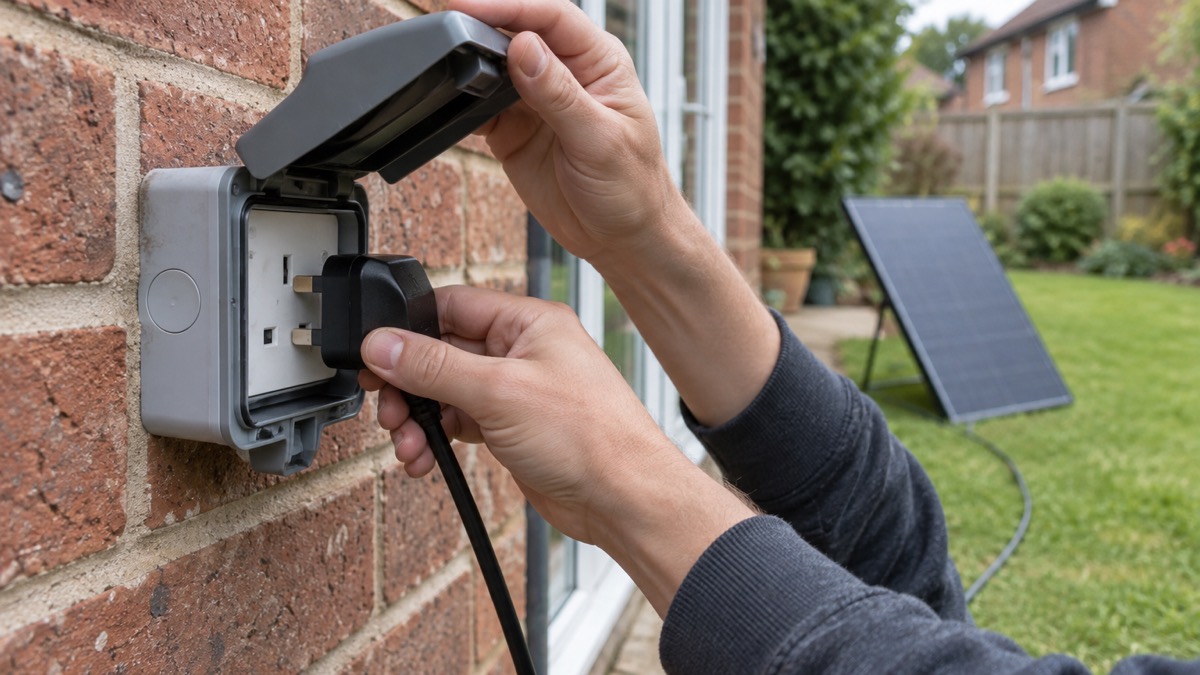
No, a plug-in solar panel should not be connected through an extension lead, and yes, it can go into an outdoor socket, provided that socket is properly rated and fitted. The London Fire Brigade is direct on the first point: plug-in solar systems should not be connected through extension leads, adaptors or overloaded sockets, because overloaded electrical connections can overheat and cause fires1. Electrical Safety First says the same, adding cable reels, multiway adaptors, travel adaptors and plug-in RCD adaptors to the list of things not to use, because these accessories can overheat, become overloaded and create additional safety risks2.
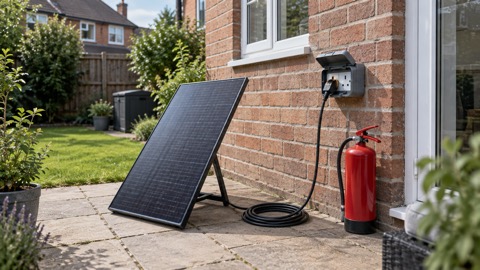
The safe arrangement is simple: the panel's own cable goes straight into a wall socket. If the socket is outside, the London Fire Brigade advises it should be a minimum IP65-rated installation fitted by a competent person1. Where electrical work is needed, such as fitting that outdoor socket, use a qualified and competent installer1.
Plug the panel straight into a wall socket, not an extension lead
The instruction from the fire and electrical safety bodies is not a preference. Plug-in solar systems should not be connected through extension leads, adaptors or overloaded sockets, the London Fire Brigade states, because overloaded electrical connections can overheat and cause fires1. Electrical Safety First's guidance names the same accessories and explains why: they can overheat, become overloaded and create additional safety risks2. Its press release responding to the roll-out of plug-in solar panels repeats the warning3.
This follows a pattern the fire services apply to other high-draw or continuously operating equipment. Electric heaters should be plugged into a wall socket, not an extension lead, because leads can easily be overloaded and cause fires8. The National Fire Chiefs Council advises plugging rechargeable bikes, scooters and mobility scooters into a mains socket rather than an extension lead10. A solar panel feeding the ring main is in the same category of advice: the wall socket is the designed connection point, and anything between the panel and the socket adds a weak link.
There is a second reason the wall socket matters. Extension leads and adaptors have a limit on how many amps they can take, and overloading them raises the risk of fire, according to North Wales Fire and Rescue Service11. FireKills tells households to check the current rating, usually 13 amps, and make sure the total power drawn by all plugged-in appliances does not exceed it6. A solar panel sharing a lead with other appliances pushes that total up.
Why extension leads and multi-way adaptors are a risk with plug-in solar
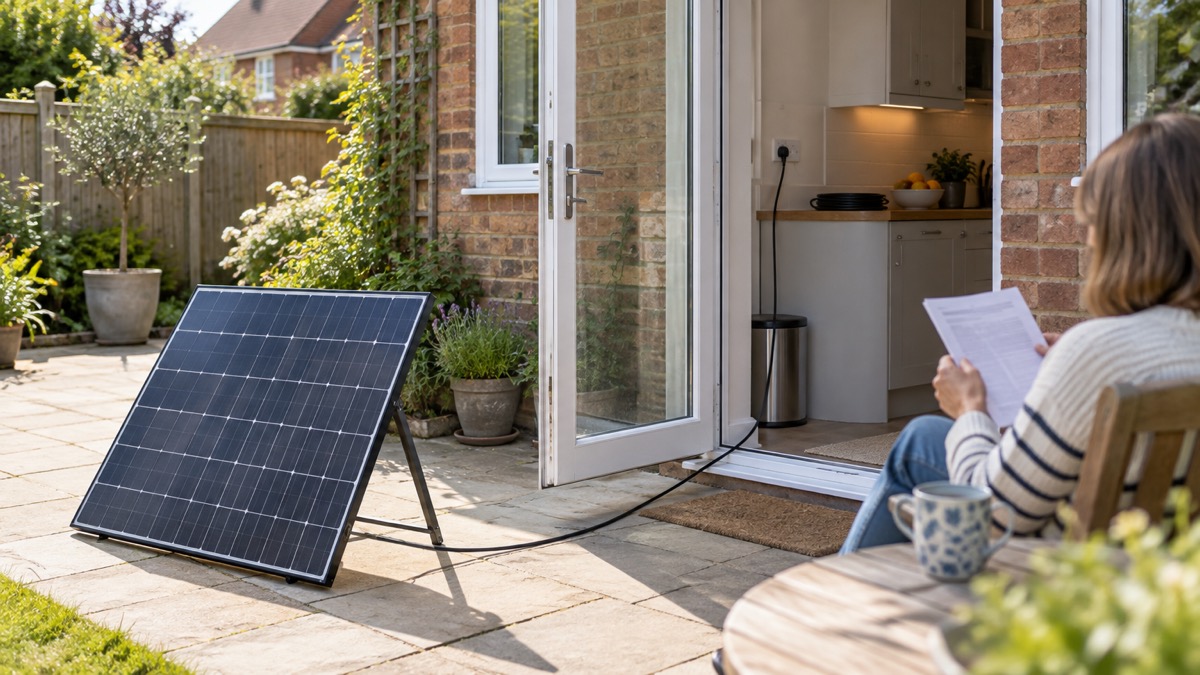
An extension lead is a cable with a plug on one end and one or more sockets on the other. It is designed for temporary use with appliances that draw a known, modest current. A solar panel is different: it can be generating whenever there is daylight, and the connection is meant to stay in place. Electrical Safety First's warning that these accessories can overheat, become overloaded and create additional safety risks applies directly2.
The risks stack up in a particular order:
- Overheating. Cable drum extension leads should always be completely unwound to avoid overheating, the London Fire Brigade advises12. A coiled lead traps heat, and a solar feed running through it for hours is exactly the wrong use.
- Overloading. Extension leads and adapters have an amp limit, and overloading them raises the risk of fire11. Doncaster and Bassetlaw Teaching Hospitals' fire safety guidance is blunt: don't overload extension leads, because this can cause fire13.
- Daisy-chaining. Do not plug one extension lead into another14. Electrical Safety First calls it bad practice that should never be done, because it presents a serious risk that the wall socket could be overloaded7. Humberside Fire and Rescue Service says connecting more than one extension lead together can overload the socket and cause an electrical fault16.
- Adaptors. Socket extenders and extension leads should only ever be attached to the wall plug, not to one another, Warwickshire Fire and Rescue Service advises17. South Wales Fire and Rescue Service recommends a maximum of one plug in each socket18.
Outdoor sockets: what makes one suitable
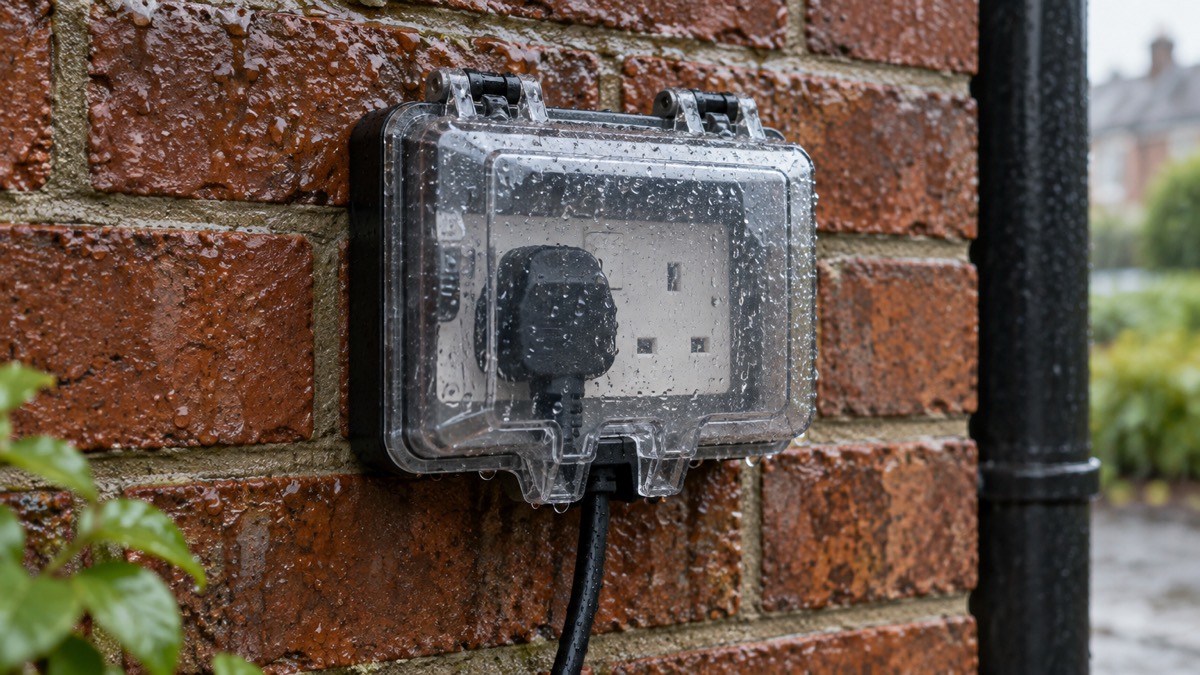
An outdoor socket is the right way to connect a plug-in solar panel that sits in the garden, on a balcony or on a wall outside. What makes one suitable comes down to three things: its weather rating, its protection, and who fits it.
The London Fire Brigade sets the rating: if you are plugging your solar panel into an outdoor socket, ensure it is a minimum IP65-rated installation fitted by a competent person1. IP65 is a standard rating for protection against dust and water jets. A socket that is merely covered, rather than rated, does not meet that bar.
Electrical Safety First's garden guidance adds the protection requirement. Always use an outdoor waterproof electric socket protected by an RCD when working with electrical equipment in the garden5. For anyone putting up outdoor lights every year, it suggests getting a registered electrician to install weatherproof, RCD-protected outdoor socket-outlets19. The same logic applies to a solar panel that stays connected through the seasons.
| What to check | What good looks like | Who says so |
|---|---|---|
| Weather rating | Minimum IP65-rated installation | London Fire Brigade1 |
| Water resistance | Outdoor waterproof socket | Electrical Safety First4 |
| Electrical protection | Protected by an RCD | Electrical Safety First4 |
| Who fits it | A competent person, or a qualified and competent installer where electrical work is required | London Fire Brigade1 |
| Lead rating, if a lead is used outdoors at all | Rated for outdoor use, weather-resistant, moulded connections | Electrical Safety First7 |
If a lead is used outdoors for anything else, it must be rated for outdoor use. Electrical Safety First advises buying one rated for outdoor use from a reputable retailer, because outdoor leads are built to resist moisture, low temperatures and physical wear19. Indoor extension leads are not designed to withstand the elements and can create electrical hazards when used outside19. Only use extension leads, cable reels and connectors suitable for outdoor use, weather-resistant with moulded connections and rated correctly for the equipment7.
Cable runs from the balcony or garden to the socket
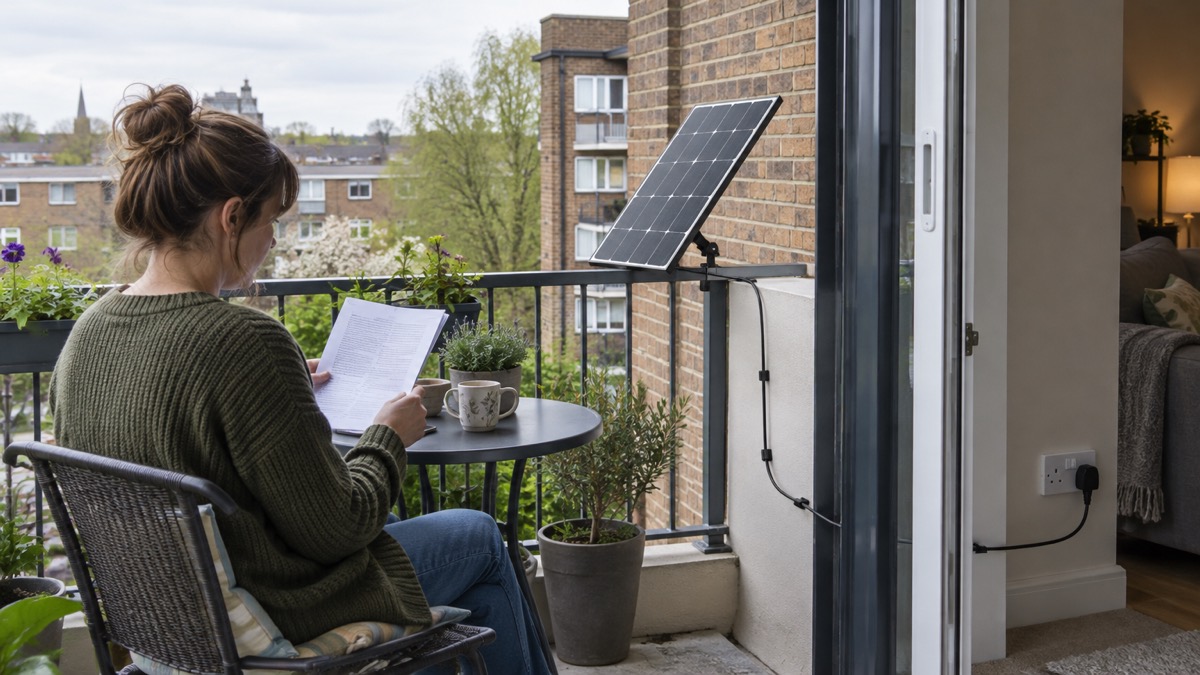
The distance between the panel and the socket is where most households are tempted to improvise, and where the advice is clearest: don't. A longer run is not a reason to reach for an extension lead, because the fire and electrical safety bodies rule out extension leads for plug-in solar altogether1.
The practical answer is to plan the position of the panel around the socket, not the other way round. If the panel cannot reach a suitable socket on its own cable, the options are to have a competent person fit an outdoor socket closer to the panel, or to reconsider where the panel goes. Where electrical work is required, for example fitting an outdoor socket, use a qualified and competent installer1.
Some makers sell dedicated solar extension cables for their own kits. EcoFlow lists a Solar Extension Cable on its UK site, available to buy there20. That is a maker's accessory for its own product, not a general licence to run any panel through any lead. If you are considering one, check with the maker that it is intended for your model and with a qualified electrician that the run is suitable.
Checks to make before connecting a plug-in solar kit
Before the panel goes live, work through the same checks a fire officer would make. Each one is quick, and each closes off a known route to overheating or shock.
- Confirm the socket is a wall socket, not a lead. The panel connects directly to a wall socket, with no extension lead, cable reel, multiway adaptor, travel adaptor or plug-in RCD adaptor in between1.
- Check the socket is not overloaded. Use a maximum of one plug in each socket, and do not overload extension leads with too many electrical goods18. FireKills advises checking the current rating, usually 13 amps, and making sure the total power drawn by all plugged-in appliances does not exceed it6.
- Give heat-producing appliances their own socket. Anything that produces heat, such as a toaster, air fryer or kettle, should have its own wall socket, not an extension lead21. Keep the solar panel's socket clear of them.
- Check any lead in the house is sound. Before using extension leads and cable reels, check they are clean and free from damage, and fully uncoil them to prevent overheating5. Position them to prevent damage and keep them dry5.
- Check your RCD protection. If you do not have RCD protection, Electrical Safety First advises using an RCD plug on the socket where the product is plugged in22. For plug-in solar specifically, plug-in RCD adaptors are on the do-not-use list2, so ask a registered electrician to check your consumer unit instead.
- Check the outdoor socket rating. If the panel connects outside, confirm the socket is a minimum IP65-rated installation fitted by a competent person1.
- Ask before you buy if you rent. Contact your landlord, housing provider, freeholder or property management company before buying or installing any plug-in solar equipment1.
Where to get advice: electricians, your supplier and your network operator
Most of the questions a household has about plug-in solar are answered by one of three people: a registered electrician, your electricity supplier, or your network operator. Knowing which to ask saves time.
A registered electrician is the right contact for anything involving fixed wiring: fitting an outdoor socket, checking RCD protection, or assessing whether your consumer unit is up to the job. The London Fire Brigade advises using a qualified and competent installer where electrical work is required, for example fitting an outdoor socket1. If a lead or adaptor is damaged, Electrical Safety First says to unplug it and contact the retailer, manufacturer or a qualified repair technician24.
Your electricity supplier handles metering. If you want a smart meter, get in touch with your energy supplier, who can arrange for one to be installed25. Age UK encourages customers to speak to their electricity supplier about upgrading their meter26. Suppliers are also required to proactively contact customers who use Radio Teleswitch meters to tell them about the switch-off date and the need to upgrade27.
Your network operator is the organisation that runs the wires in your area. If you are not sure who your electricity supplier is, contact your network to find out28. For larger solar or battery installations, telling your network operator is covered under G98, and there is a guide to that on this site: Telling Your Network Operator About Solar Panels or a Battery: G98 Explained.
If you are struggling with energy costs, the National Energy Action charity has advice on what to do28. Households that need extra help in a power cut, including older and disabled people and those with medical dependencies, can ask their supplier to add them to the Priority Services Register, which Surrey County Council describes as a way to get support29. There is more on this site at Extra Help in an Emergency: Older, Disabled and Medically Dependent Households.
For the wider safety picture around plug-in solar, see Are Plug-In Solar Panels Safe at Home?. If you rent, Do You Need Your Landlord's Permission for Plug-In Solar? sets out what to ask. And if you are thinking about storing the panel's output, Connecting Plug-In Solar Panels to a Battery explains the options. The Energy Saving Trust notes that if your battery is full and you are generating more solar electricity than you are using, you can sell the surplus back to your energy supplier through a Smart Export Guarantee tariff30; whether a particular kit qualifies is a question for your supplier.
Sources (30)
- Plug-in solar panels: safety advice for residents and homeowners, London Fire Brigade, 2026-10-25
- Plug-in solar panels, Electrical Safety First, 2026-10-25
- Responding to the roll-out of plug-in solar panels, Electrical Safety First, 2026-10-25
- Garden, Electrical Safety First, 2026-10-25
- New parents, Electrical Safety First, 2026-10-25
- Fire prevention, FireKills, 2026-03-25
- Garden safety, Electrical Safety First, 2026-10-26
- Heating your home, North Yorkshire Fire and Rescue Service, 2026-03-09
- Stay fire safe, Greater Manchester Fire and Rescue Service, 2026-10-29
- Lithium battery fires | Devon and Somerset Fire and Rescue Service, Devon and Somerset Fire and Rescue Service
- Looking after the electrics, North Wales Fire and Rescue Service, 2026-10-25
- Electrical items, London Fire Brigade, 2026-10-25
- Kitchen, Devon and Somerset Fire and Rescue Service, 2026
- Electrical fire safety leaflet, Greater Manchester Fire and Rescue Service, 2026
- Stay Warm Stay Safe leaflet, Ards and North Down Borough Council, 2025
- Celebrate safely, Humberside Fire and Rescue Service, 2026-10-26
- Fire safety advice for parents - Warwickshire County Council, Warwickshire County Council
- Student fire safety, South Wales Fire and Rescue Service, 2026-09-08
- Christmas light safety tips for a safe festive season, NICEIC, 2025-11-26
- Solar Extension Cable, EcoFlow, 2026-10-25
- Staying safe this season, Devon and Somerset Fire and Rescue Service, 2025-12-01
- Christmas tips, Electrical Safety First, 2026-10-25
- E-bikes, Electrical Safety First, 2026-10-25
- Extension leads, cable reels and block adaptors, Electrical Safety First, 2026-10-25
- Home improvements, Met Office, 2026-10-28
- Radio Teleswitch Service (RTS) switch off, Age UK, 2026-08-26
- Storm damage: how to protect your home from a thunderstorm, Which?, 2026-10-21
- Key things to do if you are struggling with your energy bills, National Energy Action, 2026-05-06
- Priority Services Register, Surrey County Council, 2026-10-28
- Battery storage, Energy Saving Trust, 2026-10-06
 Off-Grid Solar Kit Checklist
 Hydroponic System Parts List
 Year-Round Sowing Calendar
 Blocking Diode for Solar Panels
 Equalisation Charging
 Plug-In Solar to a Battery
 Plug-In Solar and Landlords
 Plug-In Solar Safety
 Solar Panel Burning Smell
 Solar Panels in a House Fire