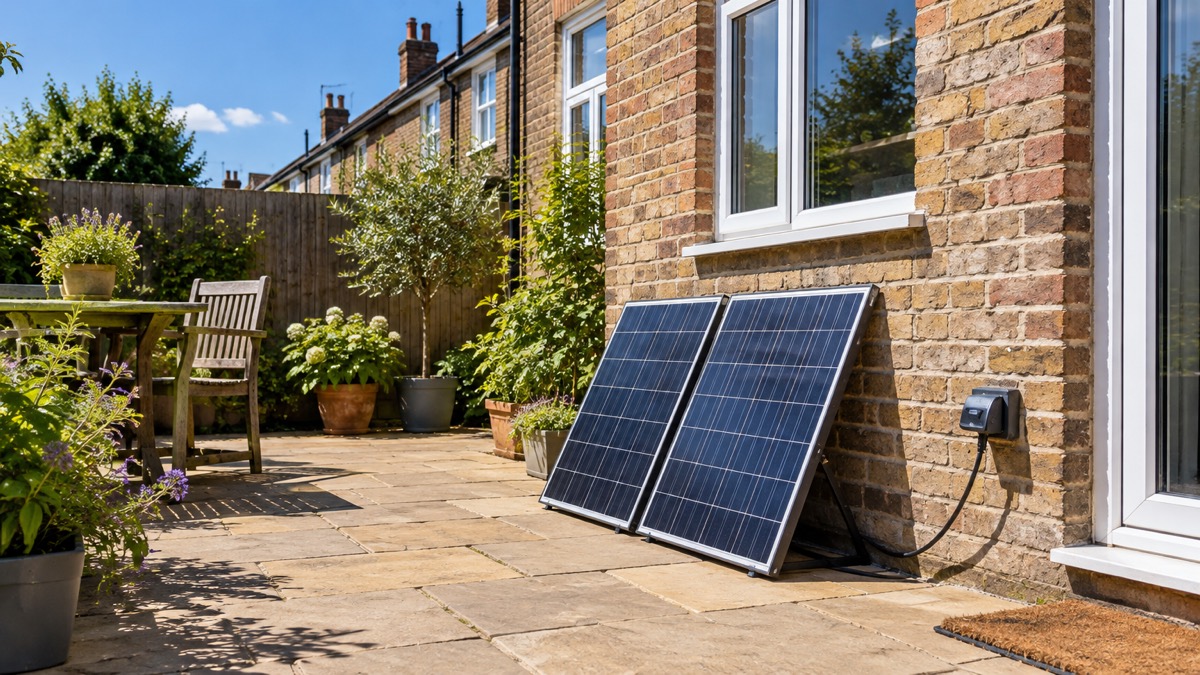
A plug-in solar panel is a panel and a small inverter that you plug into an ordinary three-pin wall socket, rather than wiring into your consumer unit1. Light from the sun hits the panels and generates energy, which flows into the electrical circuit for the home1. These panels are available to buy in the UK2.
The catch is that they are not safe in every home as it stands. Electrical Safety First, the electrical safety charity, says households should have at least a Type A bidirectional RCD protecting the circuits intended for use with plug-in solar panels, and that homes with older Type AC RCDs should not use plug-in solar systems without first upgrading to a minimum Type A bidirectional RCD on those circuits2. The charity is concerned that the reverse flow of electricity sent into a property's wiring by plug-in solar may damage or burn out older Type AC RCDs3.
So the order of work is: find out what RCD you have, check the socket and how you will connect, decide where the panels go, plug in, and then tell your Distribution Network Operator within 28 days of installation5. Do not connect through an extension lead, cable reel, multiway adaptor, travel adaptor or plug-in RCD adaptor2. And do not expect the panels to keep the lights on in a power cut: they switch off with the mains4.
How plug-in solar panels connect to your home
The connection itself is deliberately simple: the system is plugged into a three-prong wall socket1. Behind that plug, the panel produces direct current, and an inverter converts it into the alternating current that household appliances use6. That is the same principle as any solar set-up: to use the electricity generated by solar panels, you need an inverter to convert the direct current (DC) into alternating current (AC)5.
What makes plug-in solar different from a roof installation is direction. A conventional system is wired into the consumer unit and supplies the whole house. A plug-in system sends electricity in the opposite direction in your property's wiring, back through the socket it is plugged into3. That reverse flow is the reason the type of RCD matters so much, and the reason the connection point has to be a proper fixed socket rather than anything improvised.
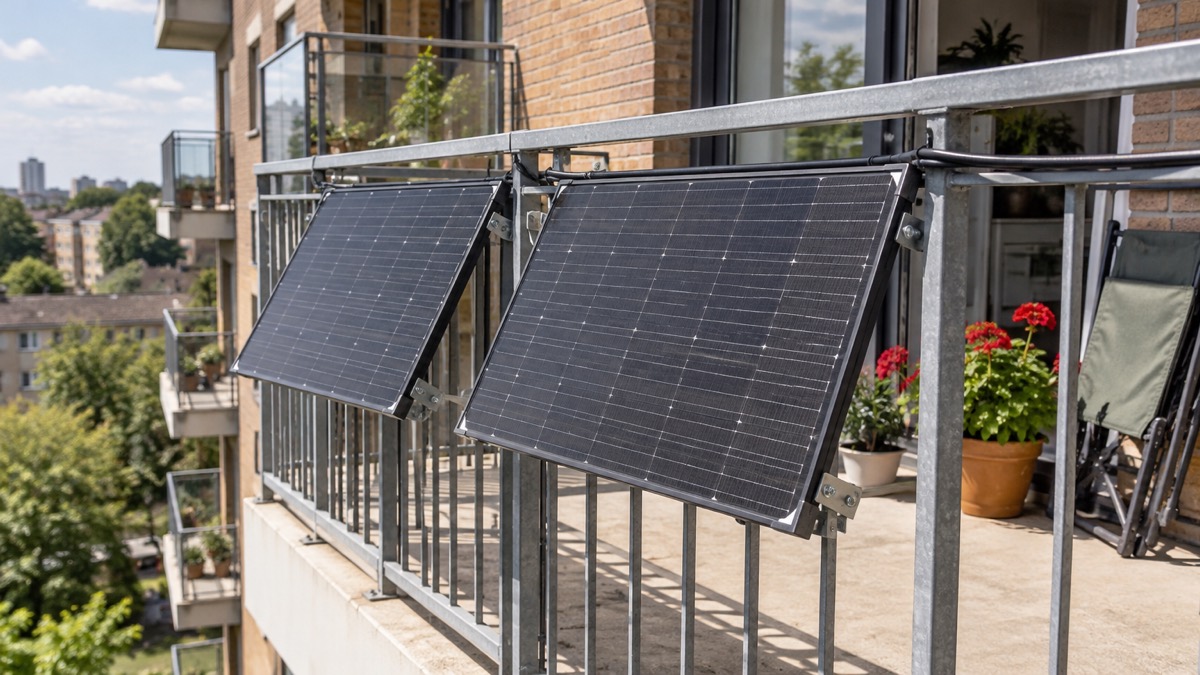
The panels themselves are modular. A connector lets two or three solar panels be connected in series7, and flexible panels can be fixed with pre-drilled mounting holes, adhesive, industrial velcro or tape, tied down, or secured permanently with bolts8. That flexibility is useful for a balcony or shed roof, but it also means the quality of the mounting and the cable routing is down to you or your installer.
Check your RCD before you buy anything
An RCD, or residual current device, is the safety switch that cuts the power if a fault sends current where it should not go. Electrical Safety First recommends households have at least a Type A bidirectional RCD protecting circuits intended for use with plug-in solar panels2. If your consumer unit has an older Type AC device, the charity's position is blunt: homes with Type AC RCDs should not use plug-in solar systems without first upgrading to a minimum Type A bidirectional RCD on those circuits2.
The concern is damage to the device itself. Electrical Safety First says the reverse flow of electricity sent into a property's wiring by plug-in solar may damage or burn out older Type AC RCDs3. A damaged RCD may not protect you when you need it, which is why the upgrade comes before the panel, not after.
| What you have | What the guidance says | What to do |
|---|---|---|
| Type A bidirectional RCD on the circuit | Meets the recommended minimum2 | Proceed, subject to the other checks on this page |
| Type AC RCD | Should not be used with plug-in solar without upgrading first2 | Have a minimum Type A bidirectional RCD fitted on those circuits before connecting |
| No RCD in the consumer unit, or not working | Use plug-in RCDs for all the sockets in your home9 | Treat this as a job for a qualified electrician before adding solar |
For a full rooftop system the picture is slightly different again: Electrical Safety First says it is important the correct type of RCD or RCBO is used with the PV system, that this should be verified with the manufacturer, and that it will often be a type B which can withstand any DC earth leakage5. That is a question for your installer, but it shows why the device type is never a detail to skip.
If you are unsure what is in your consumer unit, do not guess. A qualified electrician can identify the device and advise on any upgrade. The same principle applies to any home electrical safety check: use an RCD if your home is not already wired as standard10.
Never through an extension lead, cable reel or adaptor
This is the single instruction most likely to be broken, because plugging a solar panel in at the far end of the garden through an extension lead feels obvious. It is exactly what the guidance rules out. Plug-in solar systems should not be connected via extension leads, cable reels, multiway adaptors, travel adaptors or plug-in RCD adaptors2. The charity's reason is that these accessories can overheat, become overloaded and create additional safety risks2.
The safe pattern is one plug, one socket. Use one plug per socket, as home fire safety guidance puts it11. If the only socket near your panels is already serving something else, that is a sign to rethink the position of the panels or to have a proper outdoor socket installed, not to add a multiway block.
Outdoor wiring has its own rules. Electrical Safety First says to use only extension leads, cable reels and connectors suitable for outdoor use: weather-resistant with moulded connections and rated correctly for the equipment, and cable reels should be fully unwound and fitted with a thermal cut-out10. Those rules are for garden equipment generally, and they underline why a temporary lead is the wrong permanent answer for a solar panel.
Where to put the panels and what they can power
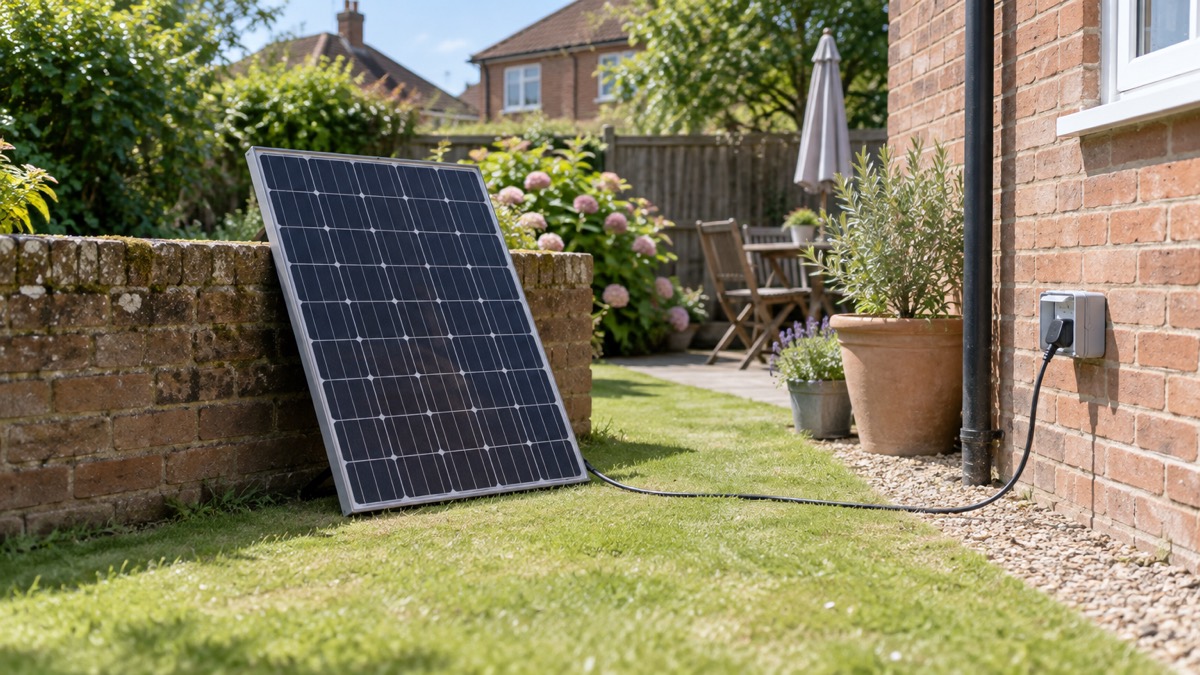
Plug-in solar panels can be placed in sunny outdoor spots: a terrace, shed or outhouse roof, a balcony and similar1. Position matters more than anything else, because output follows light. For off-grid panels the maker's own instruction is to position them in a well-lit area and mount them securely on a roof, pole or ground mount, angled for optimal sunlight exposure12. The same logic applies to a plug-in system.
Be realistic about what they deliver. The Government's own guidance says plug-in panels do not generate enough energy to power your home entirely, but they could save you some money1. They are a way of trimming daytime consumption, not a backup supply. If your aim is to keep a fridge or a boiler running through an outage, a portable power station charged from a portable solar panel is the tool built for that job, and our guide to what to keep running when the mains fails helps you decide what is worth powering.
Panels need looking after, but not much. Most panels have a self-cleaning coating which, when installed at a suitable angle, allows rain to clear dirt and debris5. Where dirt, dust, lichen or bird droppings accumulate, periodic cleaning by a specialist company can help, improving sunlight absorption and preventing hotspots which can result in a panel failing5. Electrical Safety First says keeping panels clean and maintained could increase energy production by up to 15 per cent5.
They switch off in a power cut
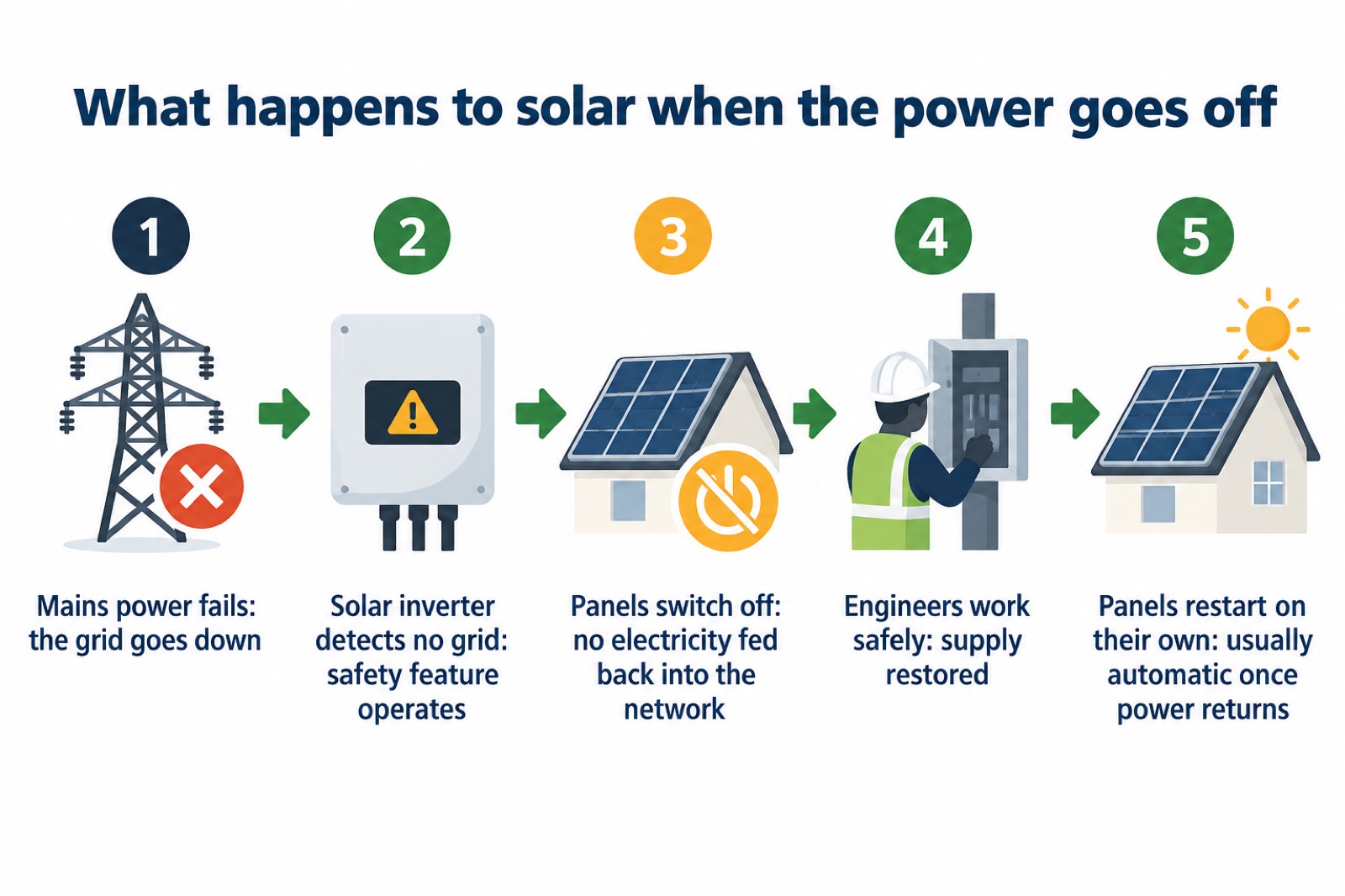
A plug-in solar system will not carry you through an outage. Solar panels automatically switch off during a power cut to prevent electricity being sent back into the network while engineers are working, and will usually restart on their own once power returns4. Your solar panels will stop working during a power cut for safety reasons13. The same applies to other low carbon technology: systems like solar panels, heat pumps, EV chargers and batteries will automatically switch off during a power cut to protect your home and engineers working on the network4.
There is one exception worth knowing. If you have solar panels and a battery storage system with power backup capability, some installations can continue to provide power during a power cut if they are designed and configured to operate independently of the electricity grid, which may help keep essential appliances running14. That is a property of the battery system, not of a plug-in panel.
If your outage letter says you will be connected to a temporary generator, turn off your solar panels before the planned outage and turn them back on once mains power has been restored, because solar panels left on may feed electricity into the generator and cause it to stop working15. For any outage, leave a light on so you know when power is restored16. Households that depend on power for medical equipment or mobility can ask their supplier for extra help through the Priority Services Register17.
Tell your Distribution Network Operator
The building owner is responsible for registering a solar PV system with the Distribution Network Operator, or DNO5. The DNOs are the infrastructure that we see bringing the electricity into our homes18, and each distributor has its own register, so you need to contact them directly, online, by phone or email17.
Finding the right one is straightforward. First, find who your electricity network operator is; when you have found your electricity network, use the Find my supplier service on their website, which will also tell you the MPAN for your address16. The MPAN is the meter point administration number that identifies your supply.
| Step | What to do | Who says |
|---|---|---|
| 1 | Identify your electricity network operator | Citizens Advice16 |
| 2 | Use the operator's Find my supplier service to get your MPAN | Citizens Advice16 |
| 3 | Notify the DNO of the plug-in solar installation | Electrical Safety First5 |
| 4 | Keep the confirmation with your system paperwork | Your own record |
Systems with an export capacity of up to 3.68kWp can be notified to the Distribution Network Operator (DNO) within 28 days of installation under the G98 'connect and notify' arrangement, while those above this limit need pre-approval through the G99 'apply to connect' process before connection5. With a plug-in system the responsibility sits with you as the building owner, so do not assume a retailer or installer has done it.
Keeping it safe once it is running
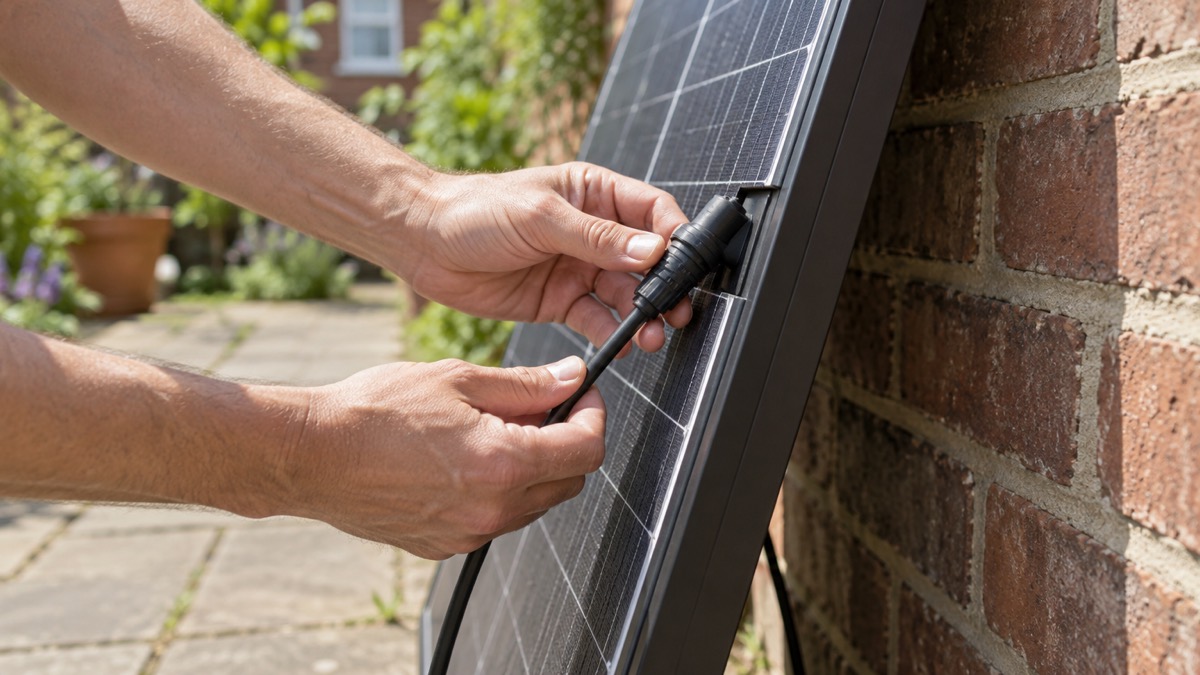
Regular checks catch most problems early. Electrical Safety First advises regular visual checks to identify any cracks, breaks, loose connections, and any cable damage caused by vermin and weathering5. It also recommends having your system inspected and tested at least every five years to ensure it remains safe5.
Know the warning signs and act on them. Do not ignore burn marks, arcing (buzzing or crackling) sounds, fuses blowing, circuit-breakers tripping, or a plug or socket that feels hot to touch: unplug and contact the retailer, manufacturer or a qualified repair technician5. Although the risk of fire from solar panels is low, known problems can occur through bad installations, poor quality connections and cable damage through vermin and weathering5.
If you are buying, buy carefully. Electrical Safety First says to be suspicious if you are contacted by solar panel companies out of the blue or put under pressure to buy quickly, especially with time-limited or one-off discounts, and that low prices or high savings may not include all necessary parts and services5. It is also common to be cold-called about add-ons to existing installations which you may not need6. Use a skilled, trained and qualified solar PV installer registered with a competent person scheme, and look for a consumer code such as the RECC; companies registered with MCS offer an additional level of assurance5.
Sources (18)
- Plug-in solar panels, London Fire Brigade
- Plug-in solar panels, Electrical Safety First, 2026-10-25
- Responding to the roll-out of plug-in solar panels, Electrical Safety First, 2026-10-25
- Planned power cuts, SSEN, 2026-10-25
- Solar panels, Electrical Safety First, 2026-10-26
- Solar panels, Electrical Safety First, 2026-10-25
- Solar panel connector, Jackery, 2026-10-25
- Flexible solar panels, EcoFlow, 2026-10-25
- Advice for an ageing society, Electrical Safety First, 2026-10-26
- Garden safety, Electrical Safety First, 2026-10-26
- Cut the risk of fire in your home - Risk Advice & Articles - Wiltshire & Swindon Prepared, Wiltshire & Swindon Prepared
- Off-grid solar power, BLUETTI, 2026-10-25
- Tips to help you during a power cut, Electricity North West, 2026-10-25
- Power cuts, Prepare, 2026-10-21
- Storm, Power Cut 105, 2026-10-26
- If you're having problems with your smart meter, Citizens Advice, 2026-10-26
- Priority Services Register, Scope
- How the power system works in the UK, Wiltshire and Swindon Prepared, 2026-10-25
 Power Cut Backup Power Checklist
 Backup Power Before Winter
 Safe Battery Charging at Home
 Running a Generator Indoors
 Carbon Monoxide from Generators
 Generator Sizing for a Power Cut
 Generator Run Time on a Tank
 Storing Petrol at Home
 Diesel Storage at Home
 Storing a Generator
 Generators in Cold Weather
 Generator Noise and Neighbours
 Power Station Capacity Sizing
 Power Station Run Time
 Power Station for a Gas Boiler