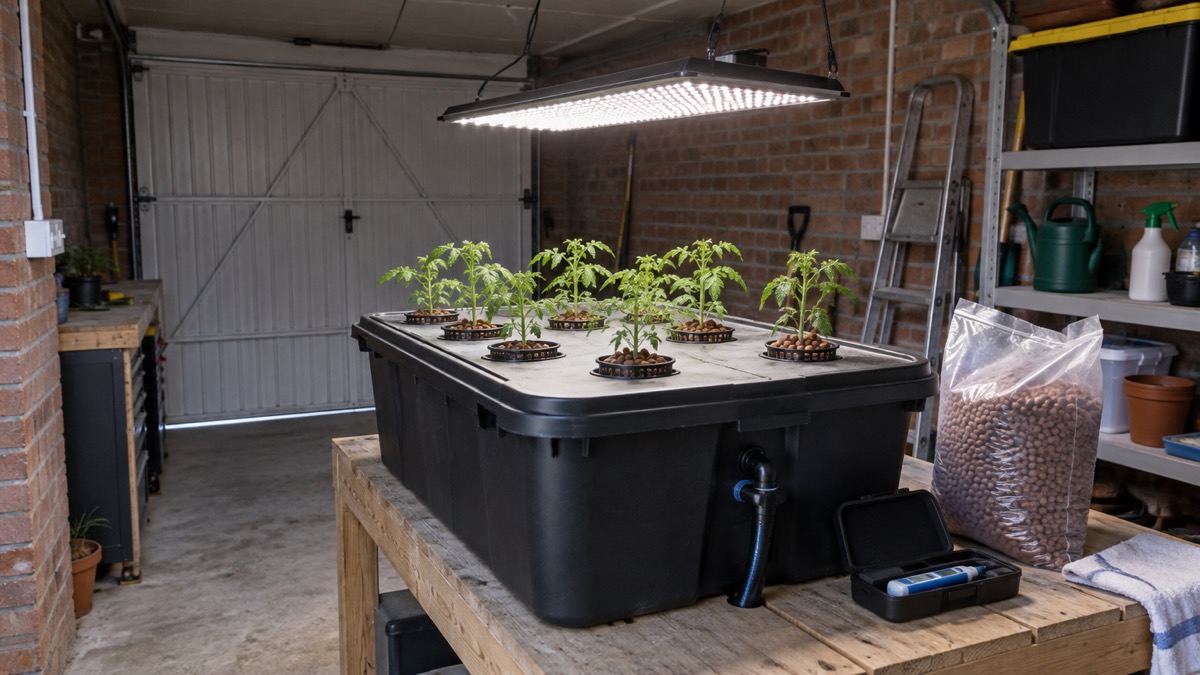
Hydroponics means growing plants with their roots in a growing medium or in a nutrient solution rather than in soil. The Royal Horticultural Society divides the whole field into just two types: plants grown in substrates such as coir, rockwool and pumice, and plants grown in a solution system, including nutrient film technique (NFT) and deep water culture (DWC)1. Everything on the parts list below follows from that one split.
For a basic indoor setup you need a watertight reservoir, a lid or tank top to hold the plants, pots or net pots to sit in it, a growing medium if you are running a substrate system, and a liquid feed that supplies the full range of nutrients. The RHS is clear that in every hydroponic system the health of the root system depends on sufficient air spaces in the substrate or oxygen content of the solution, so aeration is not an optional extra1. Get that right and the rest is containers and plumbing.
This page is a printable parts list. It sets out what each part does, how the two system types differ, how to choose between coir, rockwool and pumice, and which crops hydroponics is used for. It does not sell anything and it does not rank equipment. If you want the wider picture on grow tents, lights and nutrient systems, the indoor hydroponics guide covers it, and the self-reliance section sets growing food alongside water storage and off-grid power.
The parts list, item by item
The list below is the build-your-own system the RHS sets out, plus the supporting items its other growing guidance assumes. Each entry says what the part does for the household, so you can see which items are essential and which simply make the job easier.
Substrate or solution: the two types of hydroponic system
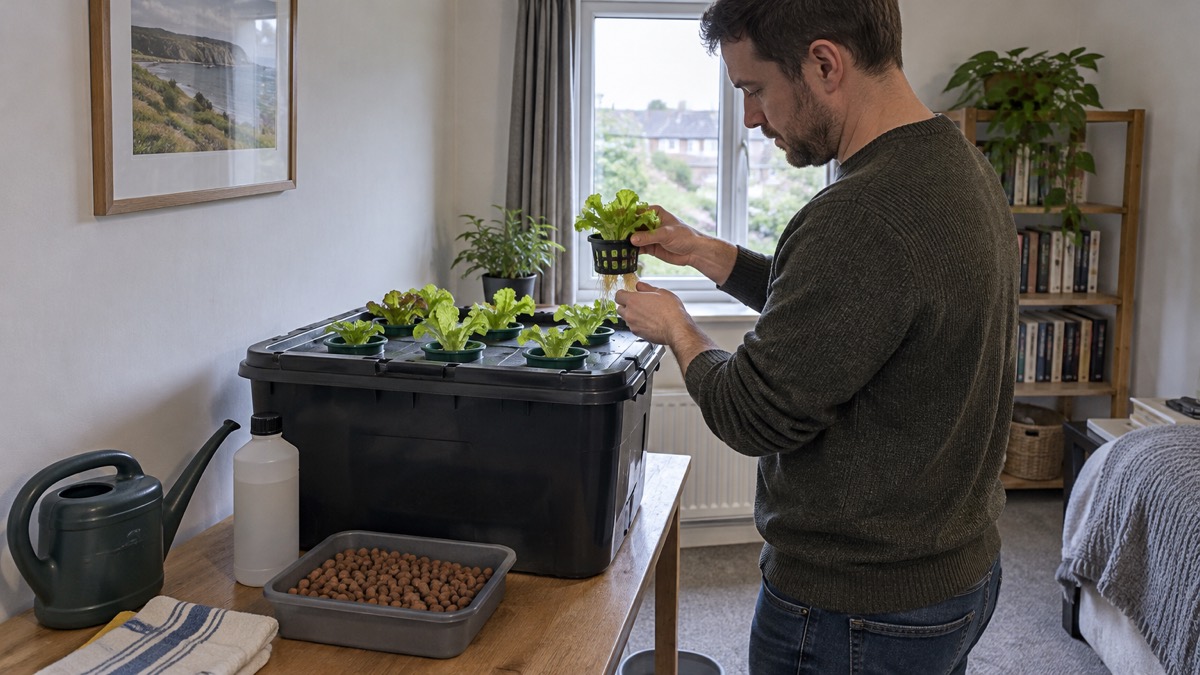
The first decision is not which kit to buy but which of the two families you are joining, because it changes the parts list entirely. In a substrate system the roots are held in a solid medium, coir, rockwool or pumice, which is kept wet with nutrient solution. In a solution system the roots sit in the solution itself, and the two named examples are nutrient film technique (NFT), where a shallow film of water runs past the roots, and deep water culture (DWC), where the roots hang in a deep body of aerated water1.
The thing that decides whether either works is air, not water. The RHS states that in all hydroponic growing systems the health of the root system depends on sufficient air spaces in the substrate or oxygen content of the solution1. A substrate holds air in the gaps between particles; a solution system has to have oxygen dissolved in the water. That is why a substrate system forgives a beginner's mistakes more readily, and why a solution system rewards attention to aeration.
The feed is the same principle in both. The liquid feed must contain all the key growing elements, N.P.K plus trace elements of Fe and Mg, at the correct ratio for the specific crop, and in commercial setups it is delivered through a drip irrigation system with samples taken every two weeks for laboratory analysis1. A household does not need a laboratory, but the principle holds: the feed has to be complete, and it has to match the crop.
| Feature | Substrate system | Solution system (NFT, DWC) |
|---|---|---|
| Where roots sit | In coir, rockwool or pumice1 | In nutrient solution1 |
| What carries air to roots | Air spaces in the substrate1 | Oxygen content of the solution1 |
| Growing medium needed | Yes1 | No1 |
| Named examples | Coir, rockwool, pumice1 | Nutrient film technique, deep water culture1 |
| What to watch | Medium damp, not waterlogged | Solution kept oxygenated1 |
If you are weighing a manufactured system against a home build, the AutoPot Tray2Grow is one example of a modular tray system, and the indoor hydroponics guide sets out how lights and tents fit around either type.
Growing media for substrate systems: coir, rockwool and pumice
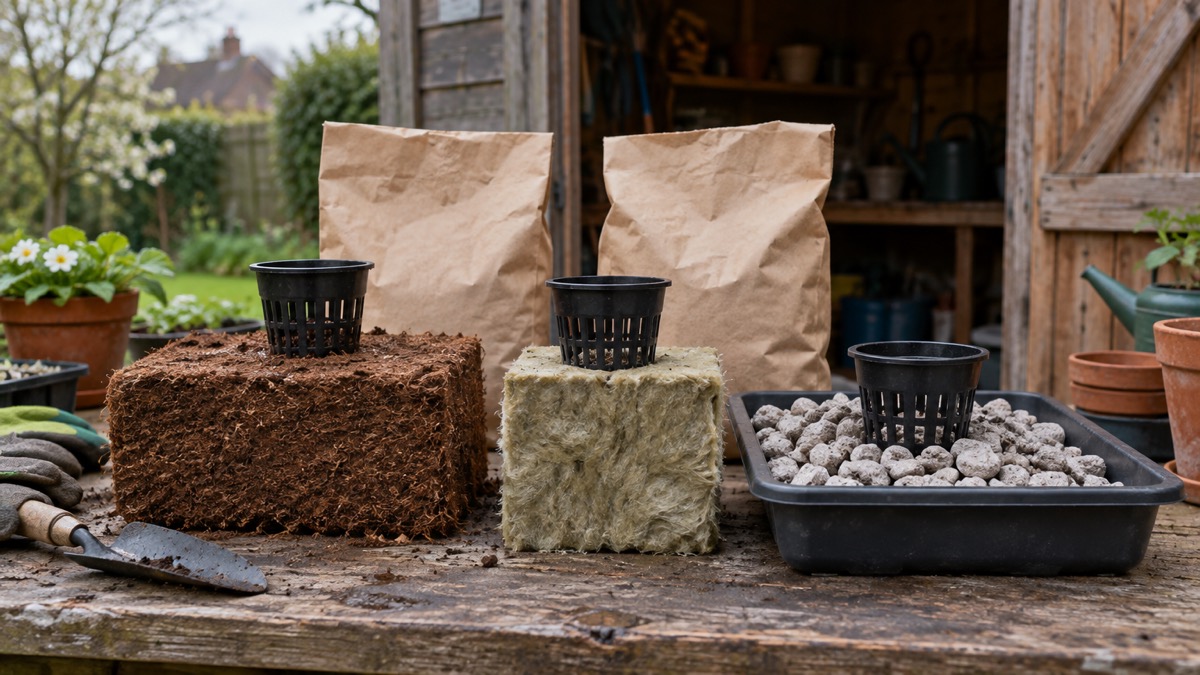
If you choose a substrate system, the medium is the part that decides how forgiving the setup is. The RHS names three: coir, rockwool and pumice1. All three do the same job, holding the roots and keeping a balance of water and air, but they behave differently in the hand and that is what you are choosing between.
Coir is a peat substitute made from coconut husks. The soil association Garden Organic notes that multipurpose potting mixes contain little or no loam and are made predominantly from peat or peat substitutes such as coir and coconut husks6. That tells you what coir is: a fibrous, moisture-retentive material of the kind that makes up the bulk of a modern peat-free compost. It holds water well, which suits a reservoir system where the medium is wetted from below.
Rockwool is a mineral fibre block or cube. It holds a fixed shape and a predictable amount of water, which is why it appears in propagation as well as in hydroponics. Pumice is a lightweight volcanic rock, and it is the most structurally permanent of the three, holding air spaces in the gaps between grains.
Whichever you pick, the rule is the same: the medium must stay damp but not waterlogged, because the roots need those air spaces. The RHS's sowing guidance makes the point in miniature, advising that compost be moistened before sowing so that it is damp but not waterlogged2. The same discipline applies to a substrate block in a hydroponic pot.
What crops hydroponics is used for
Hydroponics is not only for salad. The RHS notes that other crops may be grown hydroponically, such as strawberries and cut flowers, for example tulips and chrysanthemums1. Those are the crops the guidance names beyond the general run of vegetables and herbs, and they point to where a home system earns its space: high-value, repeat-harvest crops that are expensive to buy and awkward to grow in open ground.
The setting matters as much as the crop. Hydroponic crops are grown under cover, either in a glasshouse or polytunnel, and the growing season can be extended with extra heat and light1. That is why a hydroponic bench usually lives in a greenhouse, a polytunnel or a spare room with lights, rather than outdoors. The polytunnels and greenhouses guide covers the structure, and the polytunnel or greenhouse comparison helps if you have not chosen yet.
For strawberries specifically, hydroponics is one route and containers are another. The RHS advises planting strawberries in containers from late summer to early autumn for a good crop the following year7, and suggests planting some in pots and moving them inside just after Christmas for earlier crops8. Those timings are worth knowing even in a hydroponic system, because they set when you start plants off. The growing fruit at home guide covers the soil-based alternatives.
Cut flowers follow the same logic. Tulips and chrysanthemums grown hydroponically under cover give stems through a longer window than the open garden allows, because heat and light can be added1. If flowers are the aim rather than food, the parts list is unchanged: reservoir, lid, pots, feed and aeration.
| Crop | Grown hydroponically? | Setting | Source |
|---|---|---|---|
| Strawberries | Yes | Under cover, glasshouse or polytunnel | 1 |
| Cut flowers (tulips, chrysanthemums) | Yes | Under cover, glasshouse or polytunnel | 1 |
Keeping the system running: the two-day and two-week routine
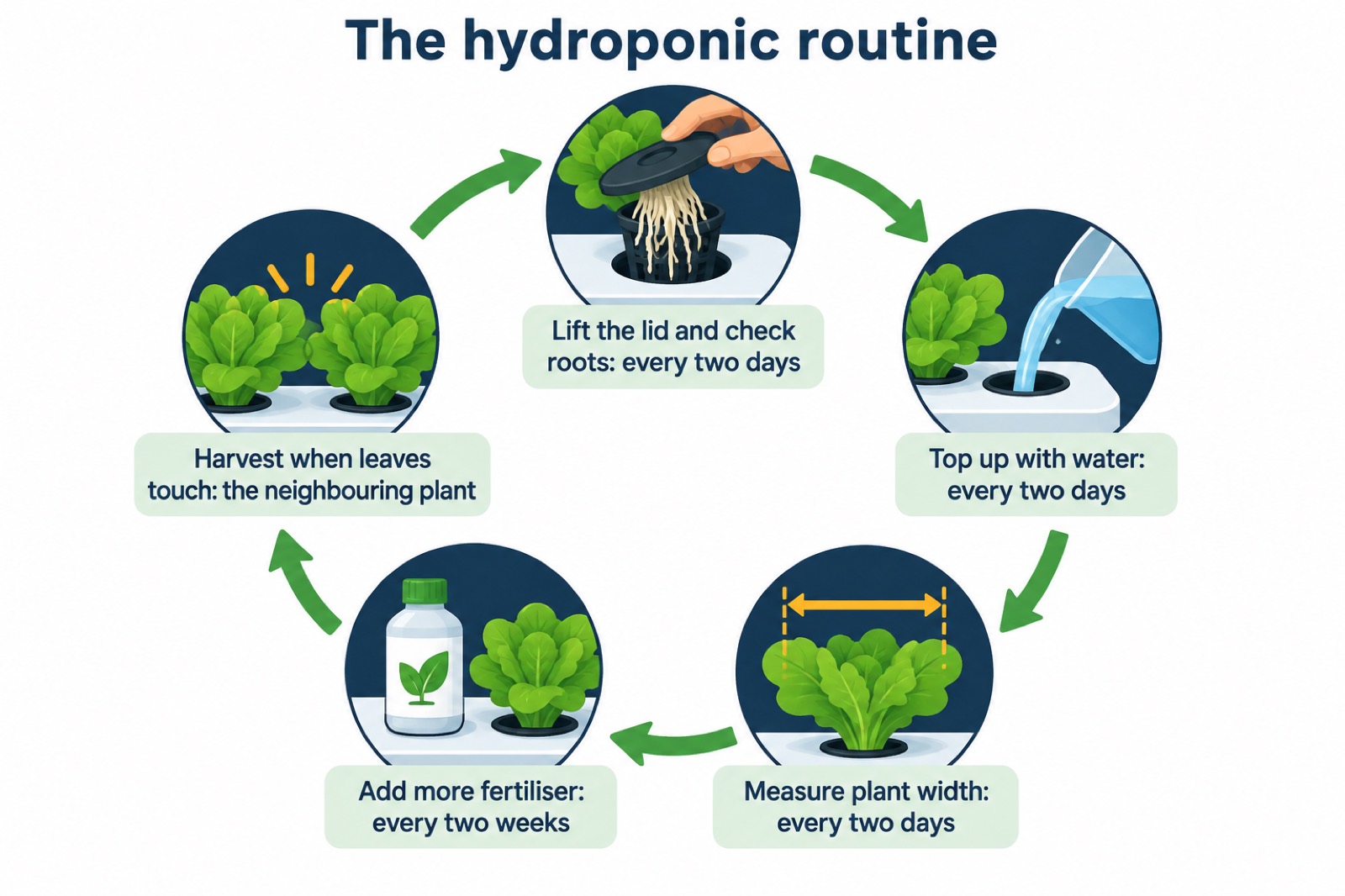
A hydroponic system fails quietly. There is no soil to hold a reserve of water, so the routine is what keeps plants alive, and the RHS sets it out plainly for the build-your-own design. Lift the lid every two days to check for new root growth from the aquatic pots and top up with water; add more fertilizer every two weeks; measure plant width every two days; and harvest once leaves start to touch the neighbouring plant1.
That gives you a simple rhythm. Every two days: lift the lid, look at the roots, top up the water, measure the plants. Every two weeks: add feed. The measuring is not fussiness. Spacing is built into the design, with holes set 15cm apart in the lid1, and the harvest rule follows from it: once leaves touch the next plant, the canopy has closed and the crop is ready.
Water quality is the other variable. If you are tempted to use stored rainwater, the RHS advises using it on established plants but avoiding it on seedlings because it may contain damping-off diseases9. For a hydroponic system, where the solution is the only water the plant gets, that is a reason to start with clean, fresh water as the RHS's build-your-own design specifies1.
Raising plants to go into the system
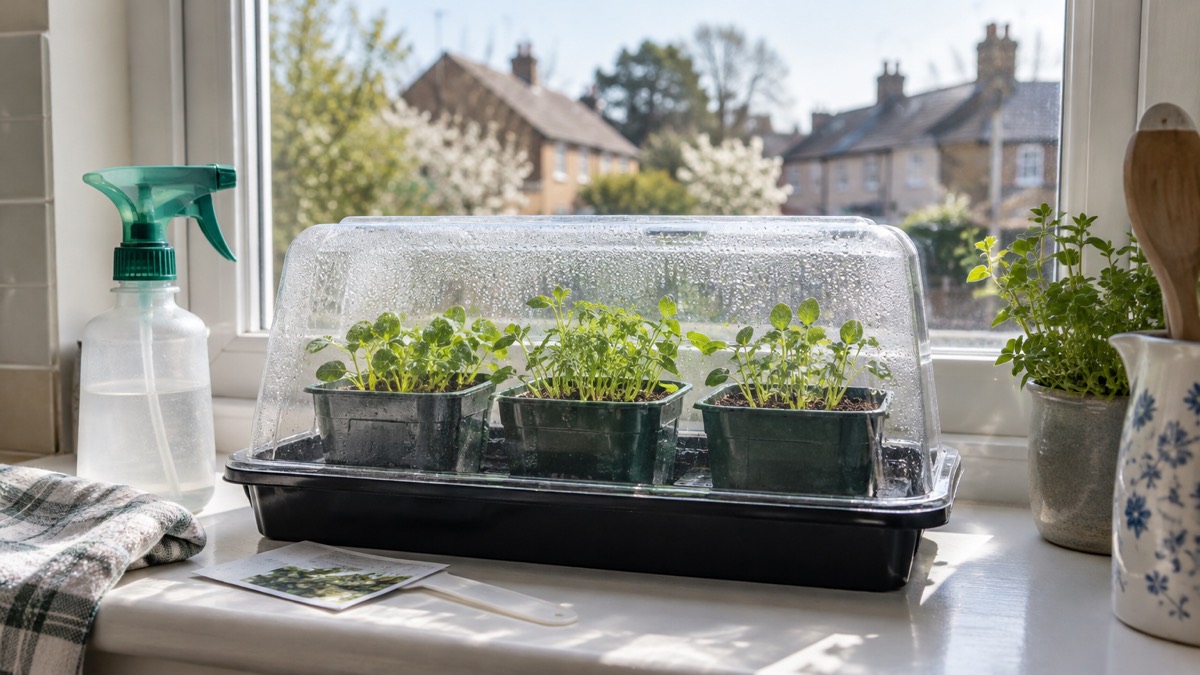
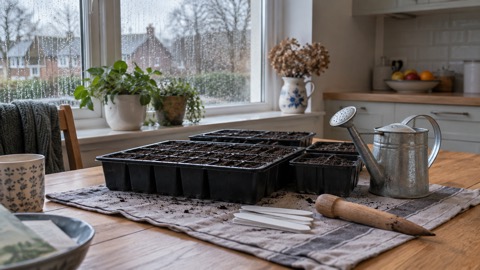
Most home systems are stocked with plants raised in pots first, so the propagation kit belongs on the parts list. The RHS's microgreens guidance gives the basic kit: seed trays or similar containers such as clean fruit punnets or juice cartons, peat-free seed compost or sieved multi-purpose compost, plant labels and pencils, and a watering can with a fine rose2. It also advises making sure all containers are clean and adding drainage holes to the base if they do not already have them, using a nail, screwdriver or similar, adults only2.
Once sown, cover the container with a layer of cling film, a plastic bag or a plastic propagator top to retain moisture and heat3. When the seedlings are ready to move on, gather the seed packet, trowels, dibbers, spacing rulers, string, kneelers, labels, pens, a watering can and the seedlings themselves, and water the plants well first so they are easy to remove from their pots4.
For a household that wants a quick first crop while the hydroponic system settles, quick-growing salad leaves can be raised in a peat-free compost in a yogurt pot or fruit punnet with holes punched in the bottom10. The microgreens guide and the seed sowing equipment checklist take this further, and the sowing seeds guide covers timing and depth.
Sources (10)
- Growing crops with hydroponics, RHS, 2026
- Growing microgreens, RHS, 2026
- Sowing in pots, RHS, 2026
- Plant out young plants, RHS, 2026
- What shall we grow?, RHS, 2026
- Garden compost or potting compost, Garden Organic, 2026
- Growing fruit in containers, RHS, 2026
- Fruit gardening calendar, RHS, 2026
- Watering advice, RHS, 2026
- Quick growing food, Garden Organic, 2026
 Year-Round Sowing Calendar
 Preserving Equipment Checklist
 Seed Sowing Equipment Checklist