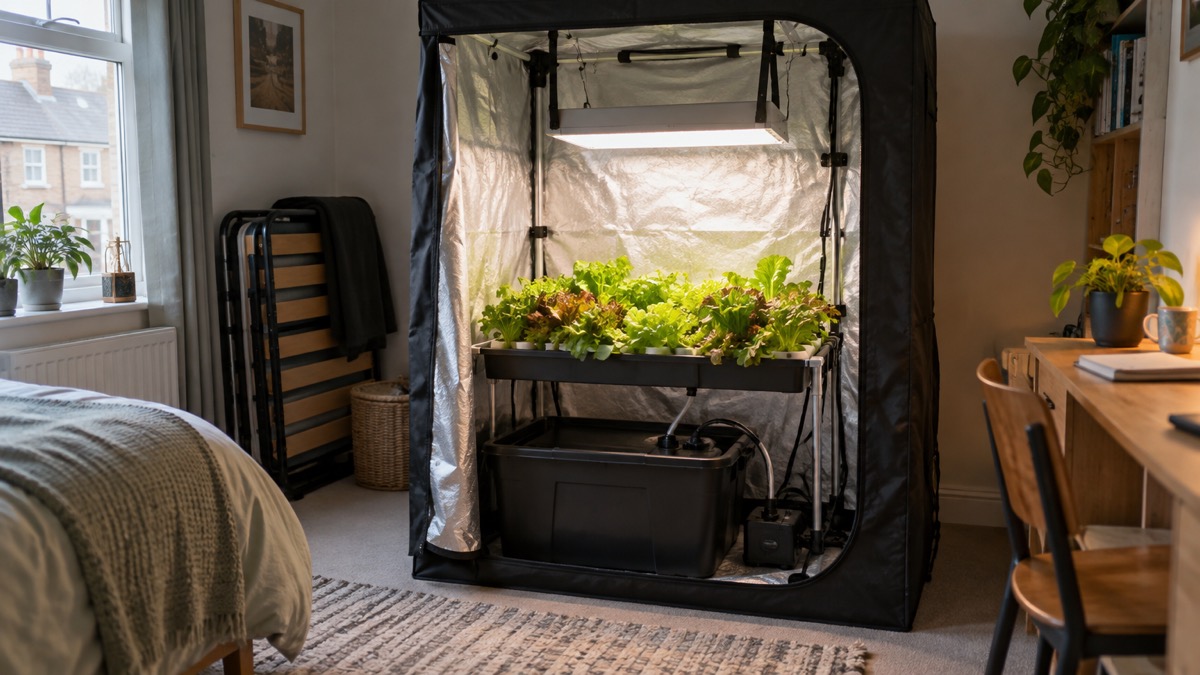
Hydroponics means growing plants without soil, feeding their roots either through a substrate such as coir, rockwool or pumice, or directly in a nutrient solution using systems such as nutrient film technique (NFT) and deep water culture (DWC)1. At home that usually means a grow tent in a spare room, garage or cupboard, with a light above the plants and a reservoir of nutrient solution below them. Commercial growers use the same methods for crops including strawberries and cut flowers such as tulips and chrysanthemums1, and the same principles scale down to a windowsill-sized container of salad leaves.
What a home setup gives you is a controllable growing space: hydroponic crops are grown under cover, and the growing season can be extended with extra heat and light1. What it does not give you is independence from the house. A system with pumps and lights is equipment that stops working in a power cut, like any other powered equipment in the home2, and it puts water, electricity and concentrated plant feed in the same room. This page sets out what each part does, how to choose and set up a system safely, and what to do when things go wrong.
What a home hydroponic setup can and cannot do
A hydroponic setup can give you fresh leaves and other crops through the year, because the plants are grown under cover and the season can be extended with extra heat and light1. The roots take everything they need from a liquid feed that must contain all the key growing elements, nitrogen, phosphorus and potassium (N.P.K), plus trace elements of iron (Fe) and magnesium (Mg), at the correct ratio for the specific crop1. That is the real attraction for a household: the feed is matched to the crop, and nothing is wasted on weeds or poor soil.
It is worth being clear about the limits. The health of the root system depends on sufficient air spaces in the substrate, or the oxygen content of the solution1, so a system that is flooded, stagnant or starved of oxygen will fail no matter how good the feed is. The routine is also a commitment: a simple build-your-own system needs its lid lifted every two days to check for new root growth and to top up with water, with more fertiliser added every two weeks1. If nobody in the household can do those checks, a passive setup watered by hand is the more honest choice.
There are safety limits too. A grow room is not the place for any fuel-powered appliance: never use fuel-powered appliances indoors, as the exhaust gases contain carbon monoxide, which can kill6. And a system does not make your household independent of the mains: power cuts will affect equipment such as pumps and lights just as they affect stair lifts and other powered equipment2. If what you want is genuinely off-grid growing, read about off-grid solar systems before committing to a powered tent.
Grow tent, lights and nutrient system: what each part does
A home hydroponic setup has three working parts, and each does a distinct job.
| Part | What it does | What to check |
|---|---|---|
| Grow tent or cover | Holds the crop, contains moisture and reflects light onto the plants | Size against your floor space; a lid you can lift for the two-day checks1 |
| Grow light | Extends the growing season by providing extra light and some heat1 | Right size and wattage for the fitting; nothing placed over the bulb7 |
| Nutrient system | Delivers a liquid feed containing N.P.K plus Fe and Mg at the correct ratio for the crop, often via drip irrigation1 | Reservoir volume; feed matched to the crop; regular sampling1 |
The tent is the container. Hydroponic crops are grown under cover, either in a glasshouse or polytunnel commercially1, and a grow tent is the indoor equivalent: a lined enclosure that keeps moisture in, keeps light directed at the plants, and gives you somewhere to hang a light safely. A simple build-your-own system can be as plain as a 100 litre container filled with clean, fresh water1, with plants in aquatic pots sitting in the lid.
The light does two jobs: it replaces or supplements daylight, and it extends the growing season, since the season can be extended with extra heat and light1. The feed is the third part. The liquid feed must contain all the key growing elements at the correct ratio for the specific crop, delivered in commercial setups via a drip irrigation system, with samples taken every two weeks for laboratory analysis1. At home you will not send samples to a laboratory, but the principle holds: follow the maker's mixing instructions exactly, and keep to a regular schedule. For a full parts list, see our simple hydroponic system parts list.
Choosing a system by space and the time you can give it
The first choice is between the two types of hydroponics: plants grown in substrates such as coir, rockwool and pumice, and plants grown in a solution system including NFT and DWC1. Substrate systems hold water around the roots in a medium, so they keep working between waterings and suit a household that can only attend to plants at weekends. Solution systems sit the roots in or above circulating nutrient solution, which grows fast but stops the moment a pump stops.
Match the system to the time you actually have. The build-your-own routine is concrete: lift the lid every two days to check for new root growth and top up with water, add more fertiliser every two weeks, measure plant width every two days, and harvest once leaves start to touch the neighbouring plant1. That is a few minutes every other day. If you cannot give that, choose a substrate system and water by hand with a watering can, which official hot weather guidance notes is more efficient at targeting the roots of plants than a hose8.
Water quality matters as much as schedule. In all hydroponic growing systems the health of the root system depends on sufficient air spaces in the substrate or oxygen content of the solution1, so a stagnant reservoir is a dying reservoir. If you harvest rainwater, official water company advice is to use rainwater rather than tap water where you have a water butt installed9, and our pages on rainwater harvesting and what harvested rainwater can be used for cover the details. Whatever the source, start a build-your-own system with clean, fresh water in a 100 litre container1.
Setting up a grow tent safely indoors
Set the tent up with the same care you would give any powered equipment in the home, and start with the room, not the kit.
- Choose a floor that can take a spill. A 100 litre container of water is heavy and wet when it leaks1. Put the tent where a spill cannot reach carpets or underfloor electrics.
- Put electrical items away from the water. Keep electrical items, plugs and sockets away from water10, so site sockets and leads above and away from the reservoir, never beside it.
- Cover open water. Official garden water safety advice is to securely cover water features after use11; a lidded reservoir does the same job indoors and is part of the routine anyway, since you lift the lid every two days1.
- Keep the load on the wiring low. Try to keep to one plug per socket, especially for high powered appliances3.
- Know your shut-offs. Know where to turn off your electricity or gas supply, and mark the points clearly so you can find them quickly12.
Ventilation and damp deserve their own attention. Cold weather can increase the likelihood of condensation forming inside your home, which left untreated can lead to damp and mould, and exposure to damp and mould can be harmful14. A tent full of warm, moist air vented into a cold room is a condensation source, so air the room regularly, and check the wall and floor behind the tent for moisture in the first weeks.
Grow lights: heat, power use and safe wiring
A grow light is a high powered electrical appliance running for long hours, and it deserves fire service levels of respect. Use bulbs that are the right size and wattage recommended by the appliance, make sure bulbs are fitted correctly, because loose bulbs may get too hot, and do not put anything over the bulb, as it can get very hot and cause a fire7. That last point matters in a tent, where fabric and ducting can drift against a hot fitting.
The wiring rules are simple and official. Try to keep to one plug per socket, especially for high powered appliances like washing machines3, and a grow light and its ballast belong in that category. To avoid the risk of overheating and possibly fire, never plug into an extension lead or socket appliances that together exceed the maximum rating, even though there is space for four appliances15. Avoid overloading power sockets and use appropriate extension cords to prevent electrical fires16. If you run lights on a timer, follow the same rule as for decorative lights: ensure electricity sockets are not overloaded and that they are switched off at the socket at night17.
Do not light a grow tent with candles or tea lights when a lamp fails. Be extra careful with tea lights, as they can get very hot18, and an enclosure with moving air and fabric surfaces is exactly where a naked flame belongs nowhere. Keep a torch by the tent instead, and see our guide to emergency lighting at home for what to keep in the house.
Water and electricity: keeping the two apart
The single rule that governs a grow room is the one the fire and rescue services repeat for every room of the house: keep electrical leads and appliances away from water19. In a hydroponic setup the water is the point of the exercise, so the rule has to be engineered in rather than remembered.
- Keep electrical leads and appliances away from water, including splashes when you top up or stir the feed19.
- Keep plugs and sockets away from water, and keep electrical items away from splashes when you work in the grow room10.
- Keep electrical leads away from water at all times, and dry your hands before touching any switch or plug21.
- If water has come into contact with electrical wiring or appliances, isolate the electricity supply and have the circuit checked by a registered electrician5. Do not simply dry it off and switch it back on.
That last instruction is the one people skip, so treat it as absolute. A splash into a socket or a flooded pump is not a nuisance, it is a damaged circuit, and the fire and rescue service advice is to isolate the supply and get a registered electrician to check it before the system runs again5. While the system is down, keeping water usage to a minimum will prolong alternative sources of water such as water tanks22, so ration what is in the reservoir to the plants that need it most.
Mixing and handling nutrient solutions safely
Nutrient concentrate is a chemical, and the habits that keep a kitchen safe when preserving food transfer directly to mixing feed. Wash your hands thoroughly before, during and after preparing solutions; clean and sanitise work surfaces and equipment; use reputable instructions and follow them exactly, including quantities and timings; use suitable containers; check containers for damage and discard damaged ones; label and date what you mix; and make sure equipment and containers are clean before use24.
The labelling habit matters more than people expect. Official food preservation guidance is to label and date what you store, use it within the recommended shelf life, and regularly check stored items for spoilage24. A bottle of mixed feed with no date on it is a guess, and a guess poured onto roots can undo weeks of growth. Follow the maker's instructions for its own product exactly, including the ratio for the specific crop, since the feed must contain all the key growing elements at the correct ratio1.
Store concentrates and mixed solution with children and pets in mind. Keep young children within arm's reach of an adult whenever they are near open water, including a reservoir11, and keep the reservoir lidded between checks. The garden safety advice to install a strong mesh grill on top of ponds, strong enough to support a child's weight11, shows the standard to aim for with any open water a child could reach; a locked lid on a 100 litre container1 is the indoor equivalent.
What happens to a hydroponic system in a power cut
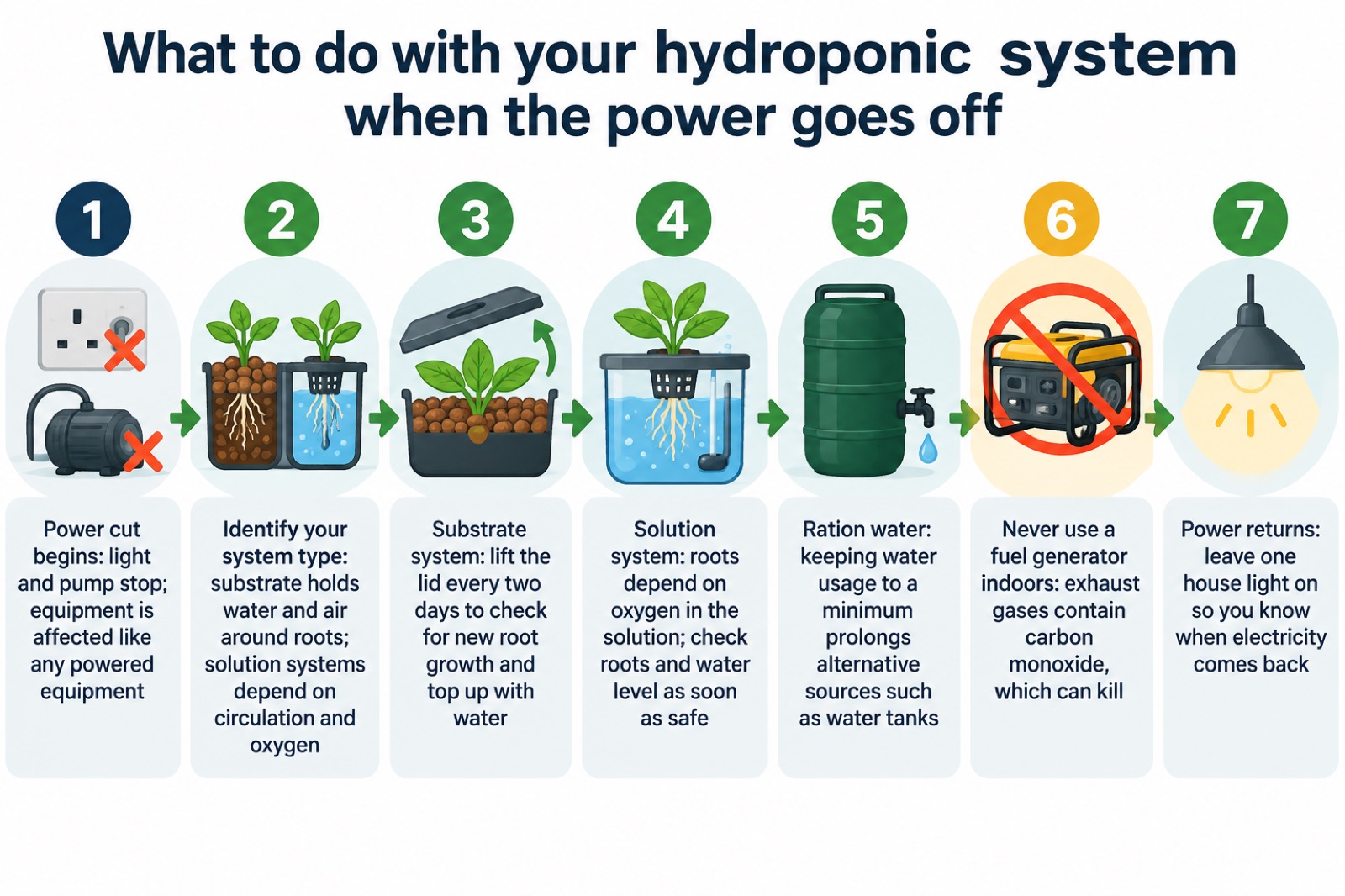
A powered hydroponic system is equipment, and power cuts will affect equipment2. The light goes off, the pump stops, and the feed stops circulating. What happens next depends on which of the two system types you chose1: a substrate system holds water and air around the roots in coir, rockwool or pumice, so the plants carry on drawing from the medium for a while; a solution system such as NFT or DWC depends on circulation and oxygen in the solution1, so the clock starts immediately.
Leave at least one light on in the house so that you know when your electricity comes back on2, and check the tent as soon as it is safe. Lift the lid and check the roots and the water level, which is the same two-day check you already do1. Keeping water usage to a minimum will prolong alternative sources of water such as water tanks22, so during a long cut, prioritise the reservoir you have rather than running taps to refill it.
If you are considering backup power, read our backup power at home and power cuts guides first, and never solve the problem with a fuel-powered appliance indoors, because the exhaust gases contain carbon monoxide, which can kill6. One flood-resilient business in Hebden Bridge solved the same problem permanently with a diesel generator, activated by a float switch, sited in its own housing outdoors, providing power for the pump, heat, light and phones until the mains supply was reconnected25; the lesson for a household is the siting, outdoors and automatic, never inside the growing space.
Common problems and how to spot them early
Most hydroponic problems announce themselves, and the two-day routine is your early warning system. Lifting the lid every two days to check for new root growth and topping up with water1 puts your eyes on the roots, the water level and the plant base before anything dies quietly. Measuring plant width every two days1 does the same for growth above the lid: a plant that stops widening is telling you something about its feed, its light or its roots.
The failures to look for all trace back to the one root rule: in all hydroponic growing systems the health of the root system depends on sufficient air spaces in the substrate or oxygen content of the solution1. Roots going brown or slimy, a smell from the reservoir, or plants wilting despite water are all signs that oxygen is missing, and the answer is to restore air to the medium or circulation and oxygen to the solution1. Feed problems show as slow growth or pale leaves, and the answer is to return to a feed containing all the key growing elements, N.P.K plus trace elements of Fe and Mg, at the correct ratio for the crop1.
Water chemistry can drift too. Official guidance on pH correction for small water supplies warns that sizing and residence times matter: undersized treatment with insufficient contact time will not correct pH enough, while too much contact may make water too alkaline, and media blends differ in activity26. The household lesson is to change feed and media deliberately, not casually, and to re-check plants after any change. For pests and diseases on the plants themselves, see our guide to vegetable pests and diseases.
Where to get advice and help
Start with the growing side. The Royal Horticultural Society's school gardening resources cover growing crops with hydroponics, including the two system types, substrates and the build-your-own routine described on this page1, and they are a sound first reference for a beginner. Our own pages on growing your own vegetables, sowing seeds and growing under cover cover the plant skills that hydroponics assumes.
For the safety side, your local fire and rescue service is the body to ask: the electrical advice quoted throughout this page, on one plug per socket, on keeping leads away from water, and on isolating the supply after water contact, comes from UK fire and rescue services3. For wiring work, use a registered electrician, as the fire service advises after any water contact with wiring or appliances5. For water quality questions, your water company or, for a private supply, the relevant council team can advise, and official guidance on pH correction for small supplies sets the standard for what good treatment looks like26.
Finally, do the household paperwork before you build. Check your home and contents insurance gives you the right cover for the likely risks in your area13, maintain all drains within your property13, and know where to turn off your electricity or gas supply, marking the points clearly so you can find them quickly12. Those three habits cost nothing and they are what turns a grow tent from a risk into a fixture.
Sources (26)
- Growing crops with hydroponics, RHS School Gardening, Royal Horticultural Society, 2026
- 12 tips to prepare for a power cut, Horsted Keynes Parish Council
- Electrical items in the home, London Fire Brigade, 2026-10-25
- Electrical Safety, Greater Manchester Fire and Rescue Service, 2026-11-03
- Steps after a fire, North Yorkshire Fire and Rescue Service, 2026-06-17
- Cleaning up and returning home after flooding, Derbyshire County Council, 2026-10-29
- Easy read fire safety booklet, London Fire Brigade, 2026
- How to stay safe in hot weather, Readiness Scotland, 2026-03-24
- Wessex Water advice on saving every drop, Wiltshire and Swindon Prepared, 2026-10-25
- Electrical Safety at home, Greater Manchester Fire and Rescue Service, 2026-10-29
- Water safety in the garden, Mid and West Wales Fire and Rescue Service, 2026-10-29
- Be prepared for emergencies, Scottish Borders Council, 2026-10-29
- Preparing for floods, nidirect, 2025-09-11
- How to stay safe in cold weather, NHS inform, 2026-09-21
- Electrical safety in your home, Mid and West Wales Fire and Rescue Service, 2026-10-29
- Hoarding and fire safety, Warwickshire County Council, 2026-10-29
- Halloween safety, Dorset and Wiltshire Fire and Rescue Service, 2026-10-23
- Candles in the home, Cheshire Fire and Rescue Service, 2026-05-20
- Cookers, microwaves and electrics, Greater Manchester Fire and Rescue Service, 2026-10-29
- Safety at home, Dorset and Wiltshire Fire and Rescue Service, 2026-04-30
- Kitchen safety, North Yorkshire Fire and Rescue Service, 2026-03-23
- Water supply interruptions or outages, Prepare campaign, 2026-10-12
- Safe use of heaters and generators, Armagh City, Banbridge and Craigavon Borough Council, 2026-10-29
- Consumer advice for food preservation at home, GOV.UK, 2026-10-26
- Property flood resilience case studies, Derbyshire County Council, 2024
- pH correction for private water supplies, Drinking Water Quality Regulator for Scotland, 2026-11-04
 Hydroponic System Parts List
 Year-Round Sowing Calendar
 Preserving Equipment Checklist
 Getting an Allotment
 Composting at Home
 Vegetable Pests and Diseases
 Fermenting Vegetables at Home
 Freezing Home-Grown Produce
 Growing Fruit at Home
 Growing Under Cover All Year
 Sowing Seeds
 Storing the Harvest