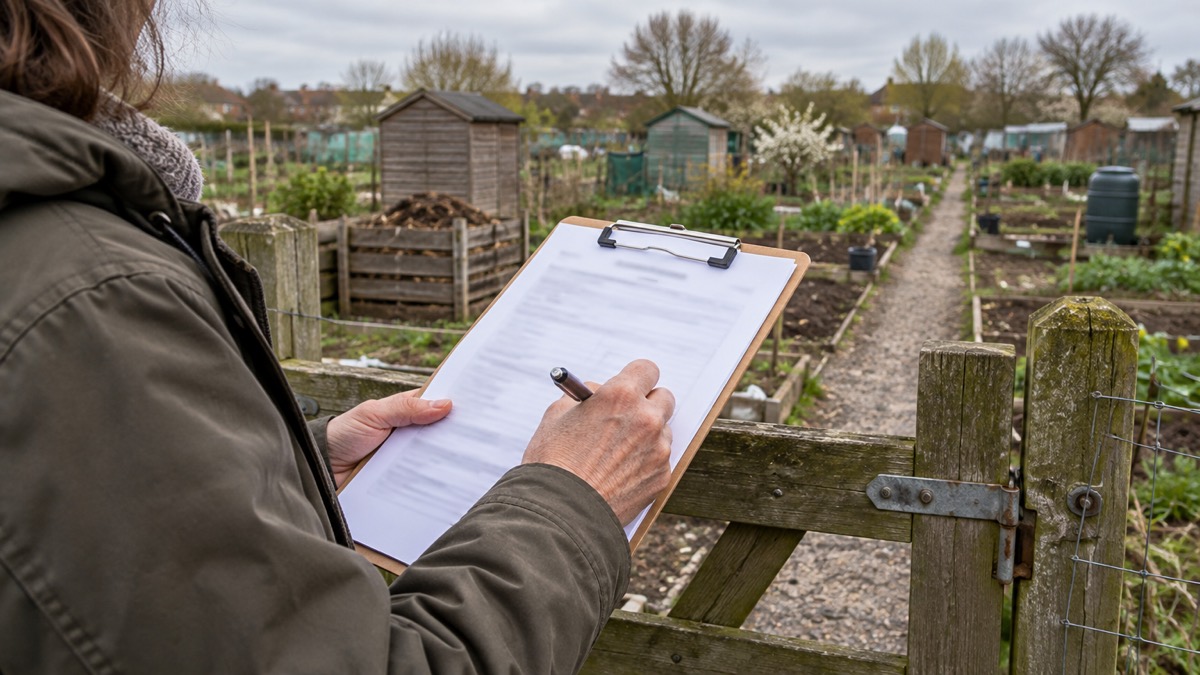
An allotment is let to you under a tenancy agreement, and the single most useful thing you can do before you sign one is read it. The fire and rescue service's advice to tenants is blunt on this point: check the terms of your tenancy or lease agreement, and seek legal advice if you are unsure1. Everything else on this page, from keeping hens to watering, sits underneath that agreement, because it is the document that says what you may and may not do on the plot.
How plots are allocated, what rent is charged and how long you wait varies between councils and site managers, so the practical first step is to contact your local council's allotment service and ask. Once a plot is offered, the facts below tell you what to check, what is involved in the most common extras such as keeping hens, and what happens when things go wrong, including flooding and problems with a private water supply. Where the arrangements differ in Scotland and Wales, that is set out too.
Your tenancy: read the agreement, then work within it
The tenancy agreement is the rulebook for your plot. It will set out the rent, what you can grow and keep, what structures you may put up, and what happens if conditions are broken. The general advice for any tenancy is to check the terms of your agreement and seek legal advice if you are unsure of them1. If you cannot afford a solicitor, free or low-cost legal support may be available from local advice services such as Citizens Advice or Shelter6.
Two principles from tenancy law and practice are worth carrying onto the plot. First, responsibility usually follows the agreement: if you rent, the fire and rescue service advises tenants to know how to isolate the gas, electric and water supplies, which on an allotment translates into knowing where the water tap and any shut-off are1. Second, costs that benefit everyone can be shared. Sussex Police's advice on security measures in shared buildings is that residents can share the expense, or, if the property is rented, approach the landlord explaining the benefit to them7. An allotment site is exactly this kind of shared property: if the site needs a new gate, a repaired fence or a communal shed, the cost can reasonably be shared among plot holders or raised with the site owner.
If your plot floods, your obligations under the tenancy still apply. Somerset Council's guidance for flooded homes sets out the pattern: pay your rent unless you agree otherwise with your landlord, take reasonable steps to protect your property and belongings from further damage, and work with the landlord, insurer and council6. A flooded allotment is a smaller matter than a flooded home, but the same logic holds: tell the site owner, protect what you can, and keep paying unless you have agreed a break.
Keeping hens on an allotment
Many allotment agreements allow hens, and the British Hen Welfare Trust's adoption scheme is the route most new keepers take. The charity rehomes ex-commercial hens, and its rules give you a clear picture of what is involved before you commit.
The starting numbers are fixed. The minimum number of hens you can reserve is three, because hens are sociable and like to be part of a flock, although the Trust will allow you to adopt two if you already have hens2. The maximum number you can adopt is 20, and they must all stay together with you2.
| Rule | Figure | Notes |
|---|---|---|
| Minimum adoption | 3 hens | Hens are sociable and need a flock2 |
| Minimum if you already keep hens | 2 hens | Allowed for existing keepers2 |
| Maximum adoption | 20 hens | Must all stay together with you2 |
| Floor space inside the house | minimum 30cm squared per bird | 2 |
| Perch space | minimum 25cms per bird | 2 |
Size the hen house before you buy it. The Trust's advice is to buy a house to accommodate more hens than you want: if you want four hens, buy a hen house to accommodate six, so you can be sure there will be sufficient room2. That margin also gives you flexibility if you later add birds.
Bringing your hens home
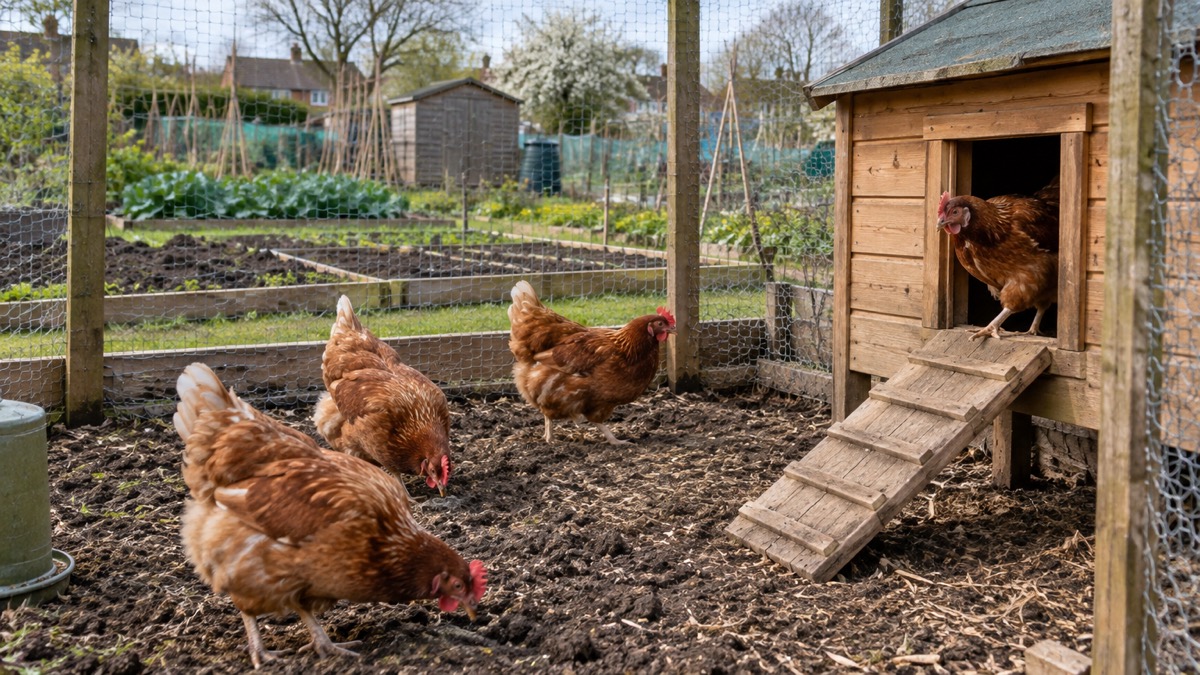
Collection day is organised and busy. Hens are taken out of the farm early in the morning, put in crates and taken to the rehoming point for a health check; adopters arrive later the same day, and there can be up to 50 adopters arriving to pick up hens, so expect a short wait2.
Transport is where new keepers most often go wrong. The Trust requires straw or newspaper lined cat carriers, dog crates or similar sized sturdy cardboard boxes, with horizontal ventilation slits around 1 x 6 inches cut into the sides; stab holes are not sufficient. Crates and dog cages need a base or cardboard in the bottom. Hens may not be driven home in enclosed saloon car boots, and you may be refused hens without adequate transportation2.
Once home, settling in is simple. The Trust advises you put them in their hen house initially so they get accustomed to where home is, but allow them outside access straight away provided you have a fenced area2. If you are adding hens to an existing flock, adopt a greater number than you currently keep: if you already have three hens, adopt at least four new ones, so the incoming hens have the advantage in numbers2.
For the wider care of livestock through disruptions such as floods, storms and power cuts, see the site's Livestock: A Household Guide page.
Composting on the plot
Almost every allotment agreement expects you to compost, and it is a practical way to feed the soil you will be growing in. Before you set up a bin, check what your council offers: you may be able to access discounted compost bins and advice from your local council, as Cheshire Fire and Rescue Service notes in its guidance on garden waste8.
A compost heap or bin on the plot takes your weeds, crop waste and kitchen scraps and turns them into soil improver. How you build and manage it is covered in full on the site's Composting at Home page, and the choice between a hot composter and a cold bin is compared in Hot Composter or Cold Compost Bin?. If your plot has mature trees around it, autumn leaves can be turned into leafmould, a free soil conditioner in their own right, as described in How to Make Leafmould.
One safety point belongs here rather than anywhere else: never burn waste on the plot without checking your agreement and local rules first. Bonfires are a common source of complaints between plot holders and neighbours, and many sites restrict them to set days or ban them outright. Your tenancy agreement is the authority on this, as it is on everything else1.
Water on the plot: taps, private supplies and grants
Most allotment sites have a mains water tap, and your agreement will say how it may be used. Some rural plots, though, are served by a private water supply, a spring, well or borehole rather than the mains, and that changes both what you should do and what help you can get.
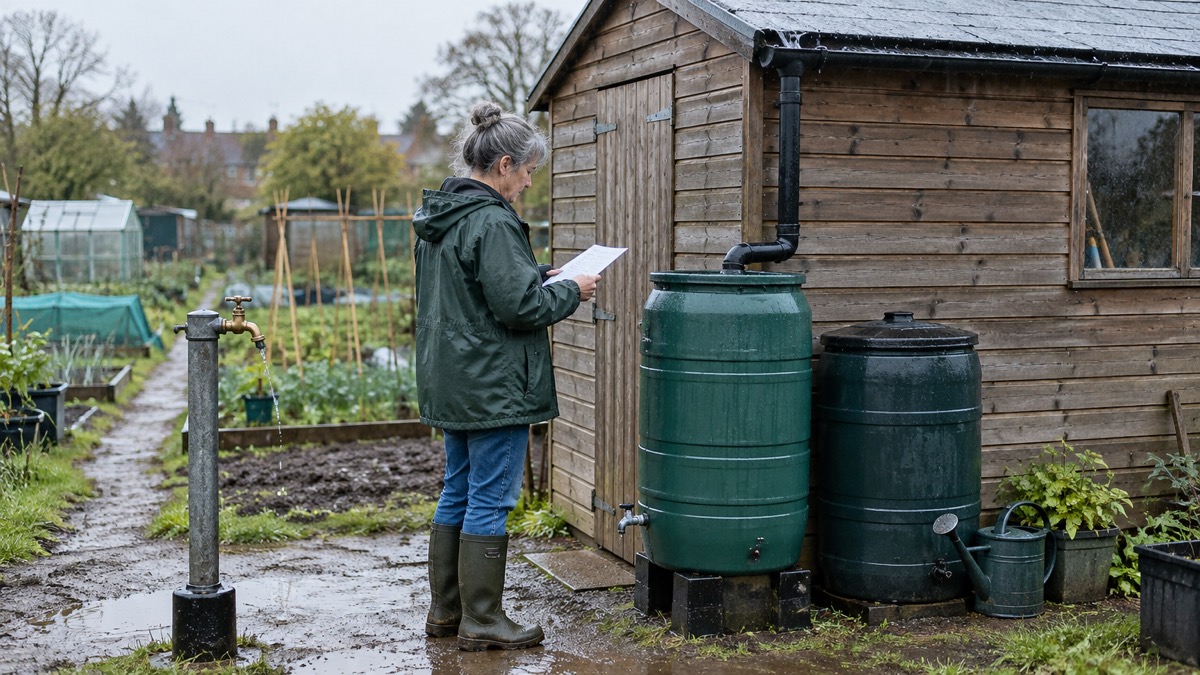
If your plot or the site has a private supply, you can ask your local authority to test it. In the Scottish Borders, the council's position is that should you wish to have your supply sampled, it can be arranged5. There is a fee for any risk assessment or sampling carried out on request9. The important exception is where the authority itself has concerns: no charge is made where the local authority has concerns that a supply to a single domestic dwelling is a risk to human health and investigates, which may require collection of samples or a risk assessment9.
Do not assume a supply has been tested. Argyll and Bute Council states that if your property is served by a single domestic supply, it may not have been sampled, and there are currently no plans to sample such supplies unless a problem is drawn to the council's attention10. Where a supply serves several properties, the local authority will only collect one sample per supply for analysis on each visit, and is not required to take samples from every property on the supply each time; where a dwelling is part of a community of properties served by a supply, the authority may sample on a rotational basis, or where it considers the risk to be greatest9.
Improving a private supply can be grant funded. In Scotland, the Scottish Government provides funding to local councils to deliver the private water supply grant scheme11, and applications can be made by owners, occupiers or landlords5. If you rent your plot from a council or association, ask whether the site owner can apply.
There is also a backstop for serious contamination. Where circumstances pose a danger to life or human health, the local authority has power to require, if practicable at reasonable cost, the local water company to supply water by means other than in pipes for a specified period; alternative supply examples include bottled water, or water supplied in tanks or bowsers12.
For reducing your water use on the plot generally, see Water Harvesting: A Household Guide and Which Vegetables Cope Best with Drought?.
If your plot floods: safety first, then council help
Allotments are often on low ground beside rivers, which makes them prone to flooding. The first rule after floodwater recedes is about soil safety: keep young children away from allotments to prevent soil eating, always wash hands after gardening, and avoid soil ingestion3. Floodwater can carry contamination, and the soil holds it after the water has gone.
The second thing to know is what your council will and will not do. In England, councils do not have a duty to provide sandbags to individuals, although some districts may still provide limited quantities, empty bags, or make them available via town or parish councils4. Oxfordshire County Council's policy is that your parish or district council may provide sandbags13. In Scotland, Highland Council states that where resources allow, it aims to provide filled sandbags to those in greatest need14. In Wales, Carmarthenshire Council will endeavour to deploy sandbags to properties deemed at risk of being affected by floodwater15, and Anglesey's council sets out how and when it will provide sandbags for flooding16.
Derbyshire shows how the chain works in practice: the county council distributes empty sandbags to district, town and parish councils for them to give to residents who are at flood risk, and each of those councils has its own policy on giving sandbags to residents and businesses17. So the answer to who to ask is nearly always your district, town or parish council rather than the county19.
Clearing up is where councils can genuinely help. District councils may provide skips and extra rubbish collections after a flood20, and you may be eligible for flood grants or support schemes, which are likely to be advertised by your district council20. Your local authority can also advise on community Flood Recovery Grants, emergency or alternative accommodation and council tax exemptions where your home, not just your plot, is affected21. Westminster City Council's approach shows the range: it advises residents to meet with neighbours and make a community flood plan, and helps with accessing insurance claims22. A plot holders' association can do the same thing for an allotment site.
If flooding makes your home unusable as well as your plot, Somerset Council's Housing Options team can give advice on dealing with the flood, visit the property with the landlord and agree repair timescales, refer you to local services for help with compensation or benefits, and help find temporary or permanent accommodation6. If you rent from the council or a housing association, they should provide temporary accommodation if you have to move out6.
For the full picture on protecting a household from flooding, see Flooding: A Household Guide.
Scotland and Wales: where the duties differ
In Scotland, the starting position is different from England: homeowners are responsible for protecting their property from flooding, securing appropriate home insurance, preparing for potential flood events, and maintaining private drainage systems including gullies on shared access roads23. The Scottish Government sets national policy on flood risk management and flood warning, develops Scottish Planning Policy, and provides resources to help authorities address flood risk23.
Warning arrangements also run differently. The Scottish Environment Protection Agency's flood monitoring scheme issues targeted flood warnings for properties located in affected areas if the residents are signed up24. If a flood alert is issued for your area, you should remain alert and vigilant and make early preparations for potential flooding; if a flood warning is issued, immediate action is required, and you should take measures to protect yourself and your property24. If your Scottish allotment is in a flood risk area, signing up for these warnings gives you time to move tools, seedlings and hens out of harm's way.
Support is available too. The Scottish Flood Forum is a Scottish Government supported organisation offering support and advice on flood protection, insurance, recovery, advice on establishing community flood groups and business continuity planning, and it represents the interests of people affected by, or at risk of, flooding23. A Scottish allotment association looking to prepare a site flood plan could start there.
In Wales, water supply interruptions have their own response pattern. When the Conwy supply was interrupted in January 2025, Dŵr Cymru Welsh Water opened bottled water stations in Dolgarrog, Colwyn Bay, Conwy and Llandudno, with plans to make deliveries to more isolated communities, and the company announced arrangements for compensation available to residential and business customers25. Natural Resources Wales also advises that your local authority can advise on community Flood Recovery Grants, emergency or alternative accommodation and council tax exemptions after a flood21. If a Welsh allotment site loses its water supply, the bottled water station network is the practical fallback for keeping plants and hens alive.
Starting a plot: what to do in the first weeks
Once the agreement is signed and the keys are in your hand, the work is clearing, planning and sowing. The safety rules above still apply: wash hands after gardening, keep young children off freshly flooded ground, and check the agreement before building anything1.
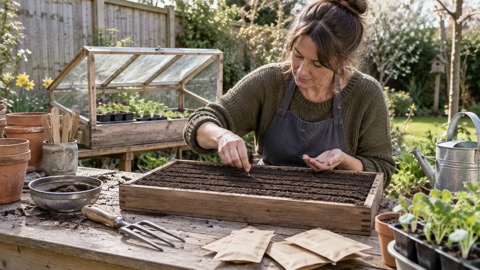
For the growing itself, the site's growing pages take you through it in order: Growing Your Own Vegetables: Where to Start for the basics, Sowing Seeds Indoors and Outdoors for timing and depth, What to Sow and Harvest Each Month for a calendar, and Seed Sowing Equipment Checklist for the first kit. If the plot is exposed, How Much Frost Protection Does Garden Fleece Give? and Extending the Growing Season Without a Greenhouse will help you protect early crops, and Polytunnel or Greenhouse? sets out the choice if your agreement allows a structure.
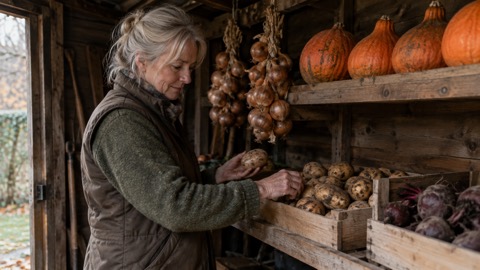
Pests and soil problems come with the territory: Vegetable Pests and Diseases covers prevention and control, and What to Do If Your Soil Has Clubroot deals with one of the most common allotment soil diseases. When the harvest arrives, Storing the Harvest and Freezing Home-Grown Fruit and Vegetables make sure nothing is wasted.
Sources (25)
- Tenants, Devon and Somerset Fire and Rescue Service
- Hen adoption FAQs, British Hen Welfare Trust, 2026-02-05
- Clearing up after a flood, Oxford City Council, 2026-10-29
- Flooding and drainage, Devon County Council, 2026-07-29
- Private water supplies, Scottish Borders Council, 2026-10-29
- Housing help if your home is flooded, Somerset Council, 2026-06-04
- How safe is your flat?, Sussex Police, 2026-11-02
- Bonfires and burning waste, Cheshire Fire and Rescue Service, 2026-10-14
- Buying a dwelling with a private water supply, Drinking Water Inspectorate, 2026-10-28
- Private water supplies, Argyll and Bute Council, 2026
- Private water supplies policy, Scottish Government, 2026-10-29
- Private water supply drought guidance, Drinking Water Inspectorate, 2026-10-28
- Flooding: our policy on sandbags, Oxfordshire County Council, 2026
- Flooding, The Highland Council, 2026-02-04
- Get prepared, Carmarthenshire County Council, 2026-10-25
- Flood and coastal risk management, Isle of Anglesey County Council, 2026-10-29
- Sandbags, Derbyshire County Council, 2026-10-29
- Sandbags policy, Derbyshire County Council, 2026-10-29
- Flooding and drainage, Devon County Council, 2026-07-29
- After a flood, Nottinghamshire County Council, 2026-10-29
- What to do after a flood, Natural Resources Wales, 2026-10-29
- Plan and prepare for floods, Westminster City Council, 2026-09-03
- Flooding, The Highland Council, 2025-09-25
- Flooding FAQs, Scottish Environment Protection Agency, 2026-10-29
- Written statement: water supply interruption, Conwy, Welsh Government, 2025-01-18
 Hydroponic System Parts List
 Year-Round Sowing Calendar
 Preserving Equipment Checklist
 Composting at Home
 Vegetable Pests and Diseases
 Fermenting Vegetables at Home
 Freezing Home-Grown Produce
 Growing Fruit at Home
 Indoor Hydroponics
 Growing Under Cover All Year
 Sowing Seeds
 Storing the Harvest