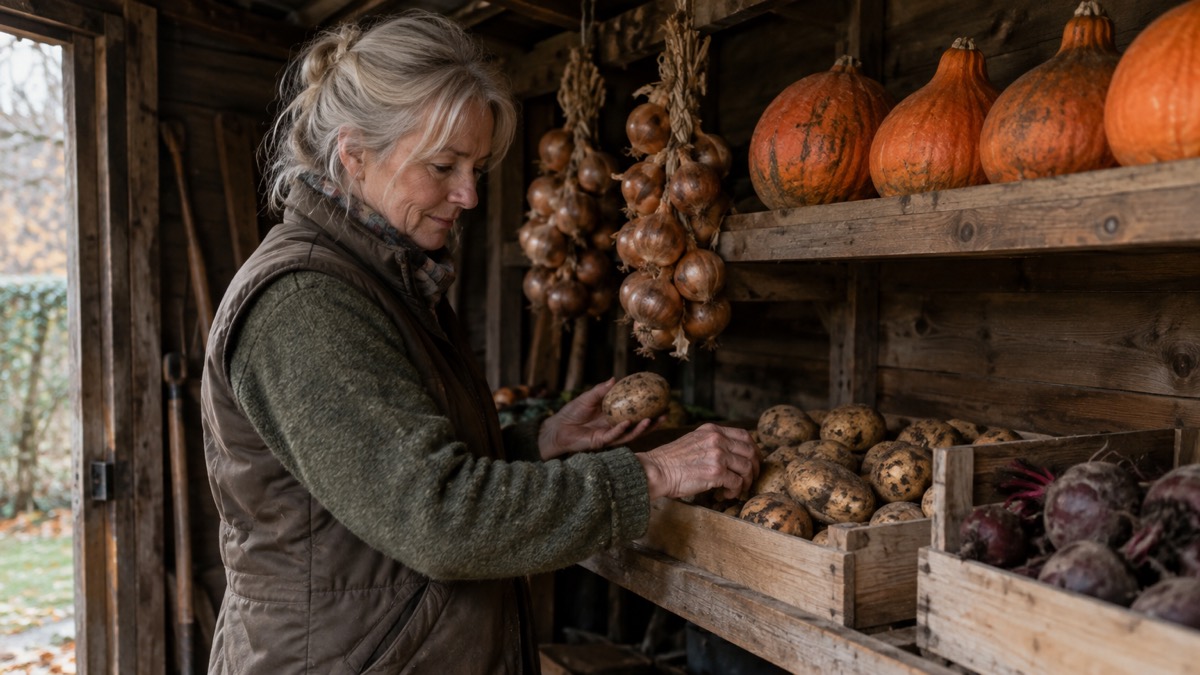
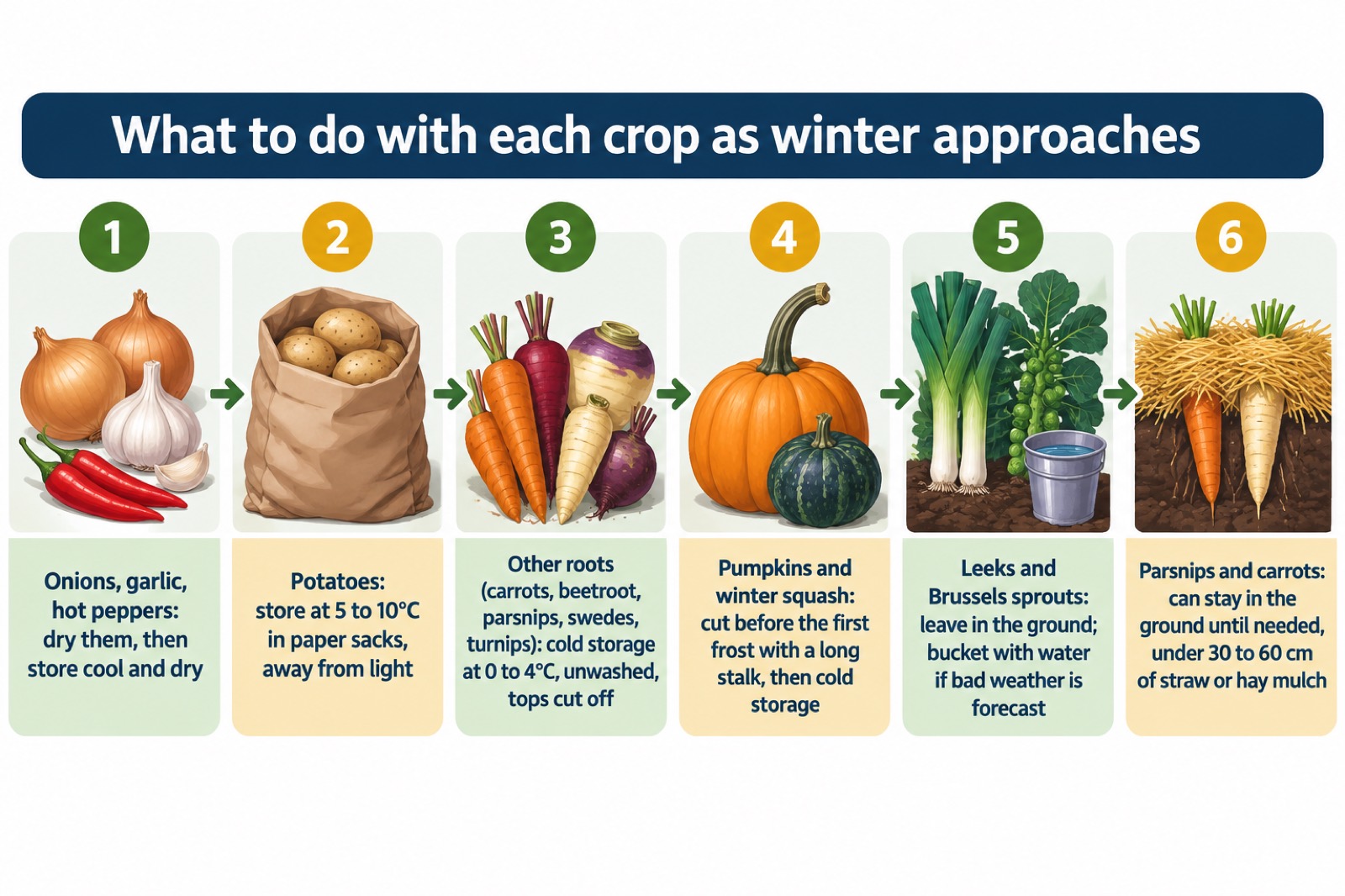
Storing a harvest without processing it is mostly a matter of matching each vegetable to the conditions it wants: onions and garlic want to be dried and then kept cool and dry, roots and potatoes want cold storage, and some crops, including parsnips, carrots, potatoes, leeks and Brussels sprouts, can simply be left in the ground until you need them1. Get the harvest timing right first: lift onions and shallots when all the leaves have fallen over naturally, cut pumpkins and winter squashes before the first frost with a long stalk attached, and harvest parsnips after the first frost, when they taste better1.
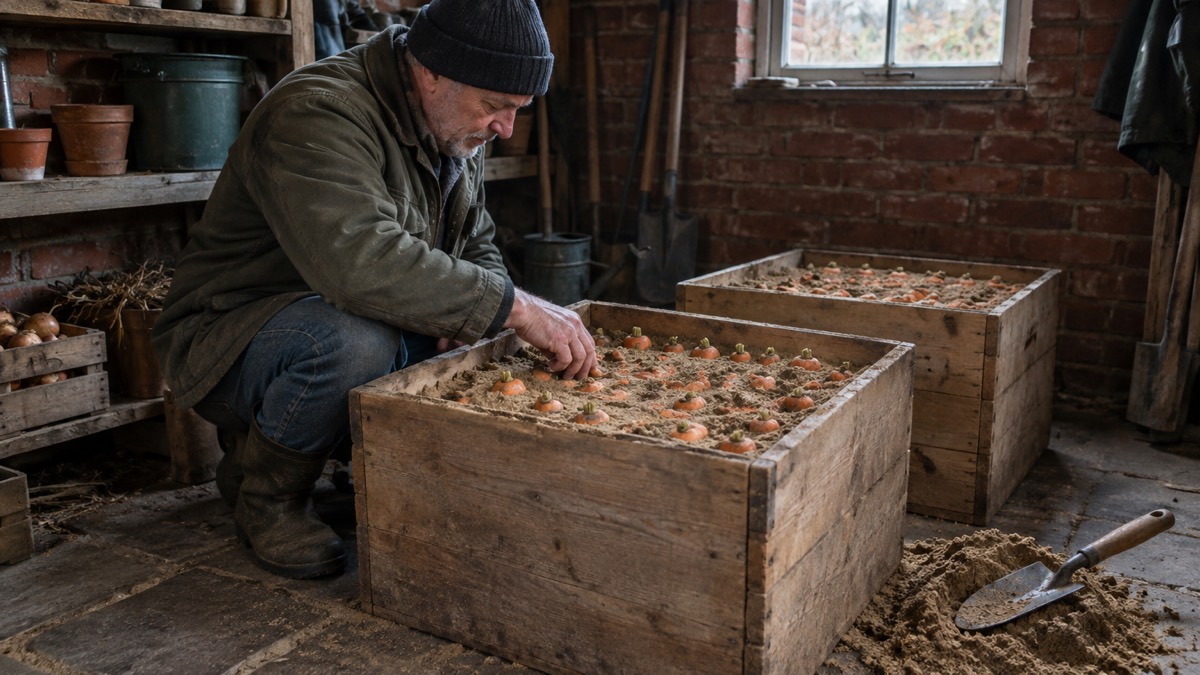
The storage itself is simple and cheap. Root vegetables keep well packed in layers of damp sand or sawdust in boxes, or in paper sacks in a cool, dark place, and potatoes store at 5 to 10°C away from light1. Check the store frequently and remove anything spoiled, because one rotting vegetable will take its neighbours with it2. What follows is what to do for each crop, in the order you need to do it, from the moment you decide to harvest.
Get the timing right before you lift anything
Storage begins in the ground, not in the shed. A vegetable lifted at the wrong moment will not keep, however carefully you store it, so the first skill is reading the signs each crop gives you.
For the onion family, the signal is the foliage. Harvest onions and shallots when all the leaves have fallen over naturally, and dig out garlic when just the first 4 or 6 leaves turn yellow1. These are visible signs, not calendar dates, and they matter: leaves that are still standing mean the bulb is still growing and its skin has not yet formed the protective layer it needs to survive months in storage.
For pumpkins and winter squashes, the deadline is the first frost. Harvest before it arrives, and cut each fruit with a long stalk, with part of the vine attached, because this protects the stem from rotting1. A squash whose stalk has been snapped off at the fruit is a squash with a door open to rot. You can read more about how long these keep in How Long Do Pumpkins and Squashes Keep?.
For parsnips, patience is rewarded. Parsnips taste better when harvested after the first frost, and they will store3. For potatoes in containers, the last job before harvest is to stop watering: water the container when the compost is dry, particularly during hot or dry weather, and stop watering when the potatoes are ready to harvest5. For crops you plan to eat the same day, harvest in the early morning, sprinkle them lightly with water and keep them in a cool place until you are ready to prepare them2.
Onions and garlic: dry first, then keep them cool and dry
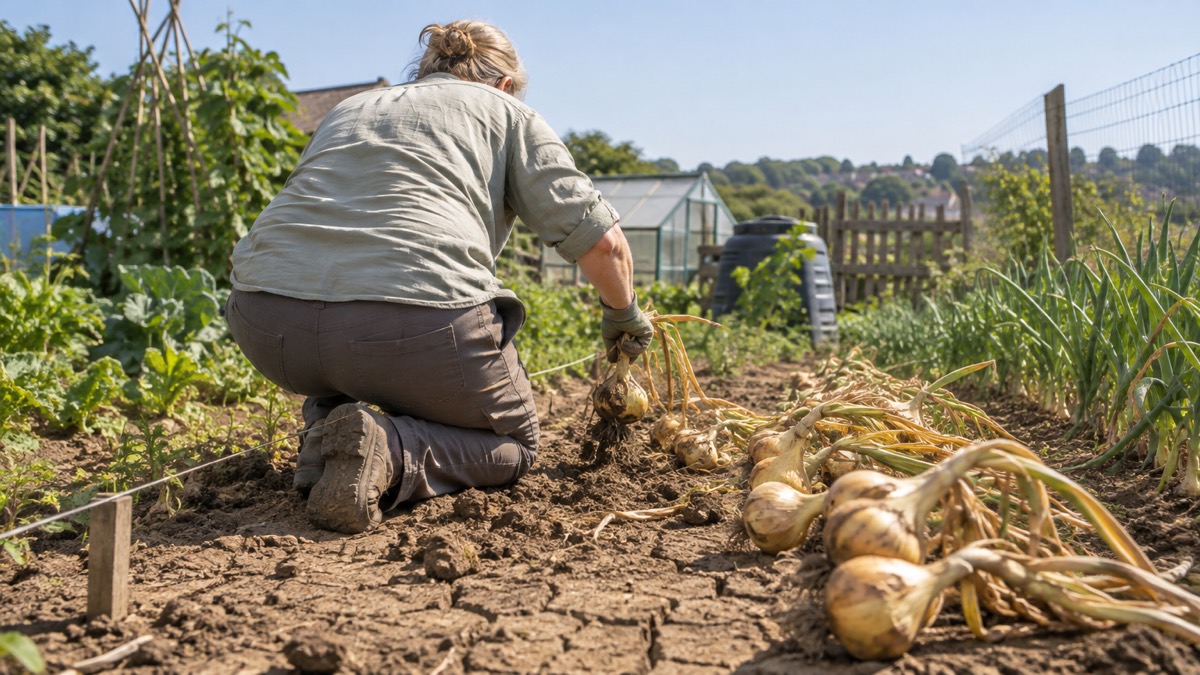
Onions, garlic and hot peppers are usually dried before storage, while winter squash, potatoes and root crops are best kept in cold storage2. That division is the heart of storing the allium family: they need a drying stage that other vegetables do not.
The purpose of drying is to take moisture out of the outer skins and the neck of the bulb, where rot would otherwise enter. Drying is the standard route for onions, garlic and hot peppers, and once onions have been dried they keep best in a cool, dry place1. So the sequence is to lift them when the leaves have fallen over, dry them, and then move them to a cool, dry place for the winter.
Once in store, the same rule applies as for every other crop in this article: check them frequently and remove any that are spoiled2. Onions are usually stored in bunches or strings once dried, and the important thing for a household store is that the place stays dry and not too warm, which is the same general condition Food Standards Scotland gives for any cupboard or pantry storage area4. Root veg harvested in late autumn, together with potatoes, onions and garlic, can be stored carefully for several months3, so a well-dried onion crop is genuinely a winter food supply, not just a way of delaying the glut by a fortnight.
A note on the wider value of these crops: if you have space, leave one leek plant, an onion plant and maybe even a carrot and parsnip plant to over-winter. The next year they will flower and you can save their seeds6. A stored onion feeds you this winter; an over-wintered one seeds next year's crop.
Roots and potatoes: cold storage, not the washing-up bowl
Roots are easy crops to store and easy to get wrong, because the mistake people reach for first is water. Don't wash vegetables before putting them into cold storage: use a brush to remove soil, and cut the tops off root vegetables2. Washing adds moisture exactly where you do not want it, and a wet root in a closed box is a rotting root within weeks.
The temperatures to aim for are specific. Potatoes should be protected from low or freezing temperatures and stored at 5 to 10°C1. Root crops other than potatoes want it colder still: keep them very cool, from 0 to 4°C1. Food Standards Scotland's advice for the kitchen agrees on the two acceptable places for potatoes: store them either in a cool, dry place or in the fridge4, and Love Food Hate Waste adds that a cool, dark, dry place helps them last longer, kept away from light, which can turn them green7. Green potatoes have been damaged by light, and light is the enemy in any potato store.
For packing, you have two good options, and they suit different households:
| Method | What it suits | How to do it |
|---|---|---|
| Paper sacks | Potatoes, and any root crop you will use over a few months | Store them in paper sacks in a cool, dark place5 |
| Damp sand or sawdust in boxes | Carrots, beetroot and other roots you want to keep for the long term | Pack in layers in wooden boxes, crocks or plastic buckets, alternating layers of vegetables and layers of damp sand2 |
The best storing vegetables for this kind of cold storage are beets, carrots, parsnips, potatoes, pumpkins, rutabagas (swedes), turnips and winter squash2. When you fill boxes of damp sand, place them where they will be stored before you fill them, because they are heavy when full2. Root veg such as carrots and beetroot can be harvested in late autumn and stored carefully for several months, as can potatoes, onions and garlic3.
Leaving crops in the ground: the store that needs no equipment
Some vegetables do not need to be lifted at all. Some vegetables, such as parsnips, carrots and potatoes, keep well in the ground until needed2, and the list of crops that can be left in the ground until you want to use them includes beets, carrots, parsnips, rutabagas (swedes) and turnips2. For a household that would rather not build a store, this needs no store at all: the ground holds the crop, and you harvest at the kitchen door as you cook.
Leeks and Brussels sprouts can normally be left in the ground over winter as well1. If extremely bad weather is forecast, Garden Organic advises that you can bring a few in: dig up entire plants, with roots, and place them in a bucket with just enough water to cover the roots1. That is a useful trick for a hard fortnight of frozen ground, and it keeps the leeks usable when you cannot dig.
If you are leaving roots in the ground through a cold spell, cover them with a 30 to 60 cm (1 to 2 foot) layer of mulch such as straw or hay, which will trap air and will not become saturated with water2. The trapped air is the insulation; the straw stays dry where bare soil would freeze.
There are two limits to in-ground storage, and both come from the same source. Vegetables can be damaged if it is too cold or too rainy, and harvesting becomes difficult to impossible if the ground is frozen2. So the in-ground approach works until a genuinely hard winter arrives, and the plan for that is in the next section.
Remember, too, that the ground is not empty in winter even if you lift everything. Brassicas such as kale, cabbage, turnips and broccoli will all grow over the winter months3, so a winter garden can be a living store of fresh greens alongside the boxes of roots. The key to having vegetables through the autumn and winter is to continue sowing, even in mid-summer3, which is a job for the growing season rather than the storing season, but it is what makes the winter supply possible. Our page on avoiding the hungry gap covers the planning side.
Where the ground freezes solid: lift before it does
The failure mode of in-ground storage is frozen ground. When the soil is frozen, harvesting is difficult to impossible, and vegetables left in ground that is too cold or too wet can be damaged rather than stored2. The answer is to lift what you can before the hard weather arrives, and to have somewhere ready to put it.
That somewhere does not need to be a traditional root cellar. The best storing vegetables for cold storage are the same list whether the store is a cellar, a shed, a garage corner or boxes of sand under the stairs2. What matters is the temperature and the checking, not the architecture.
There is also an official option for cold weather that surprises many people. If the weather is cold, below 8°C, you can store food outside in clean dry conditions, out of direct sunlight, protected from animals, in a sealed box to prevent contamination and tampering8. Food Standards Scotland gives the same advice for chilled foods: you can safely store chilled foods outside if it is 8°C or lower9. A sealed plastic box in a shaded, animal-proof spot can stand in for a cool room during a cold snap, though it stops being a store the moment the weather warms past that 8°C mark.
For the crops you cannot lift in time, the bucket method for leeks described above is the fallback1, and the mulch layer of 30 to 60 cm of straw or hay protects roots still in the ground from the cold2. Between the three, a household can get through a frozen fortnight without losing the crop.
Keeping the store cool, dry and pest-free
A store fails in three ways: it gets too warm, it gets damp, or something gets in. All three are preventable with habits rather than equipment.
The first habit is inspection. Check vegetables in cold storage frequently and remove any that are spoiled2. Rot spreads from one vegetable to its neighbours, so a weekly look through the boxes, taking out anything soft or mouldy, does more for a store than any piece of kit. This is the same principle that runs through all food storage: chilling, freezing and defrosting food properly helps stop harmful bacteria from growing10, and making sure foods are stored at the correct temperature prevents the growth of harmful bacteria11.
The second habit is controlling the conditions. Keep the storage area dry and not too warm4. For potatoes that means 5 to 10°C or the fridge, away from light1; for other roots, 0 to 4°C1. A store that swings between warm and cold, or a shed that gets afternoon sun, will shorten the life of everything in it.
The third habit is keeping animals out. The outside-storage advice from the government's food safety guidance is explicit: store food in clean dry conditions, out of direct sunlight, protected from animals, in a sealed box to prevent contamination and tampering8. Rodents will find an open sack of potatoes eventually, and a sealed box or a lidded bin removes the invitation. In the kitchen, keep unwashed vegetables separate from ready-to-eat foods during storage and preparation11, so the store and the kitchen bench do not cross-contaminate.
Damaged crops and gluts: use first, freeze the rest
Not everything you lift will be worth storing. Freeze only good-quality vegetables that are on the young side; larger vegetables are better canned or stored in a root cellar2. The same logic applies to damaged produce: the store is for sound crops, and anything bruised or damaged belongs in the kitchen this week, not in a box where it will spoil its neighbours. Check the store frequently and remove anything spoiled2, and treat that as the rule for what goes in as well as what stays in.
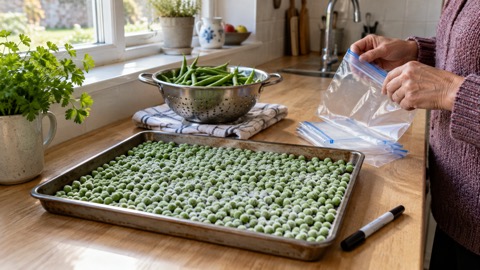
Freezing is the natural second route for a glut, and it is covered in full in Freezing Home-Grown Fruit and Vegetables. The essentials from the storage point of view: it is best to blanch vegetables in boiling water first and to freeze in manageable quantities, and tomatoes are best cooked into a sauce before freezing1. Blanching is recommended before freezing because it slows or stops the enzymes that cause loss of flavour, colour and texture, cleanses the surface of dirt and organisms, brightens colour, helps retard loss of vitamins and makes vegetables easier to pack12. One quick method for small pieces: wash and dry the vegetables, cut them up (the smaller the pieces, the quicker they will freeze), spread them out in a shallow pan and freeze, then pour into freezer bags2.
Always store frozen foods in airtight containers or freezer bags, because the cold air will cause foods to dry out11. For cooked potatoes, store in an airtight container in the fridge for 2 days and in the freezer for up to 3 months7; defrost fully in the fridge and use within 24 hours, or use a microwave on the defrost setting directly before cooking or reheating7.
One warning that belongs in any article on stored food, because it covers preserved produce of every kind: do not eat preserved food if the containers are bulging, leaking, damaged or heavily rusted, if the food shows signs of mould or spoilage, or if you are unsure whether it was preserved safely14. If in doubt, throw it out.
If flood water has touched your crops
A stored harvest has one hazard that comes from outside the garden: flooding. The advice from Nottinghamshire County Council is blunt. Do not eat any garden or allotment vegetables that have been covered by flood water. Leave undamaged vegetables in the ground for at least another 2 weeks and then only use them after thorough washing and cooking15.
That applies to the crops still in the ground and to anything in a store that flood water has reached. For the land itself, the same local resilience guidance is more forgiving about the future: you do not need to wait before planting new crops if the fruit or vegetables will be cooked before being eaten16. So a flood takes your current stored harvest off the menu but does not necessarily take the plot out of use. Our flooding guide covers the wider household side of this.
Saving seed from the crops you store
Storage of one kind feeds storage of another. If you have space, leave one leek plant, an onion plant and maybe even a carrot and parsnip plant to over-winter; the next year they will flower and you can save their seeds6. The vegetables you are keeping in boxes and sacks are the same plants that can produce next year's seed, and a household that stores crops well is already halfway to saving its own.
The seed itself needs different conditions from the crop. Store seeds in labelled paper envelopes or bags, kept in a cool, dry place, within an airtight container if possible; sachets of silica can absorb excess moisture6. Where a potato store wants 5 to 10°C and roots want 0 to 4°C1, seed wants above all to stay dry, hence the paper envelopes inside an airtight container rather than a sealed plastic bag on its own, which would trap moisture against the seed. Full detail is in How to Store Saved Seed So It Lasts and How to Save Seed from Your Own Vegetables.
A few habits that carry the whole system
Underneath the crop-by-crop detail, storing a harvest comes down to a handful of habits, and they are worth naming because they apply to everything above.
Harvest on time. Crops left past their point keep badly, and the signs, fallen onion leaves, yellowing garlic leaves, the first frost approaching for squashes, are all visible in the garden if you look1. Don't wash vegetables before cold storage; brush the soil off and cut the tops2. Check the store frequently and remove anything spoiled2. Keep the storage area dry and not too warm4. And match the crop to the place: dried and cool for onions, 5 to 10°C and dark for potatoes, 0 to 4°C for other roots, the ground itself for parsnips, carrots, leeks and sprouts until it freezes1.
None of this needs equipment beyond sacks, boxes, sand and a brush, and none of it needs processing. The point of the whole system is that in February you can still be eating your own roots and onions, and digging parsnips from under the mulch, months after the growing season ended. If you are starting from the other end, our pages on growing your own vegetables and what to sow and harvest each month cover the season that fills the store in the first place.
Sources (16)
- Harvesting and Storing Vegetables, Garden Organic, 2026
- Harvesting and Storage, Harrod Horticultural, 2026
- Vegetables All Year Round, Garden Organic, 2026
- Food Storage, Food Standards Scotland, 2026
- How to Grow Potatoes in Containers, RHS School Gardening, 2026
- Tips on Saving Your Own Seeds, RHS School Gardening, 2026
- Potato Storage and Use, Love Food Hate Waste, 2026
- Food Safety in a Power Cut: Advice for Consumers, UK Government, 2023
- Power Cuts: Food Safety, Food Standards Scotland, 2026
- How to Chill, Freeze and Defrost Food Safely, UK Government, 2017
- Preparing and Cooking Food Safely, NHS inform Scotland, 2025
- Curing and Smoking Foods, National Center for Home Food Preservation, 2026
- Potatoes: Storage and Freezing, Love Food Hate Waste, 2026
- Consumer Advice for Food Preservation at Home, UK Government, 2026
- Flooding: Before, During and After FAQs, Nottinghamshire County Council, 2026
- Flood Recovery Leaflet, Nottinghamshire County Council, 2025
 Hydroponic System Parts List
 Year-Round Sowing Calendar
 Preserving Equipment Checklist
 Getting an Allotment
 Composting at Home
 Vegetable Pests and Diseases
 Fermenting Vegetables at Home
 Freezing Home-Grown Produce
 Growing Fruit at Home
 Indoor Hydroponics
 Growing Under Cover All Year
 Sowing Seeds