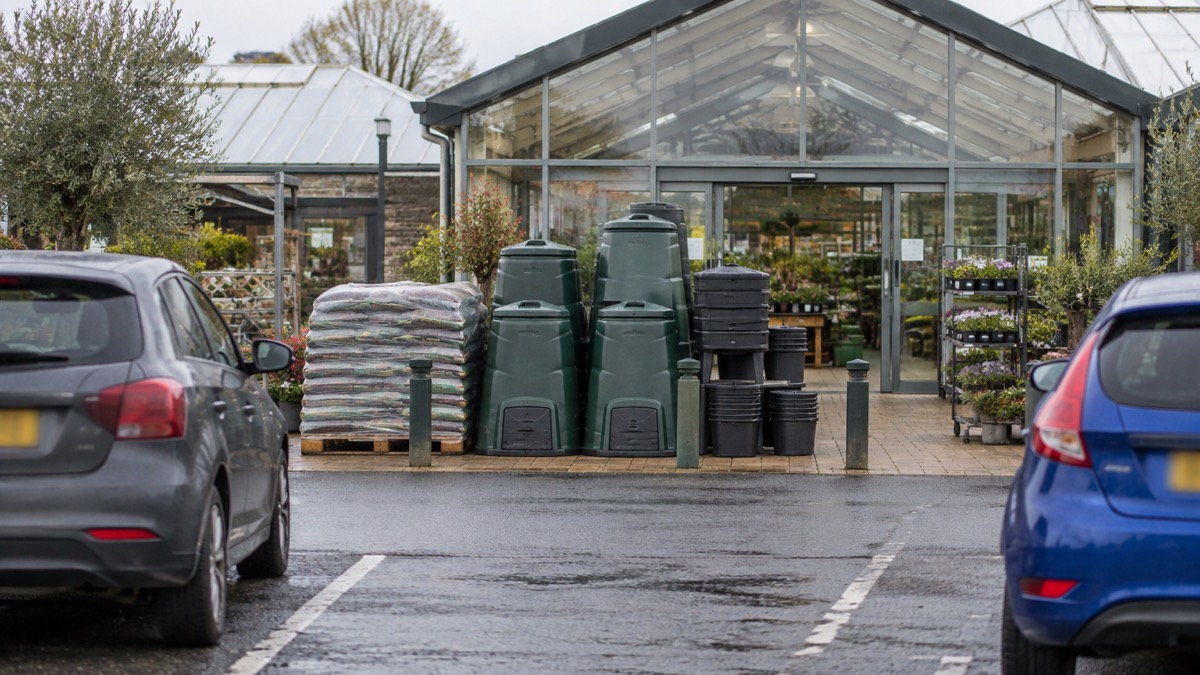
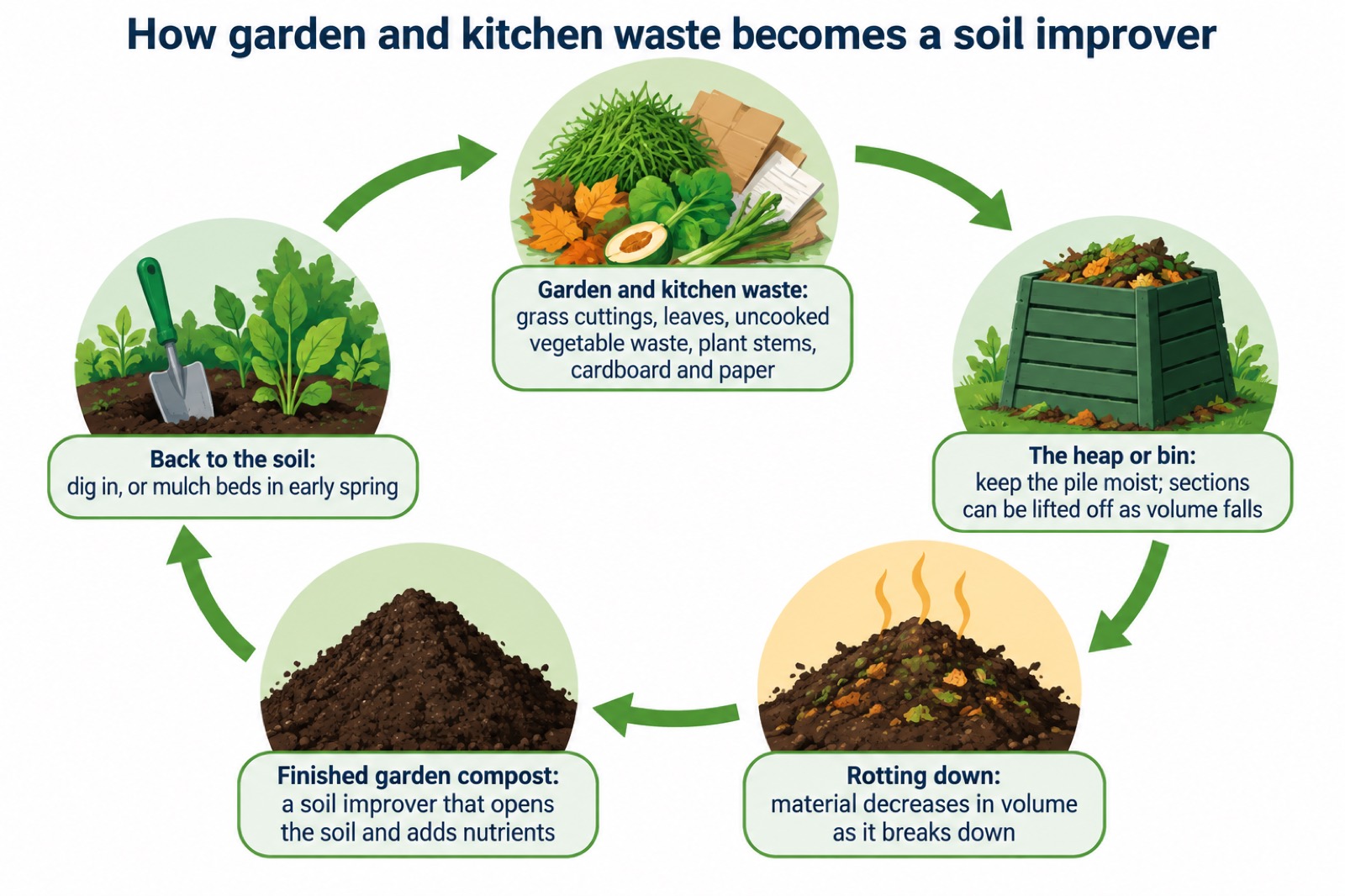
Composting at home means letting garden and kitchen waste rot down until it becomes a dark, crumbly material you can dig back into your soil. Cheshire Fire and Rescue Service describes it as "a simple way to recycle materials such as: Grass cuttings, Leaves, Uncooked vegetable waste"1, and Garden Organic explains what you end up with: garden compost is "made from rotted waste materials such as plant foliage and stems, vegetable and fruit waste, grass cuttings and cardboard and paper"2. Nothing needs to go to a bonfire or a landfill bin, and the finished material does your garden real good.
That benefit is worth being clear about, because it is the reason to keep going through the slow weeks. Garden compost "gives the soil a good structure which is open and aerated, helping water, plant roots and soil life to move freely", it "adds nutrients to the soil to feed soil life and help plant health", and it is "perfect as a soil improver"2. In other words, you are not just getting rid of waste, you are making something your soil would otherwise lack.
You can start with almost nothing. A heap of grass cuttings and leaves in a corner will rot on its own. If you want a tidier and more manageable set-up, Garden Organic publishes a design for a homemade wooden bin you can build with three tools3, and there are sealed options for kitchen waste, including wormeries and bokashi bins, which we point to below. This page covers what to do, what you need, how to use the finished compost, how to stay safe around it, and where the arrangements differ across the four nations.
What to do: starting and feeding a heap
The first step is simply to stop throwing compostable material away. Fire and rescue services and councils across the UK actively encourage this, because composting removes the temptation to burn garden waste. The Scottish Government's Ready campaign says to "consider alternatives like composting if you plan to burn leaves, waste or debris"7, and Lincolnshire Council's bonfire safety guidance notes that "most garden waste, like grass cuttings and leaves, can be recycled by composting or by being taken to a Household Waste Recycling Centre"8. Government guidance on burning wood similarly directs households to "dispose of garden waste through your Local Council's disposal scheme or consider composting it"9.
So the working method is:
- Choose a spot for the heap or bin, on soil if you can, positioned away from the house as fire and rescue services advise for garden structures generally6.
- Add materials as they arise: grass cuttings, leaves, uncooked vegetable waste from the kitchen1, plus plant foliage and stems, fruit and vegetable waste, and cardboard and paper2.
- Keep the pile moist. London Fire Brigade's wildfire protection advice for homes is blunt: "Keep your pile moist. If you're worried that it's too dry and could be a fire risk, use a watering can or hose to add a"5 little water rather than letting it dry out completely.
- Wait. The material rots down over time and shrinks in volume, which is normal and expected3.
- Use the finished compost as a soil improver, digging it in or spreading it on beds2.
Composting also earns its place as a fallback when council services are disrupted. Somerset Council's advice for delays to paid-for garden waste collections lists the options plainly: home composting, taking garden waste to any open recycling site, or storing materials until collections resume10. A household with a working heap absorbs that kind of disruption without a second thought, which is one reason composting sits alongside growing your own vegetables and other self-reliance skills.
Building a wooden compost bin
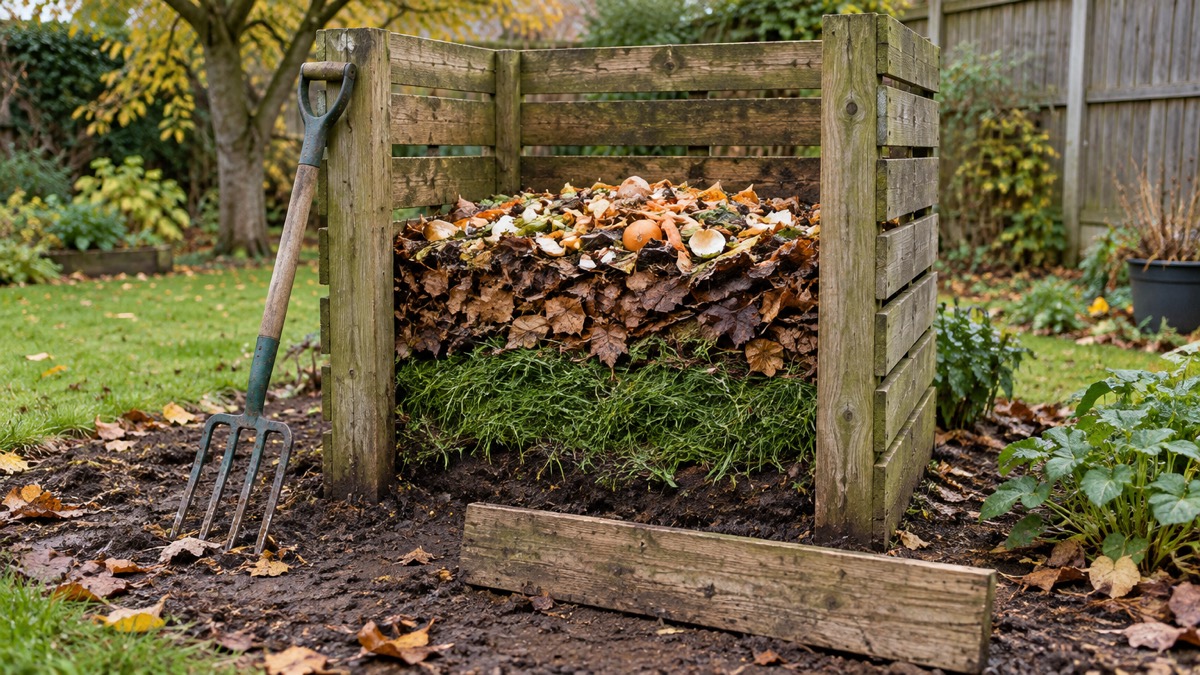
You do not need to buy anything to make a good bin. Garden Organic's design for a homemade wooden compost bin is built from separate stacked sections, and its great advantage is flexibility: "sections can be removed or added as needed, and as compost decreases in volume the top sections can be taken off to start a new container"3. When the lower material has rotted and settled, you lift off the upper rings and start a fresh heap beside it.
The tools list is short: one screwdriver, one drill and one saw3. The timber list for ten sections is 30m of 7.5cm x 1.5cm timber, 2.2m of 5x5cm timber, and 220 of 3.6cm number 8 screws3. Each section is made from two boards of 75cm and two boards of 72cm, each 7.5cm wide and a minimum of 1.5cm thick3.
| What you need | Amount |
|---|---|
| Boards, 75cm long, 7.5cm wide, minimum 1.5cm thick | 2 per section3 |
| Boards, 72cm long, 7.5cm wide, minimum 1.5cm thick | 2 per section3 |
| Timber, 7.5cm x 1.5cm | 30m for 10 sections3 |
| Timber, 5x5cm | 2.2m for 10 sections3 |
| Screws, 3.6cm number 8 | 220 for 10 sections3 |
| Tools | 1 screwdriver, 1 drill, 1 saw3 |
The fixing method is equally specific: drill 3 holes, 3cm deep, and fasten with 3 screws at each end of the shorter boards, using 2 screws only at each end of the 75cm boards3. If those exact dimensions do not match what you can get hold of, that is fine: the design's dimensions "can be adjusted to suit available materials, making it ideal for reclaimed timber such as floorboards or pallets"3. Old floorboards and broken-down pallets are exactly the kind of timber this design was meant to use.
Wormeries and bokashi for kitchen waste
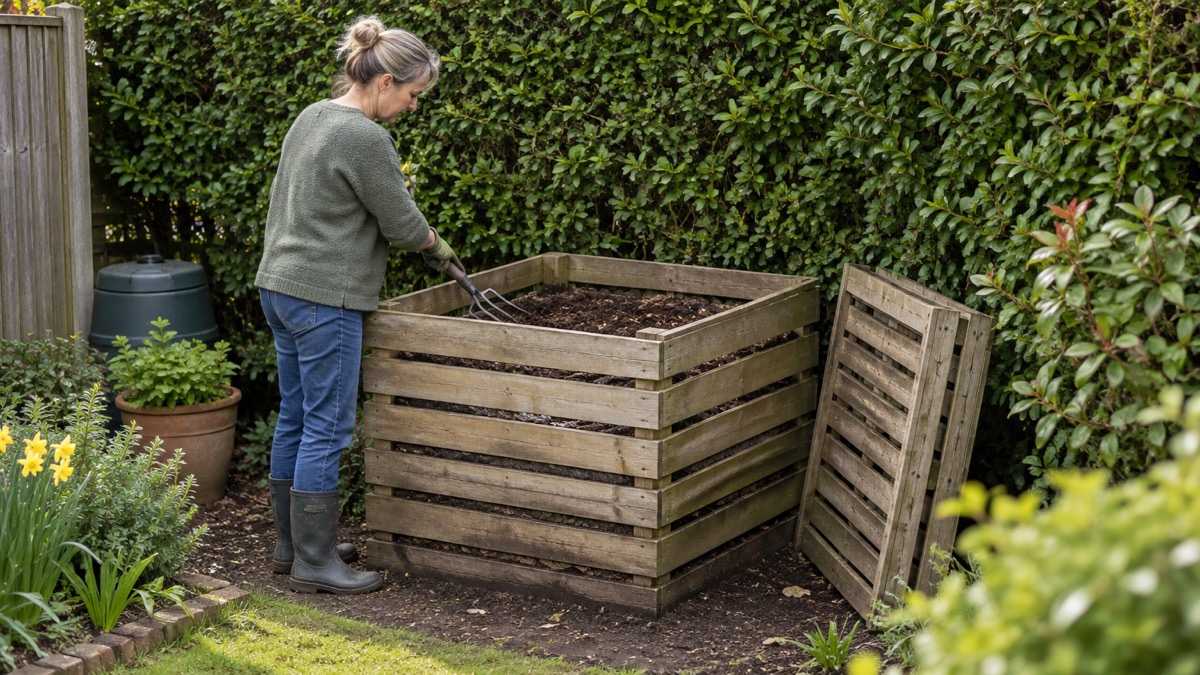
A garden heap handles grass, leaves and uncooked vegetable trimmings well, but some households produce mostly kitchen waste, or have no garden at all. For those situations the sealed options come in: a wormery, which uses composting worms to break down food scraps in a container, and a bokashi bin, which ferments kitchen waste in an airtight bucket. Which of the two suits your kitchen waste depends on your circumstances, and we set the comparison out on our wormery or bokashi bin page.
If your main question is whether a heap or a sealed container suits you better, the same applies to the choice between a hot composter and a cold bin, which we cover on our hot composter or cold compost bin page. The rest of this page concentrates on the garden heap, because that is the starting point for most households and the option the official guidance addresses directly.
Using the compost you make
Finished garden compost is a soil improver first and foremost. Dig it into beds, spread it on the surface, or use it to feed established plantings. The Centre for Alternative Technology's forest garden advice gives a model for this: "Fertilise with a mulch of homemade compost in early spring"11, with comfrey leaves cut and used as further mulch through the year. The RHS month-by-month food growing guide gives the same timing for the vegetable garden: in January, "prepare soil and add compost if conditions allow (i.e. the soil isn't too wet or frozen)"12. Working soil that is sodden or frozen does more harm than good, so wait for a dry or thawed day.
There are limits, and knowing them saves disappointment:
- Do not use garden compost for seed sowing or rooting cuttings. Garden Organic is clear that "you wouldn't use garden compost for seed sowing or to root cuttings (it has too many nutrients)"2.
- Do not use it for hanging baskets. Its bulk would make them too heavy2.
- Do turn it into potting compost if you want a mix. Garden Organic advises mixing it with sand, grit, topsoil or leafmould2. Our guide to making leafmould covers one of those ingredients.
For actual sowing and cuttings, use a proper seed compost and the right technique. The RHS advises that for small seeds you "sprinkle the seeds on top of the compost, allowing space between them" and then "sieve a thin layer of compost over small seeds"13. When filling containers, do not overfill: "tap it gently on the table or work surface three times. This removes any large air pockets in the compost"13. For semi-ripe cuttings, fill the tray with compost and "firm down with a 'presser board' or another tray, until it is 1cm from the top. The compost needs to be level"14. Our sowing seeds indoors and outdoors page takes these techniques further.
Garden compost also has a place in container growing, where it is topped up rather than mixed in. For potatoes in containers, the RHS method is to plant in compost and then, "once the shoots start to appear, gradually add more compost around the base of the stems to cover them up", continuing "burying the stems by topping up with compost until the container is full"15. For quick-growing salad and microgreens, the compost itself is the growing medium: use a container 5cm deep, "moisten the compost and gently firm it down, then sow the seeds evenly and cover lightly"16. The RHS microgreens guide adds that before sowing you should "moisten the compost before sowing using a watering can with a fine rose. It should be damp but not waterlogged"17, and at harvest you "use clean scissors to cut the stems just above the compost surface"17. Even spent salad plants feed the cycle: when leaves turn bitter or the plant attempts to flower, compost them16.
Staying safe around compost
Two risks deserve plain words: infection and fire. Neither should put you off composting, because both are easy to manage.
That is the whole of the routine: gloves on, mask if the compost is dry and dusty, hands washed when you finish. It applies to turning a heap, sieving finished compost and filling seed trays alike.
Fire risk comes from heaps that have dried out completely, particularly in hot, dry weather. London Fire Brigade's advice on protecting your home and garden from wildfires is to keep the pile moist, and if you are worried it is too dry and could be a fire risk, to use a watering can or hose to add water5. Devon and Somerset Fire and Rescue Service's wildfire guidance makes the same kind of preparation for the garden generally, including "having a hosepipe or water easily available"18 near your home. North Yorkshire Fire and Rescue Service adds the siting rule: position garden structures, "such as sheds and compost heaps away from the house"6.
The wider fire picture is the reason composting is recommended at all. North Yorkshire Fire and Rescue Service asks households to "think carefully before burning garden rubbish", not to have fires close to trees, hedges, fences or sheds, and not to have them on windy days when the fire could spread more easily19. Composting removes the fire from the equation entirely. If you do still need to dispose of material you cannot compost, take it to a Household Waste Recycling Centre rather than burning it8.
Where Scotland, Wales and Northern Ireland differ
The composting itself works the same way everywhere in the UK: the same materials rot down in the same way in Cardiff as in Carlisle. What differs is which body issues the advice and runs the services around it.
Environmental protection advice is provided by the Environment Agency in England, by Natural Resources Wales in Wales, by SEPA in Scotland and by NIEA in Northern Ireland20. The devolved governments in Scotland, Wales and Northern Ireland also provide advice for their own residents21, so if you are looking for official guidance on waste disposal or garden burning rules, start with your own nation's body rather than an England-only page.
On outdoor fires, the wildfire safety messaging, such as the Scottish Ready campaign's advice to compost instead of burning7, comes from each nation's own services, and Wildfire Aware's prevention advice is to follow the Countryside Code in England, Wales and Northern Ireland, and the Outdoor Access Code in Scotland. Council garden waste collections also vary by authority, and Somerset Council's advice on delays, composting at home, using recycling sites or storing materials10 is a fair model for what your own council will say when collections are disrupted by weather.
Where to go next
Composting is one piece of a self-reliant household, and it connects to several others naturally. The compost you make feeds the vegetables you grow, so our growing your own vegetables guide is the natural next stop, and the sowing page covers the seed compost techniques mentioned above. If you have the space and inclination, a composting toilet works on the same principle at a larger scale: the Centre for Alternative Technology notes that the compost from one, usually removed once per year, "is an excellent soil conditioner ideal for use on ornamental flowers and shrubs"22. And if your waste stream is mostly from the kitchen, start with the wormery or bokashi comparison before buying anything.
Sources (22)
- Bonfires and burning waste, Cheshire Fire and Rescue Service
- Garden compost or potting compost, Garden Organic
- Homemade compost bins, Garden Organic
- Summer health campaign, NHS inform
- Wildfires: protecting your home and garden, London Fire Brigade
- Protecting your home from wildfires, North Yorkshire Fire and Rescue Service
- Wildfires, Ready Scotland
- Bonfire safety, Lincolnshire Council
- Ready to Burn, Defra, 2023
- Bins, recycling and waste: services and weather, Somerset Council, 2025
- Forest garden, Centre for Alternative Technology, 2025
- Month by month guide to food growing: spring term, Royal Horticultural Society
- Sowing in pots, Royal Horticultural Society
- How to take semi-ripe cuttings, Royal Horticultural Society
- How to grow potatoes in containers, Royal Horticultural Society
- Quick growing food, Garden Organic
- Growing microgreens, Royal Horticultural Society
- Wildfires, Devon and Somerset Fire and Rescue Service
- Stay home and stay safe, North Yorkshire Fire and Rescue Service, 2020
- What to do in a radiation emergency, GOV.UK, 2024
- How would you prepare for an emergency?, NHS Cheshire and Merseyside, 2024
- Composting toilets, Centre for Alternative Technology, 2025
 Hydroponic System Parts List
 Year-Round Sowing Calendar
 Preserving Equipment Checklist
 Getting an Allotment
 Vegetable Pests and Diseases
 Fermenting Vegetables at Home
 Freezing Home-Grown Produce
 Growing Fruit at Home
 Indoor Hydroponics
 Growing Under Cover All Year
 Sowing Seeds
 Storing the Harvest