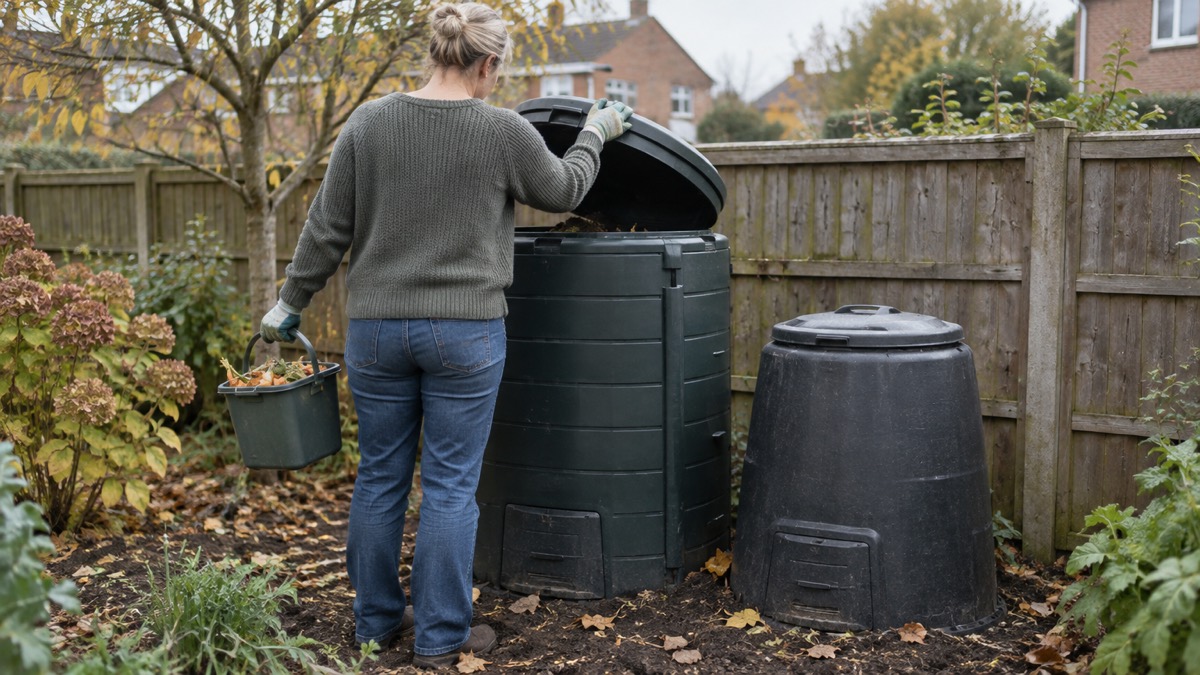
If you are choosing between a hot composter and a cold compost bin, the decision comes down to speed and effort against simplicity and cost. A hot composter is an insulated bin that holds the heat of decomposition, so waste breaks down faster and the bin can be sealed against pests. A cold compost bin is the slower, simpler option: an open heap or a lidded bin that relies on time and the weather.
For most households the sensible first step is a cold bin, because it is cheap, forgiving and turns garden waste into a soil improver without any power or attention. Choose a hot composter if you want to deal with kitchen waste, including cooked scraps, without attracting rats and flies, and you are prepared to manage it.
Whichever you choose, the rules are the same: site it on soil away from the house, keep the lid closed, never put cooked food or meat in an open bin, and keep it damp but not waterlogged. This page sets out how each one works, what each can take, where to put it, how to keep it going through dry spells and winter, and what to do when it smells, attracts flies or will not heat up.
| Hot composter | Cold compost bin | |
|---|---|---|
| How it works | Insulated bin; the maker states it can achieve hot composting1 | Open or lidded bin relying on time and weather |
| Suits | Households processing kitchen waste, including cooked scraps, in a sealed unit | Households with garden waste who can add, turn occasionally and wait |
| Effort | Higher: managed filling, mixing and emptying | Low: add, turn occasionally, wait |
| Winter | Insulation holds heat better | Slows down sharply |
| Pests | Sealed unit keeps rodents and flies out | Vulnerable if food waste is added |
Hot composter or cold compost bin: how each one works
Both systems rely on the same process. Microbes break down plant material, and the speed depends on how warm, moist and aerated the material is. The difference is how much of that the bin controls for you.
A hot composter is an insulated bin. The maker of one model states that it is a 200 litre compost bin that can achieve hot composting1. Because it is a sealed unit, it also keeps pests out and lets you process kitchen waste that an open bin would not safely take. The trade-off is that you have to manage it: the maker's instructions for filling, mixing and emptying decide whether it works.
A cold compost bin is the simpler option. It is an open or lidded container, or simply a heap, that relies on ambient warmth and time. You add material, turn it occasionally, and wait. It handles garden waste well and costs little, but it slows down in winter and it will not reliably deal with cooked food.
Composting itself is a simple way to recycle materials such as grass cuttings, leaves and uncooked vegetable waste1. Fire and rescue services recommend that garden waste is composted or disposed of through a brown bin collection or your local recycling centre6. Defra's bonfire guidance makes the same point: dispose of garden waste through your council's scheme or consider composting it7.
A hot composter is an insulated bin that breaks waste down faster
The whole point of a hot composter is insulation. Decomposition generates heat, and in an open heap most of that heat escapes. An insulated bin keeps it in, so the contents stay warmer than they would in an open heap. The maker of one model states that it is a 200 litre compost bin that can achieve hot composting1.
That speed has practical benefits. You can process more waste in the same footprint, which matters in a small garden. You can add kitchen waste, including cooked scraps, because the sealed bin and the heat suppress the smells and flies that would otherwise draw rats. And because the process is faster, you are less likely to fill the bin before the bottom is ready to empty.
It also has costs and demands. A hot composter is a manufactured unit, so it costs more than a cold bin. It needs to be filled in the right proportions, kept moist and mixed or turned as the maker instructs. If you let it dry out or overload it with one type of material, it will cool down and behave like an ordinary bin.
The honest way to judge one is to ask whether it holds heat and keeps pests out, not to chase a claimed number of days. The pack behind this page gives no figure for how long a hot batch takes, so treat any precise claim with care and follow the maker's own instructions for your model.
A cold compost bin is the slower, simpler option
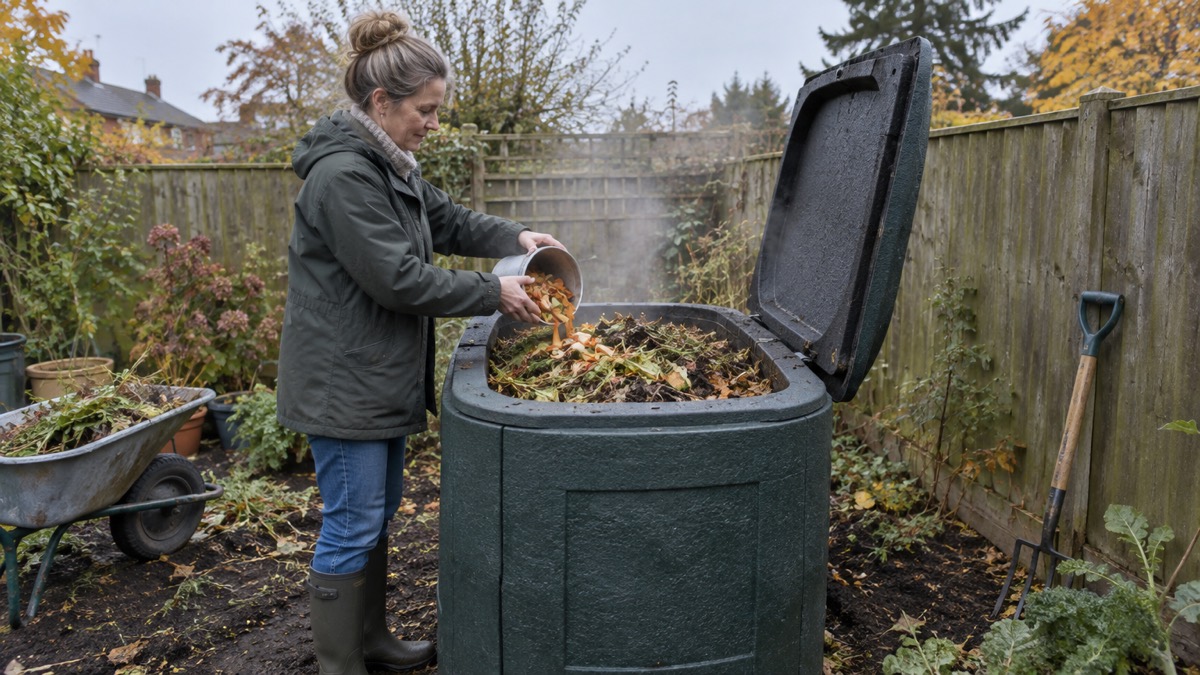
A cold bin asks very little of you. You put garden waste in, you turn it when you remember, and over months it rots down into a dark, crumbly soil improver. It needs no power, no insulation and no particular skill, and it is the natural starting point for a household that has never composted before.
The output is genuinely useful. Garden compost gives the soil a good structure which is open and aerated, helping water, plant roots and soil life to move freely, and it holds moisture well because of its bulk3. That is exactly what a vegetable bed or a new border needs.
The limits are equally clear. A cold bin slows down in winter and in dry spells. It will not reliably deal with cooked food or meat, which attract rats and flies. And it takes patience: you are relying on time rather than on controlled heat.
If your main output is grass cuttings, leaves and uncooked vegetable waste, a cold bin is the sensible choice, and fire services and Defra both point to composting or council collection for garden waste6. If your main problem is kitchen waste, a sealed system is the better fit. If you are weighing up kitchen waste options specifically, our comparison of a wormery or bokashi bin sets out the alternatives, and the main guide to composting at home covers bins, wormeries and bokashi together.
What each one can take: food waste, garden waste and cooked scraps
The single biggest difference between the two bins is what you can safely put in them. Get this wrong and you will have smells, flies and rats within a fortnight.
Official guidance lists grass cuttings, leaves and uncooked vegetable waste as composting materials1. Garden compost is made from rotted waste materials such as plant foliage and stems, vegetable and fruit waste, grass cuttings, and cardboard and paper3. That is the safe core list for any bin.
Cooked food and meat are different. They are what attract rodents and flies, and the official advice on bins is to keep lids closed at all times to prevent access by flies or rodents2. An open cold bin cannot guarantee that. A sealed hot composter can, which is why it is the better choice if you want to compost cooked scraps.
- Safe in any bin: grass cuttings, leaves, uncooked vegetable waste, plant foliage and stems, fruit waste, cardboard and paper1
- Only in a sealed system: cooked food and meat, following the maker's instructions
- Never in an open bin: cooked food, meat, and anything that will draw rats
- Better elsewhere: large woody material, which is slow to rot; fire services recommend taking garden waste to a household waste recycling centre6
If a collection is disrupted, home composting is one of the options councils themselves suggest, alongside taking garden waste to an open recycling site or storing it9. During flooding, contaminated food waste should be recycled or double-wrapped in plastic bags and put in your green bin for the next refuse collection10.
Where to site a compost bin
Site matters more than most people expect. A bin in the wrong place will be too dry, too wet, too shaded or too close to the house, and you will spend the year fighting it.
Put the bin on soil, not paving, so worms and soil life can move in and any excess water can drain away. Choose a level, stable spot, because a bin that tips or rocks will spill its contents. Keep it away from walls and fences that give rats cover, and away from windows and doors so smells and flies do not come inside.
The fire service's advice on siting anything that generates heat is a useful parallel: place it on a flat, stable surface, away from walkways and doorways, somewhere it is unlikely to get knocked over and not obstructed by objects12. A compost bin is not a heater, but the same logic applies: stable ground, clear access, nothing leaning against it.
- On soil, for drainage and soil life
- Level and stable, so it does not tip
- Away from the house, so smells and flies stay outside
- Away from fences and walls, which give rats cover
- Within reach of a water source, so you can damp it down in dry spells
- Not in full sun all day, because heat dries the contents out
If you are also collecting rainwater for the garden, siting the bin near a water butt saves a walk. Our guide to water butts covers sizes, fittings and where to put one, and the garden rainwater harvesting checklist lists the parts.
Keeping compost working in dry spells and hosepipe bans
Compost needs moisture. In a hot, dry spell an open bin dries out, the microbes stop, and the heap sits inert until autumn. The answer is to keep it damp without wasting water, and to know what you are still allowed to do when a hosepipe ban is in force.
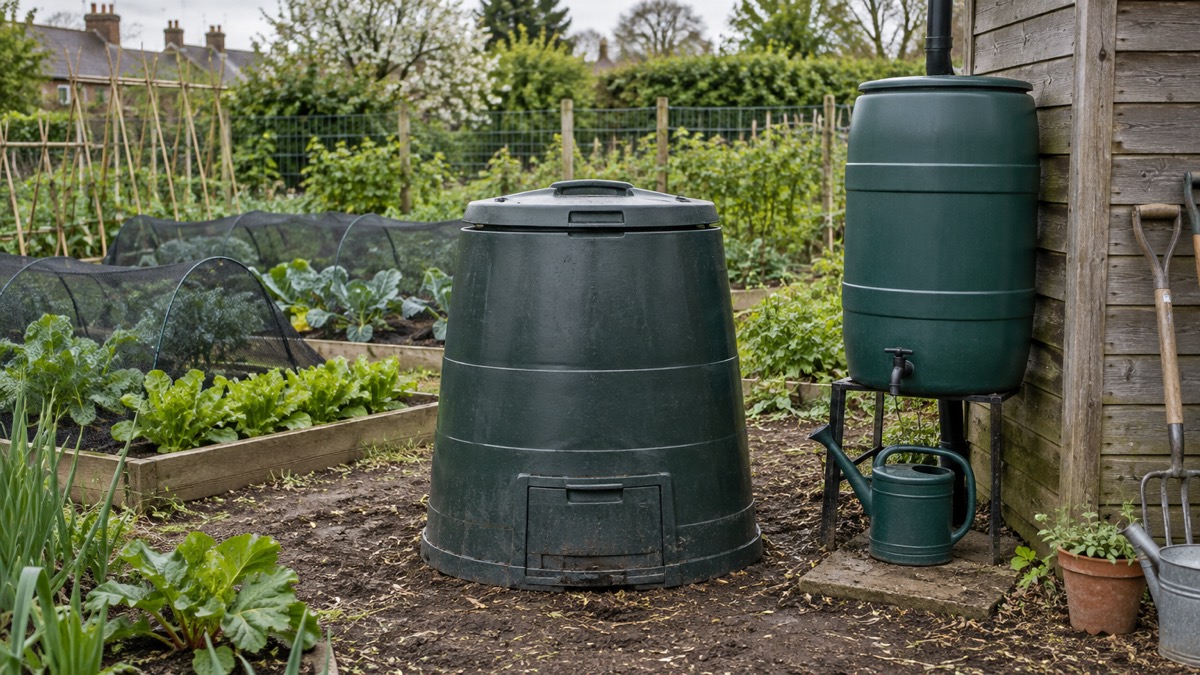
Water companies can bring in hosepipe bans when water is in short supply, usually after a long dry or hot spell4. The cause is high demand and lower supply, generally when it has been very dry and hot for a long period4. But a ban does not stop you watering the compost. Ofwat is clear that you can still use water outside with a watering can or a bucket, for example to water your plants4.
The government's drought advice is to use a watering can instead of a hosepipe and install a water butt if you can to capture rain5. During hot, dry spells you can also consider using grey waste water for watering plants and lawns, so that even if there are limits on hosepipes the ground can be kept damp14.
- Use a watering can or bucket, which is allowed under a hosepipe ban4
- Fit a water butt to capture rain for the garden5
- Use grey water from the house on plants and lawns in dry spells14
- Keep the lid on to slow evaporation
- Turn the heap if it has become too hot, so the heat dissipates15
There is one safety point worth knowing if you use a hose at all. Stagnant water in a hosepipe can become super-heated in the sun, so run hosepipes for a few moments and check the water temperature before cooling off under them16. Keep your hose somewhere cool and out of the sun, and gently run it without attachments before use until the water is cool17.
Common problems: smells, flies and compost that will not heat up
Most compost problems have one of three causes: too wet, too dry, or the wrong material. Fix the cause and the symptom goes.
Smell usually means the heap is too wet and airless. Add dry material such as cardboard, turn it to let air in, and stop adding cooked food to an open bin. Flies mean exposed food waste. Move the bin out of direct sunlight and keep the lid closed at all times to prevent access by flies or rodents2. Rats mean the same thing, plus cover: clear the ground around the bin and stop putting cooked scraps in an open heap.
A heap that will not heat up is usually too dry, too small, or short of nitrogen-rich material. Water it, add grass cuttings, and turn it to mix. In a hot composter, check that the lid seals and that you are filling it as the maker instructs.
A heap that gets too hot in a dry spell can be turned to let the heat dissipate15. This matters near hedges, fences and buildings in hot weather, because fire services warn about the risk of wildfires spreading to property and gardens15.
Composting through winter, and what to do with the finished compost
Composting does not stop in winter, but it slows. Cold slows the microbes, and an open bin may sit almost dormant until spring. An insulated hot composter holds its heat better, which is one of its real advantages in a UK winter.
Keep adding waste in thin layers through the winter, keep the lid closed, and do not expect rapid results. Use the quieter months to check the bin's structure, clear the ground around it, and plan next year's beds. It is also worth checking heating equipment in the summer, before the weather turns cold, so that job does not pile up with the winter garden work18.
When the compost is ready, use it properly. Garden compost is a soil improver, not a growing medium. Its bulk opens up the soil so water, plant roots and soil life move freely, and it holds moisture well3. Spread it on beds, dig it into vegetable plots, or use it as a mulch.
Do not use garden compost for seed sowing or rooting cuttings, because it has too many nutrients, and do not use it neat in hanging baskets because it is too heavy. Mix it with sand, grit, topsoil or leafmould to turn it into potting compost3. Bagged potting compost is a different product, created for growing plants in containers rather than as a soil improver, and usually lighter in texture than homemade garden compost3.
If you are storing produce from the plot, our guide to storing the harvest covers roots, onions, squashes and apples, and leafmould explains how to make the leaf-based material that lightens heavy compost.
Sources (18)
- Bonfires and burning waste, Cheshire Fire and Rescue Service, 2026
- Hot weather advice, nidirect, 2026
- Garden compost or potting compost, Garden Organic, 2026
- Hose pipe bans: what are they and what they mean for the public, Ofwat, 2022
- Droughts, UK Government Prepare campaign, 2026
- Garden bonfires, North Wales Fire and Rescue Service, 2026
- Bonfire safety, Lincolnshire County Council, 2026
- Ready to Burn, Defra, 2023
- Bins, recycling and waste: services and weather, Somerset Council, 2025
- Clearing flood, Oxford City Council, 2026
- Barbecue Safety, Mid and West Wales Fire and Rescue Service (mawwfire.gov.uk)
- Safe home heating, Warwickshire County Council, 2026
- Safe use of heaters and generators, Armagh City, Banbridge and Craigavon Borough Council, 2026
- Reduce the risk of wildfire damage to your property, Hampshire and Isle of Wight Fire and Rescue Service, 2026
- Wildfires: protecting your home and garden, London Fire Brigade, 2026
- Are you ready booklet, Culham Parish Council, 2025
- Hosepipes and hidden health risks, Met Office, 2026
- Winter preparedness, Essex Prepared, 2026
 Heated vs Unheated Propagator
 Polytunnel vs Greenhouse
 Pressure Canner vs Water Bath
 Wormery vs Bokashi Bin