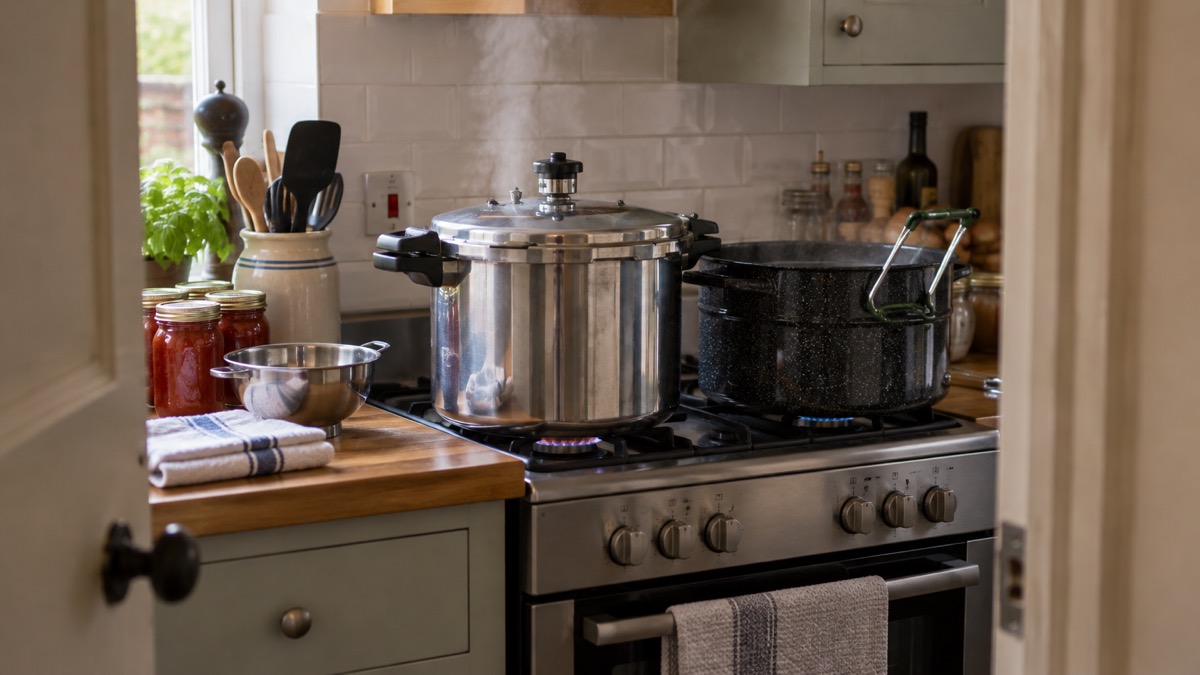
Bottling your own food at home comes down to one question: is the food acidic or low-acid? Acidic foods, such as fruit, pickles and chutneys, can be processed in a water bath, where jars sit in boiling water. Low-acid foods, such as vegetables, meat, fish and beans, need a pressure canner, because only pressure gets the jars hot enough to destroy the bacteria that cause botulism.
The official definition of canning is putting food into airtight jars or cans and heating them for a specified temperature and time to destroy bacteria and other microorganisms1. The temperature and processing time you need depend on three things: the type of food, the acidity of the food, and the size and type of container used1. Get any of those wrong and the jar can look perfectly sealed while still holding food that is not safe to eat.
This page sets out which foods need which method, how each method works step by step, how to check a jar has sealed, where to store bottled food and when to throw a jar away. It is written for a UK kitchen, with the official food safety advice as its base.
Water bath or pressure canner: which foods need which
The choice between the two methods is not a matter of preference or of which pan you own. It follows from the food. The official guidance is clear that the temperature and processing time needed depend on the type of food, the acidity of the food, and the size and type of container used1. A water bath can only ever reach the temperature of boiling water. A pressure canner raises the temperature above that by holding steam under pressure, which is what low-acid foods require.
The practical split is between high-acid and low-acid foods. High-acid foods include most fruit, and anything preserved in vinegar or brine. Low-acid foods include vegetables, meat, fish, poultry and beans. Tomatoes sit awkwardly in between and are treated as a special case, covered below.
| Food | Acidity | Method |
|---|---|---|
| Fruit, jams, jellies | High acid | Water bath |
| Pickles, chutneys, vinegar brines | High acid | Water bath |
| Tomatoes (with added acid) | Borderline | Water bath, with acid added |
| Vegetables | Low acid | Pressure canner |
| Meat, poultry, fish | Low acid | Pressure canner |
| Beans and pulses | Low acid | Pressure canner |
The same logic applies to pickling, which the official guidance describes as submerging and marinating food in acidic solutions like vinegar or brine, without oxygen, to prevent microbiological growth1. Pickling is a preservation method in its own right, not a substitute for processing a low-acid food. If you are preserving vegetables in vinegar, the vinegar is doing the work; if you are bottling plain vegetables, only a pressure canner will do.
If you are new to preserving, our home preserving equipment checklist sets out what a kitchen needs before the first batch, and our guide to fermenting vegetables at home covers the salt-brine method, which is a different route to keeping vegetables and does not involve heat processing at all.
Low-acid foods need a pressure canner
Every low-acid food, meaning vegetables, meat, fish, poultry and pulses, must be processed in a pressure canner. The reason is temperature. A water bath cannot take the food above the boiling point of water, and that is not hot enough to destroy the spores of the bacteria that cause botulism in a low-acid, low-oxygen environment. A pressure canner does reach the higher temperature needed, which is why it is the only safe method for these foods.
This is the single most important rule on the page, and it is the one most often broken by people who have bottled jam successfully and assume the same pan will do for beans. It will not. The official guidance ties the required temperature and time to the acidity of the food1, and low-acid foods are exactly the category that needs more than boiling water can give.
A pressure canner is a heavy pan with a locking lid, a pressure gauge or weighted regulator, and a vent. It is not the same as a pressure cooker, although some makers sell combination units; follow the maker's instructions for the model you have, and never use a unit that is not designed and rated for canning.
What a water bath canner can safely bottle
A water bath canner is the right tool for high-acid foods: fruit, jams, jellies, pickles, chutneys and anything preserved in vinegar or brine. These foods are acidic enough that boiling water processing is sufficient to make them safe, because the acidity itself suppresses the bacteria that a pressure canner would otherwise be needed to destroy.
The method suits a household that bottles fruit gluts, makes chutney from an allotment surplus, or puts up pickles. It is simple, cheap and safe for those foods. It is not a general-purpose preserving pan.
Tomatoes are the exception that catches people out. They are borderline in acidity, so the safe approach is to add acid to each jar, using bottled lemon juice or citric acid, so that the contents are reliably acidic before processing in a water bath. If you are not confident about the acidity of a batch, process it as a low-acid food in a pressure canner instead. The official guidance does not give a single figure for how much acid to add; follow a tested recipe for the quantity of tomatoes and the jar size you are using.
If your preserving is built around a garden or allotment, our guides to storing the harvest and freezing home-grown fruit and vegetables cover the alternatives to bottling, and our page on how to tell when chutney is ready to bottle deals with the setting point before the jars are filled.
Botulism: why boiling water is not enough for vegetables and meat
Botulism is a rare but serious illness caused by a toxin produced by bacteria that thrive in low-acid, low-oxygen conditions, which is exactly what a sealed jar of vegetables or meat provides. The bacteria form spores that survive boiling. In a sealed jar with no acid to hold them back, those spores can grow and produce toxin. A pressure canner destroys the spores by reaching a higher temperature than boiling water can.
The practical consequences for a household are these:
- You cannot see, smell or taste the danger. A jar of under-processed beans can look, smell and taste perfectly normal and still be unsafe.
- The seal is not proof of safety. A jar can seal perfectly and still hold food that was not processed long enough or hot enough.
- Boiling a suspect jar before eating is not a fix. The toxin is destroyed by thorough boiling, but the spores are not, and you cannot tell by looking which jars are affected. The safe course is not to eat them.
The same principle of matching the treatment to the hazard runs through emergency water advice. Where water quality is uncertain, official guidance is to boil it before use or use bottled water2, and where a private supply has been flooded, boiling kills bacteria, viruses and parasites but does not remove harmful chemicals, so an alternative supply is needed3. Heat treatment has limits, and knowing them is what keeps a household safe.
How each method works, step by step
Both methods follow the same broad shape: prepare the food, fill hot jars, seal, process for the required time, cool, then check the seal. The difference is in the processing step.
Water bath method
- Sterilise the jars and keep them hot until filled.
- Prepare the food to a tested recipe for the food and jar size you are using.
- Fill the jars leaving the headspace the recipe specifies, and remove air bubbles.
- Seal the jars with lids prepared as the maker instructs.
- Stand the jars on a rack in the canner, covered by water, and bring to a rolling boil.
- Process for the full time the recipe gives, counting from when the water returns to a rolling boil.
- Lift the jars out and leave them undisturbed to cool.
- Check every seal once the jars are cold.
Pressure canner method
- Sterilise the jars and keep them hot.
- Prepare the food to a tested recipe for the food and jar size.
- Fill and seal the jars as above.
- Add water to the canner as the maker instructs, and stand the jars on the rack so they do not touch the base.
- Lock the lid and heat until steam flows freely from the vent, then let it vent for the time the maker specifies.
- Bring to pressure and hold at that pressure for the full processing time.
- Turn off the heat and let the pressure fall to zero on its own. Never force-cool a pressure canner.
- Open the lid only when the pressure is fully released, then lift the jars out and cool.
- Check every seal once cold.
The processing time and pressure for any batch come from the recipe or the canner maker's instructions, matched to the food, its acidity and the jar size1. Do not shorten a time because the kitchen is hot or the jars look done.
Jars, lids and seals: checking a safe bottle
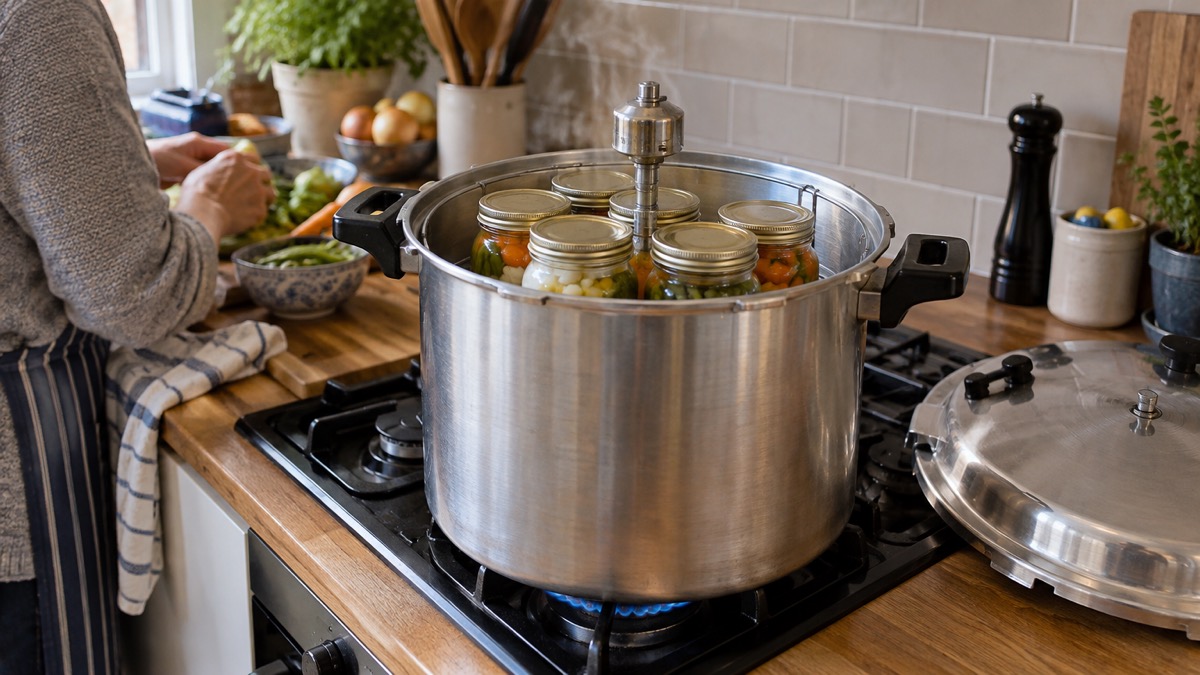
The seal is what keeps bottled food safe, so checking it is not optional. Once a jar is completely cold, press the centre of the lid. A lid that is concave and does not move when pressed has sealed. A lid that domes, pops up and down, or lifts when you press it has not sealed, and that jar is not safe to store.
The official guidance on water storage makes the same point in a different context: a storage tank must be fitted with a well-fitting lid to exclude light and pollutants4. A jar lid does the same job for food, keeping air, moisture and contaminants out. A failed seal means the contents have been exposed.
- Check every jar, every time. Do not assume a batch has sealed because most of it has.
- Listen for the ping as jars cool, but do not rely on it alone; press the lid to confirm.
- Label each jar with the contents and the date it was processed.
- Store only sealed jars. A jar that has not sealed should be eaten straight away if the food is a high-acid one and the recipe allows, or thrown away if it is low-acid.
- Check seals again before opening. A jar that was sealed in store but has since lost its vacuum is not safe.
The official guidance does not give a rule on reusing lids. Treat every lid as single-use unless the lid maker states otherwise, and inspect the sealing compound for cracks or damage before use.
Where bottled food should be stored
Store bottled food in a cool, dark, dry place, away from direct sunlight and away from sources of heat such as a boiler or a cooker. A cupboard or a pantry is ideal. The seal protects the contents, so the aim is to keep the seal intact and the contents at a steady temperature.
Keep jars off the floor, where they can be knocked, and away from damp. Do not stack heavy jars on top of each other without protection, and check the store periodically for jars whose lids have lifted or whose contents have changed colour.
The official guidance on storing water offers a useful parallel: water should be stored in containers that will not decompose or break, and glass is specifically discouraged for water storage because it can break5. For bottled food the jar is glass by necessity, so the protection has to come from how and where it is stored. Keep jars where they will not be knocked or frozen, and check them before use.
If your bottled food is part of a wider household store, our emergency food guide covers how to build a store that keeps a household fed without power, and our emergency kit guide sets out what else belongs alongside it.
When to throw a jar away
Throw a jar away, without tasting it, if any of the following apply:
- The lid has lifted or domes. The vacuum has failed and the contents are exposed.
- The jar leaks, or there is seepage around the lid.
- The contents have changed colour, are cloudy, or show any sign of mould.
- The jar smells wrong when opened, or fizzes or bubbles.
- You are unsure how long it was processed, or whether the method matched the food.
- The jar was stored somewhere hot, damp or freezing.
The official guidance on water is again a useful model: boiled water should be stored in a clean container in the fridge and discarded if not used within 24 hours6. The principle is that once you lose confidence in the conditions of storage, the safe course is to discard. For bottled food the timescale is longer, but the principle is the same.
Bottling during a power cut
An electric pressure canner depends on mains power, and a power cut in the middle of a batch interrupts the processing time. A batch that has not had its full time and temperature is not safe, however promising it looked when the power went off. Wait until power is restored, then start the batch again from the beginning with fresh jars and fresh lids.
For a gas hob and a stovetop pressure canner, a power cut need not stop you, provided you have light to work by and can see the gauge or hear the weighted regulator. Do not use candles near a hob or near jars of hot food. Our guide to power cuts covers what to do while the supply is off, and our emergency lighting guide covers safe light sources.
If the power cut is long and your freezer is at risk, our guide to freezing home-grown fruit and vegetables explains what can be saved and how, and our food guide covers meals without power.
Sources (6)
- Consumer advice for food preservation at home, GOV.UK, 2026-10-26
- Flooding food safety advice, Food Standards Scotland, 2026-10-25
- How to recover from flooding, GOV.UK, 2023-12-19
- Water storage (private water supplies), Drinking Water Inspectorate, 2025-11-05
- Create a flood pack, Bradford Council, 2026-10-29
- Boil water notice, Drinking Water Inspectorate, 2024-05-16
 Heated vs Unheated Propagator
 Hot Composter vs Cold Bin
 Polytunnel vs Greenhouse
 Wormery vs Bokashi Bin