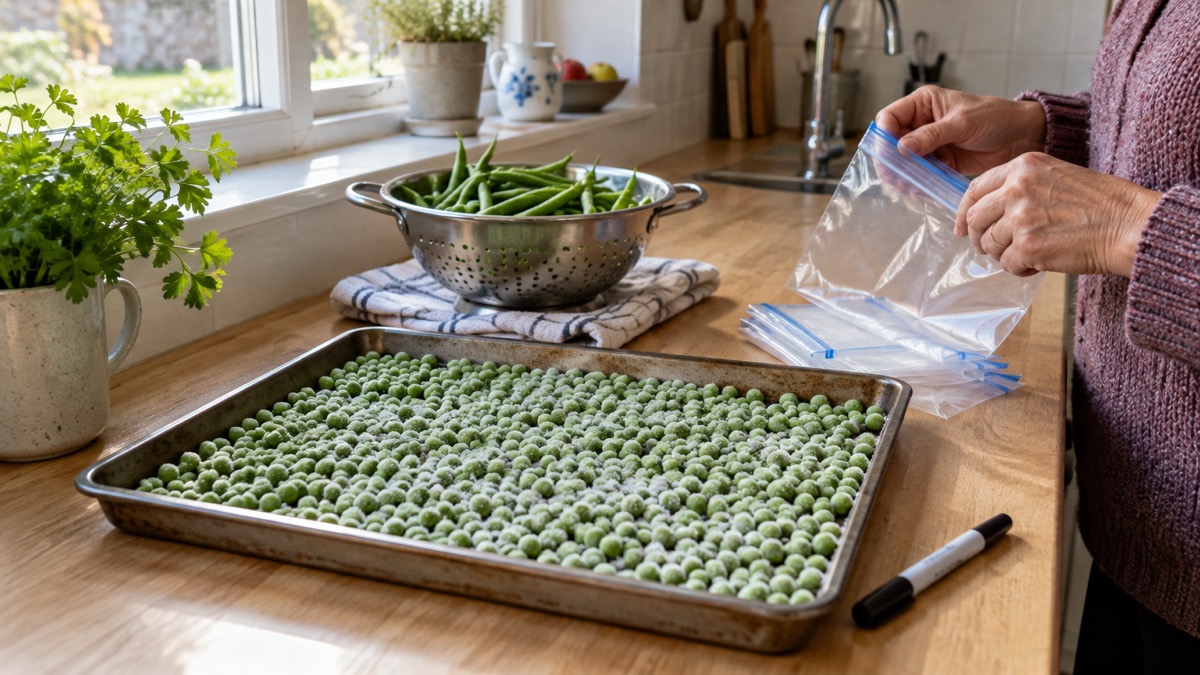
A glut from the garden or allotment is a good problem to have, and the freezer is the simplest way to deal with it. The method that works for almost everything is tray freezing: wash and dry the crop, cut it into small pieces, spread them out in a single layer on a shallow pan or tray, freeze them solid, then tip them into airtight bags or containers. Done this way, the pieces stay loose instead of freezing into one solid block, and you can pour out exactly what a meal needs for months afterwards.
Two habits do most of the work. First, keep everything clean: wash your hands with soap and warm water before preparing food, and wash the vegetables themselves to remove surface dirt and bacteria1. Second, keep everything airtight once it is frozen, because the cold air in a freezer dries food out, and always store frozen foods in airtight containers or freezer bags1.
This page covers the whole process, from washing and cutting through tray freezing, packing and labelling, and ends with what happens to your frozen harvest if the electricity goes off: keep the freezer door closed and food should stay frozen for up to 24 hours, but do not refreeze anything that has thawed.
Before you freeze anything: wash, dry and prepare
Washing is not optional, even for produce you have grown yourself. NHS guidance on preparing and cooking food safely is to always wash fruit and vegetables before you eat them, to remove any surface dirt or bacteria, and to wash hands with soap and warm water before preparing food, including when opening packaged foods1. Food Standards Scotland adds a practical detail for the washing itself: avoid cross-contamination when washing raw vegetables by rubbing them in a bowl of fresh water rather than holding them under a running tap, which reduces splashing that can spread germs around the kitchen1. Peeling or cooking also removes these germs, which is worth remembering for crops destined for the cooking pot anyway1.
Drying matters as much as washing. Wet pieces going onto a tray will freeze to each other and to the tray, and excess surface water turns to ice that contributes to the clumping you are trying to avoid. Spread the washed crop on a clean tea towel or give leafy things a good shake, and let surface moisture evaporate before it goes anywhere near the freezer.
There is one safety point that belongs here rather than later. If your garden or allotment has flooded, do not simply carry on harvesting. Oxford City Council's flood recovery advice is to wait at least six months before harvesting new produce from flooded land6. Flood water can contaminate soil, and that contamination reaches the crop itself.
Blanching: which crops need it and why
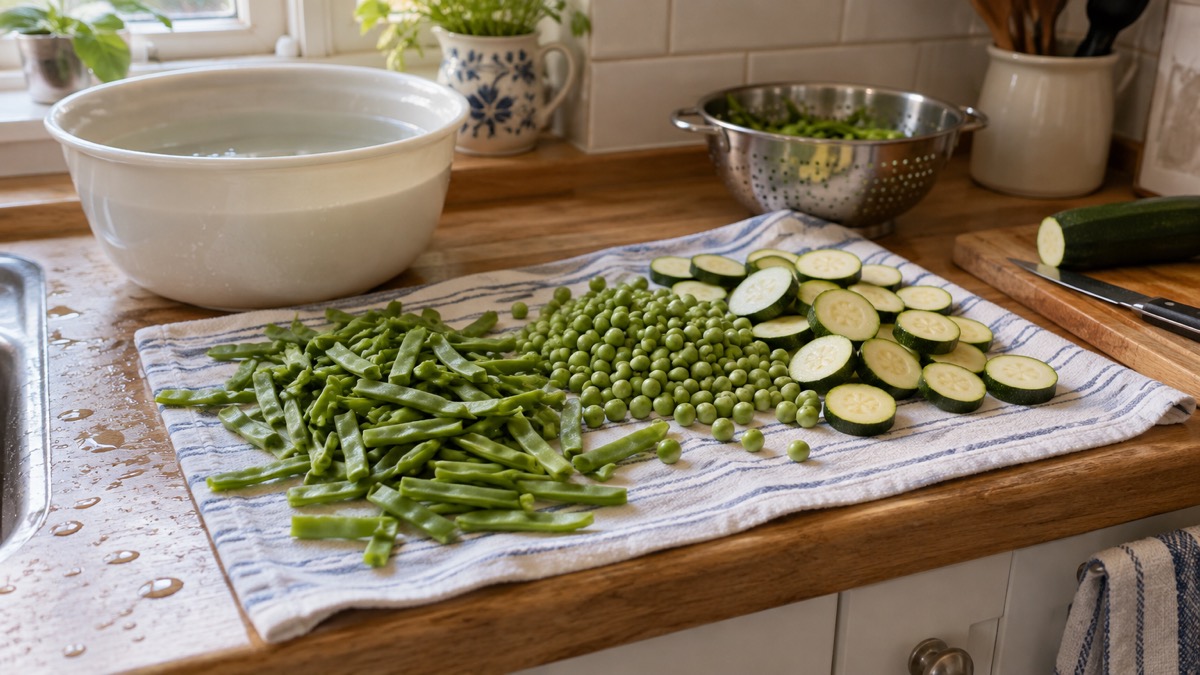
Blanching, a brief dip in boiling water before the vegetables go cold, slows the changes that would otherwise spoil the crop in the freezer, and it is the step that suits the vegetables most often grown in a UK garden or allotment. Freezing in manageable quantities, rather than packing a whole harvest into one container, keeps the process practical and the portions useful. The detailed method and timing are covered on our page on why blanch vegetables before freezing.
Tomatoes are the exception to the raw-freezing approach, and cooking them into a sauce before freezing gives a far better result. This fits with a broader point from NHS guidance: the extreme cold can affect the quality of foods with a high water content, such as fresh fruit and salad vegetables including cucumber and tomatoes1. A raw frozen tomato thaws into something watery and limp; a cooked sauce freezes well and is ready to use.
If you are picking green tomatoes before the first frost, only the ones you cannot ripen or eat fresh need to become sauce for the freezer. Ripening them slowly in a cool, dry place gives you more time to use the crop fresh, and the rest can be cooked down whenever the kitchen is free.
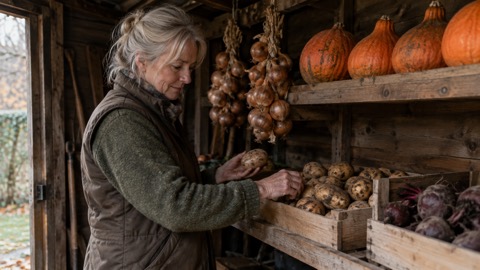
Not every crop is worth the freezer space. Some roots and hardy crops store better without freezing, using cool, dry storage in crates and boxes instead, and cabbages can be kept on shelves in a shed or garage through the cold months. Our page on storing the harvest covers these methods in full, and they free your freezer for the crops that genuinely need it.
Cut small, freeze fast
Small pieces freeze through more quickly, and that speed is what protects quality and keeps pieces separate. There is a food safety angle too: Food Standards Scotland advises that freezing in smaller portions helps, in the context of only reheating food that has been frozen once7. If a bag holds a single portion, you defrost exactly what you will cook, and nothing gets thawed, refrozen and thawed again.
Practically, this means:
- Cut vegetables into pieces of a broadly similar size, so they freeze at the same rate and cook evenly later.
- Think in meal-sized terms: slices of beans, florets of cauliflower and broccoli, shelled peas, rings or chunks of leek.
- Freeze in manageable quantities, rather than packing a whole harvest into one container.
Small pieces also suit the way you will use them later. Dorset and Wiltshire Fire and Rescue Service notes that vegetables can be par-cooked in the microwave and then transferred to the oven or air fryer, or placed under the grill, to finish and crisp up8. Evenly cut frozen pieces behave far better in that kind of two-stage cooking than a mix of large and small.
Tray freezing: the method that stops clumping
The question of how to freeze vegetables from the garden so they do not clump has one well-established answer: freeze them loose first, then bag them. If you tip wet, freshly cut vegetables straight into a bag and put the bag in the freezer, you get a bag-shaped brick. If you freeze the pieces individually first, they stay loose and pourable.
- Wash the vegetables in a bowl of fresh water, rubbing them to remove dirt, and wash your hands with soap and warm water before you start1.
- Cut into small, even pieces.
- Blanch the vegetables in boiling water first where the method calls for it.
- Spread the pieces out in a single layer on a shallow pan, tray or baking sheet.
- Put the pan in the freezer, flat and level, and leave it until the pieces are frozen solid.
- Tip the frozen pieces into an airtight freezer bag or container, and return them to the freezer.
The single layer is the heart of it. Every piece is exposed to the cold air on all sides, so it freezes quickly and separately, and nothing has a neighbour to freeze onto. A shallow pan or tray fits more easily onto a freezer shelf than a deep bowl, and it is easier to slide in and out without disturbing the layer.
Packing and labelling: bags, containers and what to avoid
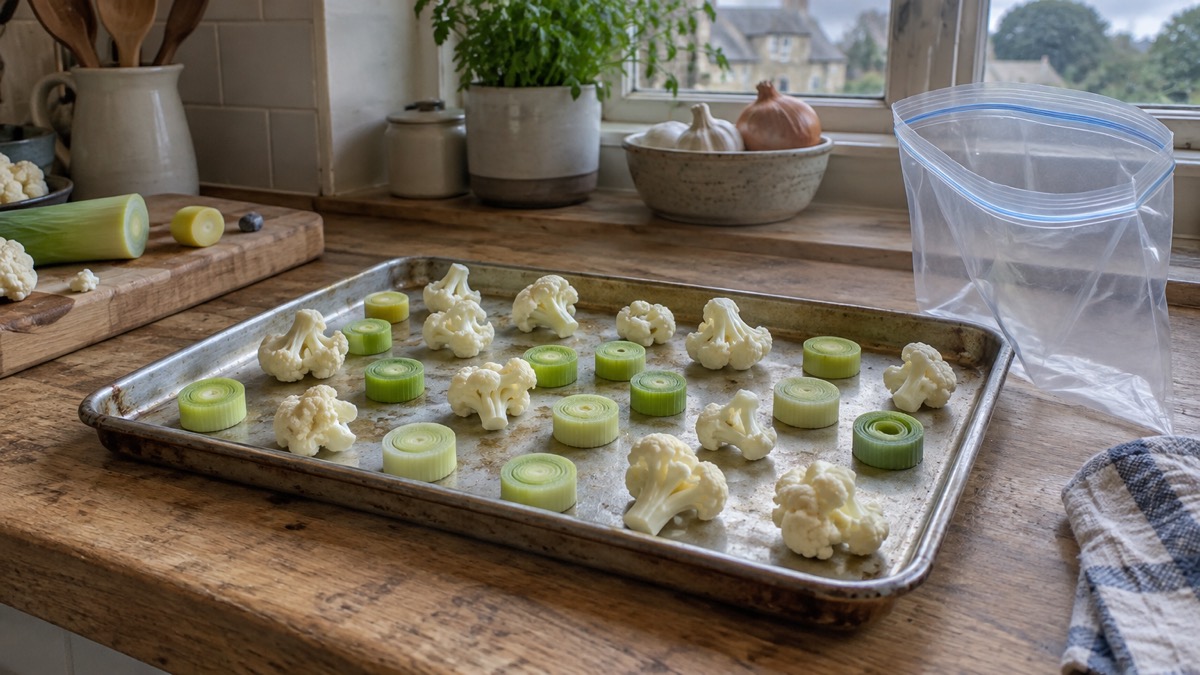
Once the pieces are frozen solid, move quickly. Every minute they spend out of the freezer at room temperature starts thawing the outside of each piece, and that surface thaw is what makes pieces stick together when they go back in. Have your bags or containers open and ready before you take the tray out.
Food Standards Scotland's rule is simple: as the cold air will cause foods to dry out, always store frozen foods in airtight containers or freezer bags1. Resealable freezer bags suit tray-frozen vegetables well, because you can press or squeeze the air out before sealing, and flat-filled bags stack neatly and thaw quickly. Rigid airtight containers suit softer things, such as cooked tomato sauce, and anything you want to defrost and serve from the same dish.
One material restriction matters for home growers. Food Standards Scotland advises it is best not to use kitchen foil or containers made from aluminium, such as aluminium pans, to store highly acidic foods, and the list it gives reads like a harvest from a typical allotment: tomatoes, rhubarb, cabbage, lemons, limes, raspberries, pineapple and many soft fruits2. Use airtight plastic or glass containers for these instead.
| What you are freezing | Best packing | Avoid |
|---|---|---|
| Tray-frozen blanched vegetables (peas, beans, broccoli, cauliflower, leek) | Resealable freezer bags, air squeezed out | Foil for acidic crops such as cabbage2 |
| Cooked tomato sauce | Rigid airtight container or freezer bag | Aluminium foil or aluminium pans2 |
| Soft fruit (raspberries and similar) | Tray frozen, then airtight bags or containers | Foil and aluminium containers2 |
| Rhubarb | Airtight container or freezer bag | Foil and aluminium containers2 |
Labelling is the step people skip and later regret. Write on each bag or container what is inside and the date it was frozen, with a permanent marker on the bag or on freezer tape on a container. A freezer full of identical white bags is a mystery box by February. Rotate the stock so the oldest bags come out first, and when you defrost, do it in the fridge so that the food does not get too warm.
The same sealed-container principle applies to your cupboard stores. Food Standards Scotland advises keeping pantry food in sealed bags or containers, which helps keep food fresh and stops anything falling into it by accident2. And if you open a tin and do not use all of it, empty the leftover food into a covered bowl or container and put it in the fridge rather than storing the open tin there9.
Freezing fruit from the garden
Fruit can go into the freezer raw, using the same tray method: wash it, dry it, spread it in a single layer, freeze solid, then pack airtight. The honest expectation to set comes from NHS guidance: the extreme cold can affect the quality of foods with a high water content, and fresh fruit is named alongside salad vegetables such as cucumber and tomatoes1. Thawed frozen fruit is soft, so plan to use it cooked, in purées, in smoothies or stirred into puddings rather than expecting it to behave like fresh fruit.
The acidic-fruit packing rule from the section above applies squarely here: raspberries, pineapple and many soft fruits should not be stored in foil or aluminium containers2. Whether sugar is needed when freezing fruit is a separate question, covered on our page on freezing fruit without sugar.
It is worth knowing what frozen fruit and vegetables contribute to your diet through the winter. NHS guidance is that tinned and frozen vegetables count towards your five daily portions of fruit and vegetables10, and winter health advice from NHS Norfolk and Suffolk is to include plenty of fruit and vegetables, whether fresh, frozen, tinned or dried11. Your home-frozen harvest counts exactly as bought frozen produce does. The City of London Corporation's cold weather advice adds a preparedness angle: stock up on tinned and frozen food so you do not have to go out when it is too cold12. A freezer full of your own produce is that stock, already in the house.
What to do with frozen food when the electricity is off
A freezer full of home-grown food is also a store for emergencies, and a power cut is the emergency most likely to threaten it. The rules are few and firm.
The first and most important instruction, repeated across official guidance, is to keep the fridge and freezer doors closed. Lancashire Prepared's power cut advice is to keep fridge and freezer doors closed during an outage13, and Wigan Council's advice to households during a power cut is to protect the food in your fridge or freezer by keeping the door closed to protect the temperature14. An unopened freezer holds its cold for a long time: official flood and power cut guidance states food should remain frozen in disconnected freezers for up to 24 hours with doors kept closed15.
The time limits, from the UK Government's after-a-flood guidance, are:
- Freezer: throw away food from a freezer if the electricity has been off for more than 24 hours3
- Fridge: throw away food from a fridge if the electricity has been off for more than 4 hours3
- Short cuts: a power outage of less than 4 hours is unlikely to impact the safety of food in chilled or frozen storage, according to the Government's consumer advice on food safety in a power cut4
While the power is off, deal with the rest of the house as official advice directs. Wigan Council advises switching off appliances and keeping a light on in one room so you know when power returns14. The UK Government's Be Ready campaign advises turning off irons, ovens, electric fires and fryers, and unplugging your TV and PC, as they can be damaged by a surge when power goes back on16. Public Health Wales adds, for power cuts in bad weather, that you should turn off big appliances, especially cookers and electric fires, until the power is back on, and not open your freezer17.
Refreezing after a power cut
The rule on refreezing is absolute: Food Standards Scotland's flooding advice states plainly, do not refreeze food that has thawed while the power was cut5. NHS guidance adds that foods stored in the freezer, such as ice cream and frozen desserts, should not be returned to the freezer once they have thawed1.
What you can do with thawed food is more encouraging. Official guidance on power cuts for food businesses, whose rules are a useful reference point for households, states that defrosted food should be safe if treated as chilled food, refrigerated and used up within a couple of days, and that if frozen food has risen above 8°C for more than four hours it should be thrown away15. The Government's consumer advice notes that in power cuts food can be stored in fridges at temperatures under 8°C4. Food Standards Scotland also sets out the order to use foods in during a power cut, to keep food safe and reduce waste: chilled fridge foods first, then defrosted frozen food that does not need cooking, then room-temperature perishable food such as bread, then room-temperature tinned, bottled and dried food18. Cook thawed vegetables thoroughly before eating them, and note that you can freeze food again once cooked, but you will only be able to reheat it once after that7.
Two further points from official guidance can save a harvest. North Yorkshire Fire and Rescue Service, in its advice on steps after a fire, suggests considering transferring food to a neighbour's house if your own fridge or freezer is out of action20. And if the emergency was a flood rather than a power cut, Food Standards Scotland's flooding advice covers food safety in the kitchen, and Oxford City Council advises recycling your food waste or double-wrapping contaminated food in plastic bags for the next refuse collection, without putting it out earlier than necessary, as extra food waste in plastic sacks might attract animals6.
For the wider picture of living through an outage, see our guide to power cuts, and for food stores and meals without power generally, our emergency food guide.
Using your frozen harvest well
Frozen home-grown vegetables are for eating, not just for owning. Defrost in the fridge, as Food Standards Scotland advises, so food does not get too warm7, and only reheat food that has been frozen once, which smaller portions make easier7. Always clean surfaces, utensils, plates and hands thoroughly after they have touched raw or thawing meat, to stop bacteria spreading around the kitchen7, and defrost any frozen meat fully in the fridge before cooking, as Cornwall Council's barbecue hygiene advice puts it21.
Even the trimmings have a use. Cheshire Fire and Rescue Service notes that composting is a simple way to recycle materials such as grass cuttings, leaves and uncooked vegetable waste22, so the tops, tails and trimmings from your freezing session go to the compost heap rather than the bin. Our page on composting at home covers the options.
One last thought on why this all matters. A freezer stocked through the summer and autumn is a practical winter reserve: it is food you already own, grown yourself, and it is ready to eat straight from your own kitchen. If you are earlier in the journey, our pages on growing your own vegetables and the self-reliance section cover everything from seed to harvest.
Sources (22)
- Preparing and Cooking Food Safely, NHS inform
- Food Storage, Food Standards Scotland
- After a Flood, GOV.UK
- Food Safety in a Power Cut: Advice for Consumers, GOV.UK, 2023-07-26
- Flooding, Food Standards Scotland
- Clearing Up After a Flood, Oxford City Council
- Chilling, Food Standards Scotland
- Cooking Safely, Dorset and Wiltshire Fire and Rescue Service, 2024-10-23
- Kitchen Crimes, Food Standards Scotland
- Keep Well, Keep Warm, Stonehill Medical Centre, 2022-11-01
- Stay Warm and Nourished, NHS Norfolk and Suffolk
- Advice on Coping in the Cold Weather, City of London Corporation, 2025-08-15
- How You Can Prepare for a Power Cut, Lancashire Prepared
- Power Cuts, Wigan Council
- Information About Specific Safety Concerns, Northumberland County Council, 2026-05-21
- Power Cuts, Be Ready Campaign
- Weather and Health, Public Health Wales
- Power Cuts, Food Standards Scotland
- Heatwave, Lancashire Prepared
- Steps After a Fire, North Yorkshire Fire and Rescue Service, 2026-06-17
- Stay Safe This Summer, Cornwall Council, 2026-08-07
- Bonfires and Burning Waste, Cheshire Fire and Rescue Service
 Hydroponic System Parts List
 Year-Round Sowing Calendar
 Preserving Equipment Checklist
 Getting an Allotment
 Composting at Home
 Vegetable Pests and Diseases
 Fermenting Vegetables at Home
 Growing Fruit at Home
 Indoor Hydroponics
 Growing Under Cover All Year
 Sowing Seeds
 Storing the Harvest